Some of the longest words in books are not really as mysterious as they look. A word like musician may seem bigger than music, but once you notice the word part they share, the meaning becomes easier to unlock. Strong readers do this all the time. They look inside words, find a meaningful part, and connect it to other words they already know.
A root is a word part that carries the central meaning. When readers know the meaning of a root, they can often understand a whole family of related words. This is especially helpful when the pronunciation of the root stays the same. If you can hear the same root clearly in several words, it becomes easier to recognize the relationship and figure out meaning.
Readers meet unknown words in stories, articles, directions, science books, and online texts. Instead of stopping every time, they can use morphology, which is the study of word structure and meaningful word parts. Roots are one of the most useful parts to know because they act like clues hidden inside words.
Root means the main part of a word that holds its core meaning.
Base word is a word that can stand alone and can also take prefixes or suffixes.
Word family means a group of related words built from the same root or base word.
Prefix is a word part added to the beginning of a word.
Suffix is a word part added to the end of a word.
Knowing roots helps in two big ways. First, it helps you read more accurately because you notice familiar parts. Second, it helps you understand meaning. If you know the root help, then helpful, helper, and helpless all become easier to understand.
Roots matter because English has many related words. Authors often use several members of the same word family in one passage. A science article might include observe, observer, and observation. A student who sees the connection between them can follow the text more smoothly.
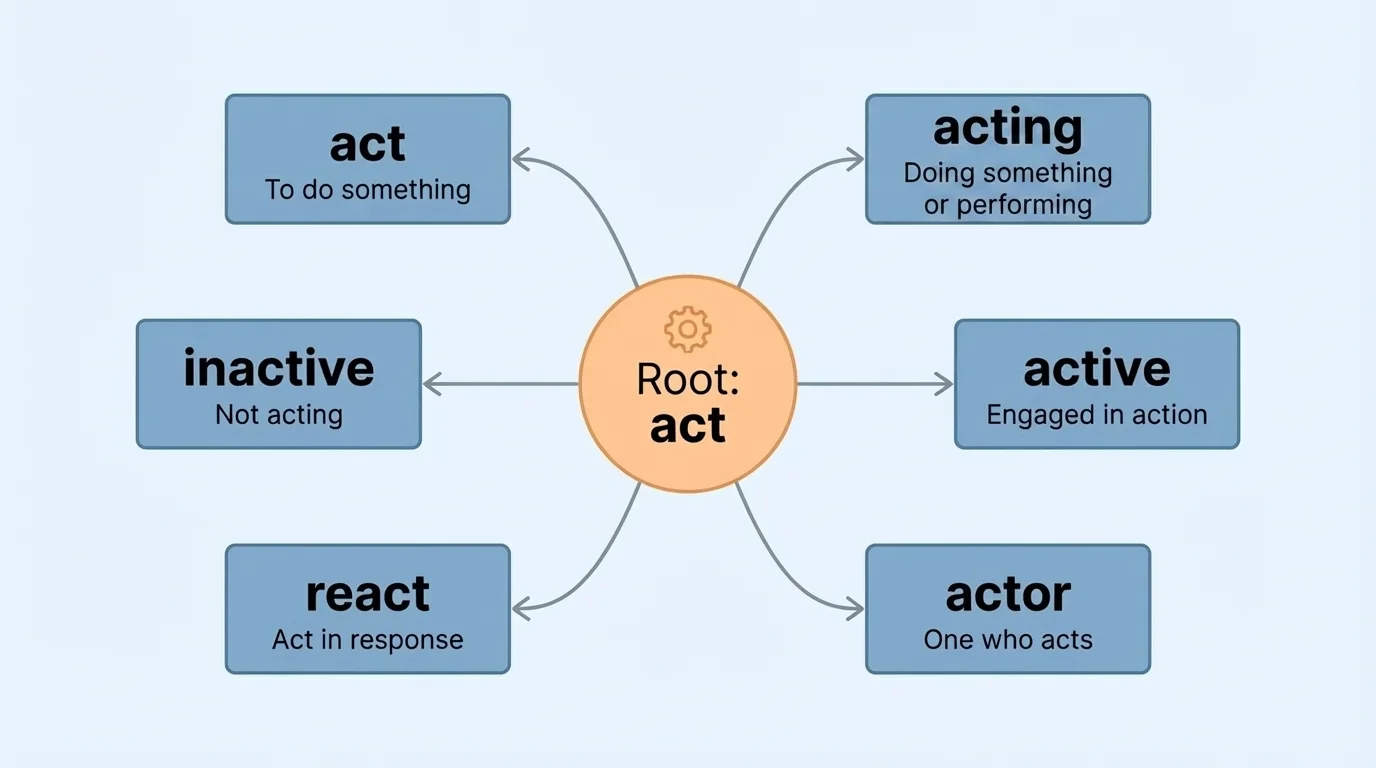
Think of a word family as a tree. The trunk is the central word part, and the branches are the related words. In [Figure 1], the family grows from one shared center, which helps show how one meaning can spread into many related forms. The words may look a little different at the ends or beginnings, but they still connect.
For example, the base word act is connected to words such as action, active, actor, and react. These words are not identical, but they all have something to do with doing, moving, or taking part. When you know one member of the family, you gain a clue about the others.
Not every word family works in exactly the same way. Some words add only a suffix, such as teach to teacher. Some add a prefix, such as view to review. Some add both, such as appear to disappearance. The important idea is that the root meaning stays at the center.
When you read, look for the part that repeats. In the words paint, painter, and painting, the repeated part is paint. That repeated part gives the family its shared meaning. A painter is a person who paints, and a painting is something made by painting.
Many English words come from older languages, but even when their history is complicated, readers can still use the parts they recognize right now. You do not need to know the full history of a word to use a root as a clue.
Word families are useful because they let your brain store meaning in groups instead of one word at a time. If you understand one family well, you are really learning several words together.
[Figure 2] The skill in this lesson focuses on word families in which the root pronunciation does not change. That means the root is pronounced the same across related words. Each family keeps a clear, easy-to-hear root sound, which helps readers spot the connection quickly.
Take the root music. You can hear it in music, musical, and musician. The root sound remains consistent enough to be easy to recognize. That makes it easier to connect all three words to the idea of organized sound and making music.
Another example is help. You can hear the root clearly in helper, helpful, and helping. Because the pronunciation of the root stays the same, readers can identify the family quickly and focus on how the added word parts change the meaning.
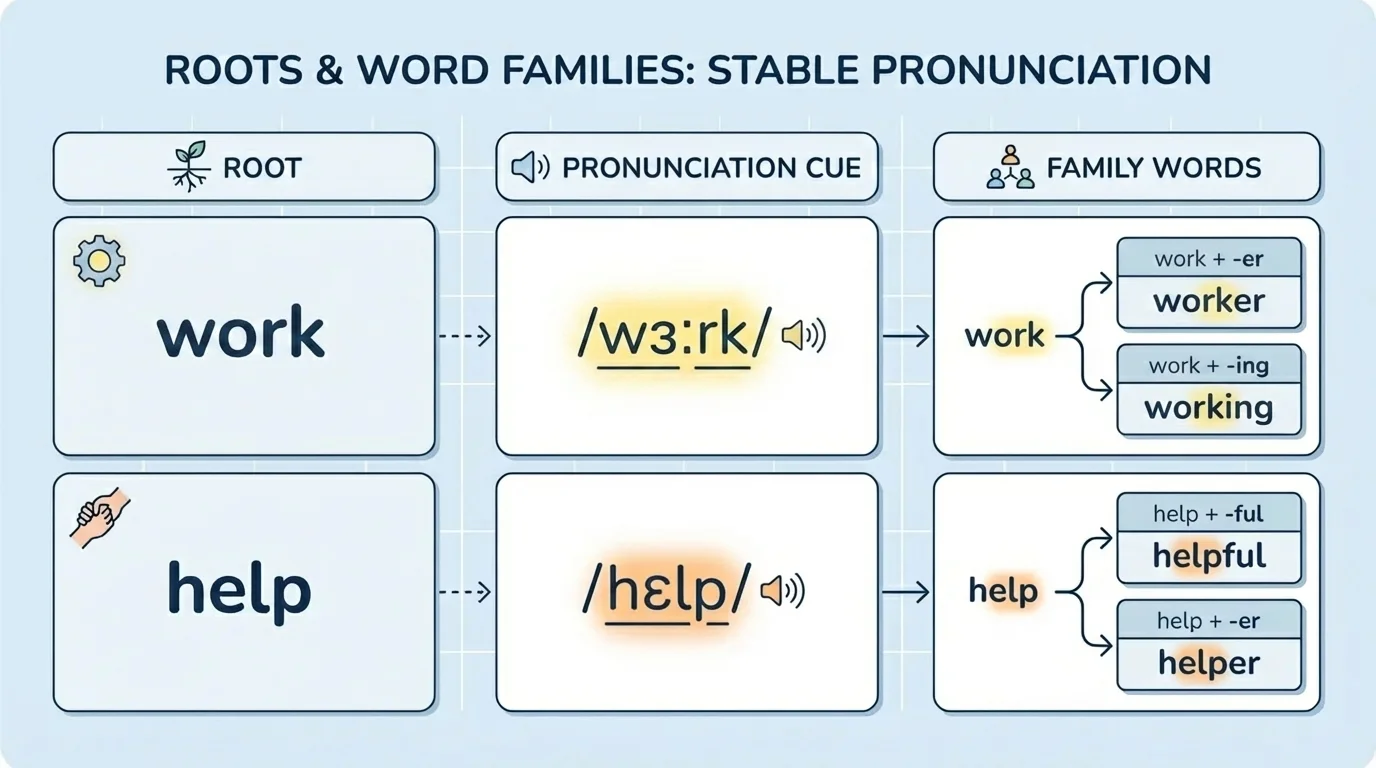
This matters because some word families are more challenging. In some words, the pronunciation shifts, and the root is harder to hear. But in this lesson, we are focusing on the easier and more direct kind: words where the root remains stable in sound. That lets you build confidence in spotting families and using them to unlock meaning.
Here are more examples of families with a stable root sound:
Notice what stays the same and what changes. The root gives the core meaning. The added parts help explain who, what, when, or how.
Some roots appear again and again in grade-level reading. Learning them gives you power across many books and subjects. The goal is not to memorize endless lists. The goal is to notice patterns and understand how the family works.
How to unlock a related word
Start by finding the familiar root. Next, think about its basic meaning. Then look at any prefix or suffix attached to it. Finally, read the full sentence to make sure your idea makes sense in context. Good readers use both the inside of the word and the rest of the sentence.
Consider the root observe. The family includes observer and observation. If a passage says, "Her observation of the nest lasted an hour," you can connect observation to observe and understand that it means watching carefully.
Now look at comfort. The family includes comfortable, uncomfortable, and comforting. The root meaning has to do with ease or relief. The prefix un- changes comfortable into the opposite meaning.
The root appear connects to appearance, reappear, and disappear. The shared idea is becoming visible or coming into view. The prefix re- means again, so reappear means to appear again. The prefix dis- often signals away or not, so disappear means to go out of sight.
The root care forms a family that students often see in stories and informational texts. Careful means showing care. Careless means not showing enough care. Caregiver means a person who takes care of someone.
| Root or Base Word | Related Words | Shared Core Meaning |
|---|---|---|
| music | musical, musician | organized sound |
| help | helper, helpful, helpless | giving aid or support |
| observe | observer, observation | watching carefully |
| appear | appearance, reappear, disappear | coming into view |
| comfort | comfortable, comforting, uncomfortable | ease or relief |
| act | action, active, actor | doing or taking part |
As you can see from the act family we explored earlier in [Figure 1], family members often belong to different parts of speech. One may be a verb, another a noun, and another an adjective. Even so, the root meaning still ties them together.
Roots are powerful, but they work best when combined with context clues. Context means the words and sentences around the unfamiliar word. Sometimes the root gives you the general idea, while the context tells you the exact meaning in that sentence.
Suppose you read: "The musician tuned her violin before the concert." If you know the root music, you already understand that a musician is someone connected to music. The rest of the sentence confirms that this person plays an instrument.
Example: Using root meaning and context together
Sentence: "After a week of careful observation, the student noticed that the plant leaned toward the window."
Step 1: Find the familiar root.
The word observation contains the root observe.
Step 2: Recall the root meaning.
Observe means to watch carefully.
Step 3: Use the sentence around it.
The sentence mentions "after a week" and "noticed," which suggest careful watching over time.
Step 4: State the meaning.
Observation means the act of watching carefully and noticing details.
Now consider: "The cave seemed comfortable in the summer because it stayed cool and shaded." The root comfort points toward ease. The context about being cool and shaded helps you decide that comfortable means pleasant and easy to be in.
Sometimes context keeps you from making a mistake. A word may look familiar, but the sentence tells you which meaning fits best. Strong readers do not guess from the root alone. They check the whole sentence.
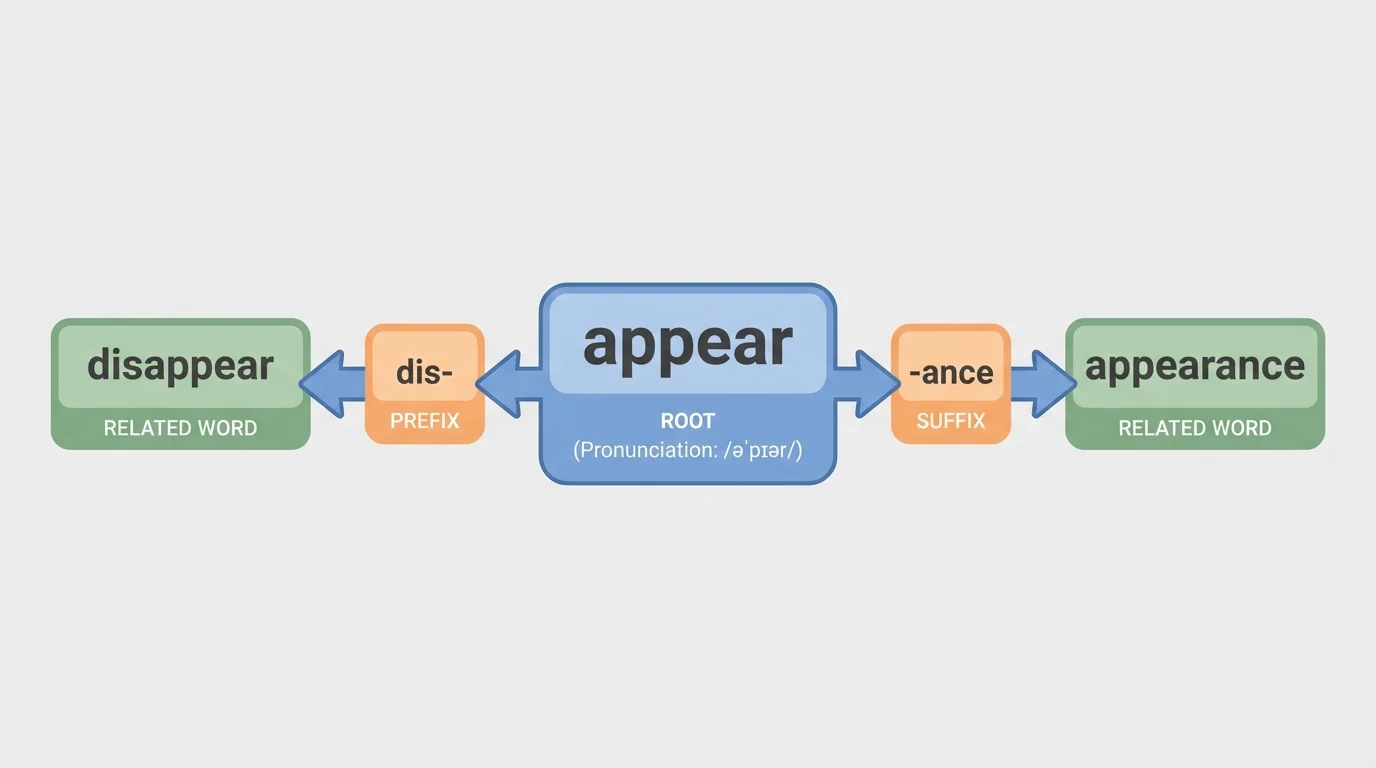
Roots carry the main meaning, but prefixes and suffixes shape that meaning. As shown in [Figure 3], the root stays at the center while added parts attach around it. This shows how the root can remain recognizable even when the word gets longer.
A prefix can change direction, time, number, or even create an opposite. In reappear, the prefix re- means again. In disappear, the prefix dis- changes the idea so that something goes out of sight.
A suffix often changes the job of the word. For example, music becomes musical with the suffix -al, making it describe something related to music. Music becomes musician with the suffix -ian, naming a person connected with music.
Here are some common suffix patterns:
The root is still your anchor. Even when a prefix and suffix are added, the central meaning often remains visible. The word family based on appear makes this easy to notice.
Root knowledge is useful far beyond language arts. In science, you may read words like observation. In social studies, you may see active and action. In music class, musical and musician are common. In health class, a teacher might use caregiver or comfortable.
Even everyday life is full of word families. A sign may say a seat is uncomfortable. A game may ask players to take action. A recipe may tell you to read the instructions carefully. When you notice the root, you understand new words faster.
You already know that readers use several strategies at once. Sounding out words helps with pronunciation, context clues help with meaning, and morphology helps you see the meaningful parts inside a word. These strategies work best together.
Digital life uses these skills too. When apps, websites, or games use unfamiliar words, root knowledge helps you stay calm and figure them out. A student who notices react and connects it to act is using the same thinking that helps with books.
Because many school words belong to families, learning roots is like building a toolkit you can carry from class to class. One useful root can unlock many more words.
Sometimes readers see a familiar chunk and jump to the wrong meaning. That is why checking context matters. A repeated letter pattern does not always mean two words belong to the same family. You need both the shared form and the shared meaning.
For example, if two words only look alike but do not share a real meaning connection, they may not belong to the same family. Good readers ask, "Do these words actually share an idea?" If the answer is no, the match may be false.
Another mistake is focusing only on the prefix or suffix and forgetting the root. In helpless, the suffix -less means without, but the word still depends on the root help. The full meaning is "without help," not just "without."
"Words are full of clues if you know where to look."
— A strong reader's habit
It is also important to notice part of speech. Observe is an action word, while observation names the act or result of observing. They share meaning, but they do not do the same job in a sentence.
When you meet a new word, slow down and ask yourself a few smart questions. What part looks familiar? Is there a root I know? Are there prefixes or suffixes attached? Does the sentence confirm my idea? This habit turns difficult words into solvable puzzles.
Over time, your brain starts spotting families automatically. You may read musician and instantly connect it to music. You may see observation and think of watching carefully. You may hear careless and realize it means "without care." That speed grows from practice and attention.
As you continue reading, stable root pronunciation gives you an advantage. If the root sounds the same from word to word, your ear and your eyes work together. The family becomes easier to notice, easier to remember, and easier to understand.
