Have you ever read a whole page and then someone asked, "What was it mostly about?" That question sounds simple, but it is actually a powerful research skill. Strong readers do more than collect facts. They figure out which ideas matter most, explain them clearly, and support them with solid evidence. That is what researchers, scientists, journalists, and students do every day.
When you research a topic, you usually do not use just one source. You may read a book, a website, an article, or notes from a video. If you tried to remember every sentence, your brain would feel full like an overfilled backpack. A summary helps you carry the most important information instead of every tiny detail.
A good summary is useful in many situations. You might summarize a chapter for class, explain an article to a friend, or gather facts for a short research project. Summarizing also helps you understand what you read. When you can say the important ideas in a shorter way, you show that you truly understand them.
Summary is a short restatement of the most important ideas from a source in your own words.
Key idea is an important point the author wants the reader to understand.
Supporting detail is a fact, example, explanation, or piece of evidence that helps prove or explain a key idea.
Evidence is information from a source that supports a statement or claim.
A summary is not the same as copying. If you copy whole sentences from a source, you are repeating the author's exact words instead of showing your own understanding. A summary is also not a list of every detail. It should be shorter than the original and focused on what matters most.
Think of a source as a tree. The trunk is the main idea, the large branches are key ideas, and the leaves are smaller details. If someone asked you what the tree looked like, you would not count every leaf. You would describe the main shape first. Summarizing works the same way.
A strong summary usually answers questions such as: What is the source mostly about? What are the most important points? Which details help explain those points? It leaves out details that are interesting but not necessary.
For example, suppose an article explains that honeybees help plants reproduce by carrying pollen from flower to flower, which helps many crops grow. A weak summary might mention the bee's color, the month the flowers bloom, and the shape of a hive. A stronger summary would focus on pollination, plant reproduction, and why bees matter to farms and food.
Authors often organize nonfiction writing with headings, bold words, captions, and topic sentences. These text features can help you spot important ideas quickly.
When you summarize, your own words matter. You may keep important science words or topic words, but your sentences should not be copied line by line. Changing just one or two words is not enough. A real summary reshapes the information clearly and honestly.
One of the most important research skills is finding the main idea. This means figuring out the central message of a paragraph, section, or whole source. Information has levels, and readers sort those levels by importance, as [Figure 1] shows when topic, main idea, and supporting details are separated clearly.
Start by asking, "What is the topic?" The topic is the subject, such as volcanoes, recycling, or space travel. Then ask, "What is the author saying about that topic?" The answer is often the main idea. For example, the topic may be sea turtles, but the main idea might be that sea turtles face dangers from plastic pollution and need protection.
You can often find the main idea by looking for clues. Headings help. Repeated words or ideas help. The first sentence or last sentence of a paragraph may help. Important facts that appear more than once are often connected to the main idea.
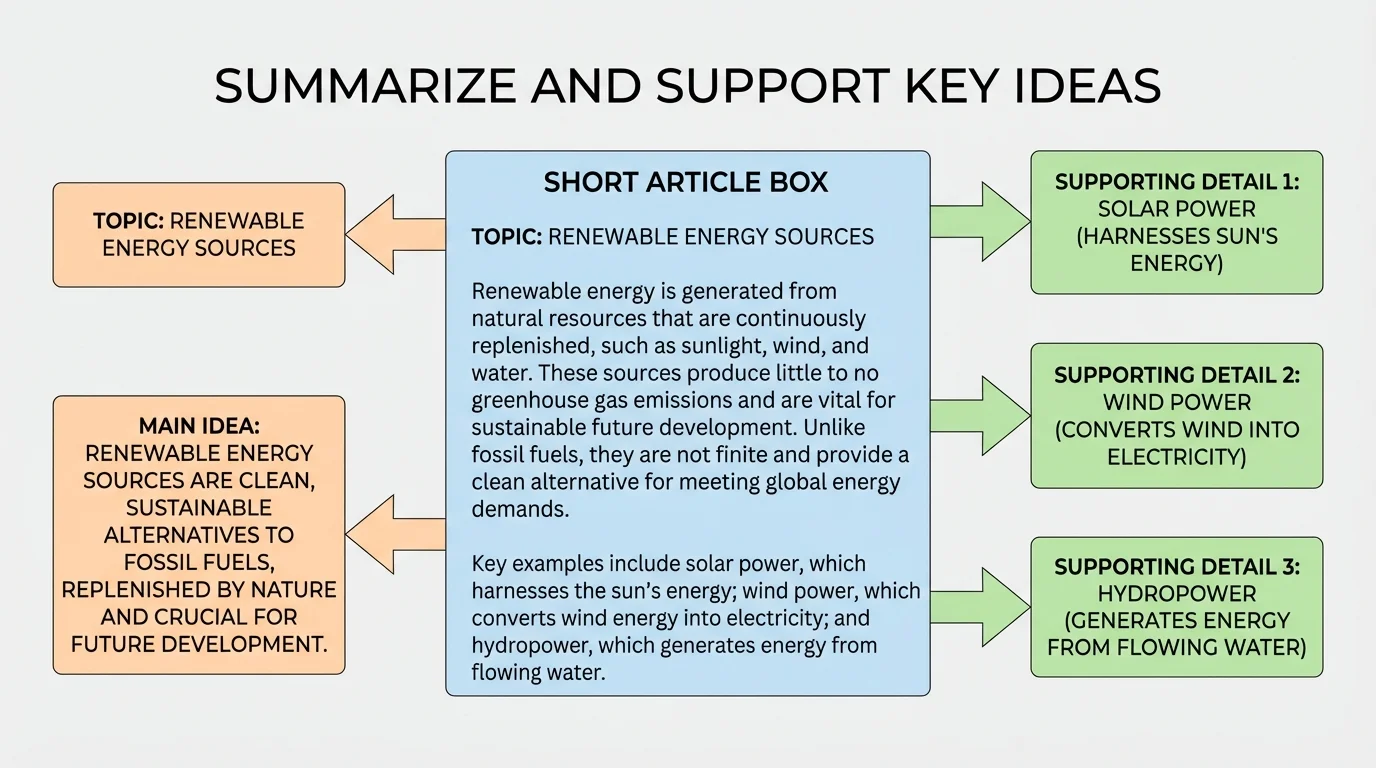
Here is a simple way to think about it. If a paragraph says that communities are planting more trees because trees provide shade, improve air quality, and give animals places to live, the main idea is not just "trees." It is that planting trees benefits communities in several important ways. The shade, cleaner air, and animal habitats are supporting details.
Sometimes the main idea is stated directly. Sometimes you must infer it by putting the details together. If several details all point to one message, that message is probably the main idea.
After you find the main idea, the next step is to choose the best supporting details. These are the details that help explain or prove the idea. They may be facts, examples, short descriptions, or information from an expert.
Not every detail deserves a place in your summary. Some details are useful for a full report but not for a short summary. Ask yourself, "Does this detail help the reader understand the main idea?" If the answer is yes, keep it. If the answer is no, leave it out.
For example, if a text explains how hurricanes form over warm ocean water, strong supporting details might include that warm water adds energy to the storm and that rotating winds grow stronger as the system develops. A weaker detail might be the exact color of a weather map shown in the article. That may be interesting, but it does not explain the key idea.
Important details support, not replace, the main idea. A summary should not become a pile of facts. The facts should work together to explain the central point. If details are piled in without a clear main idea, the reader may feel lost.
Writers also support key ideas when they make claims in their own research writing. If you write, "Plastic pollution harms ocean animals," you need evidence such as examples of animals swallowing plastic, getting tangled in it, or losing habitat because of trash. A strong idea stands on evidence, not opinion alone.
Summarizing is a process, not a lucky guess. Good readers move through clear steps, and [Figure 2] presents that process in order from reading to checking.
Step 1: Read or view the source carefully. Do not rush. Try to understand what the source is mostly saying before you write anything.
Step 2: Mark important ideas. You might underline topic sentences, note repeated words, or jot down questions in the margin.
Step 3: List the main idea and a few key details. Keep your notes short. At this point, you are collecting the strongest pieces of information.
Step 4: Write the summary in your own words. Explain the source clearly and briefly. Use complete sentences.
Step 5: Shorten and check. Remove repeated ideas, unneeded details, and your own opinions unless the assignment asks for them.
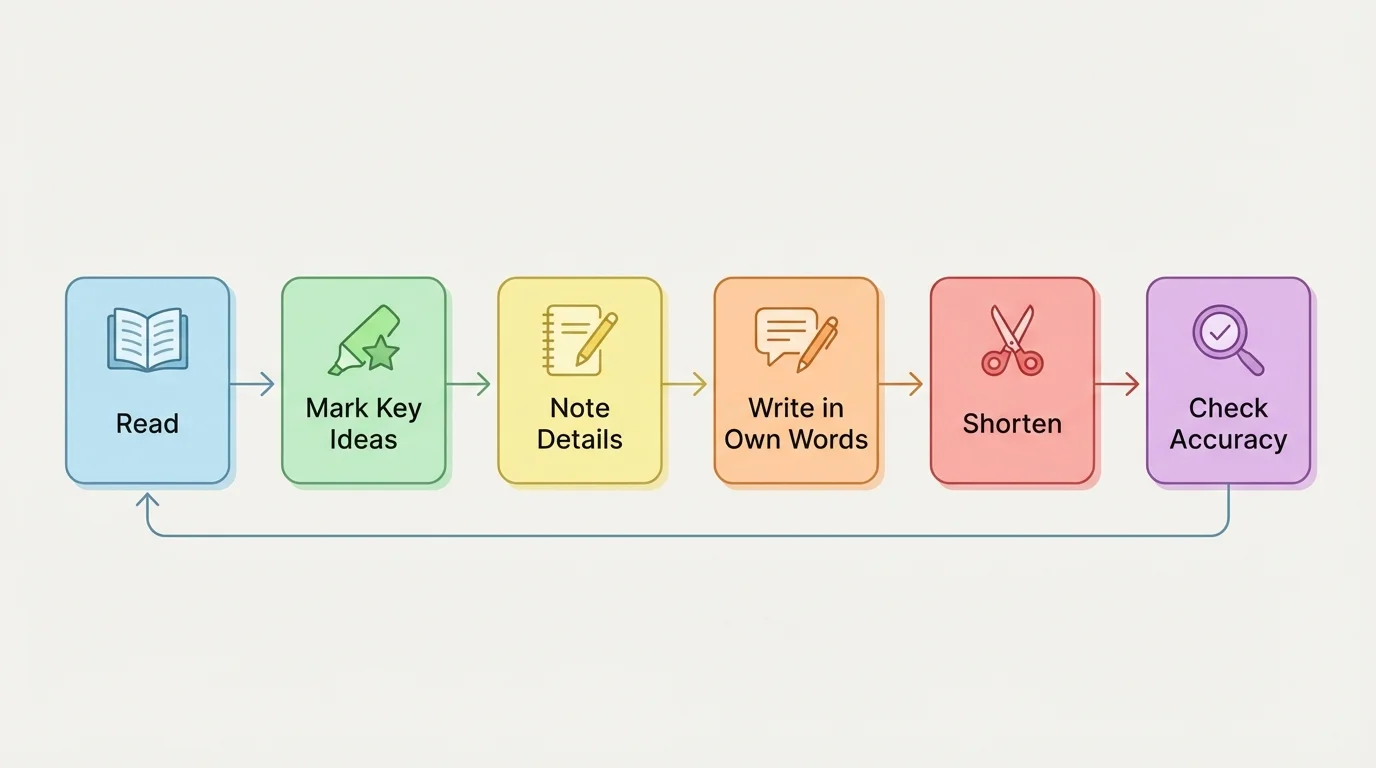
Step 6: Compare your summary to the original. Make sure it is accurate. A summary should be shorter, but it must still be true.
Example: Summarizing one paragraph
Original information: A passage explains that peregrine falcons nearly disappeared in some places because of a harmful chemical, but conservation efforts and bans on that chemical helped the birds recover.
Step 1: Find the main idea.
The main idea is that peregrine falcons were once in danger but recovered because people took action.
Step 2: Pick the best supporting details.
Important details: a harmful chemical hurt the birds, the chemical was banned, and conservation efforts helped the population grow again.
Step 3: Write in your own words.
A clear summary is: Peregrine falcons declined because of a dangerous chemical, but protections and conservation work helped them recover.
Notice that the summary is shorter than the original, includes the central idea, and keeps the most important supporting details. It does not copy the source sentence by sentence.
Research today comes from many places. Print sources include books, magazines, newspapers, and encyclopedias. Digital sources include websites, online articles, databases, and videos. You can summarize both, but each type may require a slightly different approach.
With print sources, you may use headings, page numbers, captions, and indexes to locate information. With digital sources, you may scroll, click links, and examine menus or tabs. Digital sources can be fast to search, but they also require care because not every website is trustworthy.
When using digital sources, ask questions such as: Who made this? Is the information current? Does the author seem informed? Does the source match what other reliable sources say? A summary is only as strong as the sources it is based on.
| Source Type | Helpful Features | What to Watch For |
|---|---|---|
| Book | Table of contents, headings, glossary | May include more detail than you need |
| Magazine or article | Title, subheadings, captions | May focus on one angle of a topic |
| Website | Menus, links, search bars | Author and accuracy may be unclear |
| Video | Images, narration, captions | Important details may go by quickly |
Table 1. Comparison of common print and digital source types for research.
Whether the source is on paper or on a screen, the goal stays the same: find the most important ideas and explain them clearly.
Many professional writers create summaries before they write full reports. A short, accurate summary helps them decide which evidence belongs in the final piece.
When summarizing a video, you may need to pause and take notes. When summarizing a website, you may need to ignore advertisements or extra links that distract from the main idea. Good researchers stay focused on the information that answers their question.
Sometimes one source is not enough. In a short research project, you might need to learn about several parts of one topic. This is where synthesizing becomes important. It means putting together information from different sources to build a fuller understanding. Instead of collecting separate facts like loose puzzle pieces, you connect them into one picture, as [Figure 3] shows with shared and different information from multiple sources.
Suppose your topic is renewable energy. One source may explain how solar panels work. Another may discuss wind turbines. A third may compare renewable and nonrenewable energy sources. If all three sources show that renewable energy can reduce pollution, that shared idea may become one of your key points.
Different sources may also provide different supporting details. One article may use facts and numbers. Another may give examples from a real city. Another may include expert opinions. When you synthesize, you gather those details under the same key idea instead of treating each source as a separate island.
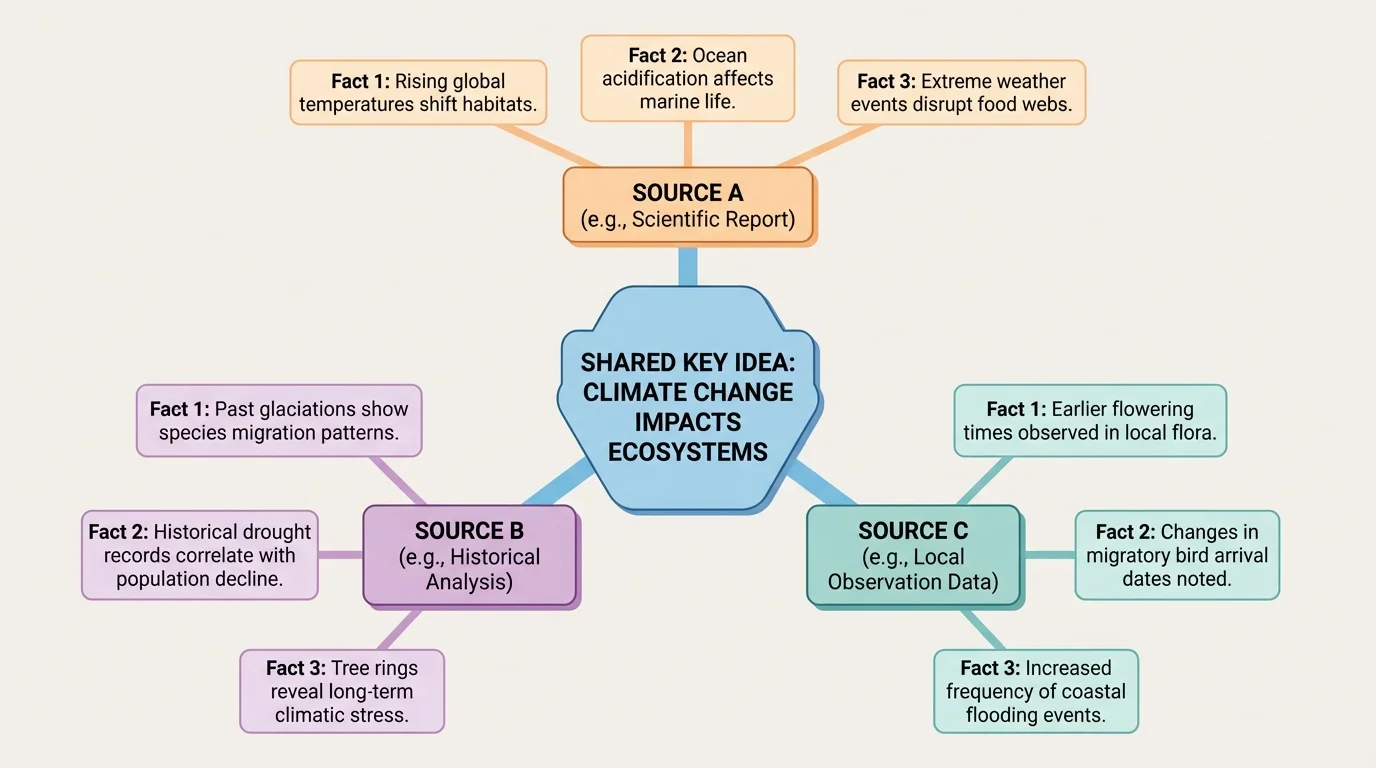
This skill matters because research is stronger when ideas are supported by more than one source. If several reliable sources agree, your understanding becomes more solid. If the sources disagree, you may need to look closer and ask why.
Example: Combining three sources about school gardens
Step 1: Source A says school gardens help students learn science by observing plant growth.
Step 2: Source B says gardens can provide fresh vegetables for school meals.
Step 3: Source C says gardens teach responsibility because students must water, weed, and care for plants.
A synthesized statement is: School gardens help schools in several ways, including teaching science, providing fresh food, and building responsibility.
That final sentence is not copied from one source. It combines key ideas from three sources into one clear statement.
Once you have gathered and summarized information, you often need to share what you learned. This may happen in a paragraph, a report, a slide presentation, or a class discussion. At that point, you are not just summarizing sources. You are using them to support your own key ideas.
For example, if your research question is "Why should communities protect wetlands?" your key idea might be that wetlands are valuable habitats and natural flood protection areas. To support that key idea, you could include evidence showing that wetlands provide homes for birds and fish and help absorb extra water after storms.
A strong research paragraph often follows a simple pattern: state a key idea, add evidence, and explain how the evidence supports the idea. Evidence does not speak for itself. The writer or speaker should connect it clearly to the point being made.
"The best evidence is not the most information. It is the most useful information."
This idea is important. A page full of random facts is not strong research. What matters is choosing evidence that truly supports your key point. As seen earlier in [Figure 1], details should connect to the main idea instead of floating around by themselves.
When speaking, summaries should be even clearer. Listeners cannot reread your words, so you need to say the main point directly and support it with a few strong details.
One common mistake is including too many small details. If your summary feels almost as long as the original source, it is probably not a true summary. Another mistake is leaving out the main idea and keeping only scattered facts.
A third mistake is adding personal opinion when it does not belong. If the source says pandas need protected habitats, your summary should report that idea. It should not suddenly change into "I think pandas are the cutest animals," unless the assignment asks for a personal response.
Another mistake is making unsupported claims. If you write, "Recycling solves pollution," that is too broad and may not be true. A better statement would be supported by evidence, such as how recycling can reduce some waste in landfills and save materials.
Students also sometimes trust the first website they find. Good researchers check whether the source is reliable before they use its information. The process shown in [Figure 2] includes checking for accuracy at the end, but smart readers begin that careful thinking as soon as they choose a source.
Now put all the parts together. Suppose your research topic is sea turtles. You might begin with a question such as, "What dangers do sea turtles face, and how are people helping?" Then you would gather several sources, perhaps a book section, a wildlife website, and a short video from a science organization.
From one source, you may learn that plastic waste can be mistaken for food. From another, you may learn that bright lights near beaches can confuse baby turtles. From a third, you may learn that conservation groups protect nests and reduce harmful fishing practices. As in [Figure 3], these separate pieces can be grouped into larger shared ideas.
Your notes might be organized like this:
| Key Idea | Evidence from Sources |
|---|---|
| Sea turtles face human-made dangers. | Plastic pollution, fishing nets, beach lights |
| Conservation efforts can help. | Nest protection, cleaner beaches, safer fishing methods |
| Different sources build a fuller picture. | Book explains habitat, website explains threats, video shows conservation work |
Table 2. Example of organizing notes from several sources into key ideas and evidence.
Using those notes, you could write a short explanation such as: Sea turtles face several human-made dangers, including plastic pollution, harmful fishing practices, and bright lights near nesting beaches. Research from books, websites, and videos also shows that conservation efforts such as protecting nests and reducing ocean trash can help these animals survive.
That response is more than a list. It summarizes and supports key ideas using evidence from several sources. It is accurate, focused, and useful for a short research project.
These skills grow stronger with practice, but the goal stays the same: find the most important ideas, explain them clearly, and support them with trustworthy information.
