A report can answer a question that people really care about. Why do sea turtles return to the same beach? How do bridges hold so much weight? Why do some storms grow so quickly? A strong research report helps others understand a topic clearly. It is not just a pile of facts. It is a focused explanation built from careful reading, smart note-taking, and details that match the main idea.
When you do research, you become an investigator. You ask a question, look for answers in more than one place, decide which facts matter most, and then share what you learned. Sometimes you share in writing. Sometimes you speak to an audience. In both cases, your job is the same: stay clear, stay focused, and support your ideas.
A research report is a short spoken or written explanation of what you learned about a topic. A good report has a clear topic, organized ideas, and details from trustworthy sources. It should help the audience learn something important or interesting.
A report needs focus. Focus means staying centered on the main question or main idea. If your report is about how earthquakes affect buildings, you should not suddenly spend a whole paragraph on volcano myths. Extra information can be interesting, but if it does not help explain your topic, it can confuse the audience.
A report also needs supporting details. These are facts, examples, descriptions, or explanations that help prove or explain your main idea. If your main idea is that honeybees are important to farming, your supporting details might include how bees pollinate flowers and help fruits and vegetables grow.
Main idea is the central point of a report.
Supporting details are the facts, examples, and explanations that help the audience understand the main idea.
Audience is the person or group the report is meant for.
The audience matters too. If you are reporting to classmates, you can use familiar examples and explain words they may not know. If you are speaking to younger students, you may need even simpler language. Strong researchers do not just ask, "What do I want to say?" They also ask, "What does my audience need in order to understand?"
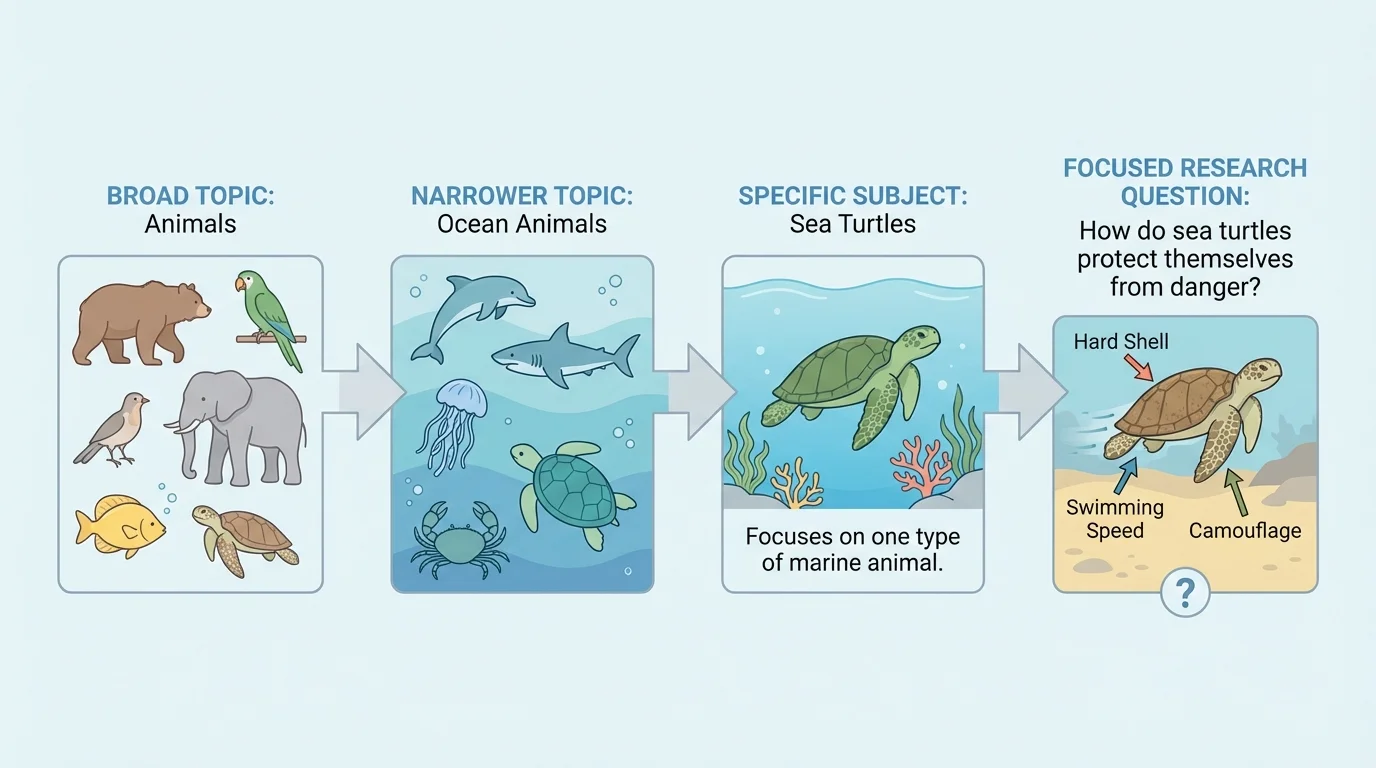
A good project begins with a research question. This is the question you want your research to answer. As [Figure 1] shows, a broad topic becomes much easier to study when it is narrowed into one clear question. "Animals" is too big. "Ocean animals" is still broad. "How do sea turtles protect themselves from danger?" is focused enough for a short report.
A strong research question is specific but not tiny. If your question is too broad, you may find too much information and not know what to choose. If it is too narrow, you may not find enough information. "Weather" is too broad. "What was the wind speed outside my house at exactly 3:12 p.m. last Tuesday?" is too narrow for a short research project. "How do meteorologists predict hurricanes?" works much better.
Once you choose your question, keep it nearby while you research. It acts like a path through a forest. Every source, note, and paragraph should connect back to it. If a fact does not help answer the question, it may not belong in your report.
Many students think research starts by collecting facts right away. Actually, it starts by deciding what you want to find out. That choice affects every other step, from the sources you search for to the details you include in your final report.
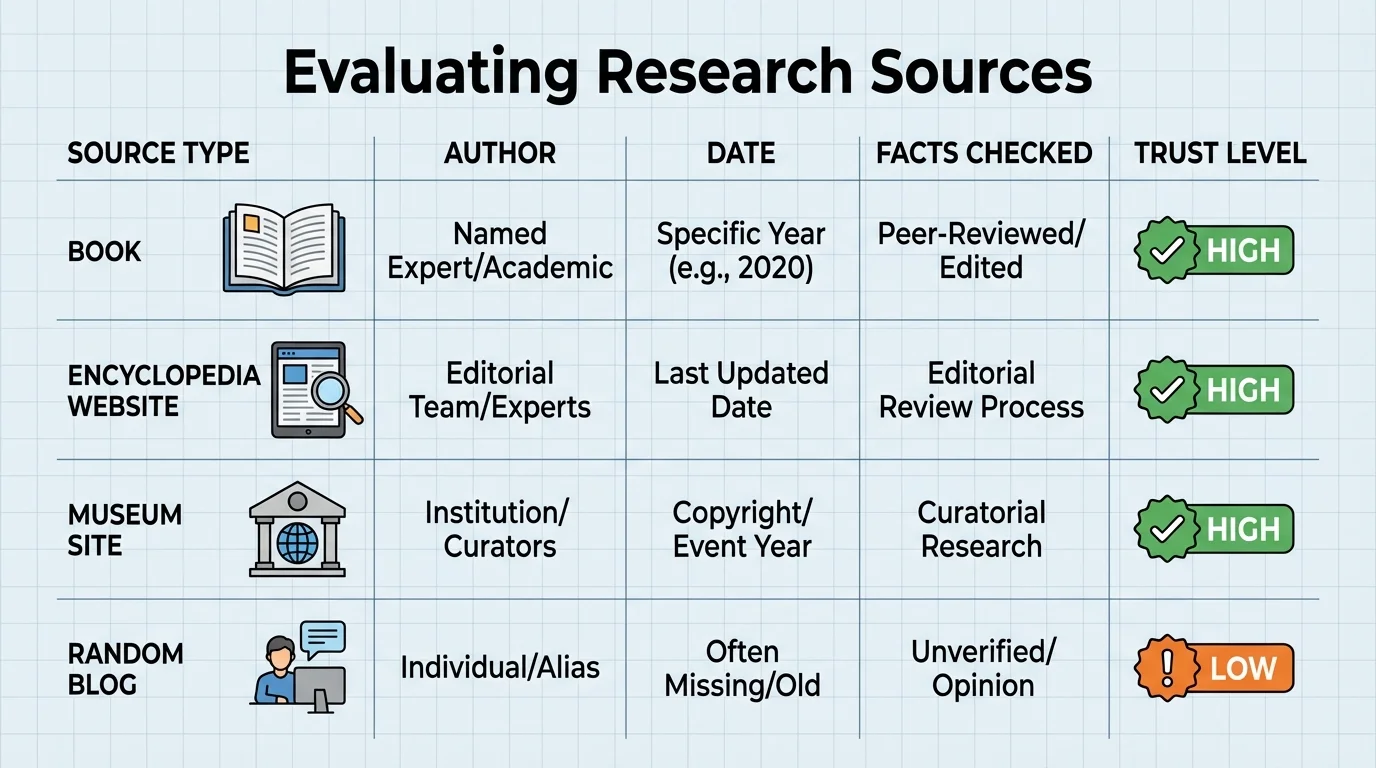
Now you need sources that can help answer your question. A source is where information comes from. Sources can be print sources, like books and magazines, or digital sources, like museum websites, news sites, and online encyclopedias. When you compare sources carefully, as in [Figure 2], you can decide which ones are most useful and trustworthy.
Not every source is equally reliable. A reliable source is one you can trust because it is accurate, current, and written by a knowledgeable author or organization. A science museum website is usually more dependable than a random online post with no author listed. A book from the school library may be very helpful, but if it is old, you should also check whether the information is still current.
Ask a few questions about each source. Who wrote it? When was it published or updated? Does it match information you found in other sources? Is it trying to inform, or is it mostly trying to sell something or express one person's opinion? Good researchers use several sources so they can compare information instead of depending on only one place.
| Source Type | What It Can Offer | What to Check |
|---|---|---|
| Book | Detailed background information | Author, publication date, accuracy |
| Encyclopedia | Quick overview and key facts | Updated edition or website date |
| Museum or university website | Expert explanations and images | Organization name, recent updates |
| News article | Current events and recent discoveries | Source reputation, date, evidence |
| Personal blog | Opinions or experiences | Author expertise, proof, bias |
Table 1. Common source types and what students should check when deciding whether to trust them.
Using several sources helps build stronger knowledge. If two or three trustworthy sources explain the same idea, you can feel more confident that the information is accurate. Later, when you explain your findings, you will be using a stronger foundation than a single source could provide.
Professional researchers often spend a lot of time deciding which sources to trust before they begin writing. Choosing the right evidence is part of the research process, not an extra step.
This careful source-checking also helps you avoid repeating errors. If one website gives a surprising fact but no other trustworthy source confirms it, you should be cautious. That is one reason researchers compare and question what they read.
Reading a source is only the beginning. Next, you take notes. Notes should be short, clear, and written in your own words when possible. You do not need to copy whole paragraphs. In fact, copying too much can make it harder to understand the information later.
A summary is a short version of the most important ideas. When you summarize, you keep the meaning but leave out less important details. For example, if an article explains that sea turtles face danger from predators, plastic waste, and fishing nets, your summary might say, "Sea turtles face several threats in the ocean and on beaches, including animals and human-made hazards."
A paraphrase is a restatement of information in your own words. A paraphrase is usually about the same length as the original idea, while a summary is shorter and includes only the most important points. Both are useful in research because they help you understand the information instead of just copying it.
Example: Turning source information into notes
Original source idea: Sea turtles often return to the beach where they were born when it is time to lay eggs.
Step 1: Identify the important idea
The important idea is that sea turtles return to a familiar beach to nest.
Step 2: Write a note in your own words
Note: Many sea turtles come back to their birth beach to lay eggs.
Step 3: Connect it to your report focus
This note could support a report about sea turtle behavior or life cycle.
Good notes are organized. You might group them by subtopics, such as habitat, diet, threats, and protection. That way, when you begin writing, you can easily find the details that belong together.
After you have notes from several sources, you need to sort them. This step is called organizing information. A report becomes much clearer when details are grouped into categories that support the same main idea.
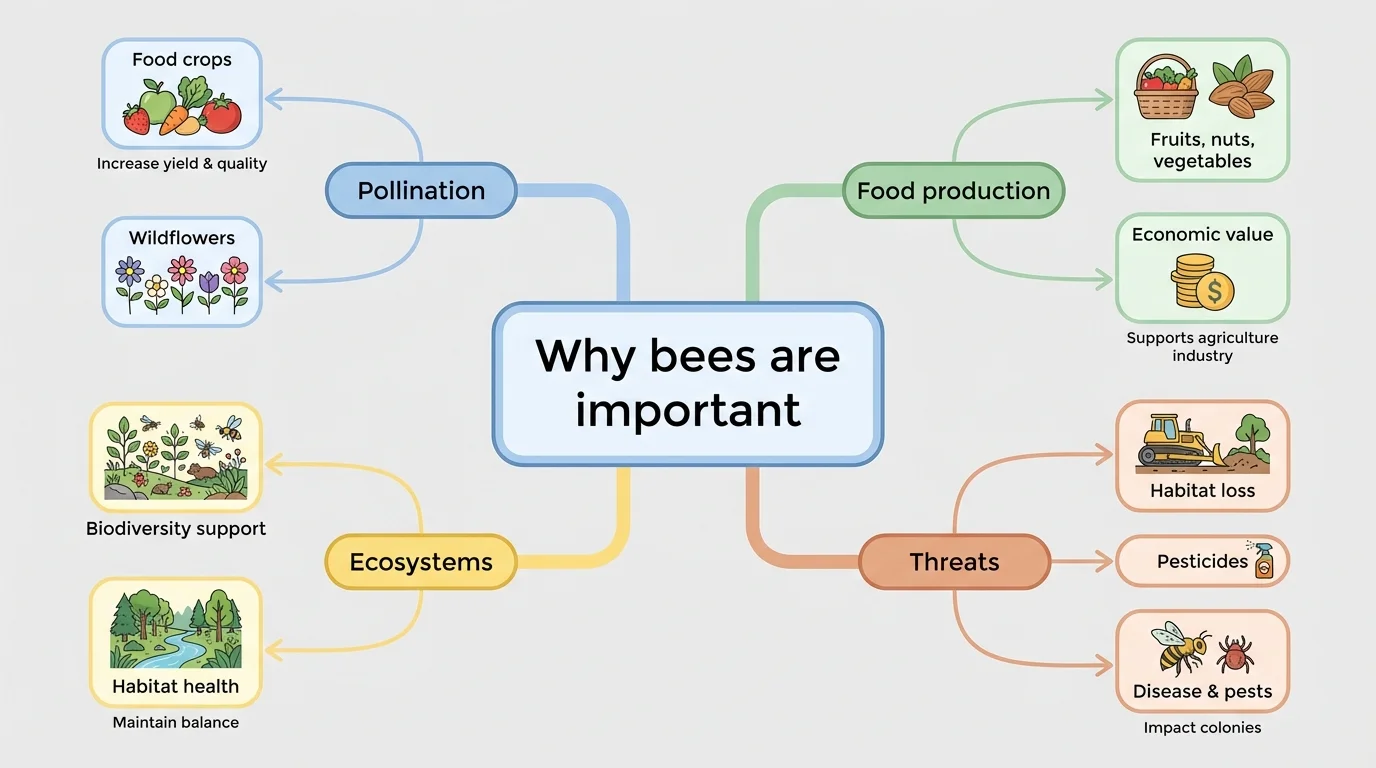
Suppose your report asks, "Why are bees important?" As [Figure 3] suggests, you might sort your notes into these groups: pollination, food production, ecosystems, and threats to bees. Each group can become part of your report. If you found a fact about how honey tastes different in different regions, that might be interesting, but it only belongs if it helps answer your question.
This is also the moment when you begin to synthesize information. To synthesize means to combine ideas from different sources into one clear understanding. Maybe one source explains how bees carry pollen, another explains how crops depend on pollination, and a third explains what happens when bee populations drop. When you put those ideas together, you can explain the bigger picture.
Synthesizing is more than lining up facts. It means noticing connections. For example, if several sources mention that bees help plants reproduce, you can combine that evidence into one strong statement: bees are important because they support plant growth, food supplies, and healthy ecosystems.
Choosing the best details
Not every fact belongs in a report. The best details are relevant, accurate, and clear. They answer the research question, strengthen the main idea, and fit the needs of the audience.
Think of focus like packing a small backpack. You only carry what helps on the trip. In the same way, your report should include the details that help your audience understand the topic, not every fact you happened to find.
A brief written report usually follows a simple structure. As [Figure 4] shows, it often includes an introduction, body paragraphs, and a conclusion. This structure helps readers follow your thinking from start to finish.
The introduction names the topic and gives the main idea or research question. It prepares the audience. If your report is about how volcanoes form, your introduction might explain that volcanoes are openings in Earth's crust and that the report will explore how they develop and why eruptions happen.
The body includes the most important facts, grouped in a logical order. One paragraph might explain how pressure builds underground. Another might explain what magma does as it rises. Each paragraph should connect to the main idea and include supporting details from your sources.
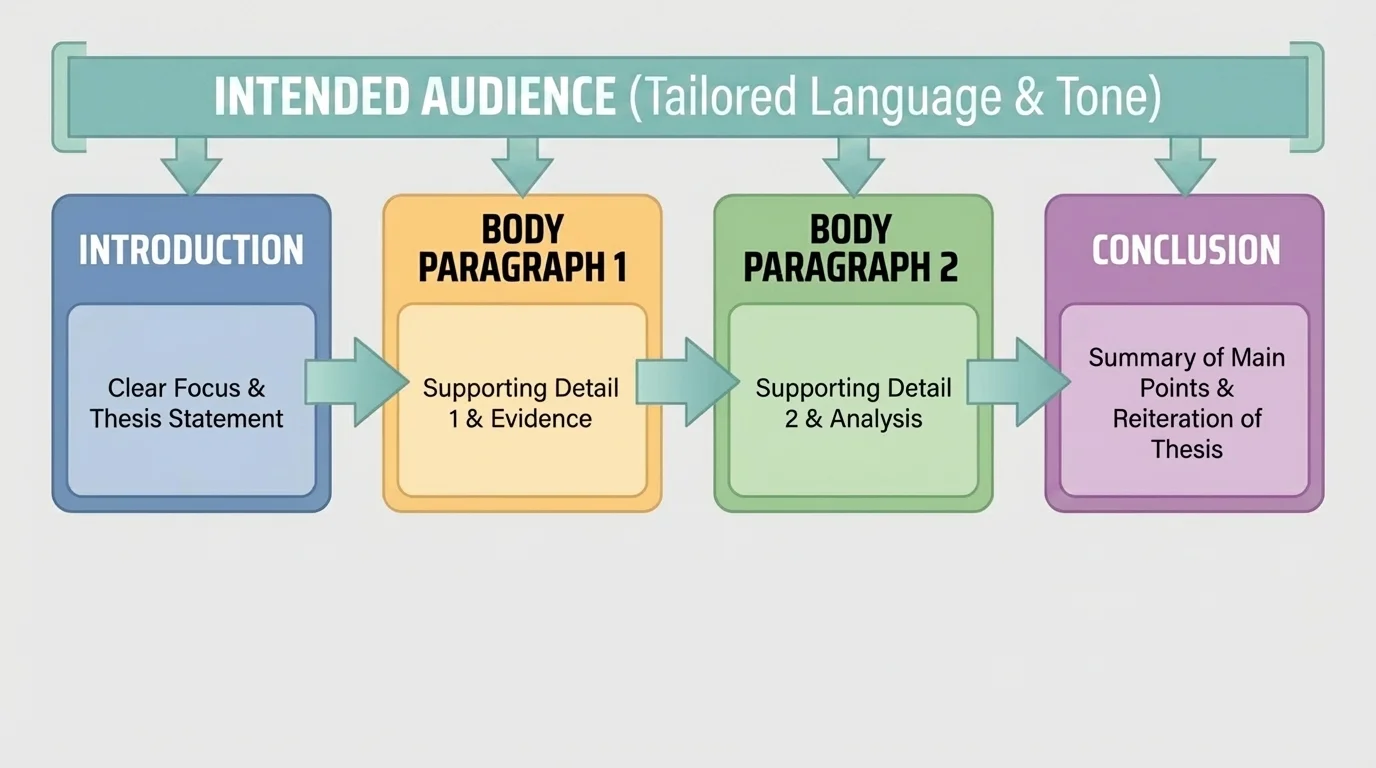
The conclusion brings the information together. It reminds the audience of the main point without repeating every detail. A conclusion might explain why the topic matters or what the research shows overall.
Use transition words to connect ideas. Words like first, next, for example, because, also, and finally help the report sound smooth. Clear transitions are especially useful when you have gathered information from multiple sources and want the final report to sound unified.
Example: A short report opening
Research question: How do sea turtles protect themselves from danger?
Step 1: State the topic clearly
Sea turtles face many dangers in the ocean and on shore.
Step 2: Give the focus
This report explains the ways sea turtles protect themselves and the challenges they still face.
Step 3: Prepare for body details
The body could then describe camouflage, swimming ability, shells, and places where turtles hide.
Good report writing sounds clear, not fancy for the sake of sounding impressive. Strong writers choose words the audience can understand. They explain special terms when needed. They also make sure each paragraph has one main point instead of many unrelated ideas.
Later, when you revise, [Figure 4] still helps because you can check whether each part of your report is doing its job. If your introduction is too long or your conclusion adds brand-new facts, the structure needs improvement.
An oral report is not exactly the same as a written one. When you speak, your listeners cannot reread a sentence, so your words must be especially clear. A strong oral presentation uses the same focused information as a written report, but it also depends on pace, voice, and eye contact, as shown in [Figure 5].
When presenting, speak slowly enough for others to follow. Use notes or cue cards instead of reading every sentence straight from a page. If you look up, face the audience, and speak with expression, listeners stay more engaged and understand more easily.
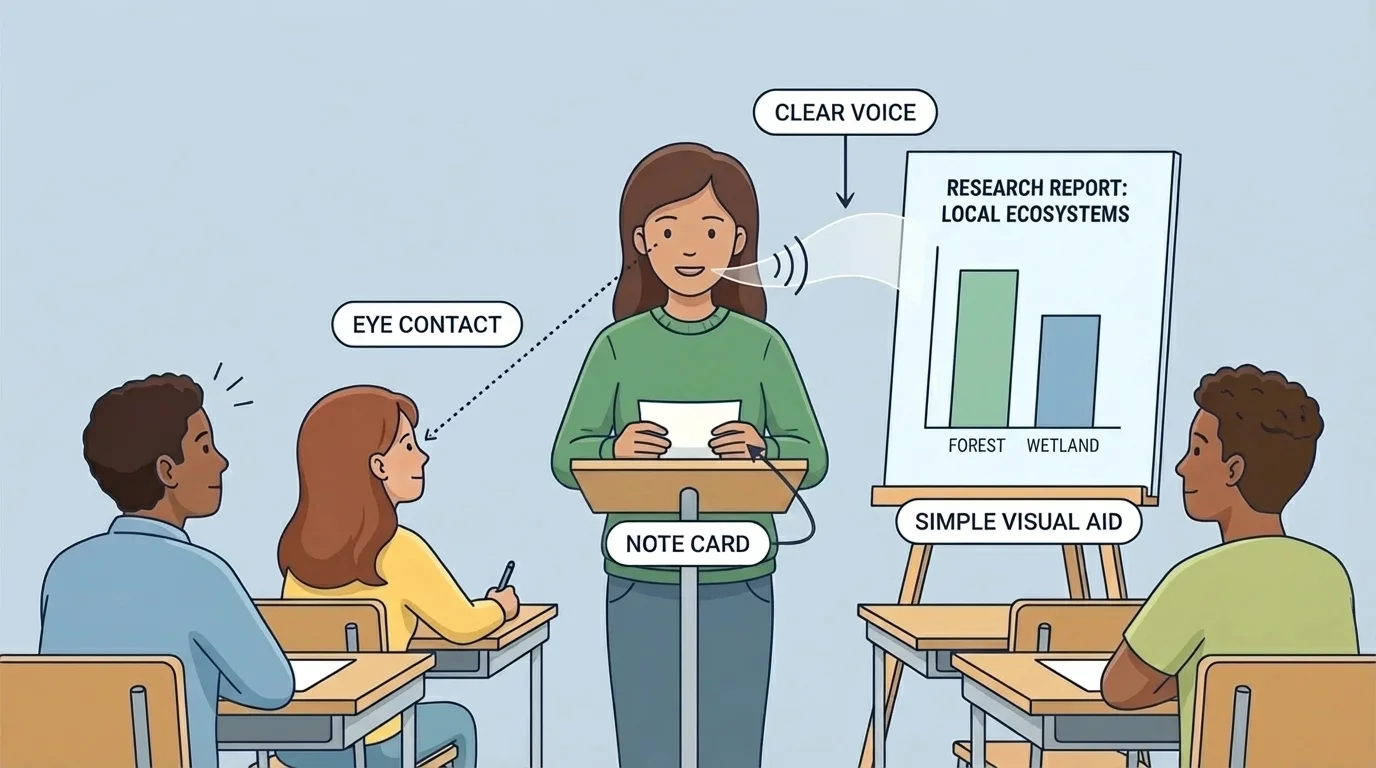
Think about the audience again. If your classmates are listening, explain unfamiliar words simply. If you use a visual, such as a chart or image, make sure it supports your message instead of distracting from it. A visual should help listeners understand a key idea faster.
Practice matters. Reading your report aloud can help you hear awkward sentences, repeated words, or places where your ideas jump too quickly. Practicing also helps you feel more confident and remember the order of your points.
When speaking in front of others, use a clear voice, stand where the audience can see you, and keep your message organized. These communication habits make your research easier to understand.
The same focused thinking used in writing helps with speaking. Just as the student in [Figure 5] uses a note card instead of a full script, a strong presenter remembers key points and explains them naturally.
Researchers should always tell where information came from. This is called citation or documenting sources. Even in a short fifth-grade report, you can do this in a simple way by listing the title of a book, the author, or the name of a website you used.
Giving credit is important for two reasons. First, it is honest. It shows which ideas came from your sources. Second, it lets others check the information if they want to learn more. Research is stronger when readers or listeners know the evidence comes from real sources.
A simple source list might include a book title, author, and year, or a website name and date. Your teacher may give a special format to follow. The exact style can vary, but the goal is always the same: show where your information came from.
"Good research is not just finding information. It is showing where the information came from and using it honestly."
Copying someone else's writing and pretending it is your own is unfair and weakens your work. Using your own words, plus giving credit to your sources, makes your report responsible and trustworthy.
Before you finish, reread or rehearse your report. Ask yourself a few important questions. Does every part connect to the research question? Are the details accurate and easy to understand? Is the report organized in a way that makes sense for the audience?
Look for places where you can improve clarity. Maybe one paragraph includes too many ideas. Maybe a fact needs an explanation. Maybe a transition is missing. Small changes can make a report much easier to follow.
You should also check for missing support. If you make a claim, ask whether you included enough evidence. For example, if you say that plastic pollution harms sea turtles, you should include details that explain how, such as turtles mistaking plastic for food or getting trapped in debris.
Editing is the final cleanup step. Fix spelling, punctuation, and grammar in writing. In speaking, check pronunciation and volume. These details may seem small, but they help the audience focus on your ideas instead of getting distracted.
Let's put the whole process together with one topic: "How do school gardens help communities?" The question is focused because it asks about one specific kind of place and one kind of effect.
First, a researcher gathers several sources. A book about plants may explain how gardens grow food. A local news article may describe a neighborhood garden project. A school website may explain how students use a garden for science lessons. Looking across these sources, the researcher notices repeated ideas: gardens provide food, create habitats for insects, and bring people together.
Next, the researcher takes notes and sorts them into groups such as food, learning, environment, and community teamwork. This step is similar to the category branches seen earlier in [Figure 3], where notes connect back to one central topic.
Then the writer drafts a short report. The introduction explains what a school garden is and names the focus. The body paragraphs describe how gardens help people learn, support nature, and strengthen the community. The conclusion explains why these benefits matter.
If the report is presented aloud, the speaker might hold a note card with only key phrases, not full paragraphs. That choice keeps the presentation natural and clear. By the end, the audience understands not only that school gardens are useful, but also why the evidence supports that idea.
