A strong writer is not just someone with a big vocabulary or neat handwriting. A strong writer is someone who can adjust. Sometimes you need to produce a thoughtful report after several days of research. Other times you need to respond quickly in one class period. Real writers do both. Journalists, scientists, historians, engineers, and students all change how they write depending on how much time they have, what they are trying to do, and who will read their work.
Writing is not one single skill used in only one way. A text message to a friend, a science explanation, a social studies response, and a class presentation all involve writing, but they do not follow the same rules. The writer has to think about the task, the purpose, and the people who will read or hear it.
That is why good writers work routinely. Writing routinely means writing regularly and with purpose, not only when a big assignment appears. When students write often, they learn how to organize ideas faster, choose stronger words, and spot errors more easily. They also become more flexible, which matters because school writing happens in many forms and many time frames.
Extended time frame means writing that happens over several days or longer, with time for research, reflection, drafting, revision, and editing.
Shorter time frame means writing completed in one sitting or over a day or two, usually with quicker planning and revision.
Audience is the person or group the writer is trying to reach.
Purpose is the reason the writer is writing, such as to explain, argue, describe, inform, or reflect.
If you only write one way, your writing tools stay limited. If you learn to write in different ways and on different timelines, you become much better at communicating ideas clearly.
Writers often move between different schedules, as [Figure 1] shows when comparing a longer project to a quick writing task. A longer assignment gives you time to explore a topic deeply. A shorter assignment pushes you to think clearly and organize ideas efficiently. Both matter.
An extended time frame is useful when the topic is complex or when accuracy matters a lot. For example, if you are writing a report about renewable energy, you may need to gather facts from several sources, compare information, take notes, build an outline, write a draft, and then revise it. This kind of writing grows over time.
A shorter time frame is useful when you need to capture an idea quickly or respond to a question right away. For example, after reading a historical document, you might write a one-paragraph response explaining the author's main claim. You still need to be organized and clear, but you may only have one class period to do it.
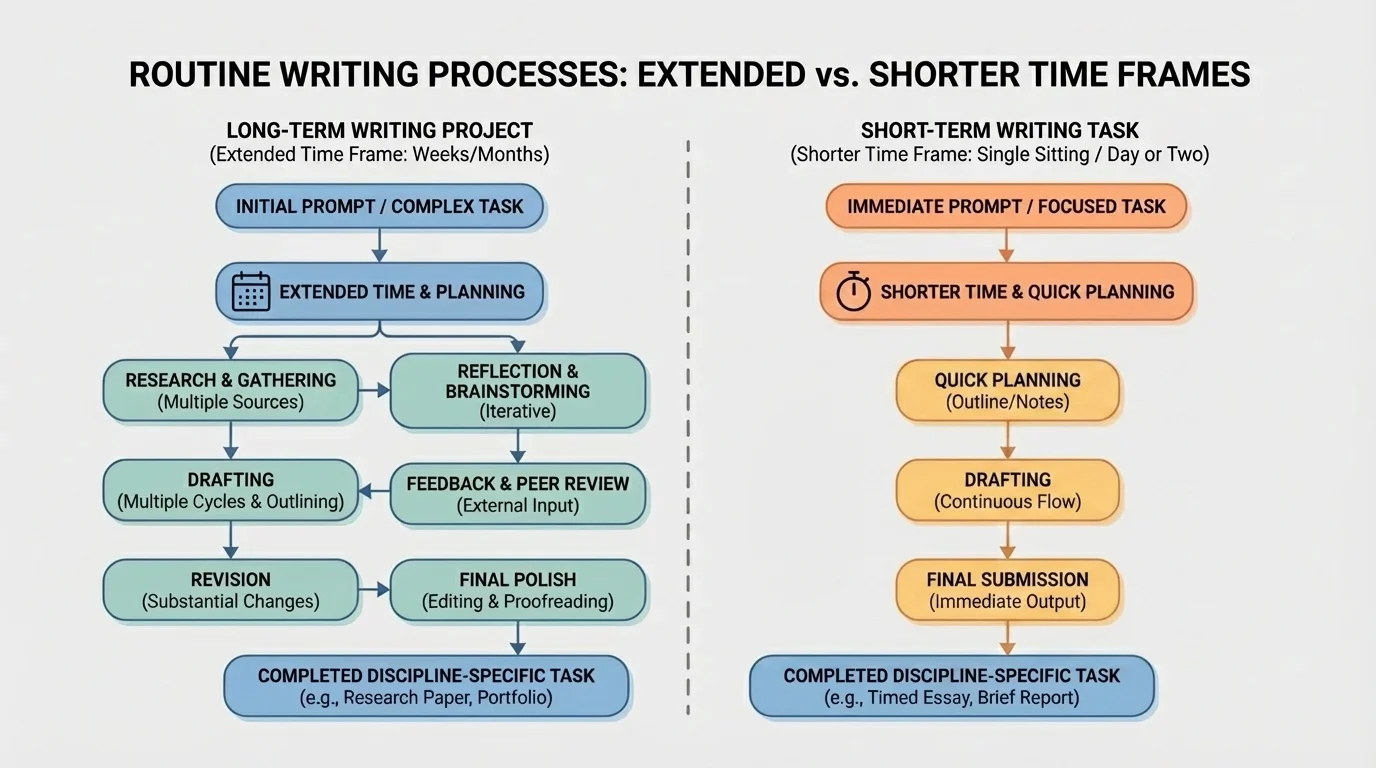
Neither time frame is better than the other. They train different strengths. Longer writing teaches patience, deeper thinking, and revision. Shorter writing teaches focus, speed, and clarity under time limits.
Think of it like sports practice. A team needs full-game strategy sessions, but it also needs quick drills. Writing works the same way. Long assignments build endurance. Short assignments build control.
Before writing, ask three important questions: What is my task? What is my purpose? Who is my audience? These questions help you make good choices from the beginning.
Your task is what you have been asked to do. You may need to explain a process, compare two ideas, summarize a source, or argue for a position. Each task requires a different structure. A compare-and-contrast response, for example, should group similarities and differences clearly. A process explanation should move in steps.
Your purpose shapes your tone and content. If your purpose is to inform, you focus on accurate facts and clear explanation. If your purpose is to persuade, you still need facts, but you also need reasoning and strong evidence. If your purpose is to reflect, you may include personal thinking and growth.
Your audience affects word choice and detail. Writing for your teacher may require complete explanations and subject vocabulary. Writing for younger students may require simpler language and more examples. Writing for classmates might allow you to connect to shared experiences, but it still needs to be clear and respectful.
One topic, different versions
The same subject can be written in different ways for different audiences. A student could write about volcanoes as a scientific explanation for a teacher, a travel warning for tourists, or a narrative from the point of view of someone escaping an eruption. The topic stays the same, but the writing changes because the task, purpose, and audience change.
Strong writers do not begin by randomly writing sentences. They begin by understanding the situation. That saves time and helps the final piece feel organized instead of confusing.
Longer assignments usually work best when you treat writing as a process, and [Figure 2] illustrates that the stages connect in a cycle rather than a straight line. Writers often move back and forth between steps as their thinking improves.
One important step is research. Research means finding trustworthy information from sources such as books, articles, interviews, or reliable websites. Good research is not just collecting facts. It is choosing information that fits your topic and checking whether the source is dependable.
After research comes planning. You might brainstorm, make a list, create an outline, or sort evidence into categories. Planning helps you avoid weak organization. Instead of throwing ideas together, you create a structure before drafting.
Next comes the draft. A draft is not supposed to be perfect. Its job is to get your ideas into sentences and paragraphs. Many students get stuck because they want the first sentence to sound finished. Skilled writers understand that early drafts are working versions, not final products.
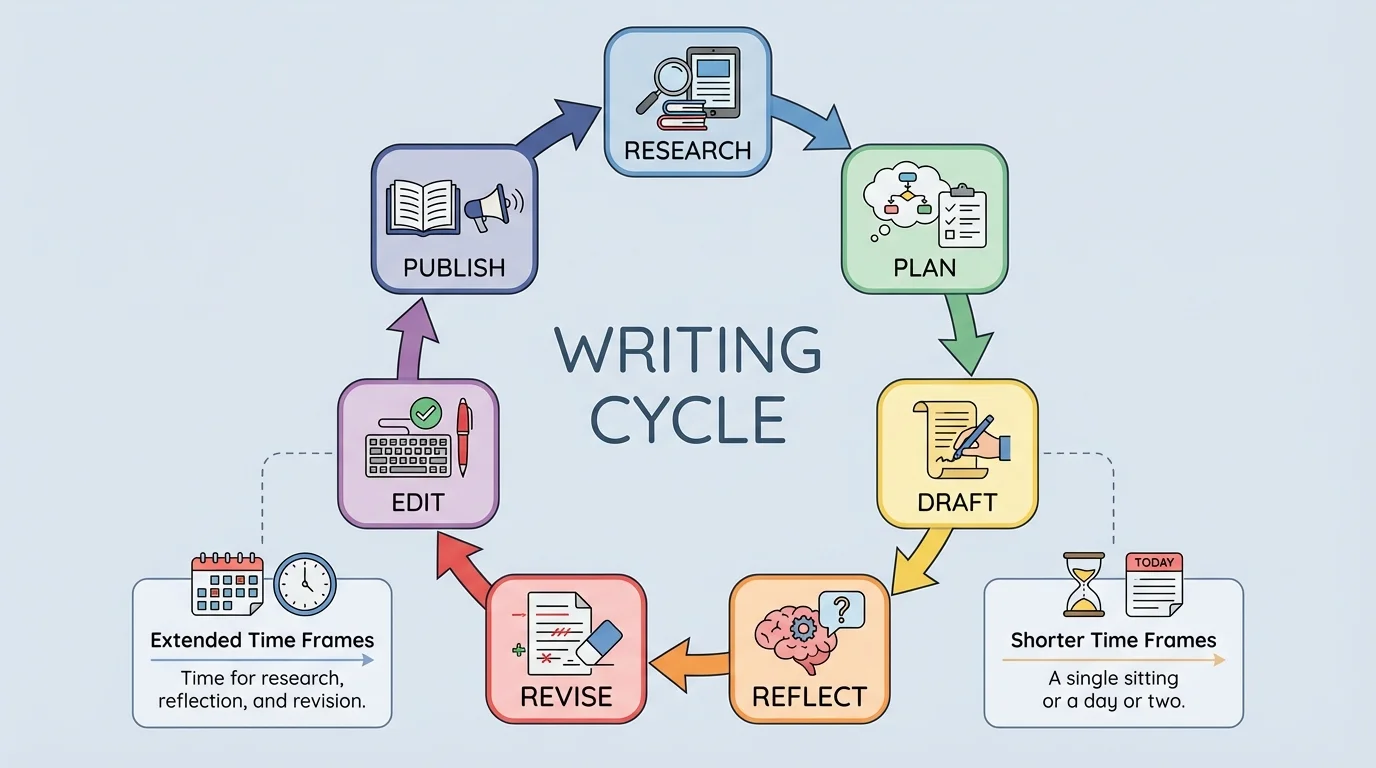
After drafting, good writers pause to reflect. Reflection means stepping back and asking questions such as: Does this make sense? Did I answer the question fully? Is my evidence strong? Are some parts too vague? Reflection helps a writer notice problems before polishing the surface.
Then comes revision. Revision means making big or meaningful improvements to ideas, organization, evidence, and clarity. A writer may add stronger examples, rearrange paragraphs, rewrite a weak introduction, or remove repeated points. Revision is different from simply fixing commas.
After revision, writers edit. Editing focuses on grammar, spelling, punctuation, capitalization, and sentence correctness. Editing matters because even strong ideas can be hard to trust if the writing is full of distracting errors.
Example: A longer writing project
A student is assigned a three-page informational report about how plastic pollution affects oceans.
Step 1: Research
The student reads articles, takes notes on sea animals, microplastics, and cleanup efforts, and records where each fact came from.
Step 2: Plan
The student groups notes into sections: causes, effects, and possible solutions.
Step 3: Draft
The student writes the first version without stopping to perfect every sentence.
Step 4: Reflect and revise
The student notices that the "effects" section is much stronger than the "solutions" section, so more evidence is added and some paragraphs are reorganized.
Step 5: Edit
The student corrects punctuation, spelling, and awkward wording before turning in the final report.
As seen earlier in [Figure 2], these stages often repeat. A writer may return to research during revision, or go back to planning after seeing that the draft is not well organized.
Short writing does not mean careless writing. It means making fast, smart decisions. When time is limited, focus on the most important moves first.
Begin by reading the prompt carefully. Circle or mentally note the action word: explain, compare, describe, argue, summarize, or analyze. That one word tells you what kind of answer to produce. If the prompt asks you to explain, but you mostly retell details, your writing will miss the target.
Next, take a minute or two to plan. Even in a short response, a tiny plan helps. You might jot down a main idea, two supporting points, and an ending sentence. That quick structure keeps your writing from wandering.
Then write directly and clearly. In shorter tasks, every sentence has to work hard. Use specific examples and avoid repeating yourself. If you have only one paragraph, make sure it has a clear topic sentence, evidence or explanation, and a strong closing thought.
Example: A shorter writing task
Prompt: Explain why a character's decision changes the plot of a story.
Step 1: Plan quickly
Main idea: The character's decision creates the main conflict. Supporting points: it changes relationships and causes later events.
Step 2: Write with focus
The response begins with the claim, includes one or two specific story details, and explains how those details affect the plot.
Step 3: Leave time to check
The writer rereads for missing words, repeated ideas, and confusing sentences.
When time is short, it is especially important to avoid unnecessary details. Say what matters most, support it, and make sure the reader can follow your thinking from beginning to end.
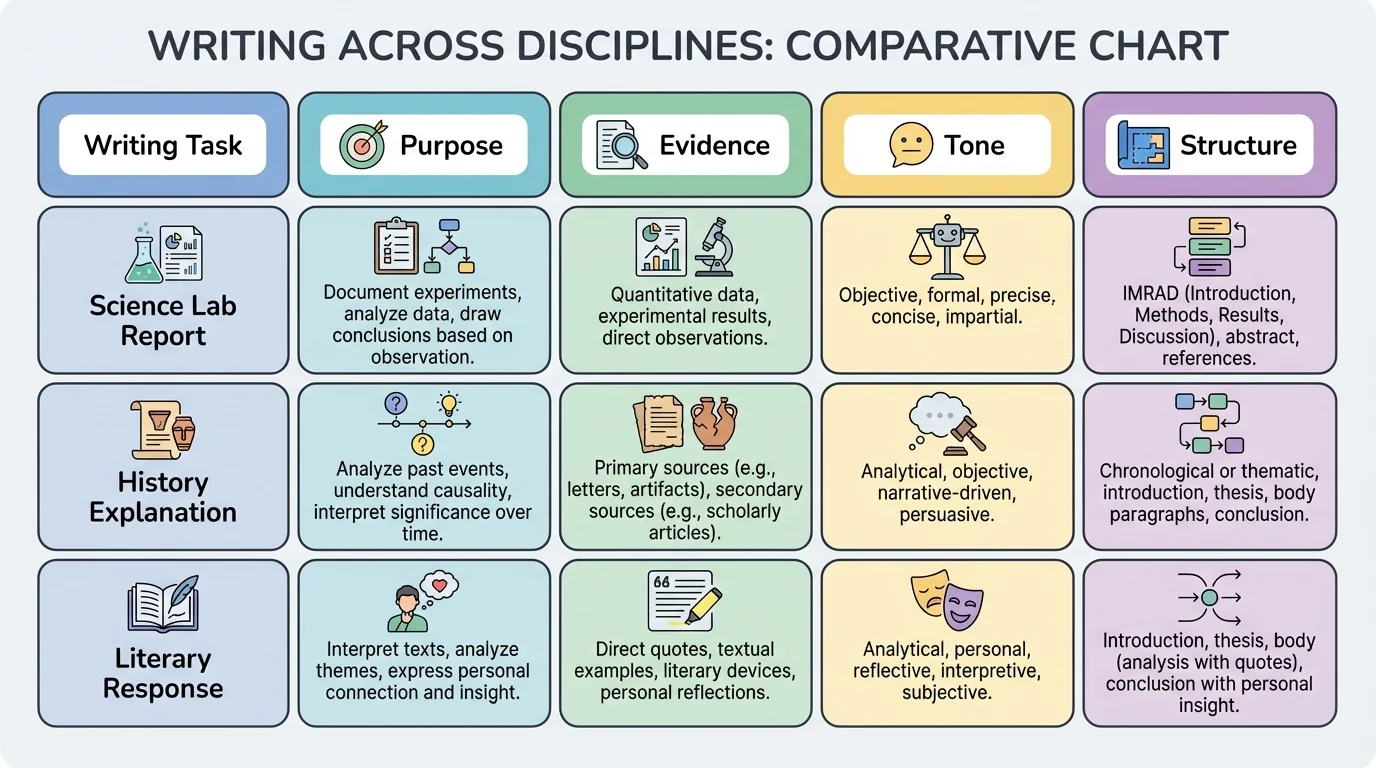
Different school subjects expect different kinds of writing, and [Figure 3] highlights how purpose, evidence, and structure shift from one discipline to another. This is called discipline-specific writing, meaning writing that follows the expectations of a particular subject area.
In science, writing often explains observations, results, or processes. It should be precise and based on evidence. In history, writing often interprets events, explains causes and effects, and uses evidence from sources. In English language arts, writing may analyze character, theme, structure, or author's craft. In each case, the writer still needs clear organization, but the kind of evidence and style can differ.
| Subject | Common Purpose | Type of Evidence | Typical Style |
|---|---|---|---|
| Science | Explain or report findings | Observations, data, results, procedures | Precise, objective, clear |
| History | Explain events or argue an interpretation | Primary and secondary sources, dates, examples | Logical, evidence-based, formal |
| English Language Arts | Analyze or interpret a text | Quotations, plot details, literary elements | Analytical, focused, text-centered |
| Health or Technology | Inform or explain a process | Facts, steps, technical details | Clear, organized, practical |
Table 1. A comparison of how writing expectations change across school subjects.
For example, if you write about weather in science, you might explain how air pressure affects storms using accurate terms and observations. If you write about a historical storm in social studies, you might focus on how it affected people, places, and decisions. If you write about a storm in literature, you might analyze how the storm creates mood or symbolizes conflict.
That is why successful writers pay attention to the assignment, not just the topic. The same topic can require very different writing moves in different classes.
Professional scientists often spend as much time revising and clarifying their writing as they spend doing experiments, because if the report is unclear, other people cannot understand or repeat the work.
The comparison in [Figure 3] remains useful when you switch classes during the school day. Your writing voice should not become fake, but it should become appropriate for the subject and situation.
One of the biggest differences between average writing and strong writing is the willingness to improve it. Many first drafts contain good ideas hidden inside weak organization or unclear sentences. Reflection and feedback help uncover those ideas.
Reflection means thinking carefully about your own writing. You might ask: What is my strongest point? Where might a reader get confused? Did I support my claim? Did I stay focused on the purpose? Honest reflection makes revision more effective.
Feedback from teachers or peers can also help. A reader may notice that your explanation jumps too quickly, that one paragraph lacks evidence, or that your ending feels incomplete. Good feedback is specific. "Make it better" is not very helpful. "Add evidence in paragraph two" is useful because it gives you a clear action.
Revision does not mean changing everything. It means changing what needs to be changed. Sometimes one strong improvement, such as a clearer thesis or better topic sentences, can lift the whole piece.
"Good writing is clear thinking made visible."
Editing should come after revision, not before. If you spend a long time fixing commas in a paragraph that you later delete, you waste energy. First shape the ideas. Then polish the sentences.
Writing improves most when it becomes a habit rather than an emergency. A routine does not have to be complicated. It can be as simple as reading the prompt carefully, planning before writing, leaving time to revise, and checking your work at the end.
For longer assignments, break the work into smaller parts. One day might be for gathering sources. Another might be for organizing notes. Another might be for drafting the introduction and first body paragraph. Smaller steps make bigger assignments feel possible.
For shorter assignments, develop a fast system. For example: read, plan, write, reread. That routine helps you stay calm and focused even when time is limited.
Clear paragraphs still matter in every kind of writing. A strong paragraph usually includes a main idea, supporting details, and enough explanation for the reader to understand why the details matter.
Another helpful habit is saving time for the end. Even two or three minutes of rereading can help you catch missing words, repeated phrases, or a sentence that does not make sense. Students often think they do not have time to check, but not checking usually creates more problems.
One common problem is starting too quickly without understanding the prompt. The fix is to pause and identify the task, purpose, and audience before drafting. Another problem is writing too generally. The fix is to add specific evidence, details, or examples.
Some writers match the topic but not the audience. For example, they may use slang in a formal explanation or leave out important background information that the reader needs. The fix is to imagine the reader clearly and choose language that fits.
Another problem is confusing revision with editing. If you only fix spelling but never improve weak ideas or organization, the writing may be correct but still ineffective. Revision strengthens meaning; editing strengthens correctness.
Finally, some students believe good writers create perfect first drafts. That is a myth. Most strong writing grows through effort, reflection, and change. The goal is not perfection at the start. The goal is progress toward clear, effective communication.
