A text message to a friend, a science explanation, and a speech to the school board may all be about the same topic, but they should not sound the same. Strong writers do not just put words on a page. They make choices. They decide what details to include, what order to use, and what kind of style fits the situation. That is what clear and coherent writing means: the writing makes sense, stays focused, and fits its job.
When people say writing should be "good," they often mean different things. A funny personal story can be good because it feels lively and honest. A set of instructions can be good because it is exact and easy to follow. A persuasive letter can be good because it gives strong reasons and speaks respectfully. In each case, the writer succeeds by matching the writing to the situation.
Clear writing is easy for a reader to understand. Coherent writing holds together. The ideas connect, the order makes sense, and the reader does not feel lost. Writing can have correct spelling and punctuation but still be confusing if the ideas jump around. Good writing needs both correctness and strong thinking.
Clear writing communicates ideas in a way the reader can understand easily. Coherent writing is writing in which ideas connect logically and flow smoothly from one part to the next.
Writers improve clarity and coherence by planning, drafting, revising, and editing. These are not just school steps. Authors, journalists, scientists, and even people writing important emails use them. Good writing is usually built in stages, not in one perfect try.
One of the most useful habits in writing is pausing to ask three questions, as [Figure 1] shows: What is my task, what is my purpose, and who is my audience? These questions guide almost every writing choice, from the first sentence to the last.
Task means the writing job you have been asked to do. Are you writing a report, a story, a response paragraph, instructions, or an argument? The task affects structure. A story usually includes characters and events. An explanation usually includes facts, details, and clear steps.
Purpose means the reason for writing. You might want to inform, entertain, explain, persuade, reflect, or describe. Even if two pieces have the same topic, different purposes lead to different writing. For example, writing about recycling to explain how it works is different from writing about recycling to convince people to do more of it.
Audience means the people who will read or hear the writing. Their age, background knowledge, and relationship to the writer matter. If you write for younger students, you may use simpler vocabulary and more explanation. If you write to a principal, you would likely choose a respectful and more formal tone.
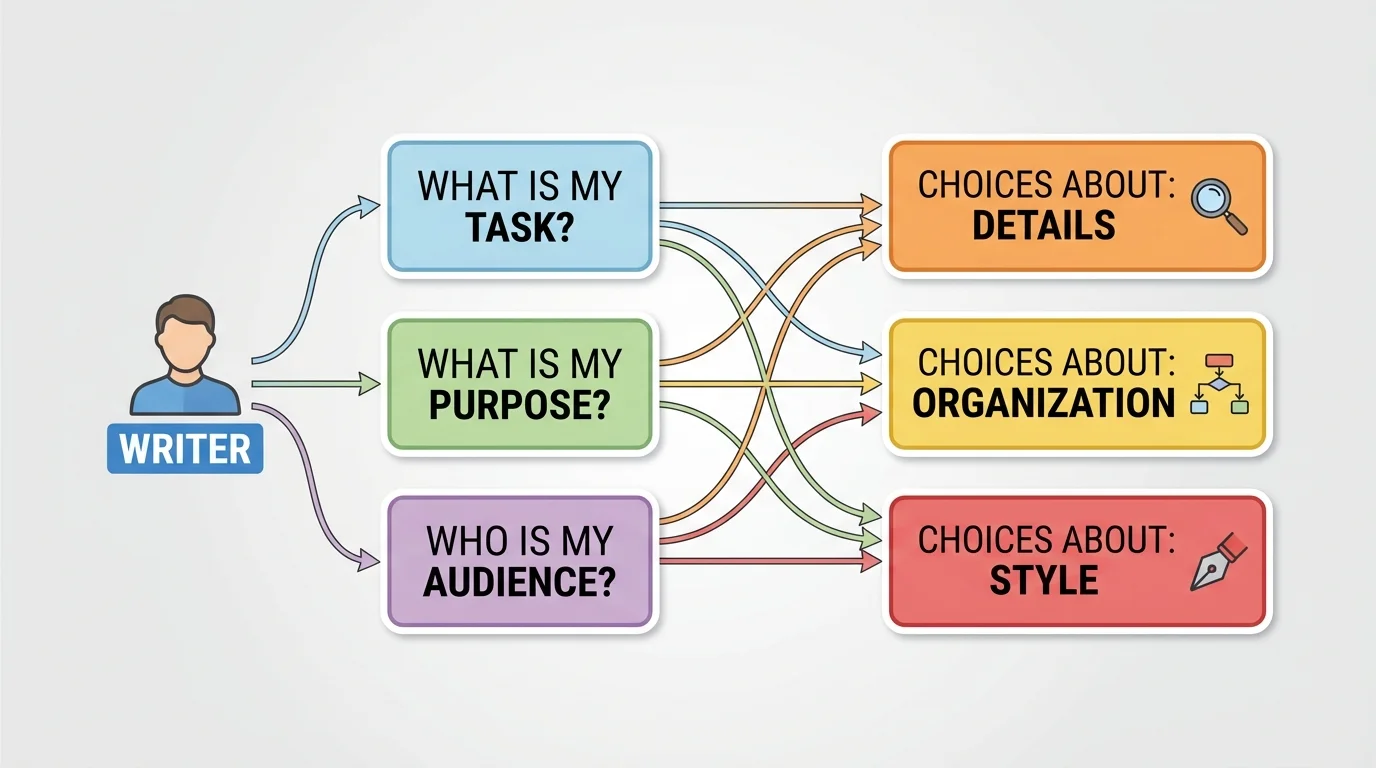
Think about the topic of school lunches. If your task is to write a personal narrative, your purpose might be to entertain readers with a true lunchroom memory. If your task is to write an argument, your purpose might be to persuade school leaders to add healthier options. If your audience is classmates, you may use shared experiences. If your audience is adults making decisions, you would probably include facts, examples, and respectful reasoning.
When writers ignore task, purpose, or audience, their writing often feels off. A piece might sound too casual for a formal setting, too vague for an informative assignment, or too detailed for a short response. Matching writing to the situation is a big part of writing well.
Strong writing does more than name an idea. It develops the idea. Development means giving the reader enough information to understand, believe, or picture what you mean.
If a student writes, "Our school should plant trees because trees are good," the idea is not fully developed. A reader may ask, "Good in what way?" Better development adds reasons and details: trees provide shade, improve the look of the campus, help the environment, and create calmer outdoor spaces. Each detail makes the writing clearer and stronger.
Different kinds of writing use different kinds of development. Informative writing may use facts, definitions, and examples. Narrative writing may use sensory details, dialogue, and action. Argument writing may use claims, reasons, evidence, and explanations. No matter the type, details should be relevant. Extra information that does not support the main idea can distract the reader.
Example: weak development and stronger development
Weak: "The robotics club is helpful."
Stronger: "The robotics club helps students learn teamwork, problem-solving, and basic engineering skills. Members test designs, fix mistakes, and present their work at competitions, so the club teaches both technical and communication skills."
Notice that the stronger version answers questions a reader might have. How is the club helpful? What do students actually do? Clear development often comes from thinking like a reader and filling in missing information.
[Figure 2] Even strong ideas can become confusing if they are arranged badly. Organization means placing ideas in an order that helps the reader follow your thinking, and the figure illustrates this with a simple structure.
Many pieces of writing begin with an introduction that tells the topic and gives the reader a sense of direction. The body paragraphs then develop the main ideas. A conclusion brings the writing to a close by reinforcing the main point, reflecting on it, or leaving the reader with something important to think about.
Writers also choose an internal order. They may organize information by time, by importance, by compare-and-contrast, by problem and solution, or by cause and effect. For example, directions for baking should be in time order. An essay comparing two sports might be organized by similarities and differences. A piece about pollution might explain causes first and solutions second.
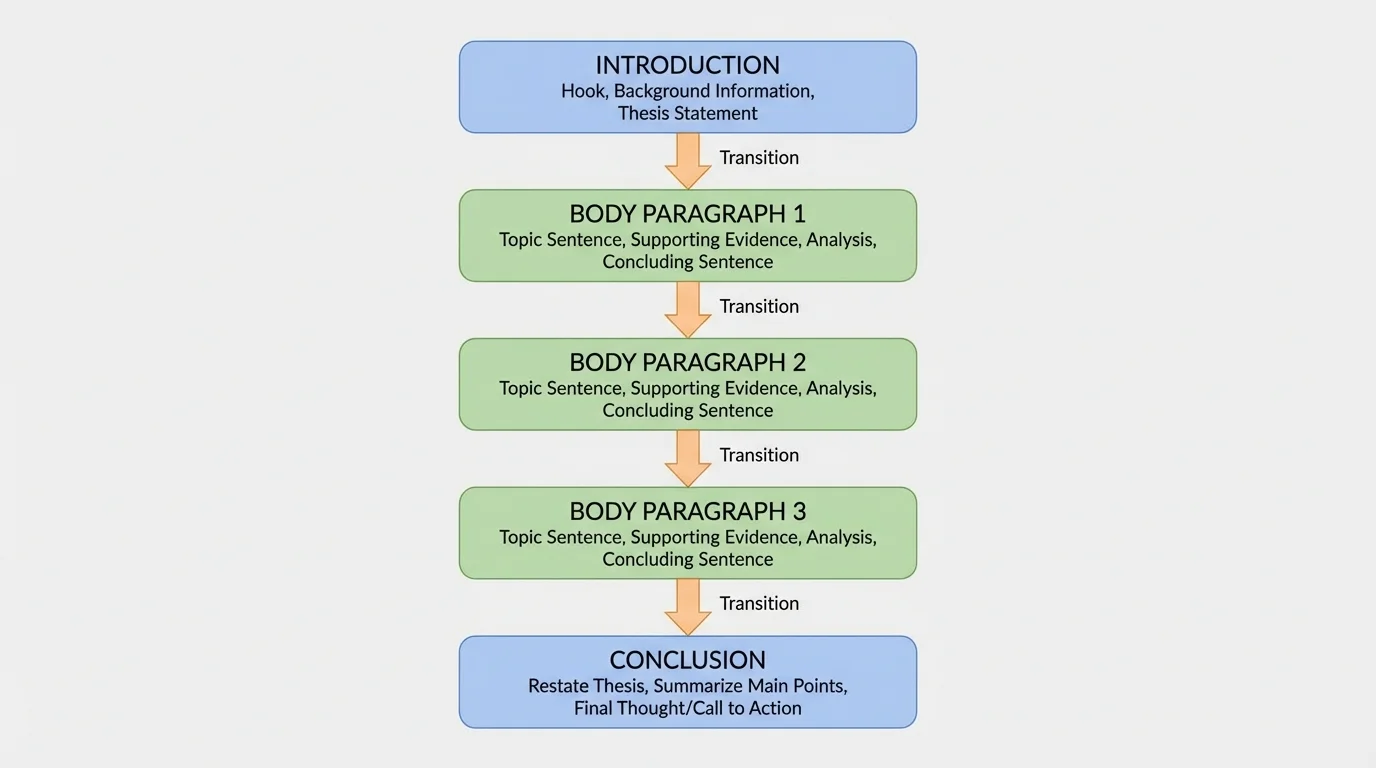
Within paragraphs, each sentence should connect to the paragraph's main point. A paragraph often begins with a topic sentence that states its main idea clearly. The sentences that follow should support it rather than wander to unrelated points.
Transitions help readers move from one idea to the next. Words and phrases such as for example, however, because, in addition, as a result, and finally act like bridges. They show relationships between ideas. Without transitions, writing may feel choppy even when the ideas are good.
Later, when you revise, you may return to the structure in [Figure 2] to check whether each paragraph has a clear job. If one paragraph repeats another or seems out of place, reordering or combining it can make the whole piece stronger.
Style is the way writing sounds and feels. It includes word choice, sentence length, tone, and level of formality. Style should fit the purpose and the audience.
A note to a friend might say, "That movie was amazing. You have to see it." A film review for a school newspaper might say, "The film uses suspense and strong acting to keep viewers interested." Both sentences communicate an opinion, but the style changes with the situation.
Tone is the writer's attitude toward the subject or audience. Tone can be serious, playful, respectful, excited, thoughtful, or urgent. A respectful tone is important in formal letters and school arguments. A playful tone might work in a humorous personal narrative. Choosing the wrong tone can confuse readers or make writing seem careless.
Sentence variety also matters. If every sentence sounds the same, the writing may feel dull. Writers can mix short and longer sentences to create rhythm and emphasis. However, variety should not make writing confusing. The goal is balance: interesting but clear.
Professional writers often change style more than students realize. A scientist may write a formal research report at work and then write a friendly social media post about the same topic for the public.
Specific words are usually better than vague ones. Compare "The day was nice" with "The afternoon was cool, sunny, and windy enough to keep the soccer field comfortable." Specific language helps readers understand exactly what the writer means.
Many writing problems begin before the first draft. Planning helps a writer decide what to say and how to say it. This step can be quick, but it matters.
Planning may include brainstorming ideas, listing key points, asking questions, gathering facts, or choosing a structure. A writer may jot down a main claim and three reasons, sketch a timeline for a narrative, or group related ideas into categories for an informative piece.
Planning also helps writers stay focused. If your topic is too broad, your writing may become scattered. For example, "sports" is a very broad topic, but "how daily soccer practice improves teamwork" is narrower and easier to develop clearly.
Planning is decision-making. Good planning is not about making writing complicated. It is about making smart choices before drafting: what belongs, what does not, what order works best, and what the audience needs to understand.
Some writers create full outlines. Others use quick notes or graphic organizers. The method can vary, but the goal stays the same: prepare a path so the draft has direction.
A draft is the writer's first full attempt to turn ideas into sentences and paragraphs. Drafting is not about perfection. It is about building something that can later be improved.
One useful goal during drafting is unity. A unified paragraph stays focused on one main idea. If a paragraph begins by explaining why reading before bed improves sleep, it should not suddenly switch to a different topic like cafeteria food. Readers stay oriented when each paragraph has a clear center.
Another goal is coherence. Coherence comes from logical order, transitions, and clear connections between sentences. A paragraph with good coherence does not feel like a pile of separate thoughts. It feels connected.
For example, a paragraph about biking to school might begin with a main idea, continue with details about exercise and reduced traffic, and end by reinforcing the benefit. Each sentence would support the same point instead of drifting away from it.
Revision is where much of the real writing happens, and [Figure 3] highlights how a rough draft can become clearer through better order, stronger details, and smoother transitions. Revising means improving ideas and structure, not just fixing tiny mistakes.
During revision, writers ask questions such as: Is my main point clear? Do my details support it? Is anything repeated? Are the ideas in the best order? Will my audience understand this part? Revision may lead to adding, removing, reordering, or rewriting sentences and paragraphs.
Example: revising a paragraph
Draft sentence: "Our town needs a skate park. Kids need things to do. It would be good. Parks are fun."
Step 1: Clarify the claim.
Replace the vague statement "It would be good" with a specific reason.
Step 2: Add useful details.
Explain how a skate park would help the community, such as giving young people a safe place to practice and gather.
Step 3: Improve flow.
Connect the ideas with transitions and combine short, repetitive sentences.
Revised version: "Our town needs a skate park because many young people want a safe place to skate, practice tricks, and spend time with friends. Instead of using parking lots or sidewalks, skaters could use a space designed for them. A skate park would give students a healthy activity and reduce conflicts in unsafe areas."
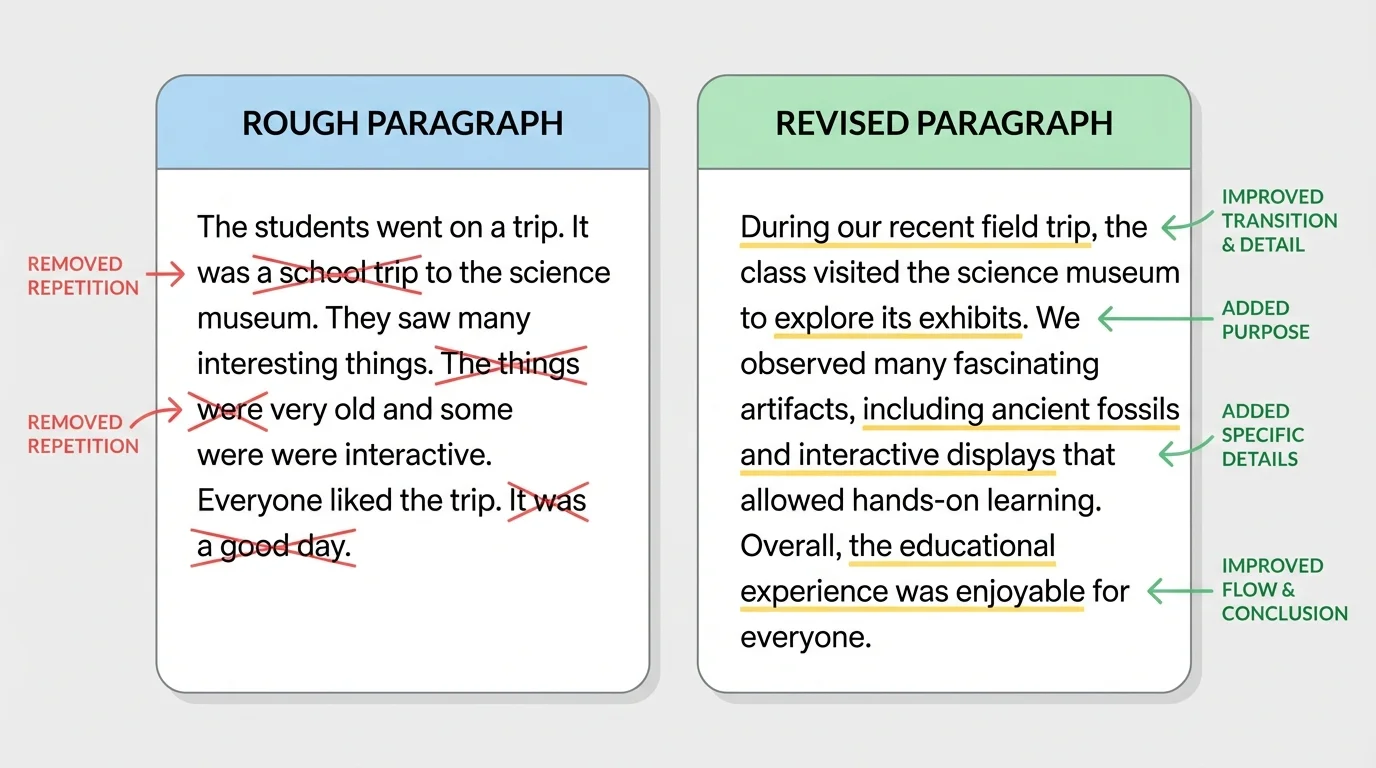
Notice how the revised version is longer, but not just longer for the sake of length. It is more precise and better connected. That is the goal of revision.
Revision also means checking audience again. A sentence that makes sense to the writer may not make sense to a reader who lacks background knowledge. As shown earlier in [Figure 1], audience affects what needs explanation. Good revisers spot what the reader may need and adjust the draft.
After revision comes editing. Editing focuses on conventions: grammar, usage, spelling, capitalization, punctuation, and sentence correctness. These details matter because they affect readability and credibility.
Conventions are the standard rules writers follow so readers can understand the text more easily. When conventions are used correctly, the writing feels polished and trustworthy.
Editing is usually most effective after big changes are done. It does not make sense to spend a lot of time fixing commas in a paragraph you may later delete. First improve ideas and organization; then polish the language.
| Area | What to Check | Example |
|---|---|---|
| Grammar | Sentence structure and agreement | "The students are ready," not "The students is ready." |
| Usage | Correct word choice | "Their project" instead of "There project" |
| Mechanics | Punctuation, capitalization, spelling | Use capitals for proper nouns and punctuation at the end of sentences. |
Table 1. Key areas to check when editing writing.
Reading aloud can help during editing. Writers often hear missing words, awkward phrasing, or run-on sentences more easily than they see them silently.
Writing does not come in one single form. Different situations ask for different choices in development, organization, and style.
In a narrative, the writer may organize by time and develop ideas with actions, thoughts, and sensory details. In an informative essay, the writer may define terms, explain steps, and use examples. In an argument, the writer makes a claim, gives reasons, and supports them with evidence. In an email to a teacher, the writer should be polite, clear, and direct.
Consider how the same topic changes across tasks. A topic like after-school activities could become a story about the first day in drama club, an article explaining why clubs help students grow, or an argument asking the school to add more activity choices. The topic stays similar, but the writing changes because the task and purpose change.
Real-world comparison
A student wants to write about phone use at school.
For classmates: The writing may include shared examples, a relatable tone, and school-life details.
For school leaders: The writing may include respectful language, clear reasons, and possible solutions such as phone lockers or specific use times.
Writers who understand these differences are more flexible. They can shape their writing to fit a classroom assignment, a contest entry, a presentation script, or a community letter.
One common problem is being too vague. Words like good, bad, stuff, and things often hide weak thinking. Replacing them with specific details improves clarity.
Another problem is including details that do not belong. Sometimes writers add interesting facts that do not support the main point. If a detail does not help the purpose, it may need to be removed.
A third problem is weak structure. If ideas are in a confusing order, readers may lose the thread. Returning to the organizational pattern in [Figure 2] can help a writer decide whether to reorder paragraphs, add transitions, or create a clearer introduction.
Some writing also fails because the style does not match the audience. Slang, jokes, or overly casual language may work in some settings but not in formal school writing. On the other hand, writing that is too stiff can sound unnatural in a personal narrative. Effective writers notice these differences and adjust.
"Good writing is clear thinking made visible."
That idea matters because writing is not only about rules. It is also about shaping thought so another person can follow it.
Before turning in or sharing a piece of writing, it helps to stop and read it like a reader. Ask: Did I complete the task? Is my purpose easy to recognize? Will this audience understand and respond the way I intend?
Then check the writing from the inside out. Look first at the big picture: focus, development, organization, and style. After that, check the smaller details: grammar, usage, and mechanics. A polished paragraph that does not fit the assignment is still weak writing. A strong idea with many distracting errors also needs work. Good writing brings both together.
Writers grow by learning to make thoughtful choices. When development is strong, organization is logical, and style matches the situation, writing becomes clearer, more powerful, and more meaningful to the reader.
