Every day, people make decisions based on research, even when they do not call it that. A student compares reviews before buying headphones, a family checks weather maps before a trip, and a doctor studies symptoms before making a diagnosis. Research is more than "looking something up." It is a careful process of asking a question, gathering information, checking whether that information is trustworthy, and building an answer from evidence.
A research project is a planned investigation that helps answer a question. In grades 6 through 8, short research projects are especially important because they teach you how to think clearly, organize information, and support your ideas with facts. A good short project does not need to be huge. It needs to be focused, accurate, and thoughtful.
Strong researchers do not stop after finding one fact in one place. They look at several sources, compare what those sources say, and ask new questions along the way. That process often leads to better understanding than a quick internet search ever could.
Research helps people move from opinions to informed answers. If someone asks, "Should our school start a garden?" a guess is not enough. You would need evidence about costs, benefits, space, maintenance, and student interest. Research gives your answer strength because it is based on information, not just personal preference.
Research also teaches important habits of mind. It helps you notice patterns, ask deeper questions, and separate strong evidence from weak claims. These skills matter in science, history, language arts, and even everyday life.
Professional researchers often begin with questions that seem simple. A question such as "Why are bees disappearing in some places?" can lead to studies about climate, pesticides, disease, farming, and ecosystems.
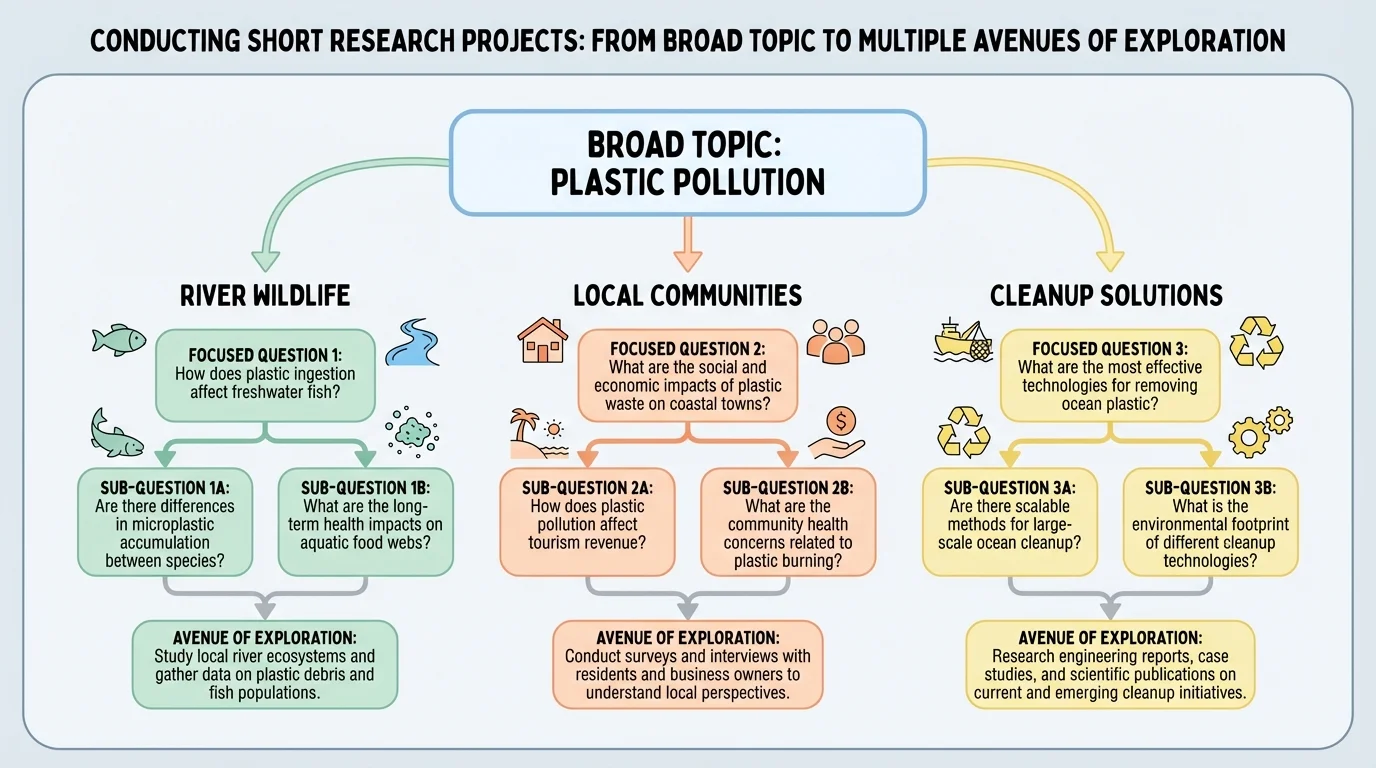
Even a short classroom project can work in a similar way. As [Figure 1] shows, one good question can open several paths of exploration and help you discover connections you did not expect.
A research question is the main question your project is trying to answer. A strong question is clear, focused, and possible to answer using available sources. A good research question narrows a large idea into something specific enough to explore with evidence.
Weak questions are often too broad. For example, "What is pollution?" is so wide that it could lead to hundreds of pages of information. A stronger version might be, "How does plastic pollution affect river wildlife in my state?" That question identifies a type of pollution, a place, and a specific effect to investigate.
You can also generate your own question from curiosity. Maybe you notice that some neighborhoods have more trees than others. That observation could lead to a question such as, "How do city trees affect temperature and air quality in urban neighborhoods?" Self-generated questions often lead to stronger projects because you are genuinely interested in the answer.
A useful test is to ask whether your question can be answered with evidence rather than opinion alone. "What is the best animal?" is mostly opinion. "How do wolves help maintain balance in ecosystems?" can be researched using scientific sources.
Research question means the main question a project aims to answer. It should be clear, specific, and open enough to require investigation rather than a simple yes-or-no response.
Focused question means a narrowed version of a broad idea so the researcher can gather useful, manageable information.
Many strong research questions begin with words like how, why, or to what extent. These forms encourage explanation, not just simple facts.
Most research begins with a broad topic such as climate change, inventions, ancient Egypt, healthy sleep, or renewable energy. Broad topics are a starting place, not the final destination. The next step is to create smaller, related questions.
Suppose your topic is school lunches. You might begin with the main question, "How do school lunches affect student learning and health?" Then you could generate additional related questions: "What nutrients are most important for middle school students?" "How does hunger affect attention in class?" "How do different schools plan healthy meals within a budget?" These related questions create multiple avenues of exploration.
Focused questions help you organize research into categories. Instead of collecting random facts, you gather information that helps answer specific parts of the larger question. This makes your final work clearer and more logical.
Example: From broad topic to research plan
Step 1: Start with a broad topic.
Topic: renewable energy
Step 2: Turn it into a main question.
Main question: How can solar energy help schools reduce electricity use?
Step 3: Generate focused related questions.
What equipment is needed for solar panels? How much sunlight does the area receive? What are the costs and benefits for schools?
Step 4: Use those questions to guide source gathering.
You would look for information on technology, weather data, school budgets, and environmental impact.
Notice that each related question points toward a different kind of source and a different part of the answer. That is what makes research richer and more complete.
A source is any place where information comes from. Sources can include books, reference databases, news articles, interviews, documentaries, government websites, museum pages, and scientific organizations. A short research project should use several sources, not just one.
Different questions call for different kinds of sources. As the evaluation process in [Figure 2] suggests, if you are researching local water quality, a city report or environmental agency website may be useful. If you are studying a historical event, you might use textbooks, articles, letters, photographs, or speeches. If you are exploring how sleep affects learning, health organization websites and science articles may help.
Using several sources matters because one source may leave out details, make mistakes, or show only one point of view. When multiple reliable sources support the same idea, your answer becomes stronger.
It is also smart to search with keywords. If your question is about bees and farming, useful search terms might include bee population decline, pollination and crops, and pesticides affecting bees. Better search terms often lead to better sources.
Not every source deserves trust. Credible sources are sources that are trustworthy and accurate. When researchers judge a source, they ask who created it, when it was published, what evidence it uses, and why it was made. This checklist organizes these questions into a quick review process.
First, check the author or organization. Is the source written by an expert, teacher, scientist, historian, journalist, or respected group? A government science site or museum page is usually more dependable than an anonymous post with no evidence.
Second, check the date. For some topics, current information matters a lot. A source about smartphone technology from many years ago may be outdated. For history, older sources can still be valuable, especially if they are primary sources from the time period.
Third, look for evidence. Does the source explain where its information came from? Does it include data, quotations, references, or expert analysis? A source that makes bold claims but gives no support is weak.
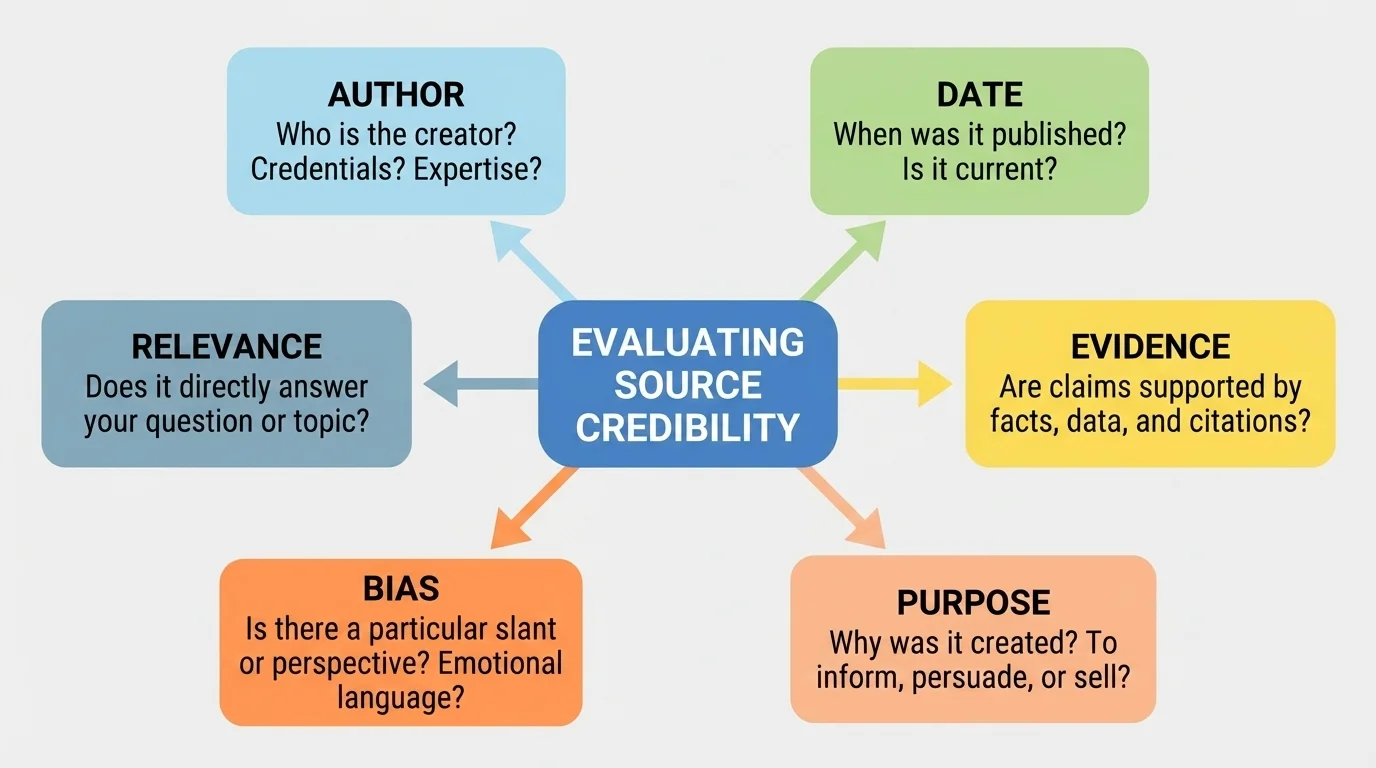
Fourth, consider purpose and possible bias. Every source is written for a reason. Some sources are meant to inform, while others are meant to persuade or sell something. That does not automatically make them useless, but it does mean you need to read carefully.
A source must also be relevant. Relevance means it directly helps answer your question. A reliable article about oceans may still be a poor source if your project is specifically about pollution in local rivers.
| Question to Ask | Why It Matters |
|---|---|
| Who wrote it? | Shows whether the author has knowledge or expertise. |
| When was it published? | Helps you know whether the information is current. |
| What evidence is included? | Strong sources support claims with facts. |
| Why was it created? | Reveals whether the source aims to inform, persuade, or sell. |
| Does it fit the question? | Keeps your research focused and useful. |
Table 1. Questions students can use to evaluate whether a source is credible and relevant.
Later in your project, the same credibility test still matters. If one source disagrees with the others, return to the checklist from [Figure 2] and examine whether that source is outdated, biased, or unsupported.
Good researchers do more than collect sources. They take useful notes. Notes should capture important ideas, details, and evidence in your own words whenever possible.
One key skill is paraphrasing. To paraphrase means to restate information in your own words while keeping the original meaning. This is different from copying. If you copy exact words, you must put them in quotation marks and give credit.
You can organize notes by categories linked to your focused questions. For example, if your project is about school gardens, categories might include health benefits, science learning, costs, and community involvement. This makes it easier to see patterns later.
When you take notes, write down source information right away. If you wait until the end, it becomes much harder to remember where each fact came from.
A simple note-taking chart can help. As [Figure 3] later illustrates, you might include columns for the source title, key fact, category, and page number or website name. Organized notes save time and reduce confusion.
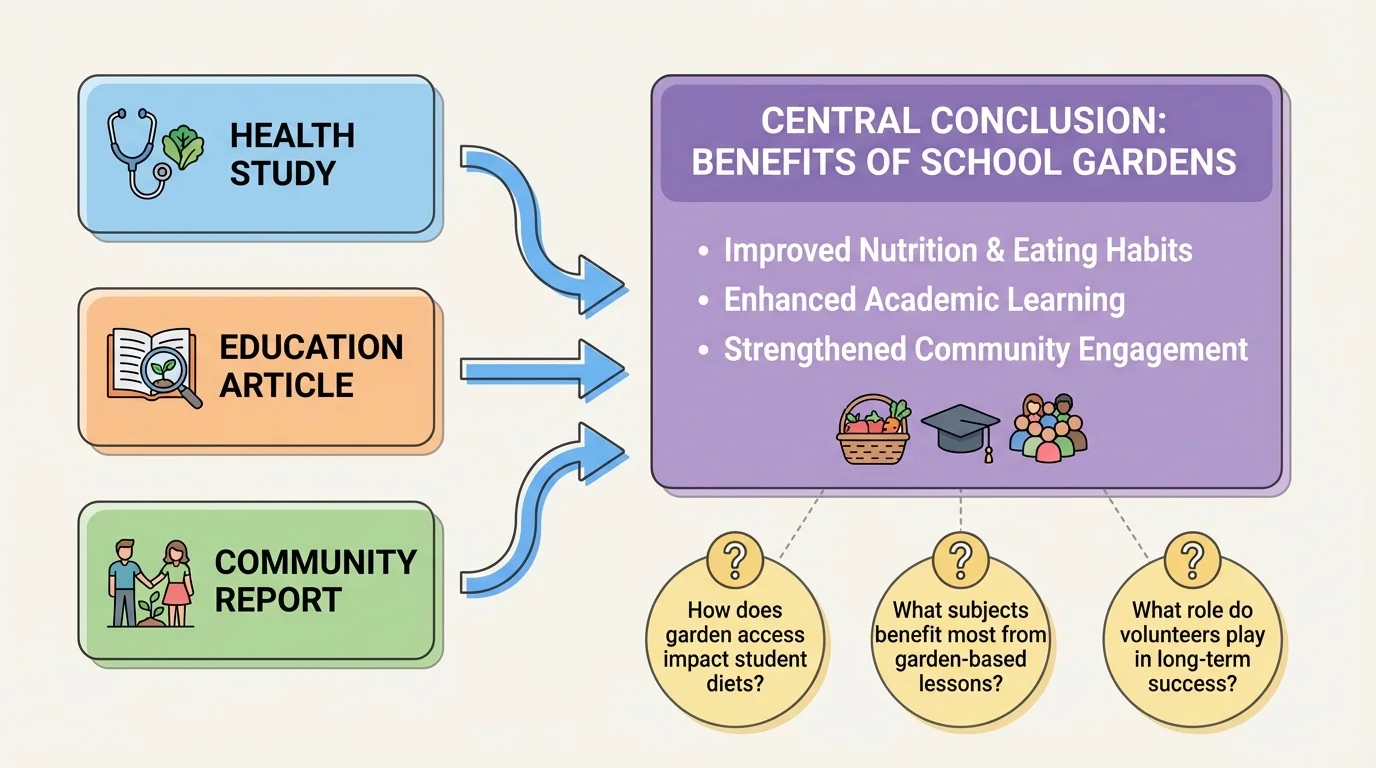
One of the most important research skills is synthesizing, which means combining information from different sources to create a new understanding. It is not enough to write, "Source A says this. Source B says that. Source C says something else." Real research asks how the ideas connect. This model shows several sources feeding into one evidence-based conclusion.
Suppose one source says school gardens help students eat more vegetables, another says gardens improve science learning, and a third says gardens build community involvement. A synthesized statement might be: "School gardens can improve health, support hands-on science learning, and strengthen school community connections." That sentence combines ideas rather than listing them separately.
Synthesis also includes noticing differences. Maybe one article says social media improves communication, while another warns that too much use can harm sleep. A strong researcher can explain both sides and show how context matters.
Synthesis is thinking, not stacking facts. When you synthesize, you compare, connect, and evaluate ideas from more than one source. This creates a clearer answer than any single source can provide on its own.
As your project develops, return to the pattern in [Figure 3]. Your final answer should grow from several pieces of evidence working together, not from isolated facts placed side by side.
Researchers must give credit when they use ideas, facts, quotations, images, or data from others. This is often called citation. Giving credit matters because it shows honesty, respects other people's work, and allows readers to check your information.
If you do not credit a source and present someone else's words or ideas as your own, that is plagiarism. Even in a short middle school project, avoiding plagiarism is essential.
You do not need a complicated system to begin. A simple source list can include the author, title, publisher or website, and date when available. For example, a book entry might list the author, book title, city, publisher, and year. A website entry might list the organization or author, page title, website name, and date accessed.
Simple credit examples
Book: Maria Lopez. Rivers and Wildlife. Blue Sky Press, 2021.
Website: National Park Service. Pollinators in North America. Accessed March 12, 2026.
Article: Jamal Reed. "How Sleep Affects Student Attention." Science Weekly, May 2025.
Different teachers may ask for different citation styles, but the basic goal stays the same: make it clear where the information came from.
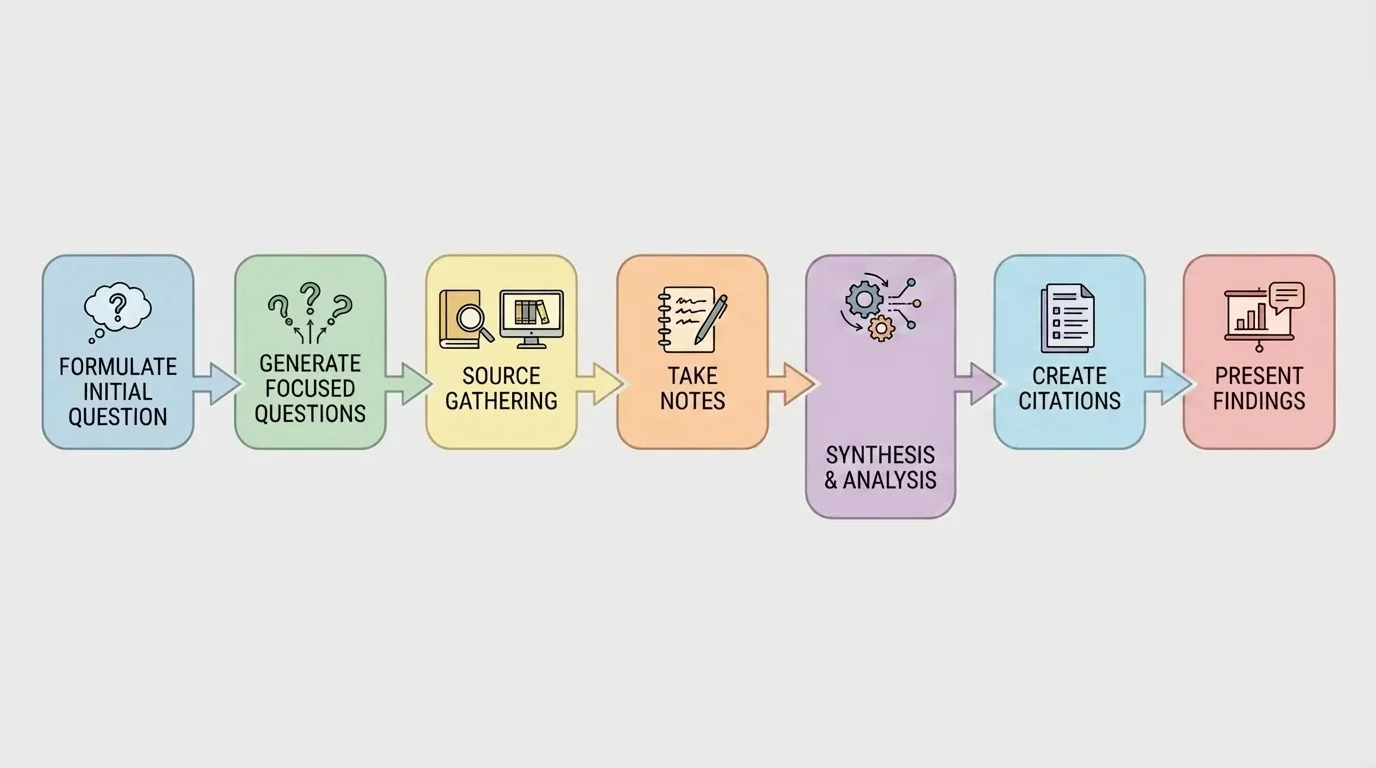
After researching, note-taking, and synthesizing, you present your findings. As [Figure 4] shows, a presentation may be a paragraph, a short essay, a slideshow, a poster, or an oral report. The form can change, but the structure should stay clear.
Begin with your main question and answer it directly. Then support that answer with evidence from your sources. Finally, explain how the evidence fits together. This helps your audience understand not just what you found, but how you know it.
Clear presentations often include these parts:
Strong presentations also use precise language. Instead of saying "I found a lot of stuff," say "Three sources explained that urban trees lower temperatures, improve air quality, and provide shade." Specific wording sounds more confident and more accurate.
A short project follows a sequence from question to source gathering to final presentation. Seeing the steps together helps you understand that research is a process, not a random search for facts.
Suppose a student asks, "How does lack of sleep affect middle school students?" That is a strong main question because it is focused, important, and answerable.
The student then creates related focused questions: "How many hours of sleep do middle school students need?" "How does sleep affect memory and attention?" "What habits make sleep harder?" These questions open several paths for research.
Next, the student gathers several sources: a health organization website, a science article about sleep and learning, and a news report summarizing research on teen sleep habits. The student checks each source for author, date, evidence, and purpose.
After that, the student takes notes. One source explains that students who sleep too little often struggle with focus. Another explains that memory improves when the brain has enough rest. A third source describes how screen time before bed can interfere with sleep.
The student then synthesizes the findings into a clear answer: "Lack of sleep can reduce attention, make learning harder, and weaken memory in middle school students. Habits such as late-night screen use may make the problem worse."
Finally, the student writes a short report with the main question, evidence-based findings, and a source list. Later, when explaining how different findings work together, the student can think back to the sequence in [Figure 4] and make sure no step has been skipped.
One common mistake is choosing a topic that is too broad. A project about "space" is hard to manage. A project about "how rovers help scientists study Mars" is far more workable.
Another mistake is relying on only one source. Even if that source seems good, a single source rarely gives a complete picture. Using several sources helps you compare ideas and confirm facts.
Copying text directly into notes without quotation marks is also a problem. It becomes hard to remember which words are yours and which belong to the source. Paraphrasing and careful note-taking prevent this.
Some students collect facts but never answer the main question. Always keep your research question in mind. Every note, source, and paragraph should connect back to that central purpose.
"Good research is not about finding the fastest answer. It is about building the strongest one."
Finally, avoid weak conclusions such as "That is what I found." A strong conclusion clearly answers the question using evidence gathered from your research.
