Professional authors, journalists, game designers, and speechwriters almost never publish their first draft. That might sound surprising, but it is actually good news: strong writing is usually not the result of instant genius. It is the result of improving a piece step by step. A writer plans, drafts, revises, edits, and sometimes starts over. With support from classmates, teachers, and other adults, students can do the same thing and become much stronger writers.
Writing is a process, not a single moment. When you write, you are making many decisions at once: what to say, how to organize it, which details to include, what words fit best, and how to make sure the reader understands. Because there are so many choices, it is normal for a first draft to be unfinished or uneven.
A first draft is like the rough version of a song before the final recording or the first practice before a big game. It gives you something real to work with. Then you can improve it. This is why writers draft, revise, edit, and sometimes rewrite. Each step has a different job.
Purpose is the reason for writing, such as to explain, persuade, entertain, or reflect.
Audience is the person or group the writing is meant for.
Revision means improving the ideas, structure, clarity, and effectiveness of a piece.
Editing means correcting grammar, spelling, punctuation, capitalization, and usage.
If a student confuses these steps, the writing process becomes frustrating. For example, fixing commas in a paragraph that still has a weak main idea will not solve the bigger problem. Strong writers learn to focus on the right kind of improvement at the right time.
Before writing begins, a writer needs to know why the piece is being written and who will read it. Those two questions shape nearly every choice that follows. A report for science class sounds different from a letter to a principal, and both sound different from a story told to entertain friends. As [Figure 1] shows, the same topic can change a lot depending on audience and purpose.
If your purpose is to inform, you need clear facts, organized details, and a serious tone. If your purpose is to persuade, you need reasons, evidence, and language that convinces the reader. If your purpose is to entertain, you may focus more on description, suspense, humor, or character.
Audience matters just as much. If you are writing for classmates, you may assume they understand school routines and common experiences. If you are writing for younger students, you may need simpler explanations and examples. If you are writing for adults, you may need a more formal tone and more complete background information.
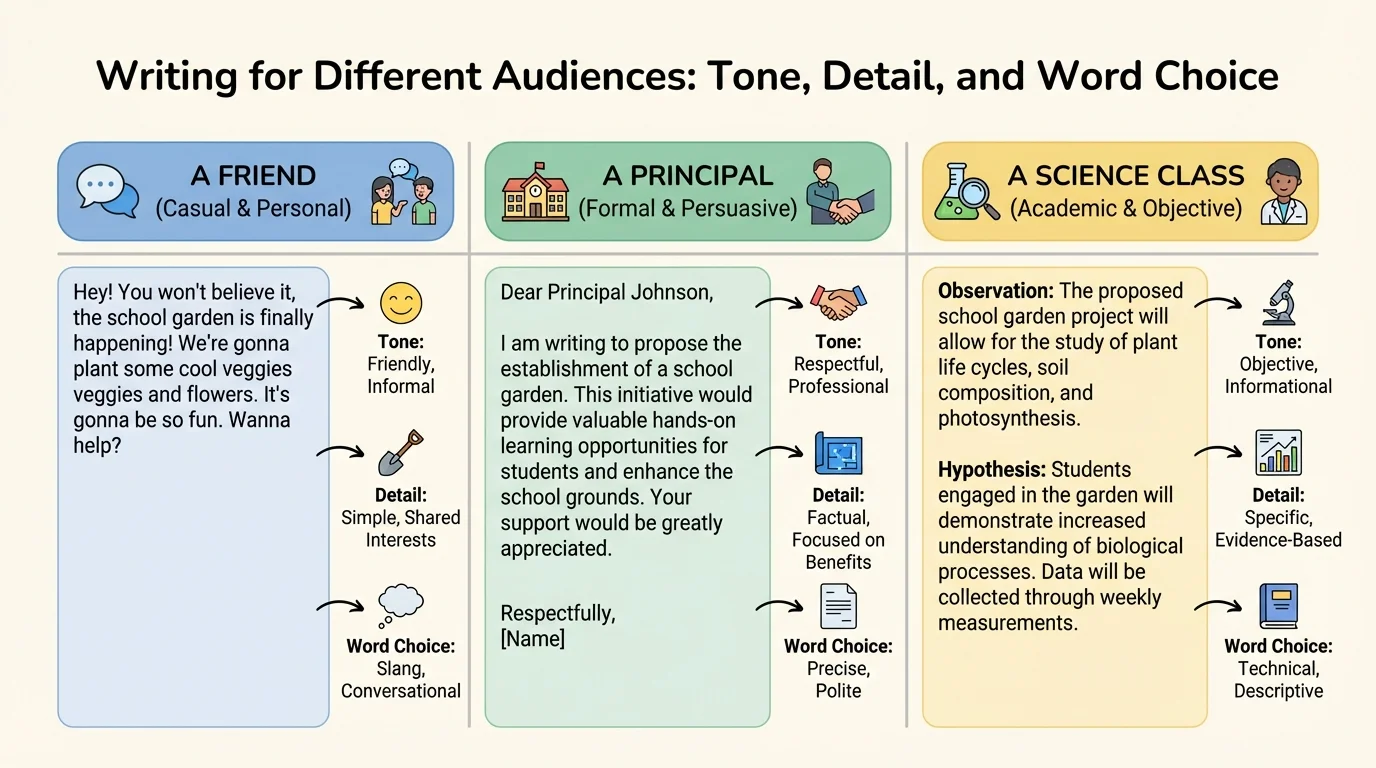
Consider one topic: school lunch. A quick message to a friend might say, "The cafeteria added spicy tacos today, and they were surprisingly good." An email to the principal about lunch quality would need a respectful tone and specific details. An informational paragraph for health class might explain nutrition, ingredients, and student choices. Same topic, different forms of writing.
When writers ignore purpose and audience, their work often feels confusing. A piece may be too casual, too formal, too vague, too detailed, or aimed at the wrong kind of reader. Good writing answers the question: Will this work for the people who are reading it and for the reason I am writing it?
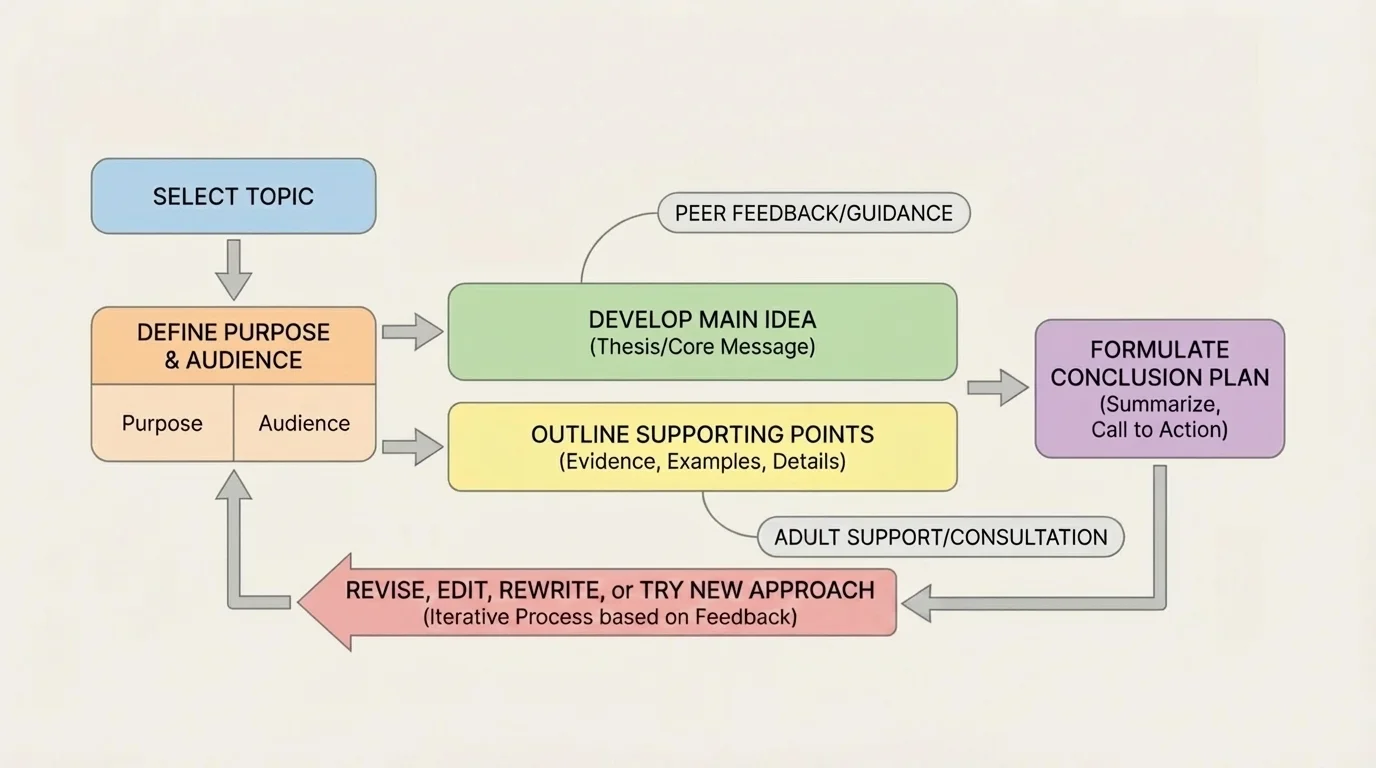
Planning gives a writer direction. Instead of staring at a blank page and hoping ideas appear, a writer can build a path from topic to finished piece. This planning process acts like a map, and [Figure 2] illustrates how writers move from a broad topic to a focused main idea and supporting points.
Planning can include brainstorming, listing key details, grouping related ideas, choosing a structure, and deciding what the reader needs to know first. Some students prefer a simple outline. Others prefer a web, chart, or note cards. The best planning tool is the one that helps organize thinking clearly.
A useful plan often includes these questions: What is my topic? What is my purpose? Who is my audience? What is my main idea? Which details support it? What order makes the most sense? How will I begin and end?
For example, suppose a student is writing an informational article about why sleep matters for middle school students. The plan might include a clear main idea, three supporting sections such as health, focus, and mood, and a conclusion that encourages better habits. With that plan, drafting becomes easier because the writer already knows where the piece is going.
Planning also helps prevent common writing problems. It reduces repetition, keeps the piece focused, and makes it easier to notice missing information before a full draft is written. Writers who plan are less likely to wander off topic because they have already chosen the path they want to follow.
Example: turning a broad idea into a plan
Topic: recycling at school
Step 1: Choose the purpose.
The writer decides the purpose is to persuade the school community to improve recycling.
Step 2: Identify the audience.
The audience is students, teachers, and school leaders.
Step 3: Create a main claim.
"Our school should add clearer recycling bins and signs."
Step 4: List supporting points.
Students are confused about what belongs in each bin, mixed trash wastes recyclable material, and clearer labels could improve participation.
Step 5: Decide on order.
Begin with the problem, explain why it matters, give solutions, and end with a call to action.
That short plan does not produce a finished essay, but it creates the skeleton of one. Writers can then build a stronger draft on that structure.
A draft is the working version of a piece of writing. During drafting, the main goal is to get ideas into sentences and paragraphs that roughly fit the plan. Writers should aim for clarity, not perfection, in this stage.
Many students slow themselves down because they try to make every sentence perfect immediately. That often interrupts the flow of ideas. A better approach is to write the whole draft first, making sure the main point is clear, and then return later to improve specific parts.
While drafting, writers should keep checking whether each paragraph supports the purpose. If the piece is supposed to inform, are the facts clear? If it is supposed to persuade, are the reasons convincing? If it is meant to entertain, is it engaging enough to hold the reader's attention?
Writers should also think about paragraph unity. Each paragraph should center on one main idea. If a paragraph starts about one thing and ends somewhere unrelated, the reader may feel lost. Strong paragraphs stay focused and connect smoothly to the next paragraph.
Many famous books went through many drafts before publication. Some writers even rewrite openings dozens of times because the beginning has such a powerful effect on the reader.
Drafting does not mean guessing wildly. It means using the plan, testing ideas, and creating something real that can be improved. Without a draft, there is nothing to revise.
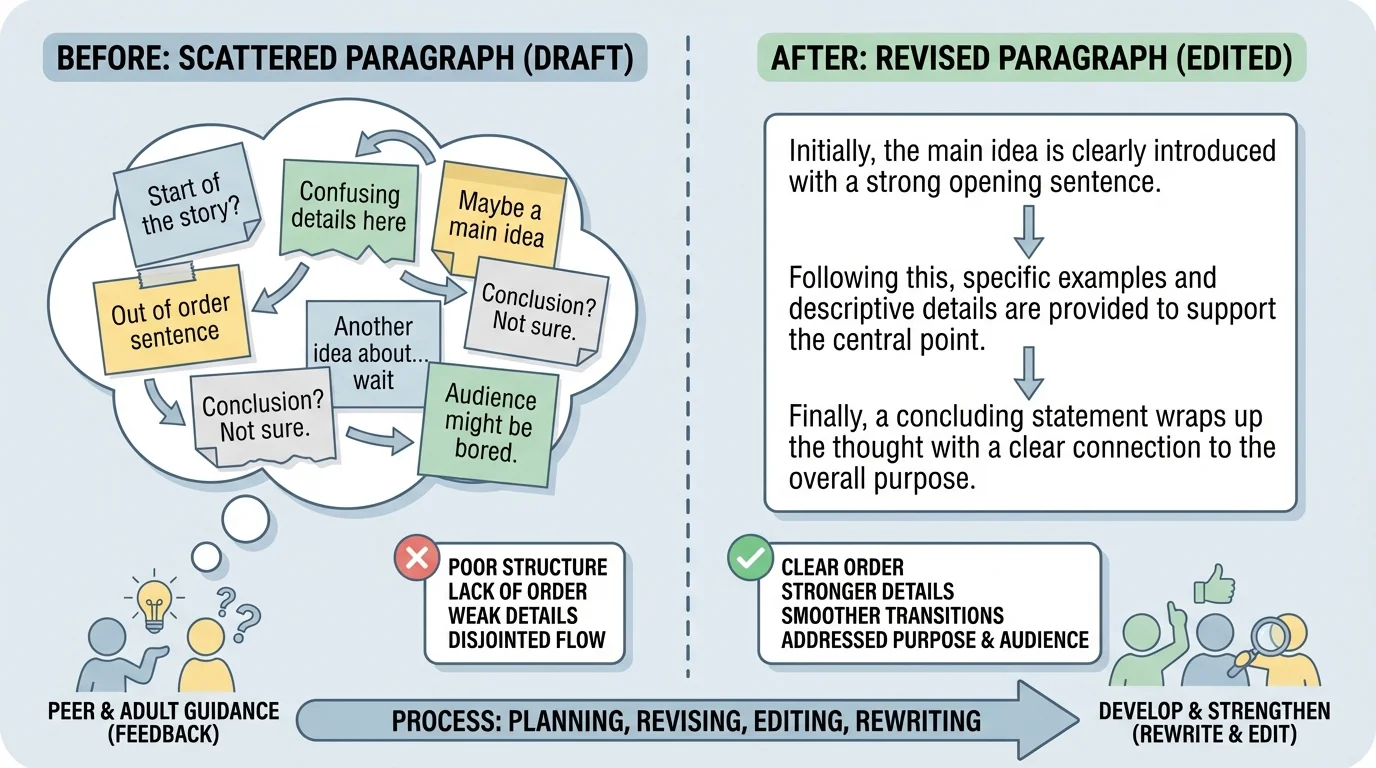
Revision is where writing often improves the most. This is the stage when a writer looks at the big picture: ideas, structure, details, transitions, and impact on the reader. As [Figure 3] illustrates, revision strengthens how ideas connect, not just how sentences are punctuated.
When revising, writers ask questions such as: Is my main idea clear? Does every paragraph support it? Are any parts confusing, repetitive, or off topic? Do I need stronger examples? Is the order effective? Does the introduction draw the reader in? Does the conclusion leave a strong final impression?
Revision can involve adding, removing, moving, or changing information. A writer might add facts to explain an idea better, cut a sentence that repeats the same point, move a paragraph to improve the order, or rewrite a weak topic sentence so the paragraph is easier to follow.
Transitions are also important during revision. Words and phrases like for example, however, because of this, and in contrast help readers understand how ideas relate. Without transitions, writing can feel choppy even if the ideas are good.
Here is a simple example. A weak paragraph might say, "Recess is important. Students like it. Learning matters. Exercise is good." The ideas are related, but the writing is scattered. A revised version might say, "Recess is important because it gives students exercise, helps them reset mentally, and prepares them to focus better during later classes." The revised sentence is more specific and connected.
Writers sometimes avoid revision because it feels like extra work. But revision is not punishment. It is where a piece becomes sharper, smarter, and more effective. Later, when thinking about audience again, the comparison in [Figure 1] still matters because revision should always bring the piece closer to what the reader needs.
Revision is not the same as editing
Revision focuses on the message and the structure of writing. Editing focuses on correctness. If a paragraph is boring, unclear, or out of order, revision is needed. If a sentence has a misspelled word or comma error, editing is needed. Strong writers usually revise first and edit later.
One useful revision strategy is rereading aloud. When writers hear their own words, they often notice awkward phrasing, repeated words, or confusing ideas more quickly. Another strategy is to ask someone else to explain what they think the piece is about. If their explanation does not match the writer's goal, the writing probably needs revision.
After revision comes editing. Editing is the stage where writers polish the piece. They check grammar, spelling, punctuation, capitalization, sentence structure, and usage. These details may seem small, but they affect how clearly and professionally the writing communicates.
Grammar and usage help sentences make sense. For example, verb tense should stay consistent unless there is a reason to shift it. Pronouns should clearly match the nouns they refer to. Subjects and verbs should agree. A sentence like "The students was excited" should be edited to "The students were excited."
Mechanics include punctuation and capitalization. Missing periods, commas, or quotation marks can confuse a reader. Capital letters matter in proper nouns, the beginning of sentences, and titles when required. Spelling matters too, because incorrect spelling can distract the reader and weaken credibility.
Editing also includes checking formatting when needed. If the writing assignment requires paragraphs, headings, or quotations in a certain style, those details matter. In digital writing, writers may also check spacing, font consistency, and whether all parts of the assignment are included.
Editing works best when done carefully and slowly. Some students try to edit while still writing new ideas, but that can break concentration. It is usually better to revise the piece first and then edit a later draft. At that point, the writer can focus on correctness because the main ideas are already in place.
Example: revising and editing the same sentence
Original sentence: "our school should recycle more because its good for the earth and people dont know were to put things."
Step 1: Revise for clarity.
The writer improves the message: "Our school should recycle more because it reduces waste, helps the environment, and shows students how to make responsible choices."
Step 2: Edit for correctness.
The edited sentence uses capitalization, correct punctuation, and standard spelling.
The final sentence is clearer and more correct.
Editing is important, but it should not be mistaken for the whole writing process. Perfect punctuation cannot rescue a weak idea, just as a powerful idea can still lose impact if errors distract the reader.
Sometimes a draft does not just need a few changes. Sometimes it needs a new approach. A writer may realize the opening is dull, the structure does not fit the purpose, or the tone is wrong for the audience. In those cases, rewriting is a smart choice, not a failure.
Trying a new approach can mean changing the order of ideas, replacing a weak introduction, shifting from general statements to a specific example, or even changing the form of the piece. For example, a student writing an opinion essay may realize that beginning with a surprising statistic or a brief real-life situation is more effective than starting with a vague sentence.
Another new approach might involve voice and tone. If the writing sounds too informal for an adult audience, the writer may need to replace slang and casual phrasing. If the writing sounds stiff and distant for a personal reflection, the writer may need to sound more natural and sincere.
Strong writers are flexible. They do not cling to every sentence just because they wrote it. If a different beginning, better structure, or sharper focus would help the reader, they are willing to rewrite.
"Good writing is often good rewriting."
This mindset helps students grow. It turns writing from a one-shot performance into a process of solving problems and making choices.
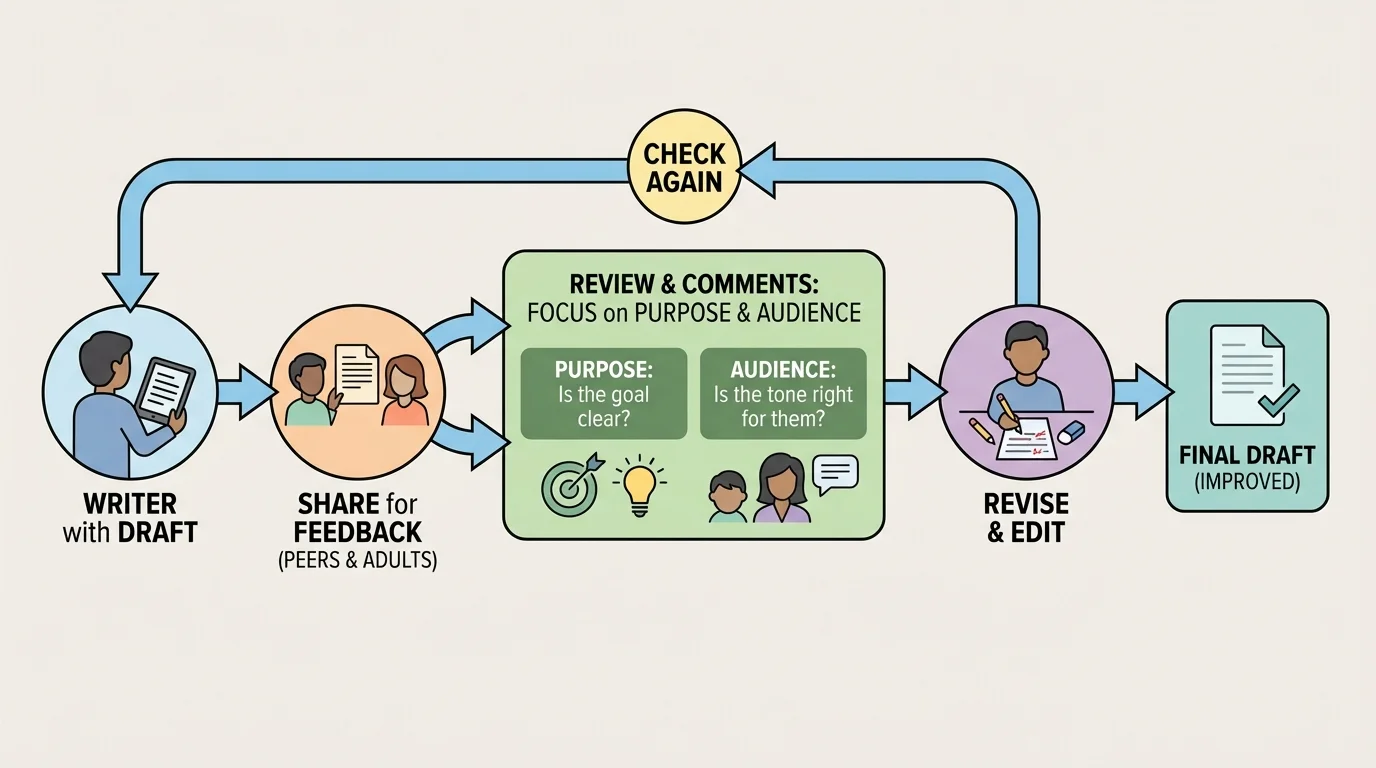
Writers often miss problems in their own work because they already know what they meant to say. Guidance from others can reveal what is unclear, weak, or missing, and [Figure 4] shows how feedback and revision can work together in a cycle of improvement.
Peers can be helpful readers because they are close to the writer's age and may notice whether the explanation makes sense to another student. Adults, such as teachers, parents, tutors, or librarians, can often help with bigger questions about structure, tone, evidence, and correctness.
Useful feedback is specific. Instead of saying, "It's good," a peer might say, "Your introduction grabbed my attention, but I wasn't sure what your main claim was until the second paragraph." Instead of saying, "Fix this," an adult might say, "This example is interesting, but how does it connect to your main point?" Specific comments give the writer something to act on.
Writers also need to know how to ask for help. Good questions include: Which part was most confusing? Does my conclusion match my purpose? Does this sound too informal? Which example was strongest? Did I explain enough for the audience to understand?
Not every suggestion must be accepted. The writer still makes the final decisions. Good writers listen carefully, look for patterns in feedback, and choose changes that improve the piece. If several readers are confused by the same paragraph, that is a strong sign it needs revision.
Later in the process, the feedback cycle in [Figure 4] remains useful because one round of comments may lead to another round of improvement. Writing often gets better through repeated checking, not through one quick fix.
When giving feedback, focus on the writing, not the writer. Saying "This paragraph needs a clearer example" is helpful. Saying "You're bad at writing" is not. Respectful feedback supports growth.
Support from others matters most when it helps the writer better address purpose and audience. The goal is not simply to collect comments. The goal is to make the piece clearer, stronger, and more effective for the intended reader.
Different types of writing require different choices. A personal narrative often uses vivid details, chronological order, and a strong sense of voice. An informational piece uses clear explanation, accurate facts, and organized sections. An opinion piece uses claims, reasons, evidence, and a convincing conclusion.
The writing process still applies to all of them, but revision may look different in each one. In a narrative, a writer may revise to improve pacing, dialogue, and description. In informational writing, a writer may revise to make explanations clearer and more complete. In opinion writing, a writer may revise to strengthen evidence and address counterarguments.
| Type of writing | Main purpose | What to focus on during revision |
|---|---|---|
| Narrative | To tell a story or reflect on an experience | Sequence, details, voice, mood, and pacing |
| Informational | To explain or teach | Clarity, organization, facts, and examples |
| Opinion/argument | To convince | Claim, reasons, evidence, and strong conclusion |
Table 1. Comparison of revision priorities for different types of writing.
This is another reason purpose and audience matter so much. A strong story and a strong report are both good writing, but they are good in different ways. Writers must choose the style, details, and structure that fit the situation.
Strong writing improves when students build habits they can use again and again. One helpful habit is breaking the process into stages instead of trying to do everything at once. Another is using a checklist: plan, draft, revise, edit, and review audience and purpose one more time.
Writers also benefit from giving themselves enough time. Rushed writing usually leads to shallow ideas and more mistakes. Even a short pause between drafting and revising can help because the writer returns with fresher eyes.
Another powerful habit is reflection. After finishing a piece, a writer can ask: What part worked well? What feedback helped most? What would I do differently next time? These questions turn one assignment into practice for future writing.
Writing is not just a school task. People use these same skills in emails, applications, speeches, reports, websites, and presentations. Being able to improve writing with guidance is a life skill. It helps people communicate clearly, solve problems thoughtfully, and make their ideas matter to others.
