A single online search can bring up millions of results in less than a second, but speed does not guarantee truth. Some sources are carefully researched, while others are outdated, biased, or completely false. Strong researchers do more than find information quickly. They ask smart questions, choose effective search terms, evaluate whether a source is trustworthy, and give credit when they use someone else's ideas.
These skills matter far beyond school. Scientists compare studies before making claims. Journalists verify facts before publishing stories. Doctors examine evidence before choosing treatments. Even when you want to know whether a viral video is real or whether a product review is reliable, you are using research skills. Learning how to research well helps you become a clearer thinker and a more responsible writer.
Research is the process of finding answers to questions by using information from reliable sources. Good research is not just collecting facts. It includes deciding what you need to know, where to look, which sources to trust, and how to combine information into your own understanding.
When students research, they often begin with a broad topic such as climate change, ancient Egypt, sleep, or school uniforms. A broad topic is a starting point, not a finished question. Strong research becomes easier when you narrow your focus.
Research question is the specific question a researcher wants to answer. Source is any place where information comes from, such as a book, website, article, video, interview, or database. Plagiarism is using someone else's words or ideas without giving credit.
A focused question helps you know what information is relevant and what information is not. If your topic is "pollution," you might end up drowning in unrelated facts. If your question is "How does plastic pollution affect sea turtles?" your search becomes much more manageable.
A good research question is clear, focused, and researchable. That means it is not too broad, not too narrow, and can be answered with evidence. For example, "What is space?" is too broad. "How do satellites help people predict weather?" is much more useful.
You can build a research question by starting with a topic, then asking what specifically you want to know. You might focus on causes, effects, solutions, comparisons, or changes over time.
| Broad Topic | Weak Question | Stronger Research Question |
|---|---|---|
| Recycling | What is recycling? | How does recycling aluminum save energy? |
| Rainforests | Why are rainforests important? | How does deforestation affect animals in the Amazon rainforest? |
| Nutrition | Is food important? | How does eating breakfast affect student concentration in school? |
Table 1. Examples of broad topics, weak questions, and stronger research questions.
Once you have a research question, you can begin looking for information that directly helps answer it. This is where search terms become powerful.
Searching works best when you use keywords, or important words connected to your topic. Better searches lead to better results, as [Figure 1] illustrates with the difference between a broad topic and a refined search. If your question is about how plastic pollution affects sea turtles, your first keywords might be plastic pollution, sea turtles, ocean waste, and marine animals.
Strong researchers also try synonyms and related terms. A search for "garbage in ocean sea turtles" may bring some useful results, but "marine plastic pollution effects on sea turtles" is more precise. If a search gives too many results, narrow it. If it gives too few, broaden it.
There are several simple tricks that help. Put quotation marks around an exact phrase, such as "sea turtle conservation," to search for those words together. Add a specific place, date, or type of source, such as government report, 2024, or scientific study. Use a minus sign to remove unwanted results, such as jaguar -car if you want the animal instead of the vehicle brand.
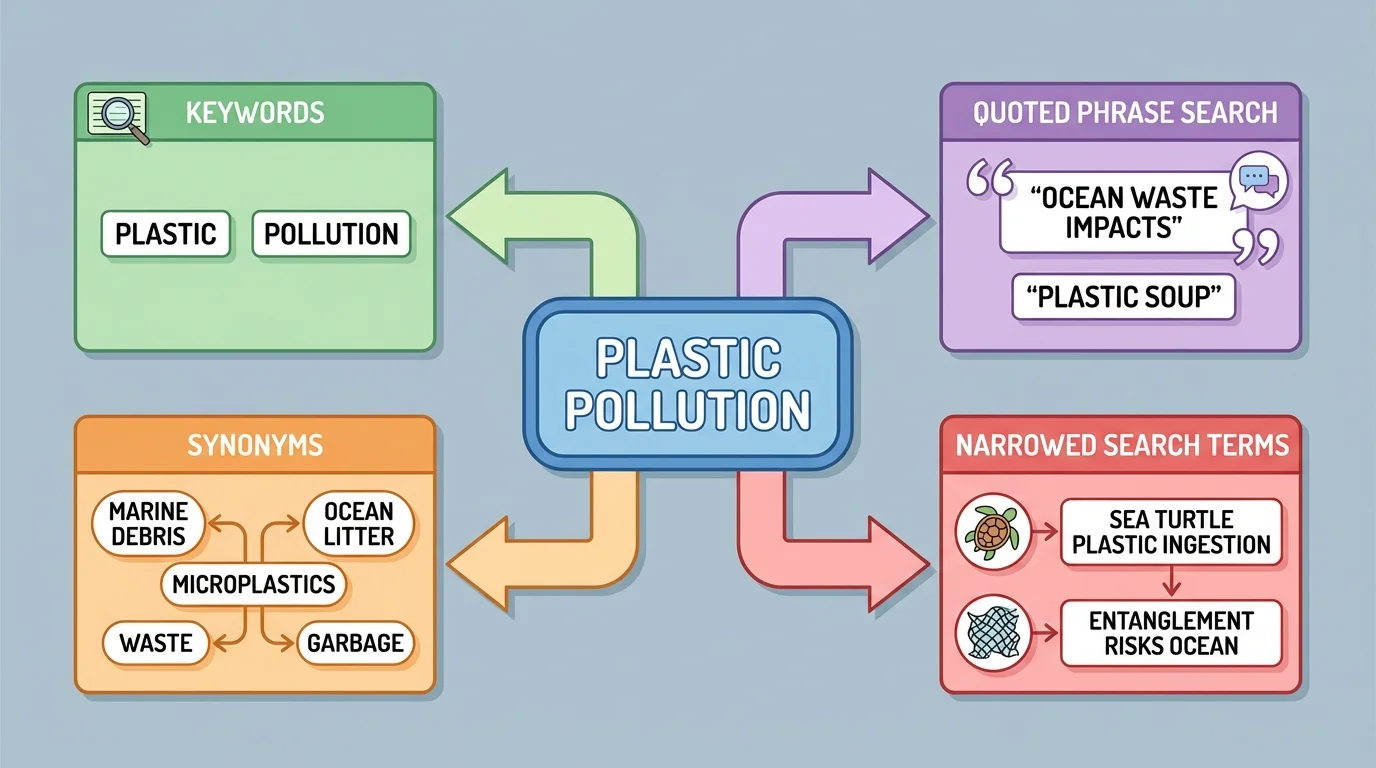
Search terms can change as your understanding grows. At first, you may know only a few basic words. After reading one strong source, you may learn new terms such as microplastics, habitat loss, or biodegradable materials. Those new terms can lead you to better sources.
Example: Improving a search
A student wants to learn how lack of sleep affects middle school students.
Step 1: Start broad
The first search is: sleep and students.
Step 2: Notice the problem
This search is too broad and may bring results about college students, babies, or general sleep facts.
Step 3: Refine the terms
The student tries: sleep deprivation middle school concentration.
Step 4: Refine again
The student tries: "middle school students" sleep deprivation academic performance.
The later searches are more likely to lead to useful, focused information.
Search engines are helpful, but they are not the only research tool. Good research uses both print and digital sources because each type has strengths.
Print sources include books, encyclopedias, magazines, newspapers, and journals you can hold in your hands. These sources are often edited before publication, which can make them more dependable. A library book on ecosystems, for example, may provide organized background information that helps you understand your topic before you search online.
Digital sources include websites, online articles, databases, e-books, videos, and online interviews. They are easy to access and often more current than print sources. If your topic involves a recent event, a newer digital article may be more useful than an older printed book.
Different source types serve different purposes. A textbook can give overview information. A news article can explain a recent event. A scientific article can provide data from a study. An interview can add a person's experience or expert opinion. Strong researchers choose sources based on what kind of information they need.
As you gather information, take notes carefully. Write down important facts, ideas, page numbers, website titles, authors, and dates right away. If you wait until the end, it becomes much harder to remember where each piece of information came from.
When taking notes, separate your own thoughts from copied words. One simple method is to label notes clearly with headings such as fact, my idea, and exact quote. This makes accidental plagiarism less likely.
Good note-taking also means collecting only what matters to your research question. If your question is about the effect of breakfast on concentration, information about dinner recipes is not relevant, even if it appears in the same article.
Not every source deserves equal trust. As [Figure 2] shows, a source might look professional and still contain weak evidence or misleading claims. Researchers evaluate credibility by asking questions about the author, the evidence, the date, and the purpose of the source.
Start by asking who created the source. Is the author named? What are that person's qualifications? A marine biologist writing about ocean ecosystems usually has more expertise than an anonymous social media account. If an organization produced the source, ask whether it is known for education, research, government work, or selling products.
Next, examine the evidence. Does the source include facts, examples, data, quotations from experts, or references to studies? Reliable sources usually explain where their information comes from. Weak sources often make strong claims with little or no proof.
Check the date. Some topics change quickly, such as medicine, technology, and current events. An old article may still be useful for history, but it may not be the best source for the newest scientific discoveries.
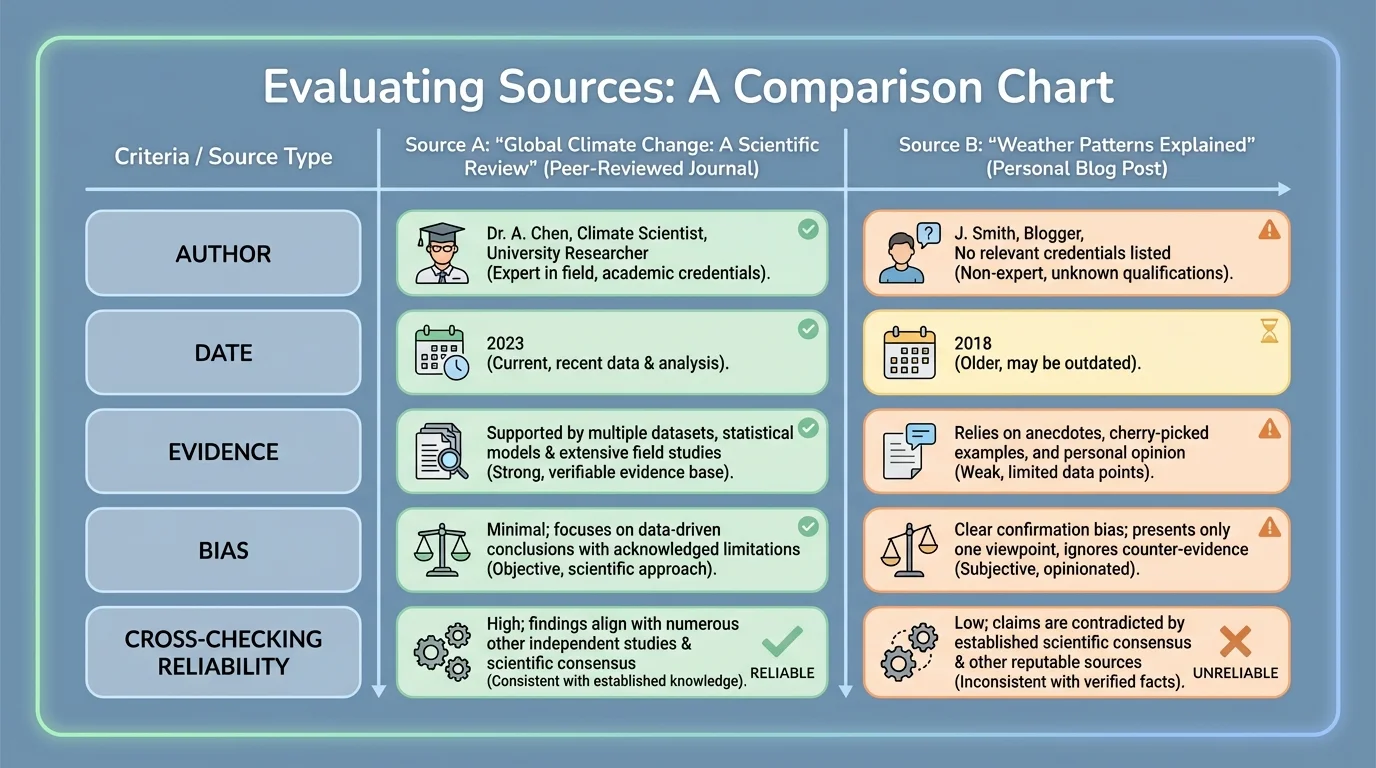
Also think about bias. Bias means a source may lean strongly toward one side or purpose. A company selling energy drinks may not be the best source for an unbiased answer about whether those drinks are healthy. Bias does not always mean a source is useless, but it does mean you must read carefully.
One clue comes from website endings, though these are not perfect by themselves. Government sites often end in .gov, educational institutions often use .edu, organizations often use .org, and businesses often use .com. A .org site can still be biased, and a .com site can still contain useful information, so the ending is only one clue.
Another powerful test is cross-checking. If several reliable sources agree on a fact, it is more likely to be accurate. If only one strange website makes a dramatic claim and no trustworthy source supports it, be skeptical. This cross-checking habit is one of the strongest defenses against misinformation.
A simple credibility checklist
Ask: Who wrote it? When was it published or updated? What evidence does it use? Why was it created: to inform, persuade, entertain, or sell? Can the information be confirmed in other reliable sources? If a source fails several of these questions, it should not be a main source for academic research.
The credibility checklist in [Figure 2] becomes especially helpful when two sources disagree. Instead of choosing the one you like better, compare their evidence and trustworthiness.
Research becomes stronger when you use more than one source. Different sources may explain the same topic in different ways. One may provide statistics, another may give historical background, and another may share an expert's explanation. Your job is to synthesize information, which means combining ideas from multiple sources into a clear understanding.
Synthesizing is not copying one article and then copying another. It means noticing patterns, agreements, and differences. For example, three sources on school start times might all agree that sleep affects learning, but one might focus on brain science, another on student attendance, and another on parent schedules. Putting those ideas together creates a fuller picture.
You can organize this by making a chart of sources and listing what each one contributes. This helps you see where sources overlap and where one adds something new.
| Source | Main Idea | Useful Evidence | How It Helps Answer the Question |
|---|---|---|---|
| Book on sleep | Sleep supports brain function | Explains memory and attention | Provides background science |
| News article | Schools are changing start times | Examples from districts | Shows real-world impact |
| Medical website | Teens need more sleep than many get | Recommendations from experts | Adds current health guidance |
Table 2. A source chart showing how different materials can contribute different kinds of information.
Synthesizing helps your writing sound thoughtful and original because you are building your own explanation from evidence, not borrowing someone else's structure.
When you use information from sources, you usually do it in three ways: direct quote, paraphrase, or summary. These choices are easier to understand when you compare them side by side, as [Figure 3] illustrates. Each method is useful, but all three require giving credit to the source.
A direct quote uses the exact words from a source inside quotation marks. Use a quote when the original wording is especially clear, powerful, or important. Do not quote too much. If your paper is mostly someone else's exact words, your own thinking disappears.
A paraphrase puts the source's idea into your own words and sentence structure while keeping the original meaning. A good paraphrase is not just changing a few words. It fully restates the idea. Even though the words are yours, the idea still belongs to the source, so you must cite it.
A summary gives the main point of a longer text in a shorter form. For example, you might summarize a whole article in one or two sentences. Summaries are useful when you want to give background without including every detail.
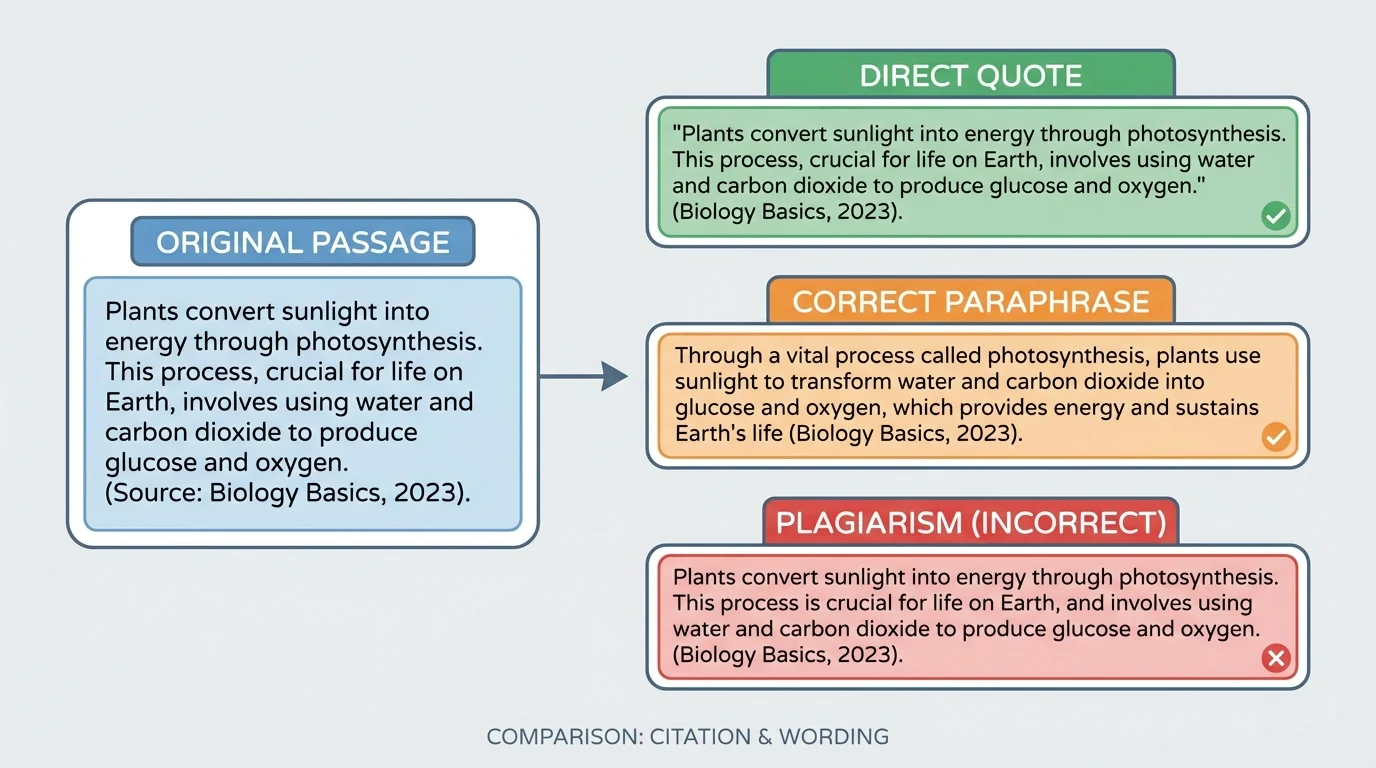
Plagiarism happens when a writer presents another person's words or ideas as their own. This can happen by copying directly without quotation marks, by paraphrasing too closely, or by forgetting to cite a source. Plagiarism is a serious problem because it is dishonest and unfair to the original creator.
Example: Quote, paraphrase, or plagiarism?
Original source sentence: "Regular sleep supports attention, memory, and emotional health in adolescents."
Step 1: Direct quote
One correct use is: According to the source, "Regular sleep supports attention, memory, and emotional health in adolescents." This uses the exact words and needs a citation.
Step 2: Correct paraphrase
Another correct use is: The source explains that getting steady sleep helps teenagers focus, remember information, and manage feelings better. This changes both wording and structure and still needs a citation.
Step 3: Plagiarism
An incorrect use is: Regular sleep supports attention, memory, and emotional health in adolescents. This copies the original wording without quotation marks or citation.
The key idea is simple: if the information came from a source, credit the source.
The comparison in [Figure 3] also helps reveal a common mistake called patchwriting, where a student changes only a few words from the original. That is too close to the source and should be avoided.
A citation is the information that tells readers where your facts, ideas, or quotes came from. Different schools may use slightly different citation styles, but each standard format includes key parts such as author, title, source name, date, and sometimes a page number or web address.
Citations usually appear in two places. First, you may include a citation in the sentence or nearby when you use the information. Second, you include a full list of sources at the end of your work. This final list may be called Works Cited, References, or Bibliography depending on the style being used.
Here are simple examples of what source information might look like in a standard list:
| Source Type | Important Information to Record |
|---|---|
| Book | Author, book title, publisher, year |
| Website article | Author or organization, page title, website name, date, URL |
| Magazine or newspaper article | Author, article title, publication name, date |
| Video | Creator, video title, website or platform, date |
Table 3. Key information to record for common source types when creating citations.
Even if your teacher gives you a citation tool or template, you still need to collect the correct information. Citation tools can help, but they are not perfect. Always double-check.
Many cases of plagiarism happen by accident, not because a student planned to cheat. Missing page numbers, copied notes without labels, and forgotten website titles can all lead to serious problems later.
One smart habit is to create source entries while you research instead of waiting until the end. This saves time and reduces mistakes.
After researching, your job is to present findings in a way that makes sense. Start with a clear claim or main answer to your research question. Then support that claim with evidence from your sources. Each paragraph should have a purpose.
For example, if your research question is "How does plastic pollution affect sea turtles?" your presentation might include one paragraph on how turtles mistake plastic for food, another on entanglement in fishing line, and another on conservation efforts. Each paragraph should use evidence from credible sources, not random facts that do not fit your main idea.
Transitions help connect ideas. Phrases such as for example, in addition, however, and as a result show readers how your evidence fits together. Good research writing sounds organized because the writer has sorted and synthesized information before drafting.
"Research is seeing what everybody else has seen and thinking what nobody else has thought."
— Attributed to Albert Szent-Györgyi
This idea matters because research is not only about collecting facts. It is also about making sense of them. Two students can read the same sources, yet the stronger researcher will organize the information more clearly and explain it more thoughtfully.
One common mistake is using weak search terms. Searching with one vague word often leads to a mess of unrelated results. A second mistake is trusting the first source you find without checking who wrote it or whether other reliable sources agree.
Another mistake is collecting huge amounts of information but not connecting it to the research question. If the evidence does not help answer your question, it probably does not belong in your final work.
A very common problem is forgetting where information came from. When notes are messy, students may accidentally mix their own words with copied lines from sources. That is why organized note-taking and immediate citation are so important.
Finally, avoid overusing quotes. Your work should show your understanding, not just your ability to copy good sentences. Use quotes when the exact words matter, but rely more often on paraphrases and summaries supported by citations.
