Two articles can be about the exact same topic and still feel completely different. One article about school lunches might calmly explain nutrition facts, while another pushes hard for menu changes. Same topic, different message. That difference comes from the author's point of view and purpose. Strong readers do more than gather information. They ask, "What does the author think?" and "Why was this written?"
When you determine an author's point of view or purpose, you are reading beneath the surface. You are paying attention not just to what the text says, but also to how and why it says it. This skill matters in science articles, history writing, news reports, opinion pieces, websites, speeches, and even instructions. It helps you become a smarter reader who can notice when a text is trying to inform, persuade, warn, inspire, or push a certain idea.
Every text has a reason behind it. Authors make choices about details, examples, and language because they want readers to think, learn, or feel something. An author might want to teach readers about volcanoes, convince them to recycle, or argue that a community should build a new park. If you can identify that goal, the text becomes much easier to understand.
Noticing the author's point of view also helps you judge the text more carefully. If an author strongly supports one side of an issue, that may affect which facts are included, which examples are emphasized, and which ideas are ignored. This does not automatically make the text false, but it does mean readers should pay attention to the author's angle.
Author's point of view is the author's attitude, belief, or position about a topic.
Author's purpose is the reason the author wrote the text.
Audience is the group of readers the author expects to reach.
Bias is a preference or leaning that can affect how a topic is presented.
Point of view and purpose are connected, but they are not the same thing. A writer's point of view is what the writer thinks. A writer's purpose is what the writer wants the reader to get, do, or believe. For example, an author may believe that plastic waste is a serious problem. That belief is the point of view. The purpose may be to persuade readers to use less plastic.
Different purposes leave different clues in a text, as [Figure 1] shows through common patterns and signals readers can spot. Many informational texts are written to inform, which means to give facts or explain a topic clearly. A text that informs often uses definitions, examples, dates, statistics, and clear explanations.
Other texts are written to persuade. A persuasive text tries to convince the reader to agree, think differently, or take action. It may include opinions, emotional appeals, strong claims, expert quotations, or repeated reasons. Persuasive writing often sounds more urgent or forceful than a purely informative text.
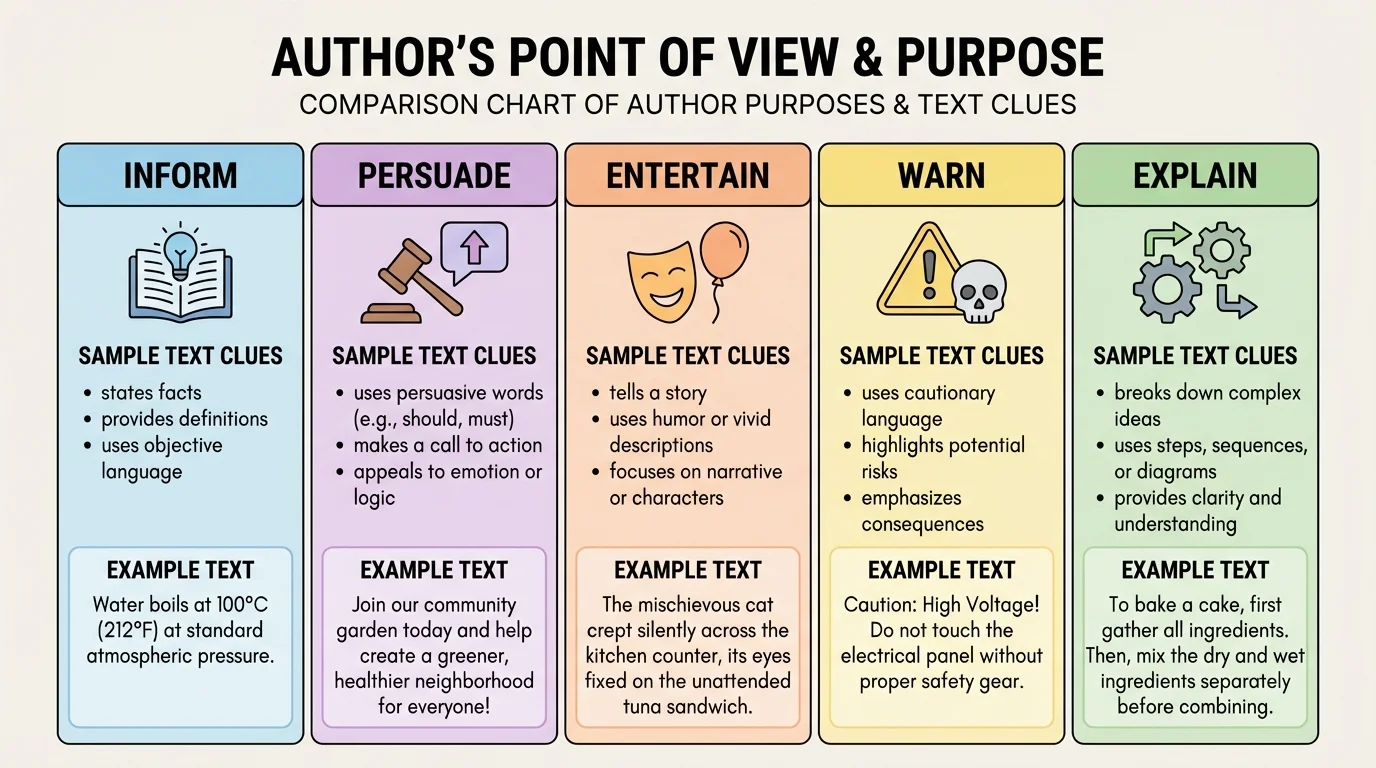
Some authors write to explain a process or idea in detail. For instance, a text about how earthquakes happen may go step by step through plate movement. Some write to warn, such as a safety guide about rip currents at the beach. Some aim to call readers to action, such as an editorial urging a city to add bike lanes. In literature, authors may write to entertain, but in informational texts for middle school reading, informing, explaining, persuading, and warning appear most often.
Purpose can also be mixed. A text about healthy sleep habits might inform readers with scientific facts while also persuading them to change their routines. Good readers stay open to more than one purpose.
Even a text that seems packed with facts can still be persuasive. Authors can choose which facts to include first, which examples to spotlight, and which side sounds more reasonable.
A quick way to test purpose is to ask: after reading, what does the author seem to want me to know, think, feel, or do? If the answer is "understand the topic," the purpose may be to inform or explain. If the answer is "agree with the author" or "take action," the purpose is likely persuasive.
An author's bias or viewpoint often appears through choices that may seem small at first. The author may describe a new law as "necessary and fair" or as "burdensome and unfair." Those words do more than give information. They reveal judgment.
Point of view can be conveyed through the examples an author chooses. Suppose two writers discuss video games. One writer focuses on teamwork, strategy, and problem-solving. Another focuses on distraction and lost sleep. Their examples reveal different attitudes, even before they directly state an opinion.
Another clue is what the author leaves out. If a text only presents one side of a debated issue, the author may have a strong point of view. Readers should notice missing perspectives. For example, an article praising a new shopping center but never mentioning traffic, noise, or cost may be showing only one angle.
Authors may also directly state their views with a claim. A claim is the main argument or position an author wants readers to accept. In a persuasive article, the claim often appears in the introduction and is supported by reasons and evidence throughout the text.
Purpose is not hidden only in the words; it often appears in the text's structure, as [Figure 2] illustrates through the way an article is built from introduction to conclusion. Informational texts are carefully organized, and that organization helps reveal what the author is trying to accomplish.
If a text begins with a question like "Should our town ban single-use plastic bags?" and ends by urging readers to contact local leaders, the structure points toward persuasion. If a text begins by defining a problem, then explains causes, effects, and solutions, the purpose may be to inform or explain. If a text starts with a danger and then gives instructions, the purpose may be to warn or protect.
Headings and subheadings also matter. A text with headings such as "What Causes Droughts?" "How Droughts Affect Farms," and "Ways Communities Save Water" is likely organized to explain a topic. A text with headings such as "Why the Current System Fails" and "What Leaders Must Do Now" suggests a persuasive purpose.
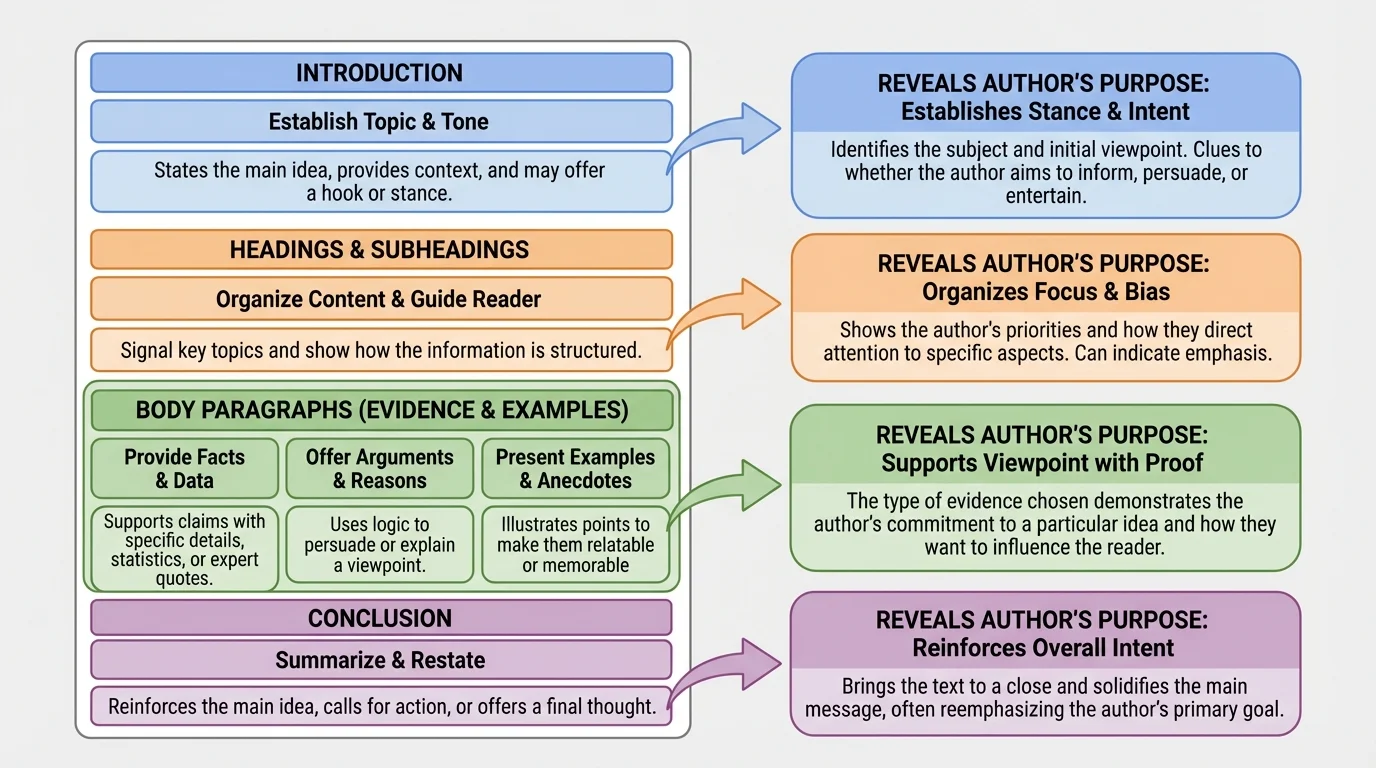
Introductions and conclusions are especially important. Authors often state or strongly hint at their purpose in these places. The introduction may present the issue, set the tone, or state the claim. The conclusion may repeat the main point, summarize important facts, or call for action. When you are trying to determine purpose, these parts deserve careful attention.
Evidence also helps reveal purpose. An author who wants to inform may include balanced facts from several sources. An author who wants to persuade may select evidence that strongly supports one side. Both use evidence, but they use it differently. The arrangement of reasons, examples, and quotations can tell you what the author is trying to achieve.
Later, when you compare two texts on the same issue, the organizational clues in [Figure 2] become especially useful because they help you see whether each writer mainly explains, argues, or urges action.
[Figure 3] shows that word choice is one of the strongest clues to an author's viewpoint. Readers should listen for whether the language sounds calm, emotional, approving, critical, or urgent.
Tone is the feeling or attitude created by the author's language. A serious tone may fit a safety article. A frustrated tone may appear in an editorial. An excited tone may appear in a piece promoting a new invention. Tone helps reveal both point of view and purpose.
Notice the difference between these sentences: "The city built a large housing project downtown" and "The city crammed an enormous housing project into downtown." Both refer to a similar event, but the second sentence sounds more negative. Words such as "crammed," "wasteful," "brilliant," "dangerous," or "unfair" often reveal the author's viewpoint.
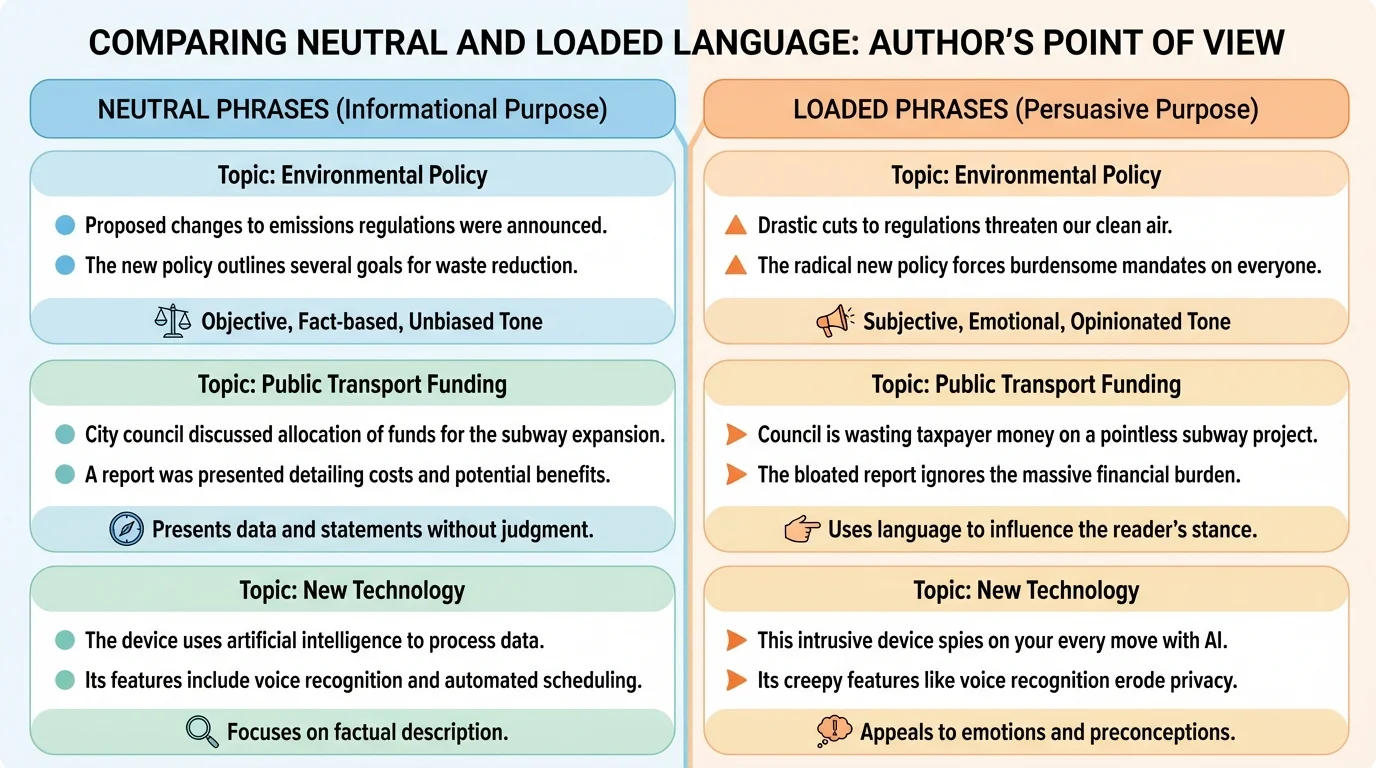
Writers may use loaded language, which is wording designed to trigger a strong reaction. Loaded language can make a text more persuasive, but it can also make it less neutral. Readers should ask whether the author is trying to help them understand or trying to push them toward a certain feeling.
It also helps to separate fact from opinion. A fact can be checked. An opinion expresses a judgment or belief. A sentence such as "The river is 200 miles long" is factual if it can be verified. A sentence such as "The river is the most beautiful place in the state" is an opinion. Texts often mix facts and opinions, especially when authors want to persuade.
Facts answer questions that can be checked with evidence. Opinions show beliefs, judgments, or preferences. Skilled readers do not reject opinions automatically, but they do notice when an opinion is being presented as if it were pure fact.
Connotation matters too. Connotation is the feeling a word carries beyond its basic definition. Calling a group "determined" creates a different impression than calling the same group "stubborn." That difference can quietly shape how readers view the topic.
Students often confuse point of view and purpose because they work together. The easiest way to separate them is with two questions: What does the author think? and Why did the author write this? The first question is about point of view. The second is about purpose.
Consider a text about renewable energy. If the author believes solar and wind power are necessary for the future, that belief is the point of view. If the author writes the article to convince communities to invest in renewable energy, that is the purpose. If the author writes mainly to explain how solar panels work, the purpose is different even if the point of view stays positive.
| Question | Point of View | Purpose |
|---|---|---|
| What does it focus on? | The author's attitude or position | The author's reason for writing |
| Helpful clue | Word choice, examples, judgments | Organization, claims, evidence, call to action |
| Example | "This change is necessary." | To persuade readers to support the change |
Table 1. Comparison of author's point of view and author's purpose.
Sometimes an author's point of view is neutral or mostly balanced, but the purpose is still clear. A textbook chapter may not show much personal opinion, yet its purpose is obviously to inform. In other cases, a strong point of view and a persuasive purpose work together very clearly.
Close reading helps you see how all these clues fit together. Instead of guessing, look for exact words, details, and patterns in the text.
Example 1: School garden article
Text: "A school garden can do more than grow vegetables. It gives students hands-on science practice, improves outdoor spaces, and can supply fresh food for cafeteria programs. Every middle school should consider building one."
Step 1: Identify the likely point of view.
The author seems positive about school gardens. Words such as "improves" and the final sentence show approval.
Step 2: Identify the purpose.
The purpose is to persuade readers that schools should build gardens.
Step 3: Explain how the text conveys that purpose.
The author lists benefits and ends with a recommendation, which pushes readers toward agreement.
This example shows that persuasive writing often includes reasons followed by a clear suggestion or judgment. The final sentence is especially important because it reveals both purpose and point of view.
Example 2: Volcano article
Text: "Volcanoes form when magma rises through cracks in Earth's crust. Some eruptions are explosive, while others release lava slowly. Scientists monitor gases, ground movement, and heat to predict activity."
Step 1: Identify the point of view.
The author's point of view seems mostly neutral. The passage does not strongly argue or judge.
Step 2: Identify the purpose.
The purpose is to inform or explain how volcanoes form and how scientists study them.
Step 3: Explain how the text conveys that purpose.
The text uses scientific facts, clear explanation, and no call to action. That structure fits an informational purpose.
Not every text contains a strong opinion. Good readers are ready to notice when the point of view is subtle or when the main goal is simply to provide understanding.
Example 3: Community pool editorial
Text: "Closing the community pool would be a costly mistake. The pool provides safe summer recreation, swimming lessons, and local jobs. Town leaders should repair it rather than shut it down."
Step 1: Identify the point of view.
The author opposes closing the pool.
Step 2: Identify the purpose.
The purpose is to persuade readers and leaders to keep and repair the pool.
Step 3: Explain how the text conveys that purpose.
The phrase "costly mistake" is loaded language, and the final sentence directly calls for action.
As with the language comparison in Figure 3, this editorial uses words with strong connotations to shape the reader's reaction instead of sounding fully neutral.
When you read an informational text, pause and ask yourself a few key questions. What is the topic? What does the author seem to believe about it? What does the author want readers to learn or do? Which details or examples reveal that? Are there emotional words, repeated ideas, or a direct claim?
It also helps to ask who the intended audience is. A text for scientists, families, voters, or students may sound different because the author chooses details that fit those readers. Audience and purpose often shape the structure and language of the text.
If the text includes evidence from only one side, ask why. If the conclusion urges action, ask what action the author wants. If the author repeats one idea again and again, that repetition is probably important.
Real texts are not always simple. A public health article might inform readers about dehydration symptoms, explain how the body loses water, and warn athletes to drink fluids in hot weather. One text can do several things at once.
When a text has multiple purposes, identify the main purpose first. Ask which goal is strongest and most central. For instance, if a brochure includes facts about wildfires but mostly focuses on helping families prepare emergency kits, the main purpose is probably to warn and instruct, not just to inform.
Similarly, an author may try to sound balanced while still leaning one direction. A writer might present several viewpoints but spend more time supporting one. That pattern can reveal a subtle point of view.
Main purpose versus secondary purpose
The main purpose is the author's strongest reason for writing. A secondary purpose is another goal the text also serves. Strong readers notice both, but they can explain which one drives the whole piece.
This is one reason close reading matters so much. You are not only deciding what kind of text it is. You are deciding which clues matter most.
One common mistake is confusing the topic with the purpose. "Recycling" is a topic. "To persuade readers to recycle more" is a purpose. A topic tells what the text is about. A purpose tells why it was written.
Another mistake is using only one clue. A single strong word can matter, but your explanation becomes stronger when you combine several clues: word choice, structure, evidence, and conclusion. Readers should build an argument from the text, not from a guess.
A third mistake is assuming that informational writing has no viewpoint. Even fact-based writing can show a point of view through emphasis, selection of details, and tone. This does not mean every text is unfair. It means readers should stay alert.
"Readers do not just receive a message; they investigate how the message is built."
That idea is powerful because it turns reading into thinking. You become an investigator of language, evidence, and structure rather than just a collector of facts.
[Figure 4] shows that a strong written response has clear parts: identify the point of view or purpose, support it with evidence, and explain how that evidence conveys the author's message. This kind of answer moves beyond "I think" and instead proves your thinking from the text.
One useful pattern is: state, cite, explain. First, state the author's purpose or point of view. Next, cite details from the text. Then explain how those details support your idea.
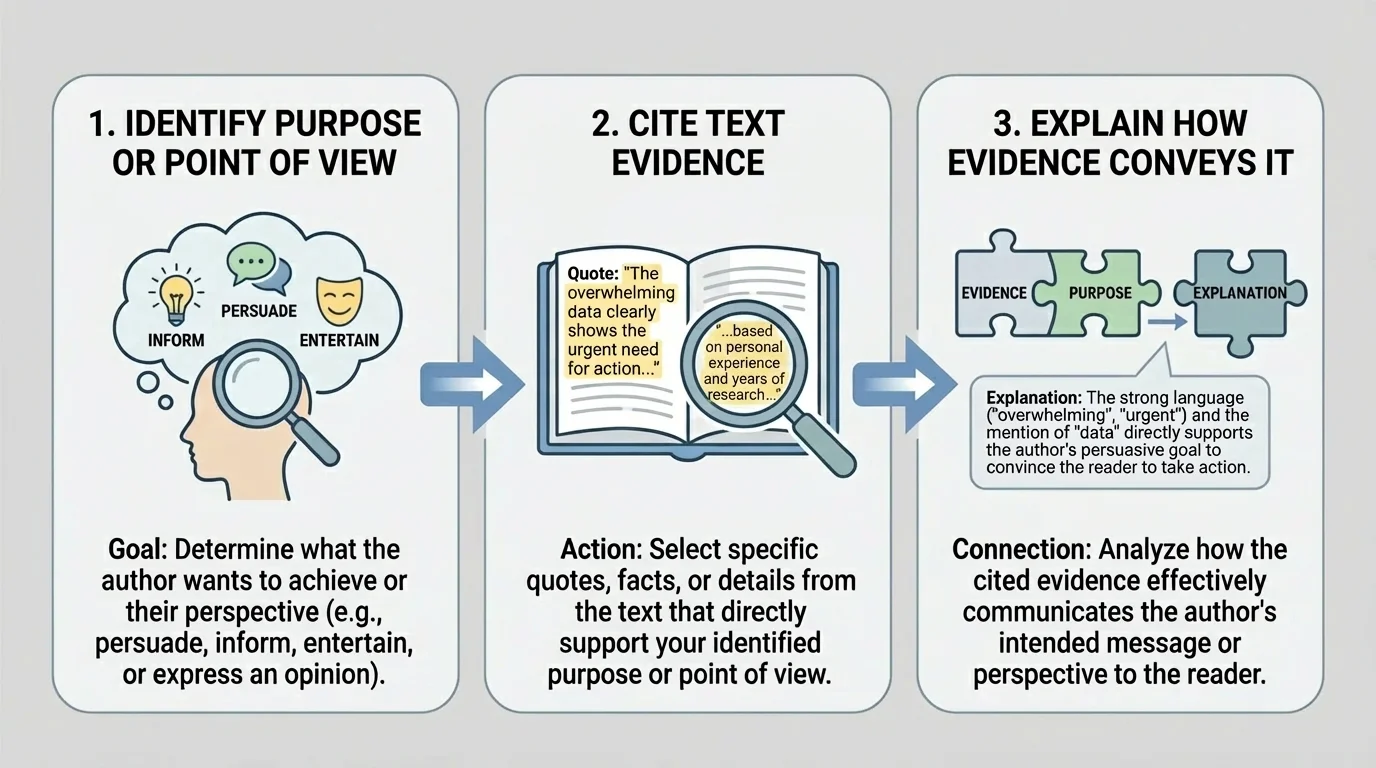
For example, you might write: "The author's purpose is to persuade readers to support longer recess. This is shown by the way the author lists benefits such as improved focus and healthier bodies, then ends by urging schools to change their schedules. These details show the author is not only giving information but also trying to convince readers."
Notice what makes that response strong. It names the purpose, gives evidence, and explains the effect of that evidence. It does not simply say, "The text is persuasive," and stop there.
Later, when you organize your own answer, the three-part pattern in Figure 4 helps you make sure your explanation includes reasoning instead of only a label.
Determining an author's point of view or purpose is really about paying attention to choices. Authors choose words, details, examples, evidence, text features, and structure for a reason. Those choices reveal what they think and what they want their readers to gain.
The more closely you read, the more you notice patterns: a claim repeated in several forms, emotional language that pushes the reader, a calm explanation that teaches step by step, or a conclusion that calls for action. Once you can spot those patterns, you can explain not only what a text says, but how it works.
