People argue every day, but the strongest arguments are not the loudest ones. The strongest arguments are the clearest. If you want to convince a principal to change a school rule, persuade your family to adopt a pet, or write an essay about whether students should have longer recess, you need more than feelings. You need a clear idea, a smart plan, and proof. That is what good argument writing does.
Argument writing is not about fighting. It is about explaining a position so well that a reader can follow your thinking step by step. A strong argument introduces a claim, supports it with reasons, and proves those reasons with evidence. When these parts are organized clearly, the writing becomes easier to understand and more convincing.
Arguments appear in school, in news articles, in advertisements, in speeches, and even in conversations. When someone says, "Our town should build a new park because kids need safe places to play," that person is making a claim and giving a reason. If they add facts about how many children live nearby or how far families must travel to reach a park, they are adding evidence.
Learning to write arguments helps you do more than complete assignments. It teaches you how to think carefully, test ideas, and support your position responsibly. It also helps you notice when other people use strong evidence—or when they do not.
Writers usually have a purpose and an audience. In argument writing, the purpose is to convince, and the audience is the group of readers you want to persuade. Keeping both in mind helps you choose the right claim, reasons, and evidence.
A good argument does not just say, "I think this." It answers an important question: "Why should anyone else agree?" That question leads directly to the heart of this topic. [Figure 1]
A claim is the writer's main position or statement about an issue. It tells what the writer believes should happen, is true, or matters most. In a well-built argument, the claim stands at the center, and all the supporting ideas connect to it. Without a clear claim, the rest of the writing may feel scattered.
For example, the topic might be "school lunches." A topic is only the general subject. A claim goes further. "School lunches should include more fresh fruits and vegetables" is a claim because it takes a position. A fact would be "The cafeteria serves lunch every school day." A personal opinion might be "I do not like the taste of cafeteria broccoli." A claim is different because it is something a writer can support with reasons and evidence.
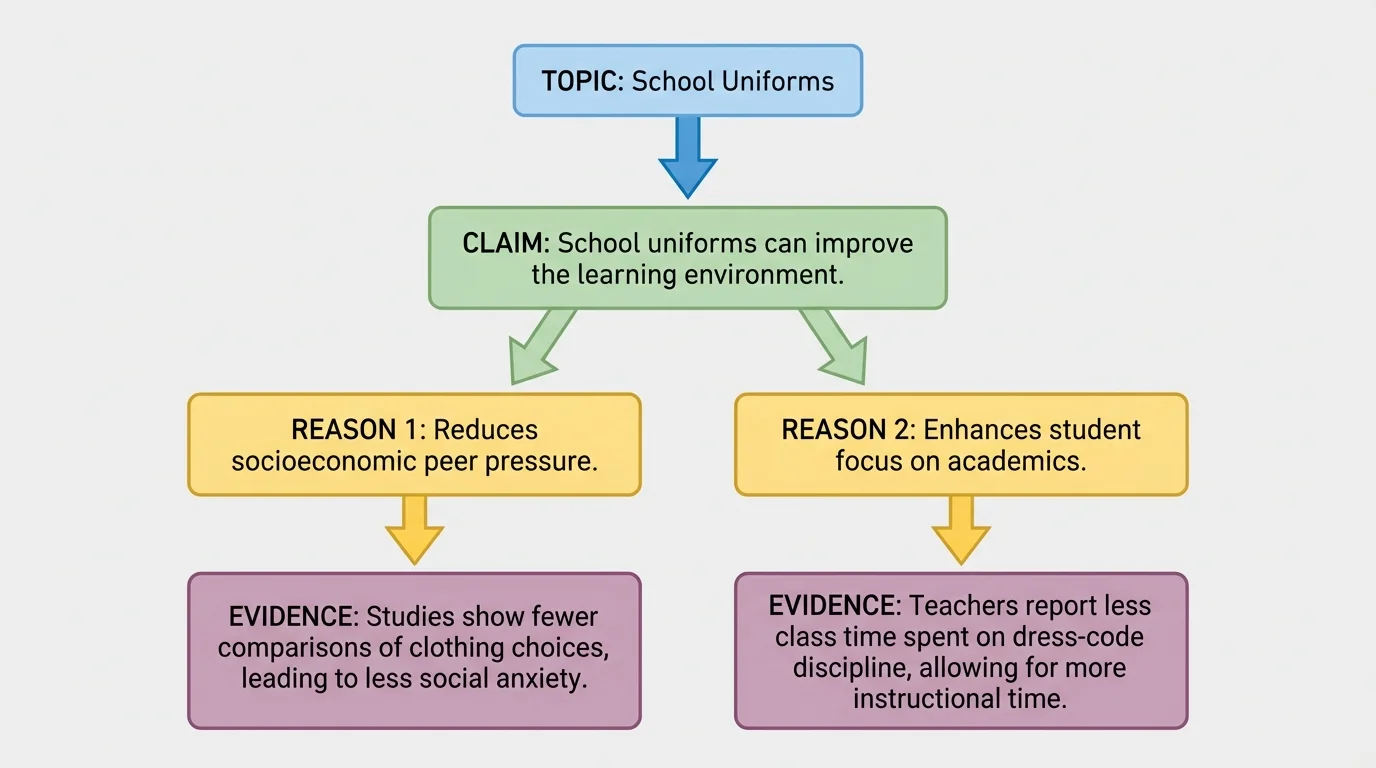
Notice that claims should usually be arguable. If everyone already agrees, there is not much to argue. "Water is wet" is not a useful claim for an argument essay. "Schools should allow reusable water bottles in every classroom" is much better because a reader could agree or disagree, and the writer can defend the position.
Claim is the main point or position a writer wants the reader to accept. Reason is an explanation that supports the claim. Evidence is the proof—such as facts, examples, quotations, or data—that supports a reason.
When writers confuse these parts, their essays become weak. A claim is not just the subject. A reason is not the same as evidence. Keeping these roles separate helps you build a stronger argument.
A strong claim is clear, specific, and focused. It does not try to cover everything. Compare these two examples:
Weak claim: "School should be better."
Stronger claim: "Middle schools should start later in the morning so students can be more alert and ready to learn."
The weak claim is too vague. Better how? For whom? In what way? The stronger claim gives a clear direction. It tells the reader what change the writer wants and hints at a reason.
Strong claims also avoid being too extreme unless the writer can truly support that extreme position. "Homework should be banned forever everywhere" is dramatic, but it may be harder to defend than "Homework should be limited so students have time for sleep, exercise, and family responsibilities." Clear and reasonable claims often persuade readers more effectively than exaggerated ones.
Professional writers often revise their claim several times before drafting the full piece. A small change in wording can make an argument much easier to support.
Another important quality of a strong claim is that it matches the assignment. If the prompt asks whether zoos should exist, a claim about protecting rain forests may be interesting but off-topic. Good writers stay focused on the exact question they are asked to answer.
Once you have a claim, you need reasons. A reason explains why your claim makes sense. Think of reasons as the main supports holding up your argument.
Suppose your claim is: "Students should have access to free drinking water throughout the school day." Your reasons might include these:
Each reason should connect directly to the claim. If one reason is "The cafeteria walls should be painted blue," that does not support the claim about water. It may be a real idea, but it belongs in a different argument.
Reasons should also be distinct. That means each one adds something new. If you write, "Water is healthy" and "Water is good for your body," those may sound like two reasons, but they are almost the same. Strong writers try to build body paragraphs around different supporting ideas instead of repeating one point in different words.
Evidence is what turns a reason from a statement into support. Evidence can include facts, examples, details from a text, expert quotations, statistics, survey results, or observations from reliable sources.
Suppose your reason is that hydration improves focus. You might use evidence such as a health article explaining that the brain works better when the body is hydrated, or a school nurse's statement about how students often feel tired or distracted when they do not drink enough water. That evidence helps show that the reason is not just personal opinion.
Writers often use several types of evidence together. A fact gives information. An example makes the idea concrete. A quotation from an expert adds authority. A statistic can show how common or important a problem is. For students in middle school, evidence does not have to be complicated, but it does need to be relevant and trustworthy.
Matching evidence to reasons means that every piece of proof should fit the point it is supposed to support. If your reason is about health, use health-related proof. If your reason is about cost, use information about money or budget. Readers notice when evidence does not match the reason.
Here is an example of a mismatch. Claim: "Schools should add more bike racks." Reason: "More bike racks encourage students to ride to school." Weak evidence: "Many students enjoy pizza on Fridays." The evidence may be true, but it does not prove the reason. Better evidence would be a student survey showing that students would bike more often if there were secure places to lock their bicycles.
Relevant evidence should be explained, not dropped into the paragraph without comment. After giving evidence, the writer should tell the reader how that evidence supports the reason. This explanation is often the bridge that makes the argument easy to follow.
Even strong ideas can become confusing if they are not arranged well. Readers follow arguments more easily when the writing moves in a clear order. Most school arguments use a simple structure: introduction, body paragraphs, and conclusion. [Figure 2]
In the introduction, the writer presents the issue, gives background if needed, and states the claim clearly. The claim often appears near the end of the introduction so the reader knows exactly what the essay will argue.
In the body paragraphs, each paragraph usually focuses on one main reason. Inside that paragraph, the writer includes evidence and explains how the evidence supports the reason. This structure keeps the writing from jumping around.
In the conclusion, the writer restates the claim in a fresh way and reminds the reader why the argument matters. A conclusion should not simply copy the introduction word for word. Instead, it should leave the reader thinking about the issue.
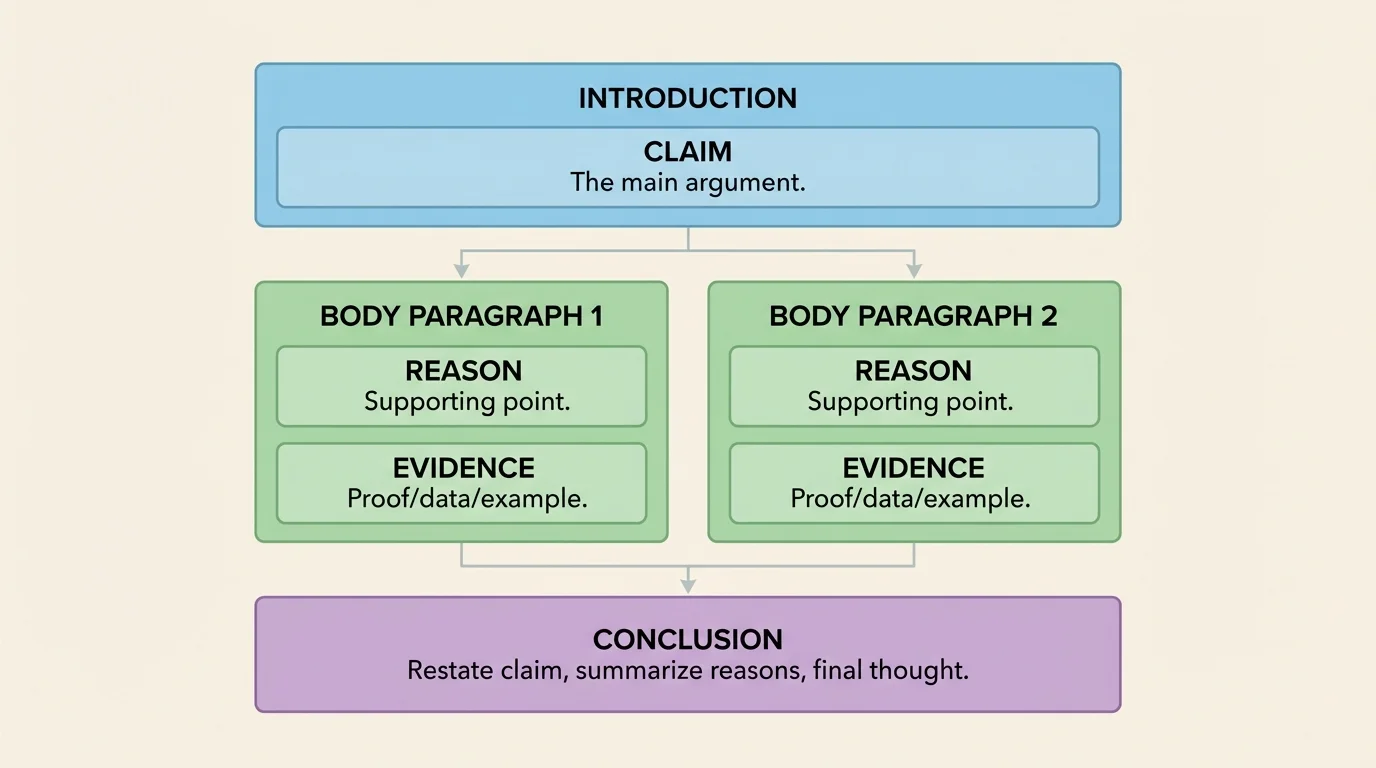
One helpful pattern is this: claim, reason, evidence, explanation. When students follow this pattern, their writing often becomes more logical. For example, if your paragraph reason is "Later school start times improve learning," you can add evidence from sleep research and then explain that students who are less tired can pay better attention in class.
Transitions also help organize an argument. Words and phrases such as for example, because, another reason, in addition, and therefore guide the reader. These signal words show relationships among ideas. They are like road signs that tell the reader where the writing is going.
| Part of the argument | What it does | Example sentence starter |
|---|---|---|
| Claim | States the main position | Schools should... |
| Reason | Explains why the claim is valid | One reason is that... |
| Evidence | Provides proof | According to... |
| Explanation | Shows how the evidence supports the reason | This matters because... |
| Conclusion | Reinforces the argument | For these reasons... |
Table 1. The main parts of an organized argument and what each part does.
Good organization also means putting ideas in the best order. Sometimes writers save their strongest reason for last so the argument ends powerfully. Other times they start with the strongest reason to capture the reader right away. Both choices can work if the order is logical.
Before drafting, many writers make a plan. An argument map is a simple visual organizer that places the claim in one spot and connects it to reasons and evidence. This helps writers see whether each reason supports the claim and whether each reason has enough evidence. [Figure 3]
For example, if your claim is "Community gardens should be built in empty lots," your map might include three reasons: they provide fresh food, improve neighborhoods, and create community cooperation. Under each reason, you would list evidence, such as examples from other towns, expert statements, or local needs.
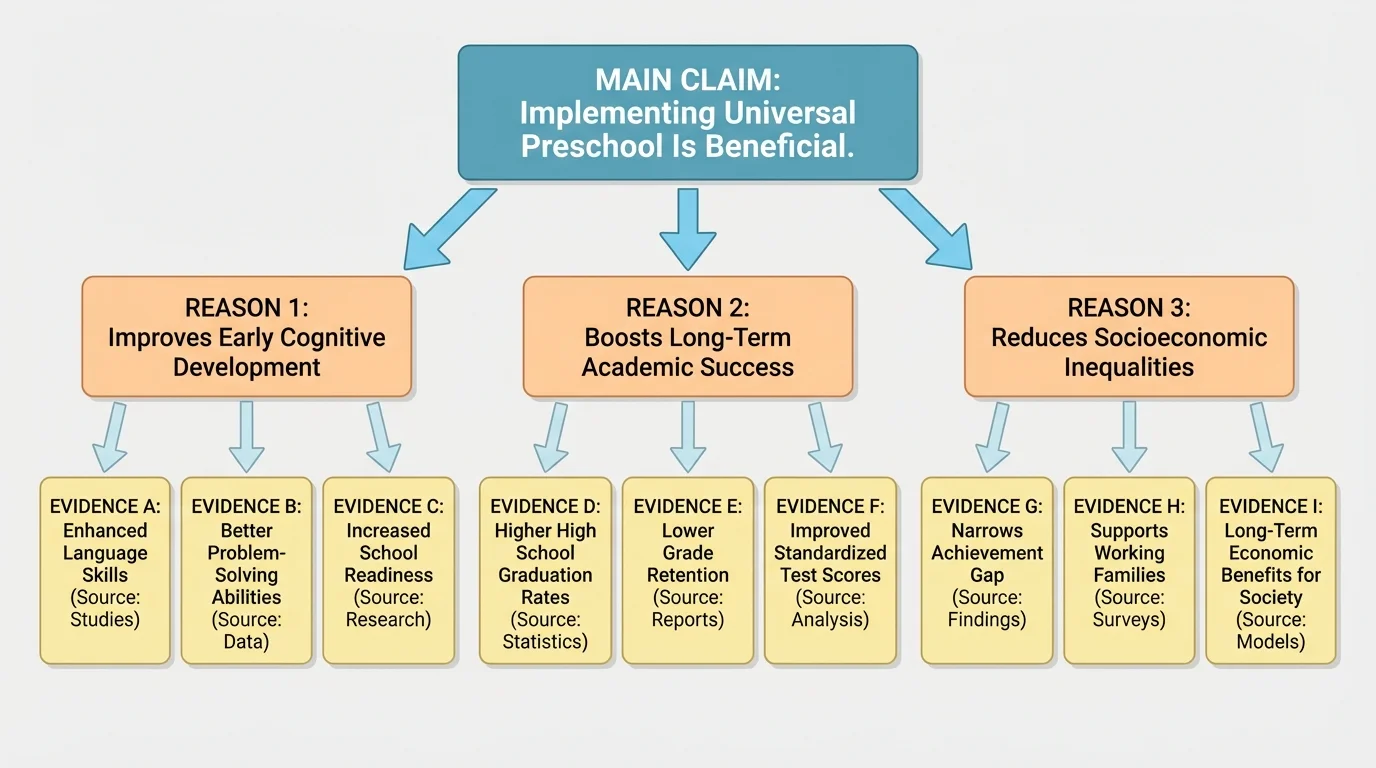
An argument map is useful because it reveals problems early. If one reason has no evidence, you know you need more research. If two reasons say almost the same thing, you can combine them or replace one. Planning saves time because it prevents messy drafts later.
Example: From plan to paragraph
Claim: "Schools should create quiet study spaces during lunch."
Step 1: Choose one reason.
Reason: Some students need a calm place to finish work or read.
Step 2: Add evidence.
Evidence: The library is often full, and some students have noisy schedules all day.
Step 3: Explain the connection.
Explanation: A quiet study space gives students another option when they need concentration.
Step 4: Turn the plan into a paragraph.
One reason schools should create quiet study spaces during lunch is that some students need a calm place to finish work or read. The library is often full, and many students move through noisy classes and crowded hallways all day. A designated quiet space would give those students a better chance to concentrate and use their time well.
Later, when you draft a full essay, the argument map still helps. As we saw in [Figure 3], the map keeps each reason connected to the right proof, which makes paragraphs more focused and easier to build.
Arguments become stronger when they use a credible source. A credible source is one that is trustworthy, accurate, and appropriate for the topic. A science article from a respected organization, a textbook, or an interview with a knowledgeable expert is usually more credible than a random online comment with no evidence.
When choosing sources, ask questions such as: Who wrote this? How do they know this information? Is the source current? Does it provide facts, data, or expert knowledge? Can the information be checked somewhere else? These questions help you avoid weak or unreliable support.
Formal style also matters. A formal style means writing in a clear, respectful, school-appropriate way. It avoids slang, texting shortcuts, and overly casual expressions. Instead of writing, "Kids are super tired and school starts way too early," a more formal sentence might say, "Many students are too tired to perform their best when school begins very early in the morning."
"A good argument is built, not shouted."
— Writing principle
Formal style does not mean dull style. It means careful word choice. Your voice can still sound confident and thoughtful. In fact, a calm and organized tone often makes an argument more persuasive than an emotional one.
When you use information from a source, be accurate. Do not twist the evidence to say something it does not really say. Honest argument writing depends on fair use of information.
One common mistake is writing a claim that is too broad. "Technology is bad" is hard to support because technology includes many different things. A narrower claim such as "Students should limit phone use during class discussions" is easier to explain and defend.
Another mistake is giving reasons without enough evidence. A paragraph that says, "This is better because it helps students," needs proof. What kind of help? How do we know? Clear evidence answers those questions.
Some writers include evidence but forget to explain it. They may add a quotation or fact and then move on. That leaves the reader to do the thinking alone. A strong writer follows up with explanation: What does this evidence show? Why does it matter?
Another problem is poor organization. If one paragraph starts about healthy lunches, shifts to playground safety, and ends with recycling bins, the reader may get lost. As we saw in [Figure 2], organized writing gives each paragraph a clear job.
Fixing a weak argument
Weak version: "School gardens are good. They are fun. Plants are nice."
Step 1: Make the claim specific.
Revised claim: "Schools should create gardens because they support science learning and healthy eating."
Step 2: Add clear reasons.
Reason 1: Gardens give students hands-on science experience. Reason 2: Gardens help students learn where healthy food comes from.
Step 3: Add evidence and explanation.
Evidence: Students can observe plant growth directly and participate in harvesting vegetables. Explanation: These experiences connect classroom ideas to real life.
Revision is where many arguments become truly strong. Writers reread their work and ask: Is my claim clear? Does each reason support it? Does each paragraph include evidence? Is the order easy to follow?
Look at this short model:
Claim: Schools should allow students to redo certain major assignments.
Reason 1: Redos help students learn from mistakes.
Evidence: When students review teacher feedback and improve their work, they practice skills again instead of simply accepting a low score.
Reason 2: Redos reward effort and growth.
Evidence: A student who studies harder, asks questions, and makes real improvements shows learning that should count.
Reason 3: Redos prepare students for real life.
Evidence: Adults often revise projects, presentations, writing, and designs before turning in final versions.
This argument works because the claim is clear, the reasons are different from one another, and the evidence matches each reason. It is also easy to organize into paragraphs. The introduction states the claim. Each body paragraph can focus on one reason. The conclusion can remind readers that school should support learning, not just one-time performance.
The same principle applies to many topics: recycling programs, later start times, healthier lunches, dress codes, homework limits, or community improvements. No matter the topic, the pattern remains steady. A clear claim leads to strong reasons. Strong reasons need relevant evidence. Good organization makes the whole argument understandable.
