A strong argument can fail for a surprising reason: it may have good ideas, but if it sounds careless, readers may not trust it. Think about two people making the same point. One says, "This rule is dumb and needs to go." Another says, "This rule should be reconsidered because it creates unnecessary problems." Both express an opinion, but only one sounds ready for a serious discussion. In argument writing, how you say something matters almost as much as what you say.
When you write an argument, you are trying to convince readers that your claim is reasonable and well supported. To do that, you need clear reasons, relevant evidence, and a style that fits the situation. A formal style tells readers that you are thoughtful, prepared, and respectful. It helps your writing sound more trustworthy.
Formal style is especially important when you are writing for teachers, classmates, school leaders, community members, or anyone who expects serious communication. If you use slang, jokes that do not fit the topic, or overly emotional language, your ideas may seem weaker even when your reasons are strong.
Formal style is a way of writing that uses standard grammar, precise word choice, respectful tone, and clear organization. It avoids slang, text-message language, and overly casual expressions.
Formal writing does not mean stiff or robotic writing. It means choosing words carefully so your meaning is clear. A formal argument can still sound confident, interesting, and powerful.
At its core, formal style means matching your language to your purpose. In an argument, your purpose is to persuade through reasons and evidence, not through shouting, insults, or dramatic exaggeration. Formal style supports that purpose, as [Figure 1] shows through the difference between casual and polished wording. A writer using formal style chooses words that are specific and accurate instead of vague or emotional.
For example, instead of writing, "School lunches are gross," a writer using formal style might write, "Some school lunches do not provide appealing or nutritious options for students." The second sentence is more specific, more respectful, and easier to support with evidence.
Formal style also avoids wording that sounds like conversation between friends. In daily speech, people may say, "kids are gonna hate this rule" or "that idea is totally unfair." In formal writing, those ideas would be revised into standard English, such as "many students may oppose this rule" or "the policy may create an unfair result."
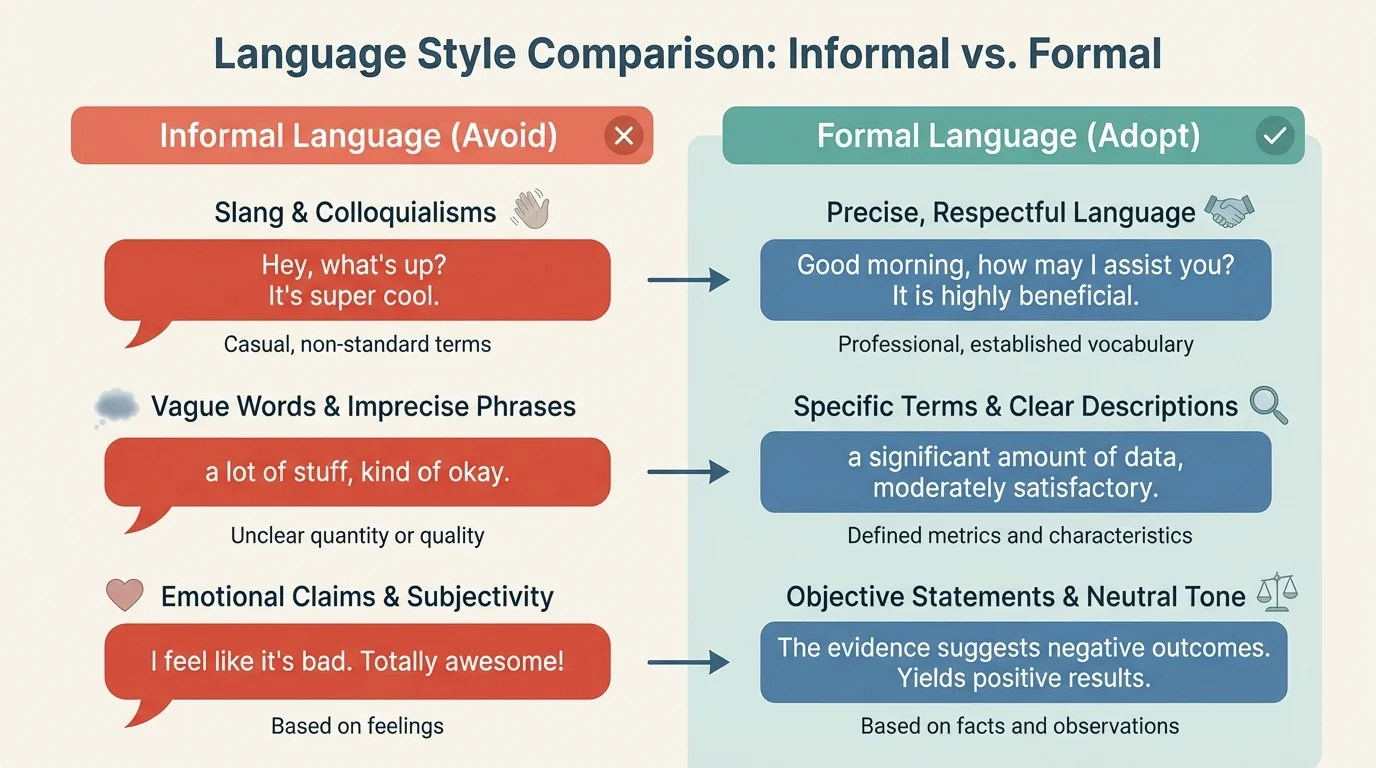
Another important part of formal style is staying focused on ideas, not attacking people. In an argument, you may disagree with another viewpoint, but formal writing expresses disagreement respectfully. Instead of saying, "People who support this rule make no sense," you could write, "Supporters of this rule may value order, but the policy has several disadvantages." This keeps the discussion thoughtful and fair.
Formal writing has several recognizable features. One feature is tone, which is the attitude the writing expresses. A formal tone sounds serious, respectful, and controlled. It does not sound rude, silly, or overly emotional.
Another feature is precise language. Precise language uses exact words instead of fuzzy ones. Compare "a lot of pollution" with "high levels of air pollution near major roads." The second phrase gives readers a clearer picture.
Formal writing also uses standard grammar, spelling, and punctuation. Complete sentences matter. So do capital letters, commas, and correct verb forms. Errors can distract readers from your argument and make it seem less reliable.
A formal argument usually avoids slang and very casual expressions. Words such as "cool," "awful," "super weird," "stuff," and "you guys" are common in speech, but they are often too informal for argument writing. Instead, writers choose words like "effective," "harmful," "unusual," "materials," or "students."
Writers often limit the use of direct second-person language such as "you" when making formal arguments. For example, instead of saying, "You can see that uniforms help," a writer might say, "The evidence suggests that uniforms can improve focus." This sounds more objective.
Formal style also includes objective language. Objective language focuses on facts, reasons, and evidence more than personal feelings. That does not mean opinions disappear. It means opinions are presented in a reasoned way. "I hate homework" is emotional. "Excessive homework can reduce time for sleep and family responsibilities" is objective and arguable.
Professional writers in newspapers, science magazines, and public reports often revise the same sentence several times just to make the tone more precise and formal. Strong writing usually sounds effortless only after careful editing.
One more feature of formal writing is the use of transitions. Transitions are words and phrases that connect ideas smoothly. In arguments, transitions such as "for example," "in addition," "however," "as a result," and "therefore" help readers follow your reasoning.
Learning formal style becomes easier when you compare examples. Notice how the meaning stays similar while the wording becomes more appropriate for an argument.
Informal: "Phones in class are a huge problem because kids are always messing around on them."
Formal: "Cell phones can disrupt learning because some students use them for activities unrelated to class."
Informal: "This rule is just bad and everybody knows it."
Formal: "This rule has several weaknesses, including inconsistent enforcement and unclear expectations."
Informal: "The other side is wrong."
Formal: "The opposing view overlooks several important concerns."
Revision example
Original sentence: "Our town really needs more trees because it looks boring and stuff gets too hot."
Step 1: Remove vague and casual wording.
Words like "really," "boring," and "stuff" are too informal and unclear.
Step 2: Replace them with specific, precise language.
Use exact ideas such as "public spaces," "shade," and "summer temperatures."
Step 3: Rewrite the sentence in a formal style.
"The town should plant more trees because they improve the appearance of public spaces and provide shade during hot weather."
The revised version is clearer, more specific, and easier to support with evidence.
Formal revision is not about using the longest words possible. It is about making your language accurate, respectful, and suited to an academic audience.
One strong sentence is not enough. A formal style must stay consistent throughout the whole argument. Your introduction, body paragraphs, and conclusion should all sound like they belong in the same piece of writing. Formal style should remain steady across every part of the essay, and [Figure 2] illustrates how that consistency connects the claim, reasons, evidence, and conclusion.
In the introduction, formal style helps you present the issue clearly. Rather than opening with "I'm here to tell you the truth about school start times," a stronger introduction might say, "School start times should be moved later because additional sleep can improve student health and attention." The sentence states a clear position without sounding dramatic.
In body paragraphs, formal style helps you explain reasons and evidence carefully. Each paragraph should stay focused on one reason. The explanation should sound measured and thoughtful, not rushed or emotional.
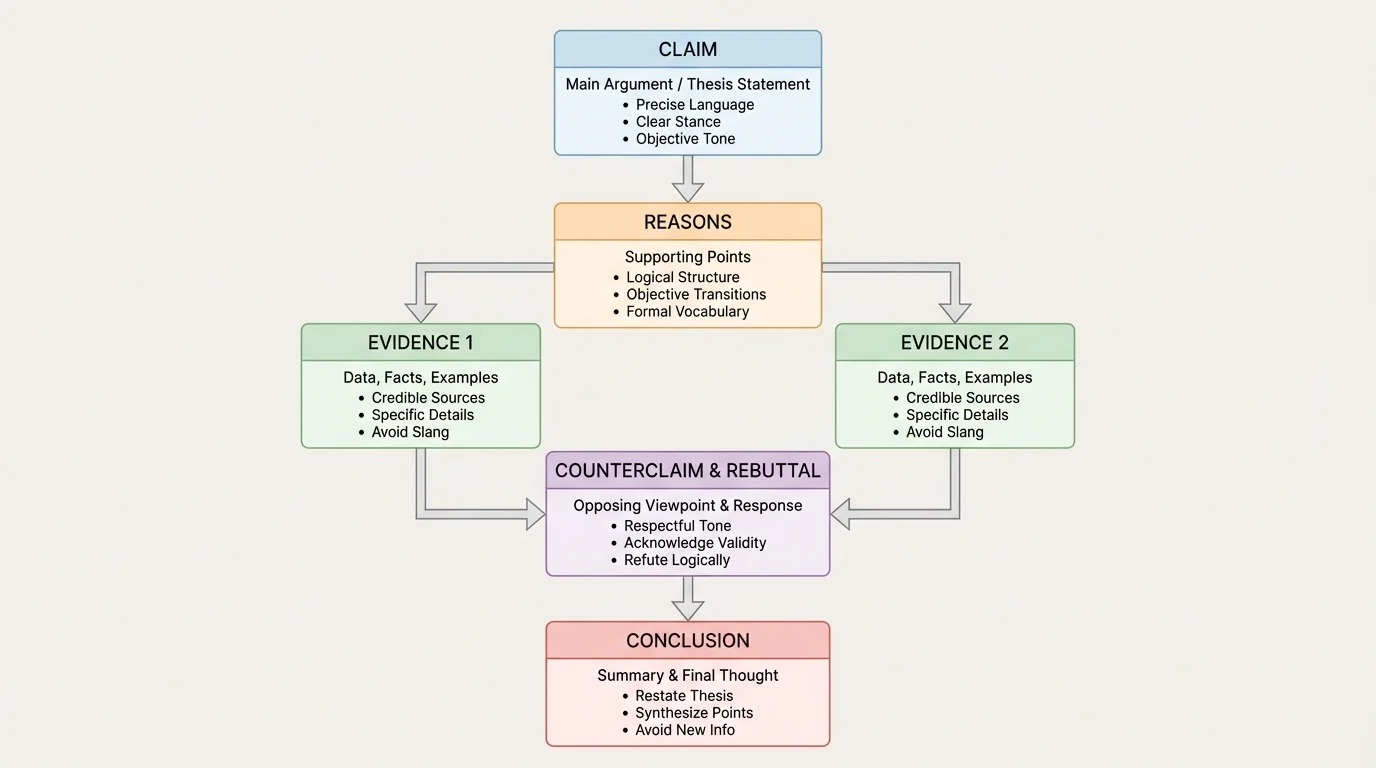
Transitions are especially useful for maintaining formal style. A body paragraph might begin with "One important reason is..." or "For example, research suggests..." These phrases guide the reader and help the writing feel organized.
When addressing another point of view, keep the tone respectful. You may include a counterclaim, which is an opposing argument, and respond to it calmly. For example: "Some people argue that homework should be assigned every night. However, studies of student stress suggest that a balanced workload may be more effective." Respectful disagreement is a sign of strong formal writing.
In the conclusion, formal style helps you finish with confidence. Instead of saying, "So yeah, that's why my idea is better," you might write, "For these reasons, the school should adopt the proposed change." The ending sounds serious and complete.
Arguments become stronger when they include facts, examples, quotations, and information from reliable sources. Formal style matters here too. Evidence should be introduced smoothly, explained clearly, and connected directly to the claim.
Suppose you are arguing that schools should offer later start times. An informal sentence might say, "Scientists basically proved kids need more sleep." A formal version would be: "Sleep researchers report that teenagers need more rest than many school schedules allow." The second version sounds more accurate and professional.
When you use a quote, introduce it in a way that fits your sentence. For example: "According to a pediatric sleep specialist, later start times can support student health." Notice that the source is named respectfully and the quote is not dropped into the paragraph without explanation.
Integrating evidence formally means blending source information into your own writing. A writer introduces the source, presents the information, and explains how it supports the claim. This helps the paragraph sound smooth and thoughtful instead of patched together.
Paraphrasing also helps maintain formal style. To paraphrase means to restate information from a source in your own words. Good paraphrasing keeps the original meaning while fitting your writing style. It should still sound formal and should still give credit to the source.
If source information is strong but the explanation after it is weak, the paragraph may still feel incomplete. Evidence needs commentary. After giving a fact or quote, explain why it matters. That explanation should remain formal and focused.
Writers often slip into informal habits without noticing. A careful editing checklist can help, and [Figure 3] presents the most common problems beside stronger revisions. One common problem is slang, which includes casual words or phrases used in everyday conversation. Slang can make an argument sound immature or unclear.
Another problem is exaggeration. Words such as "always," "never," "everyone," and "the worst ever" often make claims too extreme. Formal writing avoids overstatement unless the evidence truly supports it. Instead of "Homework always ruins students' lives," a better sentence would be "Large amounts of homework can increase stress for some students."
Writers should also watch for emotional wording. Saying "This unfair rule crushes students" may sound dramatic, but it does not explain the actual problem. Formal writing replaces dramatic wording with exact description, such as "This rule may limit student choice and create unnecessary penalties."
Contractions such as "don't," "can't," and "isn't" are not always forbidden, but many school writing situations prefer the full forms "do not," "cannot," and "is not." Using full forms can help the writing sound more formal and consistent.
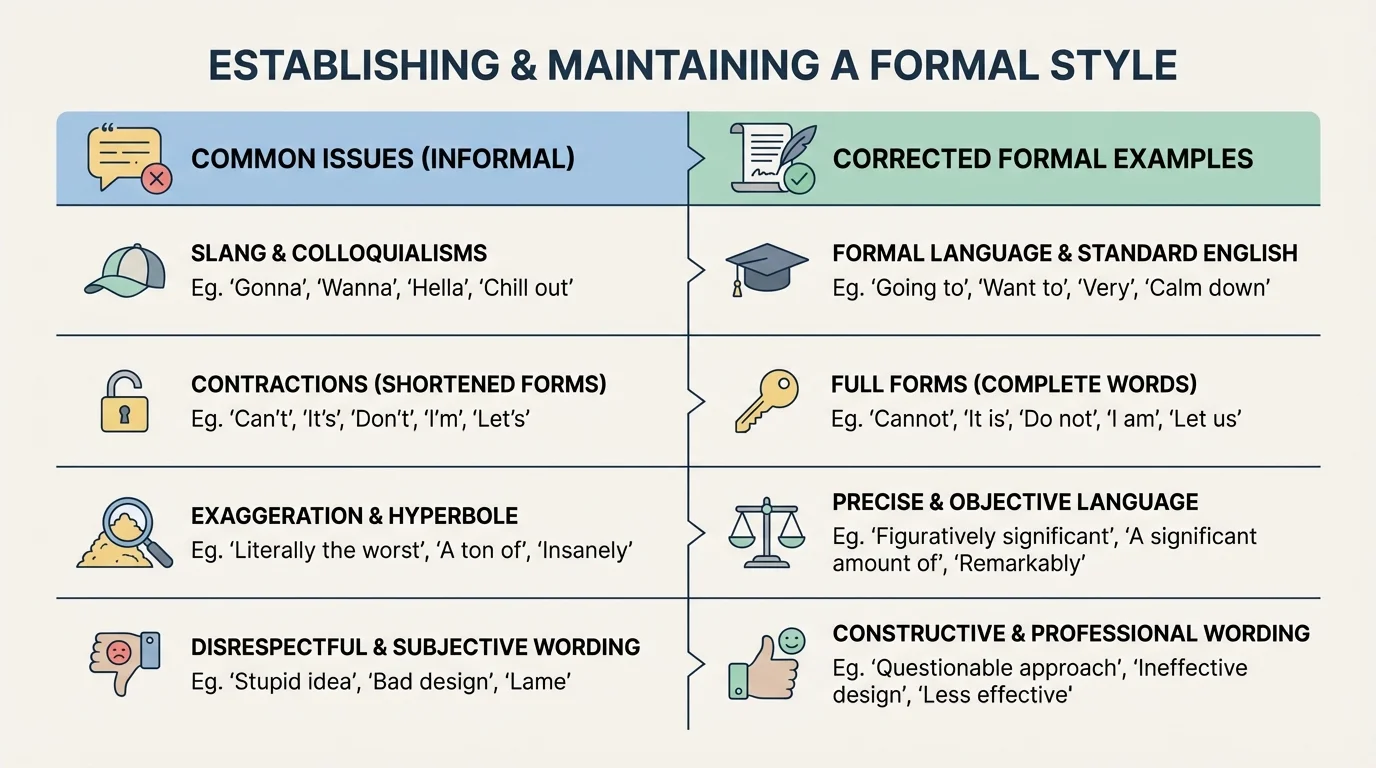
Text-message habits should also stay out of formal arguments. Abbreviations like "u," "bc," or "idk" are not appropriate. Neither are multiple exclamation marks or all-capital shouting. Formal writing relies on clear wording, not visual tricks.
Weak transitions can also hurt style. If a paragraph jumps from one point to another without connection, the writing may seem rushed. Clear transitions help your ideas build logically.
| Common issue | Less formal version | More formal revision |
|---|---|---|
| Slang | "That rule is lame." | "That rule is ineffective." |
| Vague wording | "Stuff gets messed up." | "Important materials are often misplaced." |
| Exaggeration | "Everyone hates it." | "Many students have criticized it." |
| Disrespectful tone | "The other side is clueless." | "The opposing view misses key concerns." |
| Text-message style | "u should def change it" | "The policy should be changed." |
Table 1. Examples of common informal writing problems and stronger formal revisions.
Reading a full example helps show how formal style works in connected writing. Notice how the paragraph below uses a clear claim, specific reasons, evidence, and respectful tone.
Model argument paragraph
School libraries should remain open after the regular school day because they provide students with a quiet place to read, study, and use technology. Many students do not have reliable internet access or a peaceful workspace at home. Keeping the library open for additional hours would give those students a better chance to complete assignments successfully. In addition, librarians can help students locate trustworthy sources, which improves the quality of research and writing. Although extended hours may require planning, the academic benefits make this change worthwhile.
This paragraph sounds formal because it uses precise wording such as "reliable internet access," "trustworthy sources," and "academic benefits." It also includes a respectful response to a possible concern: extended hours may require planning. The writer does not insult anyone or rely on emotion alone.
Notice also that the paragraph stays consistent. It does not suddenly switch from formal language to casual comments. That consistency is an important part of maintaining style.
Some students worry that formal writing will erase their personal voice. That does not have to happen. Your voice is the way your thinking comes through in your writing. A formal style does not remove your ideas; it shapes them so readers can take them seriously.
You can still sound confident and original in formal writing. For example, a writer might say, "A later school start time is not simply a convenience; it is a practical response to how adolescents learn and rest." That sentence is formal, but it also has a strong voice.
When you write an argument, start with a clear claim, support it with reasons and evidence, and connect ideas with transitions. Formal style strengthens each of those parts by making your writing sound credible and focused.
A good way to think about formal style is this: write as if your words are entering an important conversation. You want to sound informed, respectful, and ready to support your ideas. That is true whether you are writing about school rules, community issues, environmental changes, or technology in classrooms.
With practice, formal style becomes less about memorizing rules and more about making smart choices. Each word, sentence, and transition should help readers see that your argument deserves attention.
