Two students can read the same story and come away with different ideas about a character. That is normal. What matters is this: which student can prove the idea using the text? In strong reading, you do not just say, "I think this character is brave" or "The mood feels scary." You show why by pointing to the author's exact words and explaining what those words mean. That skill is called using evidence, and it turns a guess into an analysis.
When readers cite evidence, they act a little like detectives. A detective does not solve a mystery by saying whatever sounds right. A detective studies clues. Readers do the same thing. They notice details, repeated words, actions, descriptions, and dialogue. Then they connect those details to an idea about the text. This is important in class discussions, reading responses, essays, and even everyday conversations about books.
Textual evidence is information from a text that supports an idea, answer, or conclusion. It may be a direct quotation, a paraphrase, or a specific detail from the passage. Analysis is careful thinking about what those details mean. Explicit means clearly stated in the text. An inference is a conclusion a reader draws by combining text clues with what the reader already knows.
A key idea to remember is that evidence and analysis are not the same thing. Evidence is the proof from the text. Analysis is your explanation of what the proof shows. If you only copy a quotation, you have not fully answered. If you only give an opinion without proof, you have not supported your thinking. Good readers do both.
Evidence matters because texts can be understood in more than one way, but not every interpretation is equally strong. A strong interpretation can be backed up with details. For example, if someone says a character is selfish, that claim needs support. Did the character refuse to help others? Did the narrator describe the character as caring only about personal gain? Did the character's choices hurt other people? Without proof, the claim stays weak.
Using evidence also helps you avoid misunderstandings. Sometimes readers remember only part of a scene or focus on one exciting moment. But one detail by itself may not tell the whole story. Strong readers look across the text and choose details that truly fit the idea they are explaining.
Remember that a claim is the idea you are trying to prove. Evidence supports the claim, and explanation shows how the evidence proves it. If one of these parts is missing, the response is incomplete.
This skill matters far beyond English class. Journalists support reports with sources. Historians support arguments with documents. Scientists support conclusions with observations and data. In reading, the source of proof is the text itself.
Sometimes a text gives information directly. When that happens, the answer is explicit, and the reader can point to exact words in the passage, as shown in [Figure 1]. If a story says, "Marta slammed the door and shouted, 'I'm leaving now,'" you do not need to guess whether Marta left angrily. The text states actions and words that clearly show what happened.
Questions about explicit meaning often ask who, what, when, where, or which event happened. To answer them well, reread carefully and locate the part of the text that directly gives the information. Then cite that line or paraphrase it accurately.
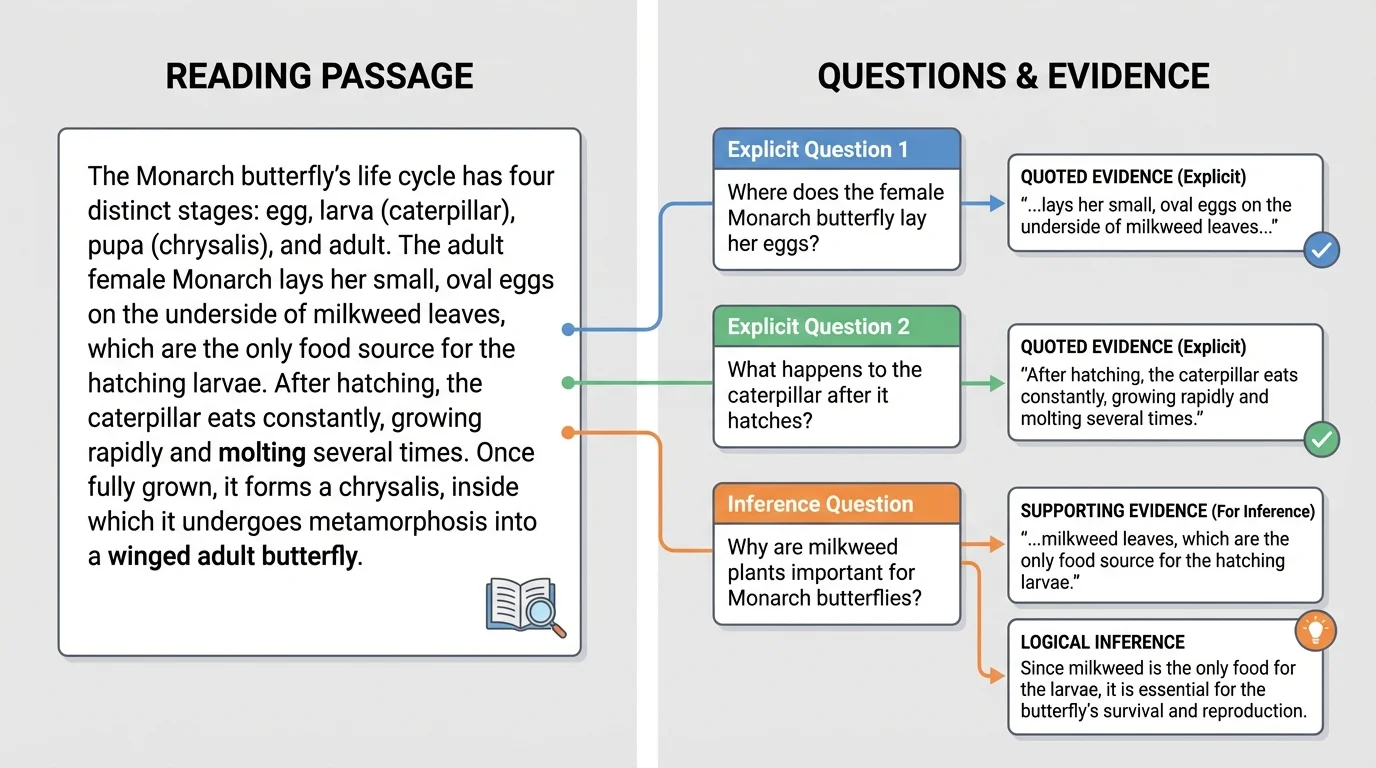
Here is a simple example. Suppose a passage says, "The river had risen three feet overnight, and the bridge was closed by morning." If a question asks why the bridge was closed, the answer is directly in the text: the river rose. A strong response might say, "The bridge was closed because 'the river had risen three feet overnight.'"
Notice that the response does more than copy random words. It chooses the specific part that answers the question. That is an important habit. Not every quote is useful. The best evidence is relevant, which means it directly supports the point you are making.
Example: Finding explicit evidence
Passage: "By the time the team reached the field, rain had soaked the grass, and puddles covered the goal area. Coach Lewis checked the sky, sighed, and canceled practice."
Step 1: Read the question carefully.
Question: Why does Coach Lewis cancel practice?
Step 2: Find the exact detail that answers the question.
The passage states that "rain had soaked the grass, and puddles covered the goal area."
Step 3: Turn the detail into a complete answer.
Coach Lewis cancels practice because the field is too wet to use safely; the text says that rain soaked the grass and puddles covered the goal area.
When you answer explicit questions, accuracy matters. Do not add information the text never says. Do not stretch a small detail into a larger claim. Stay close to the author's words.
[Figure 2] shows that not everything important is stated directly. Authors often expect readers to notice clues and figure out deeper meaning. That process is called an inference, and it works by combining clues from the text with what readers already know. If a character's hands shake, speech becomes short, and eyes avoid contact, the text may never say "the character is nervous," but readers can infer nervousness.
Inference is not random guessing. It must be based on evidence. A reader cannot simply invent an idea and call it an inference. The clues have to lead to the conclusion.
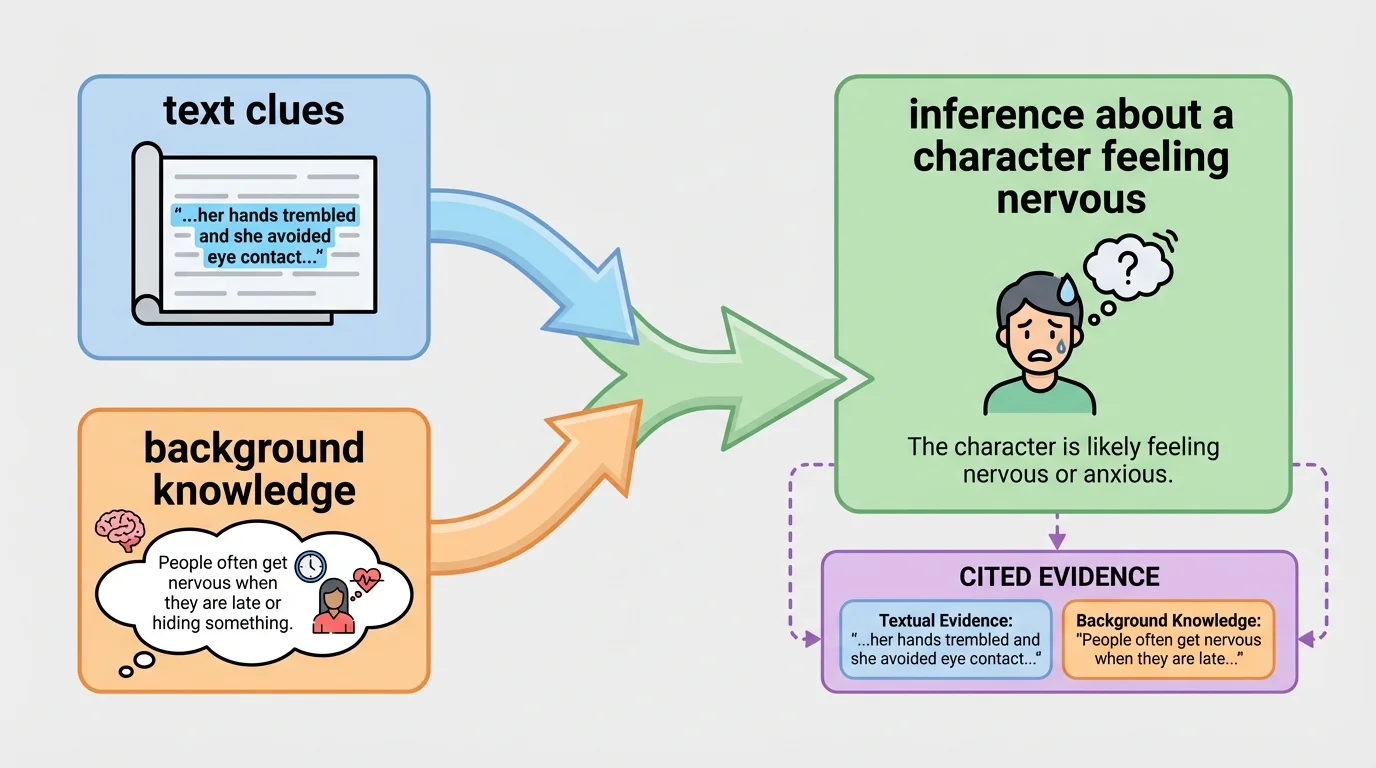
Think of inference as reading between the lines, but not beyond the lines. You stay connected to the text. For example, if a poem describes gray clouds, silent streets, and a flag hanging limp in the rain, you might infer a gloomy or heavy mood. Those details support the idea.
Readers make inferences about many things: a character's feelings, a narrator's attitude, the reasons behind an action, the relationship between two people, the mood of a scene, or the theme of a text. In each case, the reader should be able to answer the question, "What details made you think that?"
How inference works
Readers often use this pattern: notice clues, connect them, and form a conclusion. For example, if a character checks the clock every minute, taps a foot, and rereads a message three times, those clues work together. A reader may infer that the character is anxious or waiting for important news. The inference is strong because it grows out of several details, not just one.
Suppose a story says, "Jalen folded the letter twice more than necessary, tucked it into the back of his desk, and answered his mother with a quick 'fine' without looking up." The author never says Jalen is upset. Yet many readers would infer that he is worried, secretive, or unhappy. The evidence lies in his actions.
Later, when you explain a character's emotions, you can return to the same idea we saw in [Figure 2]: clues lead to conclusions. The best inferences grow from a pattern of evidence rather than a single isolated word.
Strong evidence is specific, accurate, and connected to the point you are making. It may come in the form of a direct quotation, a paraphrase, or a brief description of an event. The form matters less than the precision. A weak response says, "The text shows this." A stronger response identifies exactly how the text shows it.
Direct quotation uses the author's exact words. Quotations are especially useful when the wording is powerful or precise. Paraphrase means restating the text in your own words while keeping the original meaning. Paraphrasing is useful when you want to explain a longer idea clearly and briefly.
A good reader chooses the kind of evidence that fits the purpose. If one word in dialogue reveals a character's attitude, quote that word or sentence. If an entire event matters, summarizing the event briefly may work better than quoting a long section.
| Type of evidence | What it does | Best use |
|---|---|---|
| Direct quotation | Uses the text's exact words | When wording is especially important |
| Paraphrase | Restates the idea in your own words | When the original is long or complex |
| Specific detail | Points to an action, description, or event | When explaining plot, character, or setting |
Table 1. Types of textual evidence and when each is most useful.
Strong evidence is also enough evidence. One detail may help, but sometimes one detail is not enough. If you are explaining a theme or a character trait, more than one piece of evidence often makes your analysis stronger. A repeated pattern in the text is more convincing than a single moment taken out of context.
Skilled readers often reread short parts of a passage several times. The first reading helps them understand what happens; later readings help them notice patterns, word choice, and clues that support deeper analysis.
Be careful not to confuse a summary with evidence. A summary tells what happened in general. Evidence points to the exact part of the text that supports your point. A summary can help set up your response, but it does not replace proof.
[Figure 3] shows how many strong responses follow a simple structure: make a claim, give evidence, and explain how the evidence supports the claim. This pattern keeps your thinking organized. Without the explanation, the reader may not understand why the evidence matters.
A useful sentence frame is: "The text shows ___ because ___." Another is: "This suggests ___ because the author writes ___." These are not the only possible structures, but they help you connect proof to meaning.
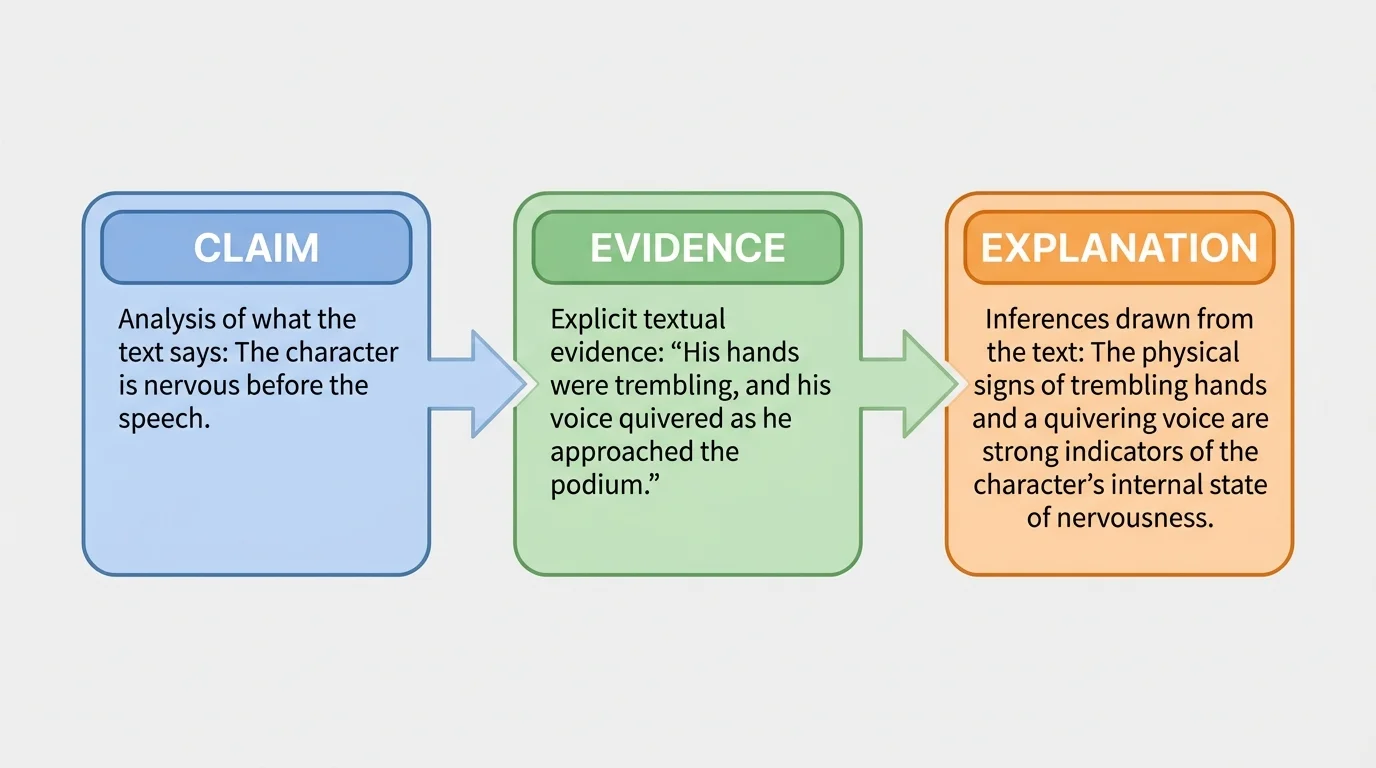
Consider this claim: "Ava feels nervous before the performance." Evidence might be: "She keeps smoothing the edge of her sleeve and whispering the first line to herself." The explanation would connect the detail to the claim: these repeated actions suggest nervousness because people often fidget and rehearse when they are worried about making a mistake.
Example: Building an analysis response
Passage: "Before stepping onto the stage, Ava smoothed the edge of her sleeve three times and mouthed the opening line under her breath. When the curtain rustled, she drew in a quick breath and closed her eyes."
Step 1: Make a claim.
Ava is nervous before going on stage.
Step 2: Add evidence.
The text says that she smoothed her sleeve three times, mouthed the opening line, and took a quick breath when the curtain rustled.
Step 3: Explain the evidence.
These actions suggest nervousness because they show repeated fidgeting and mental preparation right before the performance.
A full response could say: Ava is nervous before going on stage because she repeatedly smooths her sleeve, mouths the opening line, and takes a quick breath when the curtain rustles. These details show that she is tense and trying to steady herself.
In discussion, the same skill applies. If a classmate disagrees, you can return to the text. You might say, "I think the character is lonely because the narrator describes the apartment as silent and says he listens for footsteps in the hall." That kind of response is respectful, clear, and evidence-based.
Later, if you are writing about a theme, the structure in [Figure 3] still works. Your claim may be larger, but you still need proof and explanation, not just a statement of belief.
It helps to see the difference between responses that merely sound confident and responses that are actually supported.
Weak response: "The main character is kind."
This is only a claim. It has no support.
Better response: "The main character is kind because she gives her lunch to a new student and later walks him to class when he is lost."
This response uses evidence, but it can still improve.
Strong response: "The main character is kind because she notices that the new student has no lunch, gives him her own, and later walks him to class when he is lost. These actions show that she pays attention to other people's needs and chooses to help without being asked."
Now the response includes a claim, evidence, and analysis. It explains why the actions matter.
Example: Weak evidence vs. strong evidence
Claim: The setting feels threatening.
Weak support: "It is scary."
This gives an opinion but no proof from the text.
Stronger support: "The alley is described as narrow and dark."
This uses a detail, but it may still need explanation.
Strong support with analysis: "The setting feels threatening because the alley is described as narrow, dark, and silent except for footsteps echoing behind the character. These details create a sense of danger and make the character seem trapped."
Three common mistakes appear often. First, some readers use evidence that does not actually support the claim. Second, some choose evidence that is too broad or vague. Third, some provide evidence but never explain it. When you revise, check for all three problems.
[Figure 4] organizes the kinds of clues readers often use because different literary elements call for different kinds of support. When analyzing character traits, readers often look at actions, dialogue, thoughts, and how others react to the character. When analyzing setting, readers notice sensory details and descriptions of place and time.
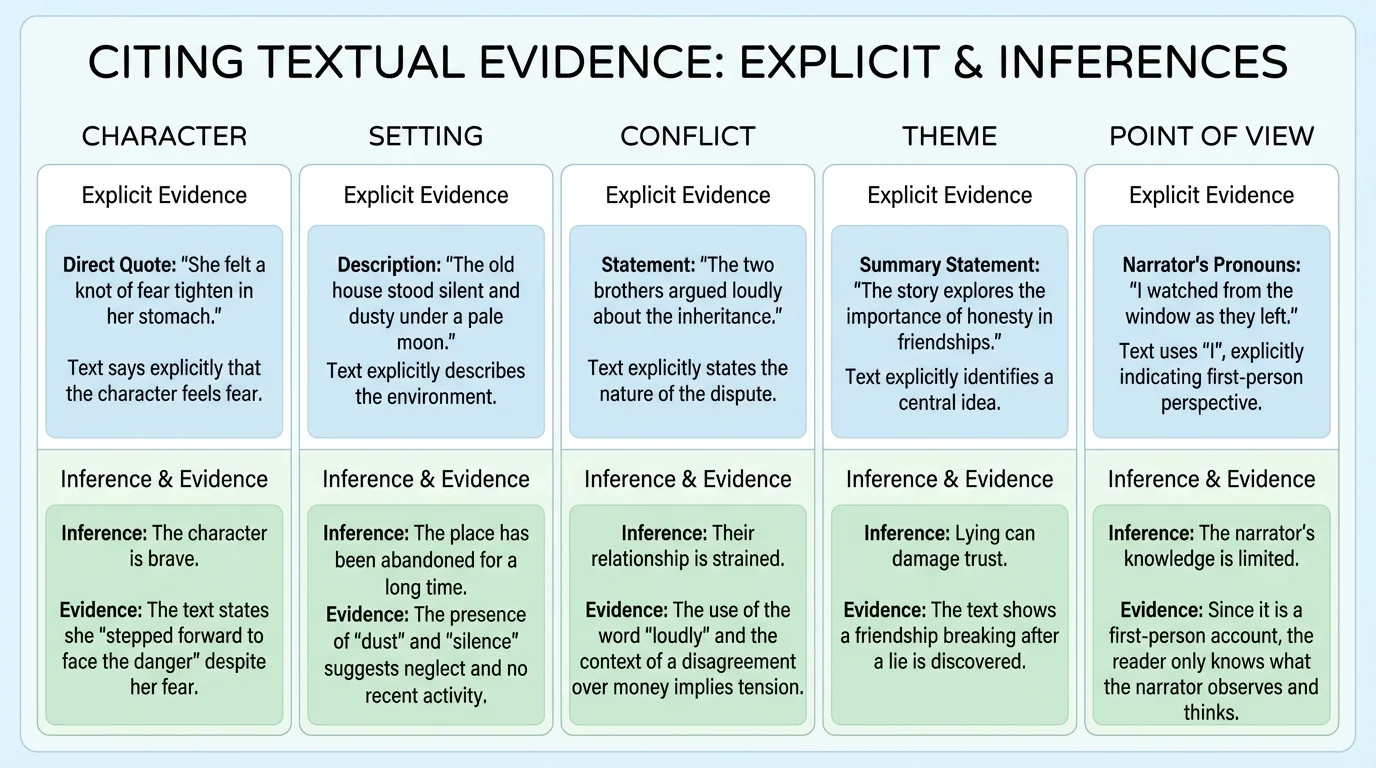
For conflict, evidence may come from obstacles, arguments, inner struggles, or difficult choices. For theme, readers often gather evidence from repeated ideas, turning points, and lessons suggested by events. For point of view, evidence may come from the narrator's language, perspective, and limits in what is known.
Suppose you claim that a story's theme is perseverance. Strong evidence might include a character failing, trying again, and continuing despite embarrassment or pain. A single line about hard work might help, but repeated moments across the story would support the theme more strongly.
Poetry also requires evidence, though it may look different. In a poem, one image, repeated word, or contrast between two ideas can be powerful evidence. If you claim that a poem creates a peaceful mood, you might cite images of still water, quiet light, and slow movement.
Drama gives evidence through dialogue, stage directions, and character interactions. If a playwright writes that a character speaks "in a trembling voice," that stage direction can support an inference about fear. The same habit of proof still applies, even though the text form is different.
When you analyze literary elements, the chart in [Figure 4] remains useful because it reminds you to match your claim to the right kind of clue. Character claims need character evidence; theme claims need pattern evidence; point-of-view claims need narrator evidence.
The skill of citing evidence works across many kinds of reading. In fiction, you may analyze plot, character, theme, and mood. In nonfiction, you may support ideas about the author's main point, reasons, examples, or tone. In both cases, the rule stays the same: point to details from the text and explain how they support your answer.
In an article about recycling, for example, a reader might infer that the author wants communities to act quickly if the article includes urgent words, statistics, and examples of overflowing landfills. In a memoir, a reader might infer how the author felt about an event by noticing the details included and the tone of the narration.
"The text says more than the words on the page when a careful reader follows the clues."
Sometimes students think quoting more automatically means stronger writing. It does not. A long quotation with no explanation is often weaker than a short, precise quotation that is carefully explained. The goal is not to pile up lines from the text. The goal is to choose the best evidence.
Before giving an answer, slow down and ask yourself several questions. What exactly is my claim? Which detail from the text best supports it? Is the detail explicit, or am I making an inference? If I am making an inference, what clues lead me there? Have I explained how the evidence connects to my idea?
Many readers find it helpful to annotate while reading. They underline important details, circle repeated words, and jot short notes in the margin. These small actions make it easier to return to evidence later. They also help you see patterns, which are especially important when analyzing themes and character development.
Another strong habit is checking whether the evidence could support a different claim better than your own. If so, you may need new evidence. The best responses fit together tightly: claim, evidence, and explanation all point in the same direction.
As you become a more skilled reader, you will notice that evidence-based analysis makes books, poems, plays, and articles more interesting. Instead of reading only for events, you begin to notice choices the author makes. You see how words shape meaning, how details build mood, and how clues guide inference. Reading becomes deeper, sharper, and more rewarding.
