A single word can take on very different meanings depending on its context. If someone says a comedian is sharp, that probably means clever. If a knife is sharp, it means it can cut easily. If a sound is sharp, it might mean harsh or sudden. Strong readers do more than recognize words—they study how those words work inside a sentence, a paragraph, and a whole text.
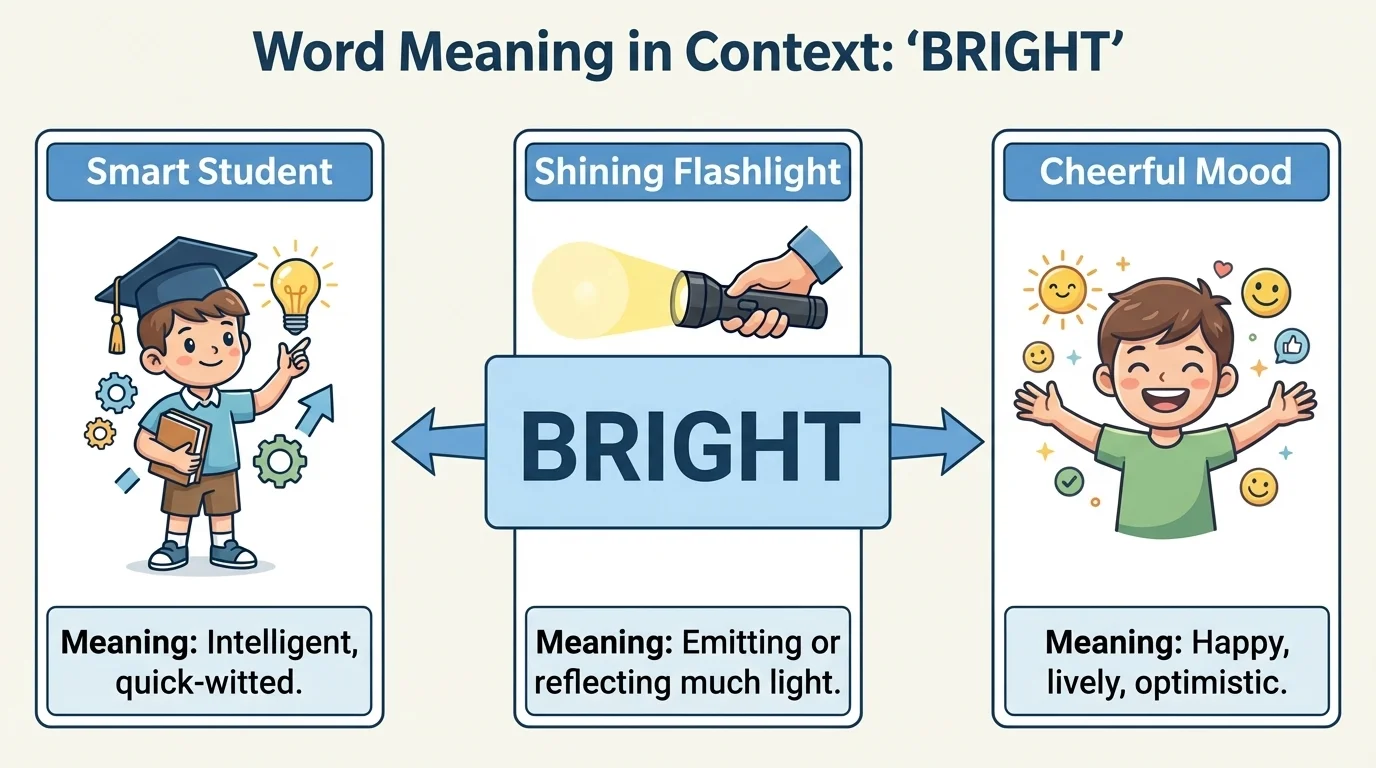
When readers determine meaning, they do not just grab the first definition they remember. They look at context, or the words, sentences, and ideas around the word. As [Figure 1] shows, the same word can point to very different ideas depending on the clues surrounding it.
Suppose you read, "Mina had a bright idea for fixing the robot." Here, bright does not mean full of light. It means smart or clever. But in the sentence "The bright flashlight lit the cave," the word means shining strongly. In "His bright mood lifted the whole team," it means cheerful. The exact same word shifts meaning because the context shifts.
Authors count on readers to notice these clues. A story, poem, or article often gives hints through actions, descriptions, comparisons, or the topic being discussed. If readers ignore those hints, they may misunderstand the whole passage.
Literal meaning is the ordinary, direct meaning of a word or phrase.
Figurative meaning is a nonliteral meaning that goes beyond the exact words.
Connotative meaning is the feeling or association a word carries in addition to its basic meaning.
Technical meaning is the special meaning a word has in a particular subject or field.
These kinds of meaning often overlap. A writer may choose a technical term in a science article, a figurative phrase in a poem, or a word with a strong connotation in a speech. Skilled readers learn to ask not just "What does this word mean?" but also "What kind of meaning is the author using here?"
The most direct type is literal meaning. If a text says, "The glass fell off the table and broke," the sentence means exactly what it says. There is no hidden comparison. Literal meaning matters because every reader needs a clear understanding of what is directly happening.
Figurative meaning appears when words are used in a creative or nonliteral way. If a character says, "My backpack weighs a ton," the backpack probably does not actually weigh a ton. The phrase uses exaggeration to show that it feels very heavy.
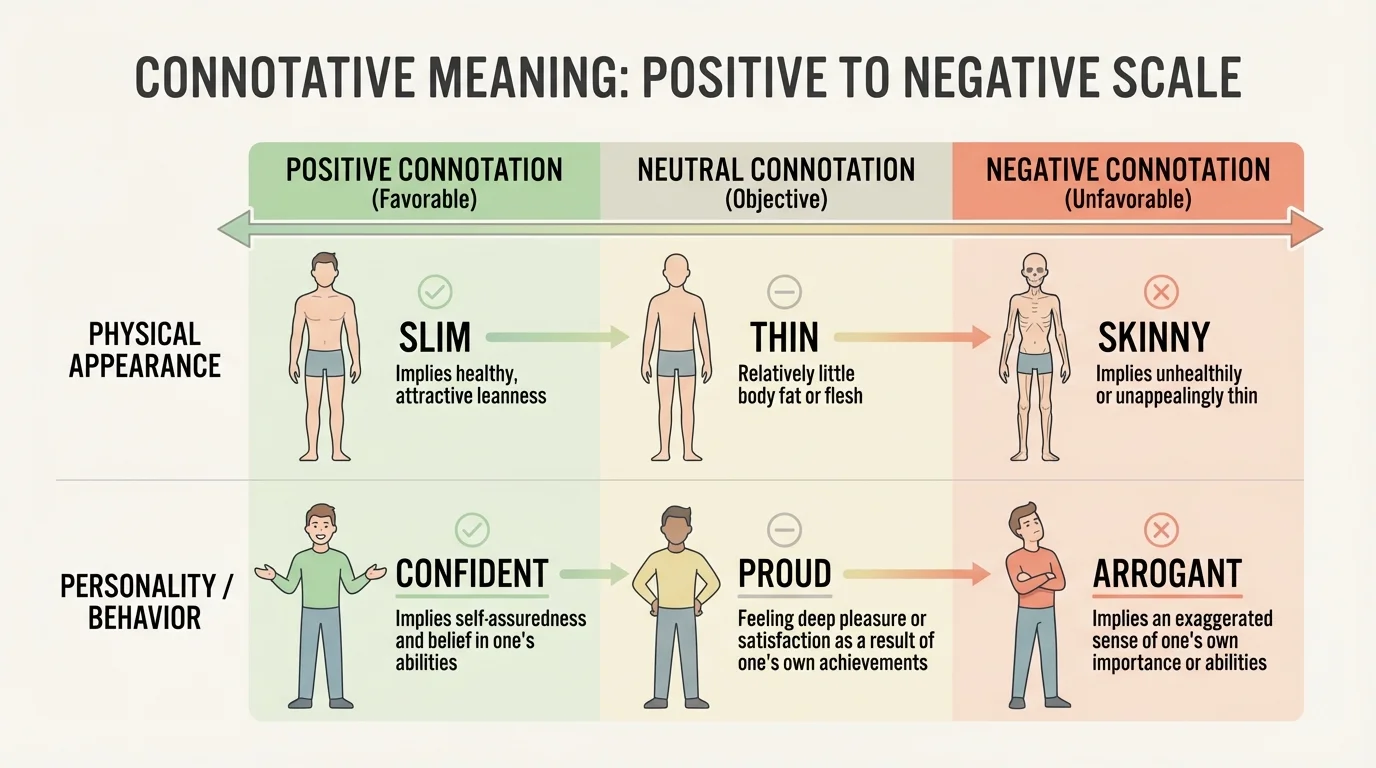
Connotative meaning deals with feeling and attitude. Two words may share nearly the same dictionary meaning, yet one sounds positive and another sounds negative. For example, confident and arrogant can both describe someone who believes in themselves, but confident is usually positive while arrogant is usually negative.
Technical meaning appears in subject-specific reading. In everyday conversation, cell might mean a small room, such as a prison cell. In biology, a cell is the basic unit of life. In technology, a cell can also mean part of a battery. The topic of the text helps you decide which meaning fits.
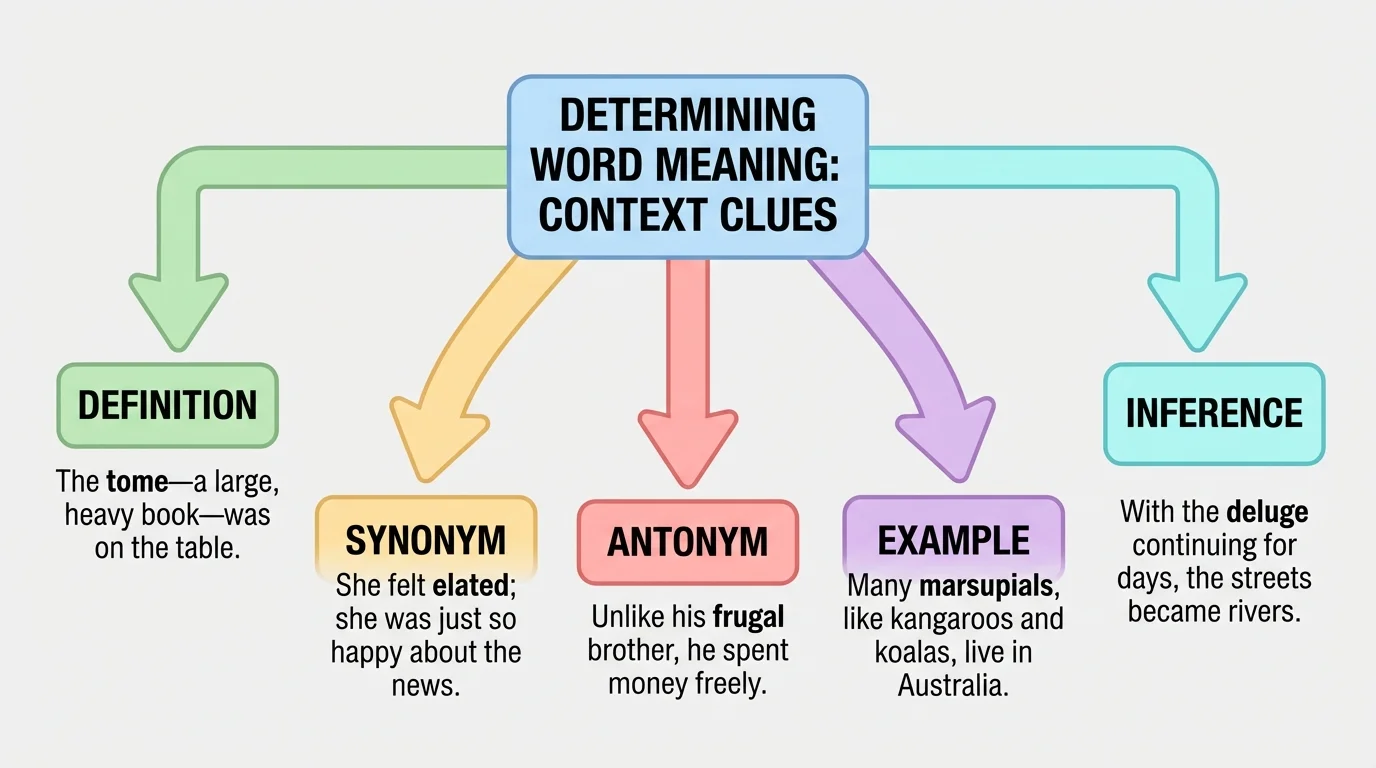
Readers often act like detectives. When an unfamiliar word appears, they search the surrounding text for clues. Some clues are direct, and some must be inferred. The main kinds of clues are definition clues, synonym clues, antonym clues, example clues, and inference clues, as [Figure 2] illustrates.
A context clue can appear right next to the word. In "The desert was arid, or extremely dry, for most of the year," the phrase "extremely dry" gives a definition clue. The text explains the word directly.
Writers also use synonym clues. In "The path was narrow, so slim that only one hiker could pass," the word slim helps explain narrow. Antonym clues work through opposites. In "Unlike his timid brother, Jay was bold and ready to speak," the contrast with timid helps the reader understand bold.
Example clues provide samples. In "Celestial objects, such as stars, planets, and moons, fill the night sky," the examples explain what celestial means. Inference clues are less direct. In "Tasha pulled her coat tight, her teeth chattered, and frost covered the window," the word frigid is never defined, but the details suggest intense cold.
Context clue example
Read this sentence: "The audience was captivated; everyone leaned forward, listened closely, and forgot to check their phones."
Step 1: Notice the surrounding details.
The audience leaned forward, listened closely, and stayed focused.
Step 2: Infer the meaning.
Those actions suggest strong interest and attention.
Step 3: State the best meaning in context.
Captivated means very interested or completely absorbed.
Not every clue is equally strong. A direct definition is easier to use than an inference clue, but both matter. Good readers gather several hints before deciding on meaning. They test a possible meaning in the sentence and ask whether it makes sense in the paragraph and the whole text.
Figurative language is one of the most exciting parts of reading because it lets writers express ideas in memorable ways. Instead of saying "The classroom was noisy," a writer might say, "The classroom buzzed like a beehive." That comparison creates a stronger image.
A simile compares two unlike things using words such as like or as. "Her smile was as warm as sunlight" does not mean her smile is made of light. It means the smile feels comforting and kind. A metaphor makes a direct comparison without like or as. "Time is a thief" means time takes things away from us, not that time is literally a criminal.
Personification gives human traits to nonhuman things. "The wind whispered through the trees" suggests a soft, quiet sound. Hyperbole is purposeful exaggeration, as in "I waited forever." An idiom is a phrase whose meaning cannot be understood by the exact words alone. If someone says, "Break a leg," they usually mean "Good luck," especially before a performance.
To understand figurative meaning, ask what idea or feeling the writer is trying to create. If a poem says, "Hope is a small candle in the storm," the phrase points to persistence and light in hard times. The reader should focus on the comparison, not on whether a real candle is present.
Many everyday expressions are figurative. Phrases like "spill the beans," "hit the books," and "under the weather" make sense only when readers know their nonliteral meanings.
Poetry often depends heavily on figurative language, but fiction and nonfiction use it too. Sports writing may describe a player as "on fire," and news writing may say a debate "sparked" controversy. These expressions are common, but they still require readers to think beyond literal meaning.
[Figure 3] Words do more than name things; they also carry feelings. This emotional association is called connotation. Words can point to a similar basic idea while sounding positive, neutral, or negative.
Consider the words slim, thin, and skinny. All can describe a person with low body weight, but they do not sound the same. Slim often sounds positive, thin is more neutral, and skinny can sound negative. The denotation, or basic dictionary meaning, overlaps, but the connotations are different.
Connotation strongly affects tone, the author's attitude toward the subject or audience. If a writer calls a plan careful, the tone may sound respectful. If the same plan is called overcautious, the tone may sound critical. The facts may be similar, but the word choice changes the reader's impression.
Authors choose connotations on purpose. In a mystery story, a house might be described as lonely, abandoned, or decaying. Each word gives a slightly different feeling. In a speech, calling a group determined sounds different from calling them stubborn. Readers should ask, "Why did the author choose this word instead of another one?"
| Word Set | Basic Meaning | Connotation |
|---|---|---|
| childlike / childish | having qualities of a child | childlike is often positive; childish is often negative |
| fragrance / smell / odor | a scent in the air | fragrance is positive, smell is neutral, odor is often negative |
| thrifty / cheap | careful with money | thrifty is positive; cheap is often negative |
Table 1. Examples of words with similar basic meanings but different connotations.
Later, when you analyze a character or speaker, the idea in [Figure 3] remains important. If a narrator describes someone as bossy instead of confident, that choice signals attitude. Connotation helps readers hear the hidden feeling inside a word.
Some words become more precise in special fields. This is their technical meaning. In everyday speech, volume may mean how loud music is. In mathematics, volume measures the amount of space inside a solid figure. In publishing, a volume can mean one book in a series.
In science, a theory does not simply mean a wild guess. It means a well-supported explanation based on evidence. In computer science, a bug is not an insect; it is an error in a program. In art, medium can refer to the material used, such as paint, clay, or ink. The subject area changes the meaning.
Readers must pay attention to the topic, the text features, and the author's purpose. A science textbook, a sports article, and a fantasy novel may use the same word differently. If a basketball article says a player has "great vision," it likely means awareness of the court, not eyesight alone.
How technical meaning helps precision
Specialized subjects need words that are exact. When scientists, historians, coders, or musicians use technical terms, they can communicate complex ideas clearly and efficiently. Readers who notice the subject and purpose of a text are more likely to choose the correct meaning.
This is why reading in different subjects can feel different. Literature may ask you to notice mood and symbolism, while science often asks you to notice precise definitions. Both kinds of reading require careful attention to how words are used in context.
An author's craft and structure shape the meaning of words and phrases. Craft includes the writer's choices about language, imagery, and style. Structure includes how ideas are organized in sentences, paragraphs, stanzas, scenes, or sections.
Suppose an author repeats the phrase "still they climbed" several times in a survival story. The repeated phrase gains power with each use. It comes to mean more than the act of climbing; it suggests determination. Placement matters too. A short sentence after a long descriptive paragraph can make one word or phrase stand out sharply.
In poetry, line breaks can affect how a word is understood. In drama, a character's words may mean one thing on the surface and another through sarcasm or tension. In informational text, headings, bold print, and sidebars can signal that a word is important or used in a special way.
Readers should also notice who is speaking. If a narrator says a town is "peaceful," that may sound sincere. If an angry character calls the same town "peaceful," the word might be sarcastic. Meaning is not only in the word itself but also in the speaker, the situation, and the structure around it.
In a story, readers often study words to understand character, setting, and conflict. If a forest is described as twisted, shadowy, and silent, those words create suspense. In a poem, a phrase might carry several layers of meaning at once, including sound, image, and emotion.
In drama, dialogue can contain hidden meaning. A character may say "Fine" while clearly meaning the opposite. Readers must notice stage directions, punctuation, and the situation. In informational text, readers need to be alert for technical meanings and carefully defined terms.
Even within one type of text, a phrase can shift in meaning over time. A repeated image in a novel may first seem simple and later become symbolic. A phrase in a speech may begin as a description and later become a call to action. Meaning develops as the text develops.
Comparing meanings across text types
The phrase "a storm is coming" can work differently in different texts.
Step 1: In an informational weather report, it is literal.
It means an actual storm is approaching.
Step 2: In a novel, it may be figurative.
It can suggest trouble, conflict, or change is about to happen.
Step 3: In a speech, it may carry connotation.
It may create urgency, fear, or determination depending on the speaker's tone.
This is why strong readers always connect a word or phrase to the whole text. They ask what kind of text they are reading, what the author is trying to do, and what effect the language has on the audience.
One common mistake is relying only on the dictionary. Dictionaries are useful, but they list many meanings. Readers still have to choose the meaning that fits the context. Another mistake is taking every phrase literally. If a poem says "the stars danced," literal reading will miss the image and feeling.
A third mistake is ignoring connotation. Two answer choices in a discussion may seem close, but one may better match the author's attitude because of its emotional shading. A fourth mistake is forgetting technical meaning in subject-area reading. In science and social studies especially, words may have more precise meanings than they do in everyday conversation.
Readers also sometimes focus on only one sentence. But meaning often becomes clearer when you read before and after the line. Looking at the full paragraph, the speaker, and the text structure usually leads to a stronger interpretation.
When you meet an unfamiliar or interesting word, slow down. First, reread the sentence. Next, read the sentences around it. Then ask whether the word is being used literally, figuratively, connotatively, or technically. After that, test a possible meaning in the sentence. If it fits the whole passage, you are probably on the right track.
This habit works in every subject. It helps when reading novels, poems, science articles, historical speeches, and even instructions for technology. Careful attention to words is one of the fastest ways to become a stronger reader because meaning is built word by word, phrase by phrase, and sentence by sentence.
When readers learn to determine meaning accurately, they do more than define vocabulary. They uncover tone, understand characters, follow ideas, and notice the author's craft. A single word can reveal mood, attitude, conflict, or precision. That is why paying attention to how words are used in a text is such a powerful reading skill.
