A single word can change how clearly you understand a science article, a history chapter, or even a set of directions. Think about the difference between reading "The solution was effective" and encountering "The antidote neutralized the venom." The second sentence is more precise, but only if you know what the important words mean. Strong readers and writers do more than memorize definitions. They notice clues, study how words are built, and choose words carefully so their ideas are exact.
Comprehension means understanding what you read, hear, or view. Vocabulary is one of the strongest tools for comprehension because texts in every subject depend on words that carry precise meanings. If you do not know an important word, you may miss the meaning of a sentence, a paragraph, or even a whole chapter.
Vocabulary also helps with expression. When you have a wider word bank, you can explain ideas more exactly. Instead of saying something was "good," you might say it was effective, convincing, efficient, or beneficial. Each word has a slightly different meaning. Accurate word choice makes your speaking and writing clearer, stronger, and more mature.
General academic words are words that appear across many subjects, such as analyze, compare, factor, structure, and evidence.
Domain-specific words are words tied closely to a particular subject, such as photosynthesis in science, legislative in civics, or denominator in mathematics.
Knowing both kinds of words is important. General academic words help you understand school language across classes. Domain-specific words help you understand the exact content of a subject.
In school, you regularly meet two major kinds of important vocabulary, as [Figure 1] shows through a subject-by-subject comparison. One kind travels across many classes, while the other belongs mostly to one discipline. Learning to notice the difference helps you decide how a word functions in a text.
General academic words are useful in many settings. Words like interpret, maintain, significant, contrast, and method appear in literature, science, social studies, and math. For example, you can interpret a poem, interpret a graph, or interpret a historical event.
Domain-specific words belong to a narrower field. In science, you may read ecosystem, molecule, or evaporation. In social studies, you may encounter amendment, economy, or migration. In math, you may see coefficient, integer, or ratio. These terms are especially important because they often carry the main ideas of the lesson.
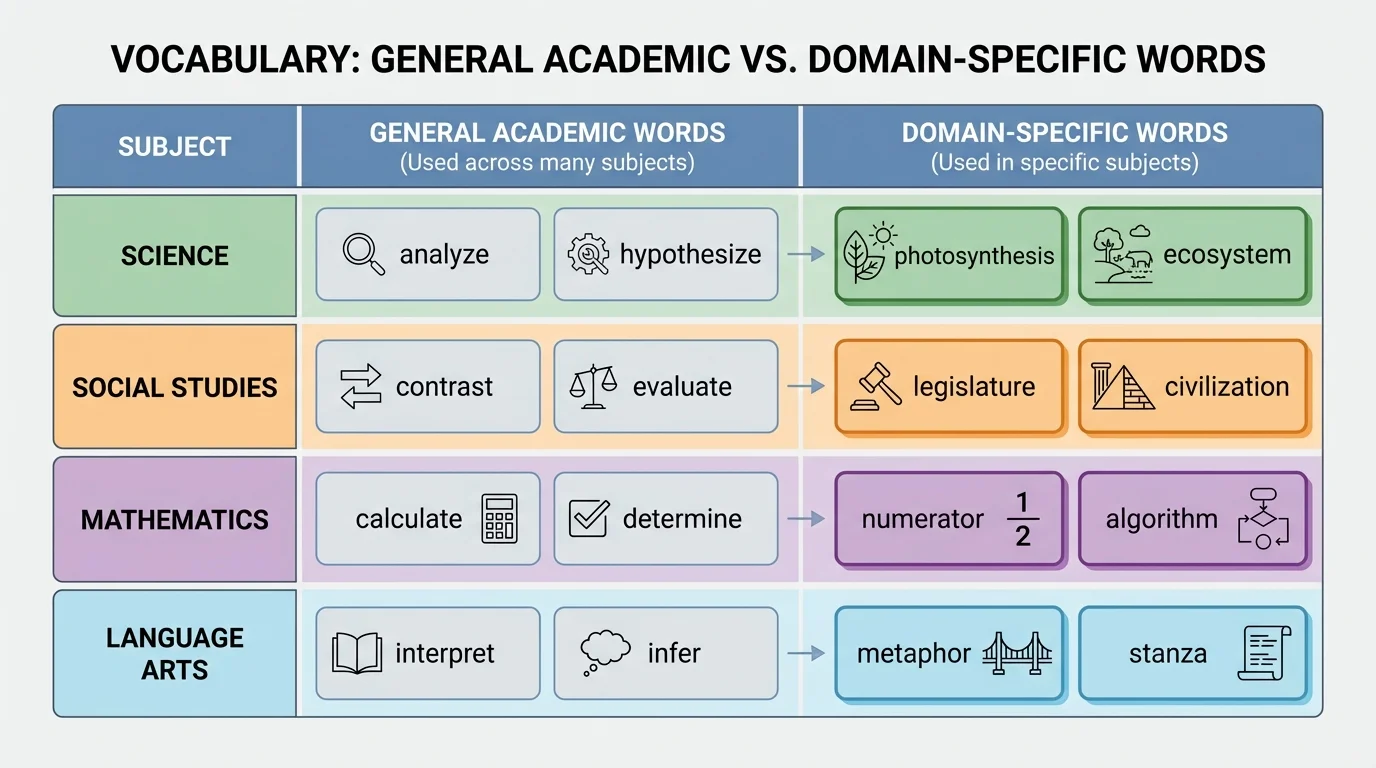
One smart habit is to ask, "Is this a word I can use in many classes, or is it mostly used in one subject?" That question helps you connect new learning. If you know that analyze is useful everywhere, you can reuse it often. If you know that photosynthesis belongs mainly to biology, you understand that it names a very specific concept.
Many of the longest words in textbooks become less intimidating once you realize they are built from smaller meaningful parts. A word that looks difficult at first often becomes manageable when you break it apart.
Not every important word is long. Short words can also carry big meaning. In history, the word draft can mean a first version of writing or required military service, depending on context. In science, cell means something very different from a prison cell. Accurate vocabulary knowledge means understanding which meaning fits the situation.
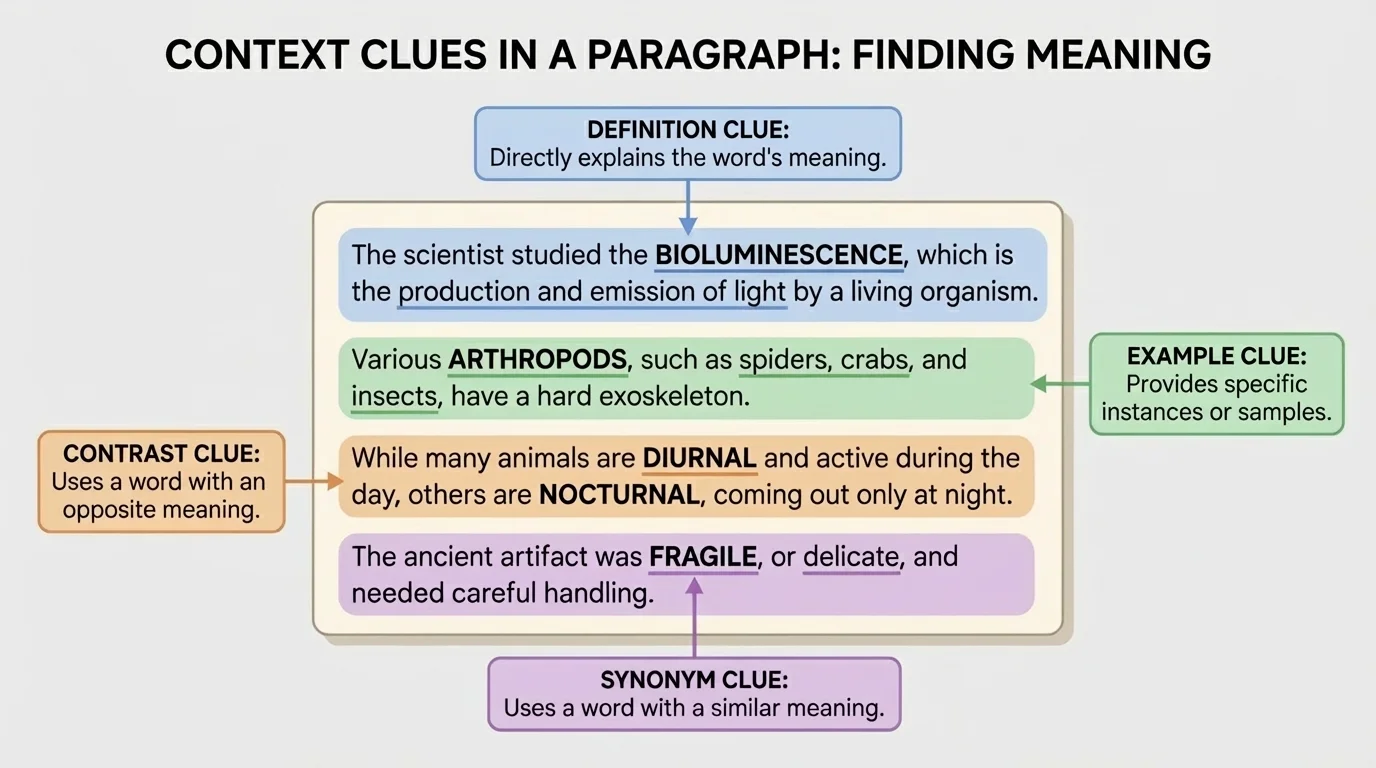
Sometimes a text gives you enough clues to figure out an unfamiliar word without stopping immediately for a dictionary. These context clues act like signals hidden around the unknown word, and [Figure 2] illustrates how different clue types can appear in the same paragraph. Good readers scan the sentence before and after the word, not just the word itself.
Writers often provide clues in several ways. A definition clue directly explains the word. An example clue gives examples that reveal the meaning. A contrast clue shows what the word is not. A synonym clue places a similar word nearby.
Look at these examples. "The desert is an arid region, a place with very little rainfall." The phrase after the comma defines arid. In "Many nocturnal animals, such as bats and owls, are active at night," the examples show that nocturnal means active at night. In "Unlike the fragile vase, the metal container was durable," the contrast suggests that durable means strong or long-lasting.
Context clues are helpful, but they are not perfect. Sometimes they help you get a rough meaning, not a complete one. If a word is central to understanding the text, you should gather stronger vocabulary knowledge by rereading, checking word parts, and confirming the meaning in a reliable source.
Reading example: using context clues
Read this sentence: "After weeks of argument, the two sides finally reached a compromise, an agreement in which each side gave up something."
Step 1: Find the unfamiliar word.
The word is compromise.
Step 2: Look for nearby clues.
The phrase after the comma explains the word: "an agreement in which each side gave up something."
Step 3: Build the meaning.
A compromise is an agreement where each side accepts less than it originally wanted.
The context gives a direct definition, so the reader can determine the meaning accurately.
Later, when you meet the same word in a debate article or a classroom discussion, you can connect it to this meaning. That is how vocabulary grows: not from one quick guess, but from repeated accurate use.
Another powerful strategy is morphology, the study of word parts and how they work together. When you understand prefixes, suffixes, and roots, you can often unlock unfamiliar vocabulary, as [Figure 3] demonstrates with a word broken into meaningful pieces.
A prefix comes at the beginning of a word. It changes meaning. For example, un- means "not," re- means "again," and pre- means "before." A suffix comes at the end. It may change a word's meaning or its part of speech. For example, -ful means "full of," -less means "without," and -tion often turns a verb into a noun.
A root is the core part that carries the main meaning. In transport, the root port means "carry." In inspect, the root spect relates to "look." In biology, the root bio means "life." When readers know common roots, they can make smart predictions about meaning.
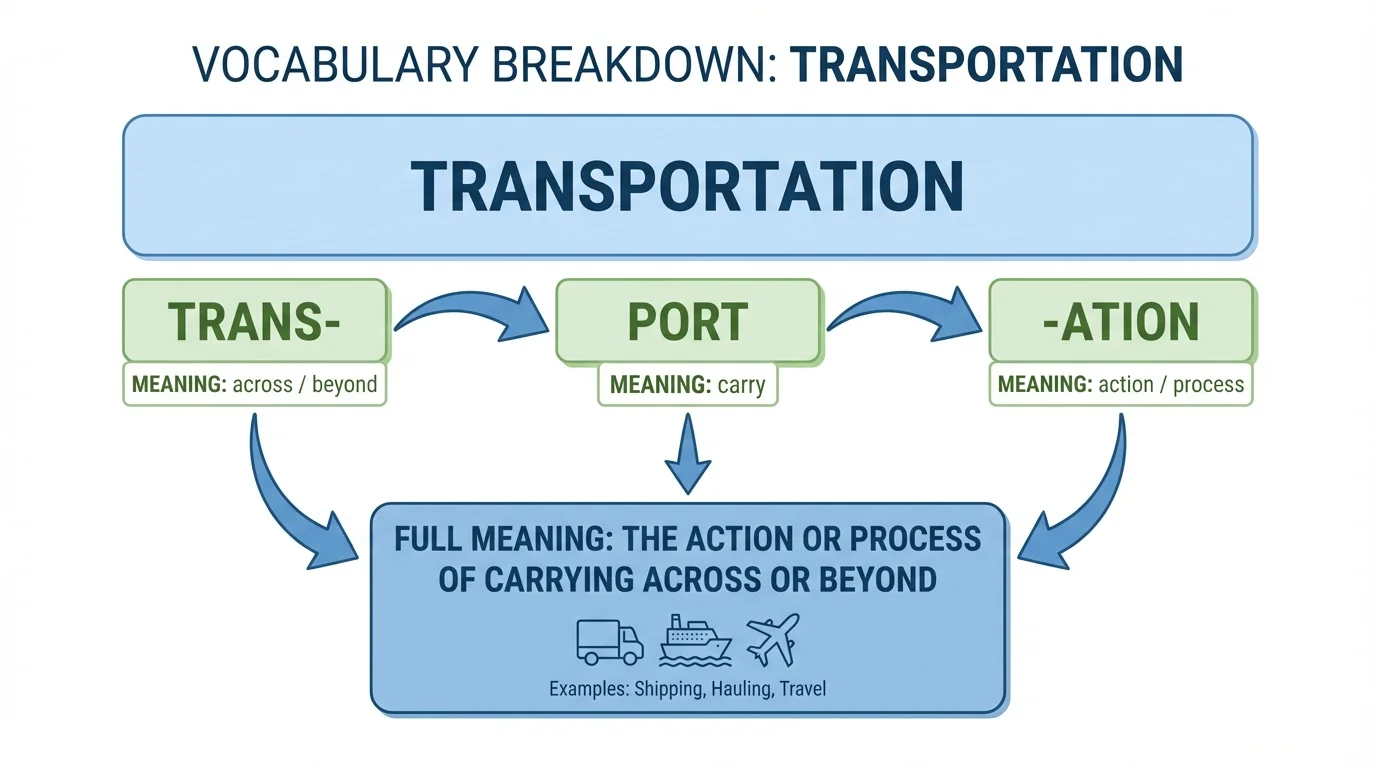
For example, if you see the word preview, you can break it into pre- meaning "before" and view meaning "look." A preview is something you look at before the full event or text. If you see careless, the suffix -less tells you it means "without care" or "not careful."
This strategy works especially well with academic vocabulary. Consider submarine: sub- means "under," and marine relates to the sea. A submarine operates under the sea. Or consider geology: geo means earth, and -logy means study. Geology is the study of Earth.
| Word Part | Meaning | Example | Helpful Meaning |
|---|---|---|---|
| pre- | before | predict | say before it happens |
| re- | again | rewrite | write again |
| un- | not | unequal | not equal |
| -less | without | hopeless | without hope |
| -ful | full of | helpful | full of help; useful |
| bio | life | biography | writing about a life |
| spect | look | inspect | look closely at |
Table 1. Common prefixes, suffixes, and roots that help students determine the meanings of unfamiliar words.
Word parts do not solve every mystery. Some words come from older languages and have changed over time. Still, morphology gives you a strong starting point, especially when combined with context clues. The chart in [Figure 1] helps here too, because many academic and domain-specific words repeat common roots across subjects.
Words are connected to other words. Understanding those relationships helps you learn new vocabulary faster and use it more accurately. Synonyms are words with similar meanings, such as happy and joyful. Antonyms are opposites, such as ancient and modern.
But words are rarely exact copies of one another. They carry different strengths and feelings. Compare walk, stride, stroll, and march. All relate to moving on foot, but each creates a different image. This is called a shade of meaning. Skilled writers choose the word whose shade of meaning fits their purpose.
Another important idea is connotation, the feeling or association a word suggests. The words slim and skinny can describe a similar body shape, but slim often sounds positive while skinny can sound negative. Denotation is the basic dictionary meaning; connotation is the emotional coloring.
Precise word choice means selecting the word that most exactly matches your idea. Precise vocabulary improves both comprehension and expression because it helps readers form a sharper picture and helps writers communicate with fewer misunderstandings.
Categories also matter. If you learn the word mammal, you can connect it to a category that includes whales, dogs, and humans. If you learn legislature, you can place it in the category of government institutions. Organizing words into categories helps memory because your brain stores connected ideas more easily than isolated ones.
Multiple-meaning words require special attention. The word volume can mean loudness in music, space in math and science, or a book in a series. The right meaning depends on the sentence and subject. That is why students must always pay attention to context and domain.
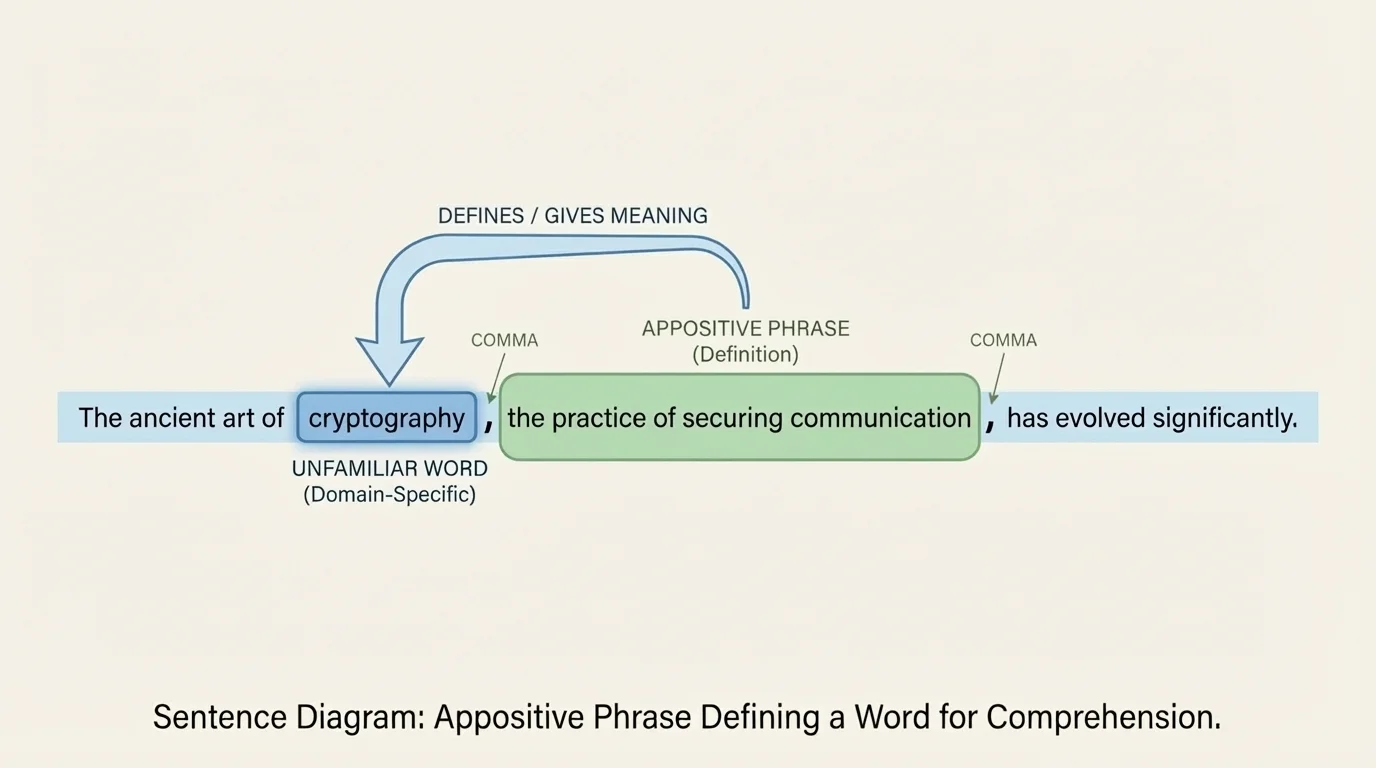
Sometimes the sentence itself acts like a built-in definition, and [Figure 4] shows how punctuation and structure can reveal the meaning of a difficult word. Writers often place an unknown word next to a phrase that renames or explains it.
One common structure is an appositive, a noun or noun phrase that sits next to another noun to explain it. In the sentence "The arboretum, a garden devoted to trees, attracted many visitors," the phrase after the comma explains the word arboretum. Dashes and parentheses can do similar jobs.
Clauses can also help. In "Because the metal expanded when heated, scientists described the material as responsive to temperature," the cause-and-effect structure helps the reader infer the meaning. Signal words like because, although, for example, such as, and in contrast often point toward useful clues.
Longer sentences may seem harder, but they sometimes provide more help than short ones. A short sentence like "The cave was cavernous" gives little support. A longer sentence such as "The cave was cavernous, stretching far underground with vast chambers and echoing spaces" gives much richer information.
When a text becomes challenging, slow down and examine how the sentence is built. Ask: What is being explained? Which phrase restates the idea? Which signal word connects the parts? As with the clue types shown in [Figure 2], structure often works together with context rather than separately.
Strong learners do not wait for vocabulary to appear again by accident. They actively gather vocabulary knowledge whenever a word is important to understanding or expressing an idea. This means noticing key words, recording them, revisiting them, and using them correctly.
When reading a science article, for example, you might decide that organism, adaptation, and habitat are essential because they repeat and carry the central concepts. In a history chapter, words like alliance, revolution, and treaty may serve the same role. In English language arts, words such as theme, narrator, and conflict help you discuss literature accurately.
Earlier reading skills still matter here: identify the main idea, notice repeated terms, and ask which words are necessary to explain the text. Vocabulary gathering works best when it connects to what the author is mostly trying to teach.
One effective method is to keep a vocabulary notebook or digital document organized by subject. Include the word, the sentence where you found it, a meaning in your own words, related word parts, and a sentence of your own. This turns vocabulary from a list of definitions into a system of connected knowledge.
Another useful strategy is to revisit a word in new settings. If you learn evidence in science, you can notice how it also appears in writing and social studies. The word does not mean exactly the same thing in every context, but the core idea of support for a claim remains. That kind of transfer makes academic language stronger and more flexible.
Cross-subject vocabulary example
Consider the word structure.
Step 1: Notice the general academic meaning.
Structure can mean the way something is arranged or built.
Step 2: Apply it in different subjects.
In science, the structure of a cell matters. In writing, the structure of an essay matters. In architecture, the structure of a bridge matters.
Step 3: Refine the meaning by context.
The core idea stays the same, but each subject adds its own details.
This is how a single academic word becomes more powerful over time.
Gathering vocabulary knowledge also means knowing when a word is important enough to study deeply. If a rare word appears once and does not affect meaning, you may move on. But if a word is repeated, appears in a heading, or is necessary for explaining the topic, it deserves closer attention.
Learning a word is only half the job. The other half is using it correctly. To use a word accurately, you need to know its meaning, its tone, the kinds of sentences it fits into, and the subject where it is most useful.
For example, a student might say, "The character was nice," but a more accurate choice could be compassionate, loyal, or generous. In science, saying "the plant made food" is understandable, but saying "the plant produced glucose through photosynthesis" is much more precise when the audience expects scientific language.
Accurate use also involves grammar. A word may be a noun, verb, adjective, or adverb. The root may stay the same while the form changes. Compare decide, decision, decisive, and decisively. If you choose the wrong form, the sentence sounds awkward or incorrect.
Improving vague language
Original sentence: "The experiment had a good result."
Step 1: Identify the vague word.
The word good does not say enough.
Step 2: Choose a more precise academic word.
You might replace it with successful, reliable, or accurate, depending on the situation.
Step 3: Rewrite for precision.
"The experiment produced reliable results."
The revision communicates more exact meaning and sounds more academic.
Writers often test word accuracy by asking three questions: Does this word mean exactly what I want? Does it fit the subject? Does it fit the tone of my audience and purpose? If the answer to any question is no, revise.
A common mistake is guessing too quickly. Students may latch onto a familiar-looking part of a word and ignore the rest. Another mistake is using a new word after seeing it once without checking how it really works in a sentence. Both errors can lead to confusion.
Another problem is overusing broad words such as thing, stuff, good, bad, or nice. These words are not always wrong, but they are often too vague for academic reading and writing. Replacing them with more exact language improves clarity immediately.
Smart strategies include pausing at important unknown words, rereading nearby sentences, examining prefixes and roots, noticing punctuation and appositives, and checking whether the word belongs to a larger category. The appositive pattern in [Figure 4] is especially useful in textbooks because authors often define technical terms that way.
It also helps to say new words aloud and use them in original sentences. If you can explain a word in your own words and use it correctly in a new context, you probably understand it. If not, you may need another look at the text or a better example.
"The limits of my language mean the limits of my world."
— Ludwig Wittgenstein
Expanding vocabulary expands what you can understand and communicate. That matters in every subject, from analyzing a poem to explaining a lab result to debating a historical decision. Accurate vocabulary is not extra decoration. It is part of thinking clearly.
