One sentence can sound thoughtful, respectful, careless, funny, or rude depending on how it is said and where it is said. Telling a friend, "Hey, move over," during lunch is very different from telling a principal, "Excuse me, may I get by?" Strong speakers know that speaking is not only about what they say. It is also about when, why, and to whom they say it. Learning to adjust speech for different situations helps you succeed in class, work well with others, and make your ideas easier to understand.
When you speak, you are making choices. You choose words, tone, volume, and even how much detail to include. Those choices should match the context, or the situation in which you are speaking. They should also match your audience and your purpose. A casual conversation with a teammate after practice is one kind of speaking situation. A class presentation, student government speech, or interview is another. Skilled speakers can move between these situations without losing clarity or respect.
Context includes the place, the people involved, and what is happening. If you are answering a question in class, the context is academic. If you are talking with relatives at home, the context is personal. If you are giving a speech at a ceremony, the context is formal and public. Each context has different expectations.
Your audience is the person or group listening to you. Your purpose is the reason you are speaking. Maybe you want to explain, persuade, inform, entertain, or ask for help. Your task is the kind of speaking you are doing, such as presenting, debating, discussing, introducing a guest, or responding to a question. Effective speaking happens when your language matches all three: audience, purpose, and task.
Context is the situation in which communication happens. Audience is the person or group listening. Purpose is the reason for speaking, and task is the kind of speaking a person is expected to do.
If these parts do not match, the message can feel wrong. A joke that fits a lunch table may sound disrespectful in a memorial speech. A super-formal answer may sound stiff during a relaxed class discussion. Adapting speech does not mean pretending to be someone else. It means choosing the best way to communicate in each situation.
The clearest way to see adaptation is to compare formal English and informal English. Formal English is usually more careful, complete, and polished. Informal English is more relaxed and conversational. As [Figure 1] shows, the same idea can be expressed in very different ways depending on whether you are talking to friends, speaking in class, or addressing adults in an official setting.
Formal English is often used in presentations, speeches, interviews, academic discussions, and serious conversations with adults you do not know well. It usually avoids slang, uses complete sentences, and sounds respectful. For example, instead of saying, "That movie was kinda awesome and stuff," a speaker using formal English might say, "The film was impressive because it used strong visual effects and an emotional storyline."
Informal English is common in everyday conversations with friends and family members. It may include slang, shorter sentences, contractions, and a more casual tone. Saying, "I'm gonna head out," is informal. Saying, "I am going to leave now," is more formal. Neither style is always right or always wrong. The key is knowing which one fits.
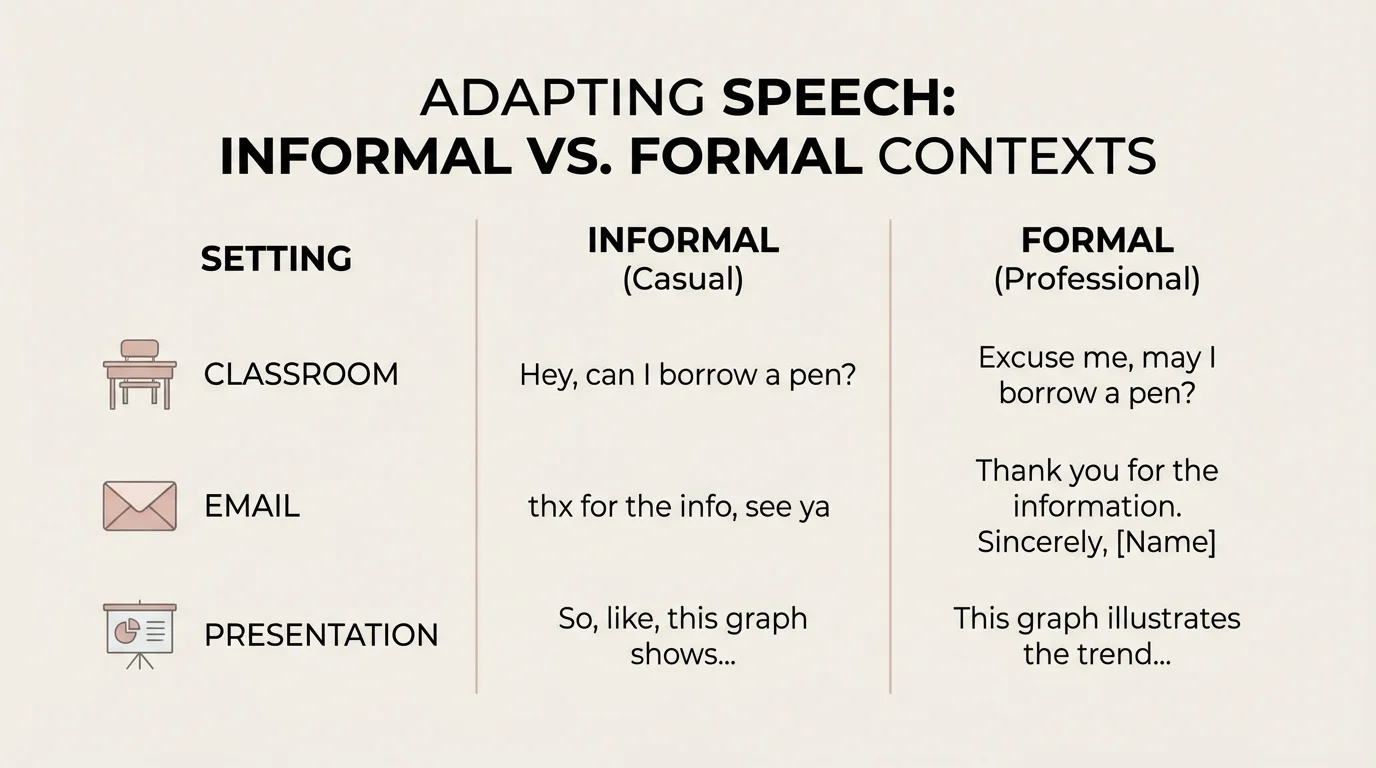
Using formal English when it is appropriate does not mean using huge words just to sound impressive. In fact, overly fancy language can confuse listeners. Good formal speech is clear, specific, and respectful. A strong speaker does not say, "I am endeavoring to communicate my dissatisfaction." A clear formal speaker says, "I would like to explain why I disagree."
Here are some common differences between formal and informal speech:
| Feature | Informal Speech | Formal Speech |
|---|---|---|
| Word choice | slang or casual words | precise and respectful words |
| Sentence style | short, relaxed, sometimes incomplete | complete and carefully structured |
| Tone | friendly and casual | serious, polite, or professional |
| Audience | friends, close family | teachers, officials, unfamiliar adults, larger groups |
| Examples | "That was cool." | "That was impressive." |
Table 1. A comparison of common features of informal and formal speech.
Notice that formal English is not "better" than informal English in every situation. If your friend tells you good news and you respond like a robot, the moment feels strange. But if you give a presentation using lots of slang, the audience may take your ideas less seriously. Matching the style to the moment is what matters, just as we see in [Figure 1].
Some people are excellent at code-switching, which means changing the way they speak depending on the setting. This is a real communication skill, not a trick, and many strong leaders use it every day.
One sign of mature speaking is knowing when to shift from casual speech to formal speech quickly. For example, you might be laughing with classmates before school starts, but when class begins and you present your research, your language should become more organized and more academic.
Speaking effectively begins with thinking about who is listening. If your audience is your classmates, you may use examples they already know from school life. If your audience is younger students, you may explain ideas more simply. If your audience includes teachers, families, or community members, you should be especially careful to sound respectful and clear.
Audience also affects how much background information you need. If you are speaking to people who already know the topic, you can move more quickly to your main point. If your listeners are new to the topic, you need stronger explanations. For example, in a science fair talk, you would explain the experiment more carefully to visitors who have never seen your project before.
It also matters whether the audience knows you personally. People who do not know you cannot fill in missing details as easily. They rely on your words to understand your message. That is one reason public speaking often requires more complete sentences and stronger organization than a private conversation.
Respect changes with audience. Respectful speech is not only about saying "please" and "thank you." It also means not interrupting, not using rude jokes, and not assuming that every listener shares your background or opinions. A respectful speaker considers what the audience needs in order to understand and feel included.
When students forget to consider audience, they may speak too quietly, explain too little, or use jokes that only a few people understand. An effective speaker tries to help everyone follow the message, not just close friends.
Two speeches about the same topic can sound completely different because they have different purposes. If your purpose is to inform, you focus on facts and explanations. If your purpose is to persuade, you still use facts, but you also build an argument. If your purpose is to entertain, you may tell a story or use humor more often.
The task matters too. A class discussion is different from a formal presentation. In a discussion, you may speak in shorter turns, respond to others, and ask questions. In a presentation, you usually speak longer without interruption and must organize your ideas more carefully. In a debate, you need to state a claim, support it with reasons, and respond to opposing ideas. In an interview, you answer clearly and professionally while staying focused on the question.
Here is how speech may change by task:
| Task | Main Goal | Speaking Style |
|---|---|---|
| Discussion | share and build ideas | responsive, thoughtful, cooperative |
| Presentation | teach or explain to a group | organized, clear, formal |
| Debate | defend a position | logical, evidence-based, confident |
| Interview | answer questions well | focused, polite, professional |
| Storytelling | engage listeners | expressive, descriptive, paced well |
Table 2. Different speaking tasks and the style each task usually requires.
Suppose you are speaking about school uniforms. In a discussion, you might say, "I think uniforms could reduce distractions, but I also understand some students want more choice." In a debate, you might say, "School uniforms should be required because they reduce social pressure and help students focus on learning." In an interview, you might say, "I can explain both sides, but my position is that uniforms can improve school climate when students help shape the policy." Same topic, different task, different speech.
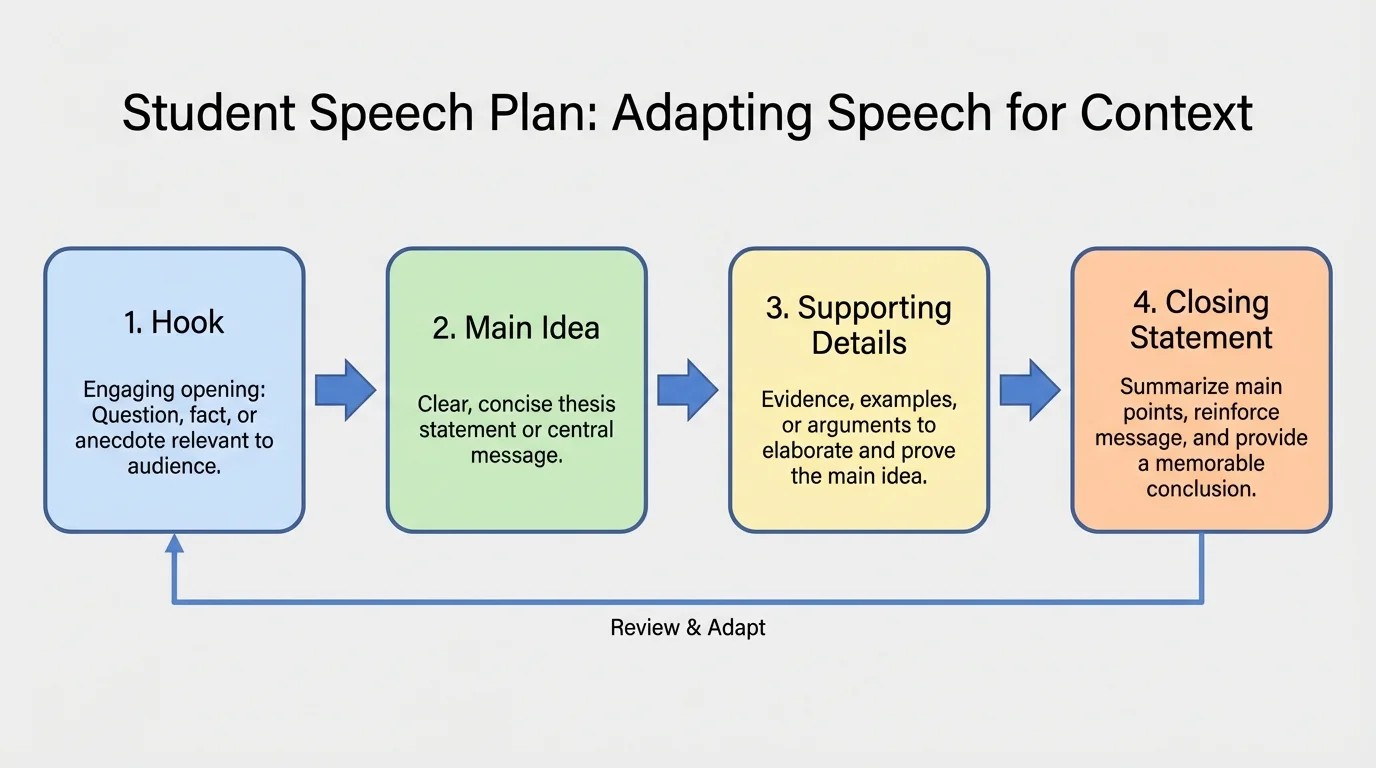
Even confident speakers can lose their audience if their ideas jump around. Clear organization helps listeners follow your thinking. As [Figure 2] illustrates, many effective speaking tasks use a simple structure: a beginning that introduces the topic, a middle that develops the main ideas, and an ending that leaves the audience with a clear final thought.
For a short speech or presentation, begin by stating the topic and why it matters. Then present your main points in a logical order. Finally, end with a conclusion that reinforces the message. This structure works because listeners cannot reread your words the way they can reread a page. They hear your ideas once, so organization matters a lot.
Transitions help connect ideas smoothly. Words and phrases such as "first," "for example," "in contrast," "as a result," and "finally" guide listeners through your thinking. A speaker who uses transitions sounds more prepared and easier to follow.
It also helps to choose only the most important details. If you try to say everything you know, your main point can get buried. Strong speakers select examples, facts, and explanations that support the purpose. In a persuasive speech, those details should strengthen your argument. In an informative speech, they should improve understanding.
Adapting the same idea for different tasks
Topic: The school should add more recycling bins.
Step 1: For a discussion
"I noticed that students often throw recyclable bottles in regular trash cans. Maybe adding more bins would make recycling easier."
Step 2: For a presentation
"Our school should add more recycling bins because students currently have limited access to them in busy areas such as the cafeteria and gym hallway."
Step 3: For a formal request to an administrator
"I would like to propose adding recycling bins in high-traffic areas. This change could reduce waste and make recycling more convenient for students."
Each version expresses a similar idea, but the wording changes to fit the task and audience.
Planning does not always mean writing a full script. Many speakers use notes with key points rather than memorizing every word. This can make speech sound more natural while still staying organized. If you do memorize, be careful not to sound mechanical. Good speakers sound prepared, not frozen.
Later, when you revise your speech, think back to the structure shown in [Figure 2]. Ask yourself whether your opening introduces the topic clearly, whether each main point has support, and whether your ending leaves the audience with a strong final idea.
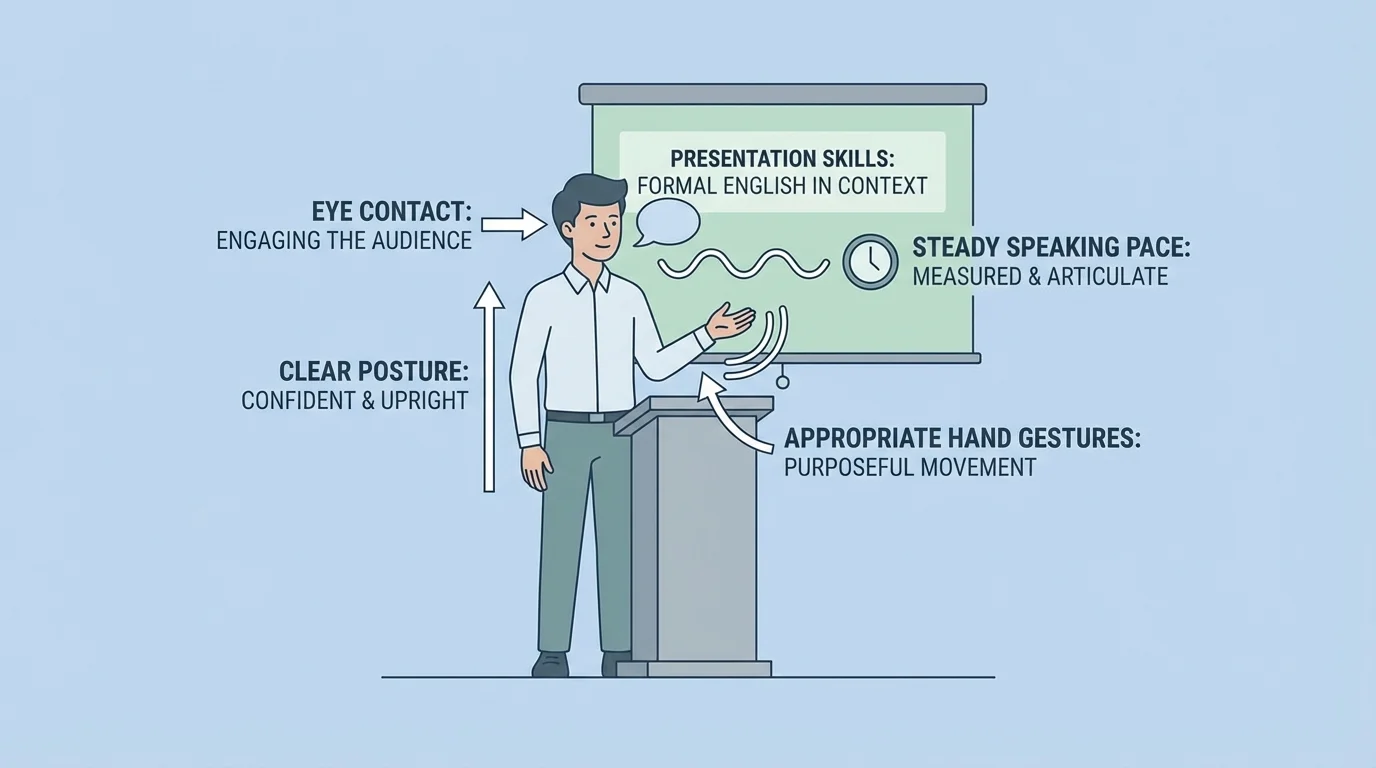
Words matter, but delivery matters too. A strong message can lose power if the speaker mumbles, rushes, or looks at the floor the whole time. [Figure 3] presents several parts of effective delivery: eye contact, steady posture, clear volume, and a speaking pace that listeners can follow.
Tone is the feeling or attitude your voice communicates. A serious topic calls for a serious tone. A celebration may allow a more cheerful tone. If your tone does not match your message, listeners may get confused. For example, if you announce important safety information while giggling, people may not take you seriously.
Volume should fit the room and the audience. Speak loudly enough to be heard, but not so loudly that it sounds aggressive unless the situation truly calls for urgency. Pace is how fast or slowly you speak. Speaking too quickly can make your ideas hard to understand. Speaking too slowly can make listeners lose focus.
Pronunciation and clear articulation also matter. Listeners should be able to understand your words without extra effort. If a term is difficult, practice it ahead of time. This is especially important in academic speaking when you may use subject-specific vocabulary.
Body language supports your words. Standing upright can make you appear confident. Natural hand gestures can help emphasize points. Eye contact helps listeners feel included. However, too much movement can distract from the message. Good delivery supports ideas instead of competing with them.
Listening is part of speaking well. In conversations and discussions, adapting your speech also means noticing how others respond. If listeners look confused, you may need to explain more clearly. If someone else is speaking, respectful communication means waiting, listening, and responding to what was actually said.
Delivery choices also shift by context. In a quiet classroom presentation, a calm and steady voice often works best. In a pep rally, the speaker may use more energy and a louder volume. In both cases, the speaker is still adapting speech to the setting. That is why the delivery features in [Figure 3] matter so much: the basics stay important even when the exact style changes.
One of the most useful speaking skills is being able to say the same basic idea in more than one way. This is not being insincere. It is being flexible and thoughtful. Consider the message "I disagree." Here are several ways to express it:
To a close friend, you might say, "I don't really see it that way." In a class discussion, you might say, "I understand your point, but I have a different opinion." In a formal setting, you might say, "I respectfully disagree because the evidence suggests a different conclusion." The idea stays the same, but the wording becomes more precise and more formal as the context changes.
Another example is asking for help. Informal: "Can you help me with this?" More formal: "Could you please help me understand this part?" Formal and task-specific: "Would you be willing to explain the second step? I want to make sure I understand it correctly." The most effective version depends on the relationship, situation, and purpose.
Adapting is not changing your beliefs. It is changing the way you express those beliefs so that your message fits the moment. You can stay honest, confident, and respectful at the same time.
This skill matters far beyond school. Adults shift their speech in workplaces, community meetings, interviews, and public events. Coaches adjust how they speak during practice, halftime, and postgame interviews. Doctors explain one way to other medical professionals and another way to patients. Effective communication often means translating ideas into the right style for the right audience.
One common mistake is using too much slang in a formal setting. Slang can make speech sound relaxed and natural among friends, but in a presentation or interview it may make the speaker seem unprepared. The solution is not to remove personality. The solution is to replace overly casual phrases with clearer, more specific language.
Another mistake is speaking too casually to an audience that expects respect. For example, answering a teacher or judge with "yeah" instead of "yes," or interrupting with "wait, wait, wait," can sound careless. Small changes in word choice and tone can improve the message right away.
Some speakers make the opposite mistake: they become so formal that they sound unnatural. If every sentence is stiff and memorized, the audience may stop connecting with the speaker. The goal is not to sound like a textbook. The goal is to sound clear, thoughtful, and appropriate.
Another problem is ignoring the listeners. If people seem confused, effective speakers notice and adjust. They may define a term, slow down, add an example, or repeat a key point. Good speaking is flexible, not rigid.
Fixing casual speech
Casual version: "So, like, our project was pretty cool and we did a bunch of stuff with water filters."
Revised version: "Our project tested how different materials affected water filtration, and the results showed that layered filters worked best."
The revised version is more specific, more academic, and easier for an audience to understand.
Strong speakers also avoid filler words when possible. Words like "um," "like," and "you know" are common in everyday speech, but using them too often can distract from the message. Pausing briefly is often better than filling every silence.
Becoming skilled at adapting speech takes awareness and practice. Before speaking, ask yourself a few questions. Who is my audience? What is my purpose? What is the task? How formal should I be? What tone fits this moment? These questions help you prepare language that fits the situation rather than using the same speaking style every time.
It also helps to listen to skilled speakers. Notice how a student leader sounds different while joking with friends, introducing a guest speaker, and presenting a proposal to the school board. Notice how a news reporter speaks differently during an interview than during casual conversation off camera. These shifts are not accidents. They are choices.
When you adapt your speech well, people understand you more easily. They are more likely to trust your ideas, respond thoughtfully, and take your message seriously. Whether you are sharing an opinion in class, presenting research, telling a story, or asking an adult for help, effective speaking means choosing language that matches the moment.
