Have you ever read a line like "the wind whispered through the trees" and known instantly that wind cannot actually whisper, yet still understood exactly what the writer meant? That is one of the powers of figurative language. Writers often choose words that mean more than their literal definitions. When readers learn how to interpret those words in context, they unlock richer meaning, stronger emotion, and more vivid images.
Figurative language is language that is not meant to be understood in a strictly literal way. Instead, it creates comparisons, exaggerations, pictures in the mind, and deeper layers of meaning. Reading figurative language is a bit like decoding a message: the words say one thing on the surface, but the context helps you understand what the author is really communicating.
Writers use figurative language to make writing more powerful. A sentence such as "The hallway was noisy" gives information, but "The hallway roared like a stadium" gives information and creates a strong feeling. Figurative language can help readers see, hear, and feel a moment more clearly.
It also helps writers express ideas that are hard to explain plainly. Feelings, moods, and experiences are often complex. Saying "her sadness was a heavy backpack" does not mean she is carrying an actual backpack. It means her sadness feels like a burden. Figurative language lets writers connect one thing to another so readers understand the experience more deeply.
Literal language means exactly what it says. If someone says, "The glass broke," the words are meant literally.
Figurative language uses words in a nonliteral way to create an image, comparison, or special effect. If someone says, "Her voice was music," the meaning is figurative, not literal.
Context is the surrounding words, sentences, situation, and tone that help a reader determine meaning.
Strong readers pay attention not only to the figure of speech itself but also to why it appears in a particular moment. A phrase can reveal a character's feelings, build suspense, create humor, or emphasize an important idea. That is why interpreting figures of speech in context matters so much.
To interpret a figure of speech in context, you look at where it appears and how it fits with the rest of the passage. Suppose a character says, "I'm drowning in homework." Literally, that is impossible in a classroom setting. But context tells you the speaker probably feels overwhelmed by too much work.
Context includes several clues: the words around the phrase, the situation in the story, the speaker's emotions, and the overall tone. If the same words appeared in a different situation, the meaning might shift. For example, "The classroom was a zoo" could suggest wild noise, messy energy, or lack of control. The exact meaning depends on what else the passage says.
Readers already use context clues when they figure out unfamiliar vocabulary. The same skill helps with figurative language. Instead of asking only "What does this word mean?" ask "What does this phrase mean here?"
One useful habit is to test the literal meaning first. If the literal meaning does not make sense, or if it seems impossible, that is a sign the language may be figurative. Then you can ask what feeling, image, or idea the author wants you to notice.
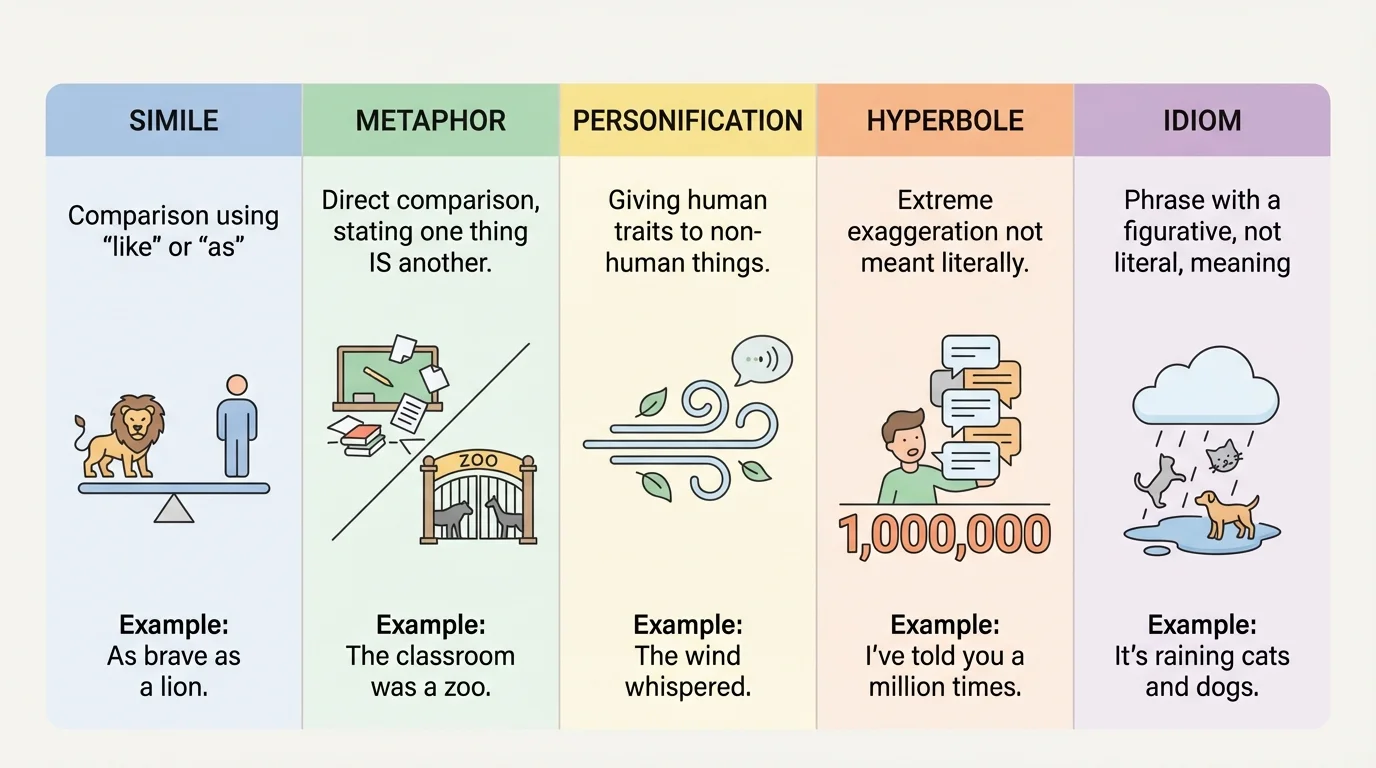
There are several common types of figures of speech, and each one works a little differently. The overview in [Figure 1] helps distinguish these types so you can identify what kind of meaning the writer is building. Knowing the type does not solve everything by itself, but it gives you a strong starting point.
A personification gives human qualities or actions to animals, objects, ideas, or forces of nature. A simile compares two unlike things using words such as like or as. A metaphor compares two unlike things without using like or as. Hyperbole is a deliberate exaggeration used for effect. An idiom is a phrase whose meaning is different from the literal meaning of its words.
| Figure of speech | What it does | Example | Meaning in context |
|---|---|---|---|
| Personification | Gives human traits to nonhuman things | The alarm clock screamed. | The alarm sounded loudly and harshly. |
| Simile | Compares using like or as | He ran like the wind. | He ran very fast. |
| Metaphor | Directly compares unlike things | The test was a mountain. | The test felt difficult and challenging. |
| Hyperbole | Uses exaggeration | I waited forever. | The wait felt very long. |
| Idiom | Has a nonliteral meaning | Break the ice. | Make people feel more comfortable. |
Table 1. Common figures of speech, what they do, and how to interpret them in context.
When you read, do not stop at naming the figure of speech. If you identify a simile but cannot explain what it suggests, your understanding is incomplete. Good interpretation always answers two questions: What kind of figure is this? and What does it mean here?
For example, if a narrator says, "My backpack weighs a ton," the phrase is hyperbole. The backpack does not literally weigh a ton. In context, the speaker probably means the backpack feels extremely heavy, perhaps because it is full of books or because the student is tired. The type of figure helps, but the context gives the exact meaning.
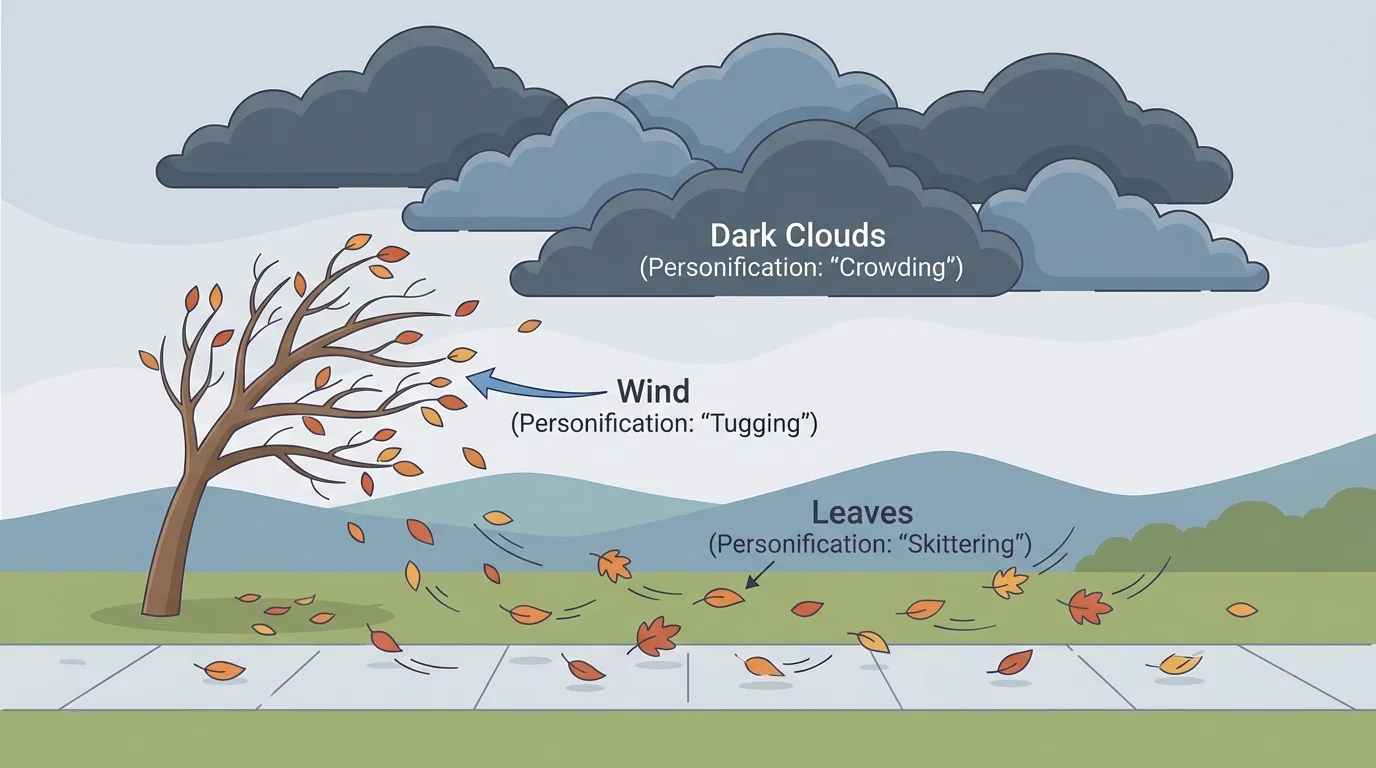
Personification deserves special attention because it appears often in stories, poems, and songs. As [Figure 2] shows, writers can make weather, objects, or places seem to act like people, and that choice often creates mood. When an author writes, "The angry storm pounded on the roof," the storm is not literally angry. The human emotion helps the reader feel the violence and force of the weather.
To interpret personification, ask what human action or quality has been assigned to the nonhuman thing. Then ask why the author chose that action. If "the sun smiled down," the word smiled suggests warmth, comfort, or happiness. If "the shadows crept across the room," the word crept suggests something slow, quiet, and maybe unsettling.
Personification often affects mood, which is the feeling a text creates for the reader. It can also affect tone, which is the author's or speaker's attitude toward the subject. A cheerful description such as "the morning danced through the curtains" creates a very different mood from "the cold morning stared through the windows."
Interpreting personification
Read the sentence: "The tired old house groaned in the wind."
Step 1: Notice the impossible literal meaning.
A house cannot truly be tired or groan like a person.
Step 2: Identify the human quality.
The human-like action is groaned, and the human-like condition is tired.
Step 3: Use context clues.
The phrase in the wind suggests the house is making sounds when the wind pushes against it.
Step 4: Infer the deeper meaning.
The sentence suggests the house is old, weak, and perhaps a little eerie.
A strong interpretation would be: The author uses personification to make the house seem old and alive, creating an uneasy mood.
Notice that this interpretation goes beyond "It is personification." It explains the effect. That is what skilled readers do. They connect the figure of speech to the mood, setting, or idea in the passage.
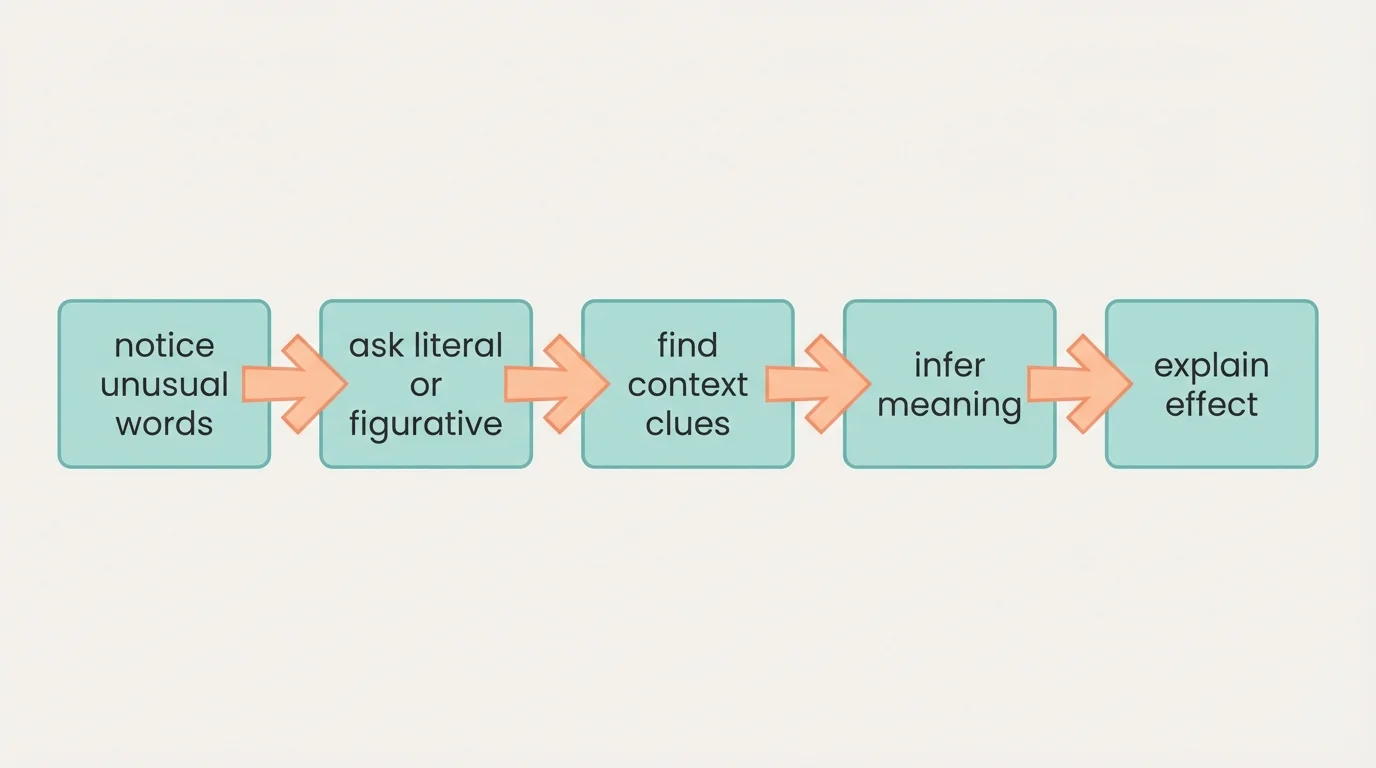
When figurative language feels confusing, a simple process can help. The reading path in [Figure 3] moves from noticing unusual wording to explaining its effect. You can use these same steps with personification, similes, metaphors, idioms, and hyperbole.
First, notice words that seem unusual, impossible, or especially vivid. Second, ask whether the phrase makes literal sense. Third, look at the surrounding details for clues. Fourth, decide what the phrase suggests about the subject, feeling, or situation. Fifth, restate the meaning in your own words.
This process is especially useful when the meaning is not obvious right away. For instance, if you read, "Her words were knives," you can tell the phrase is not literal. The context may show that someone has been insulted or hurt emotionally. The metaphor suggests that the words were sharp, painful, and damaging.
Interpretation is more than translation. When you interpret figurative language, you are not just swapping a figurative phrase for a plain one. You are also explaining what the phrase adds. A metaphor might show intensity. A simile might make an image clearer. A personification might make a setting feel alive. The added effect is part of the meaning.
The same flow works with idioms. If someone says, "We are on thin ice," they probably do not mean real ice. Context might show that they are in a risky situation and need to be careful. As with the process in [Figure 3], the key is to move from the impossible literal image to the most logical meaning in the situation.
Figures of speech appear in many kinds of texts. In poetry, they often create strong imagery and condensed meaning. In stories, they can reveal a character's emotions or deepen the setting. In songs, they make lyrics memorable. Even in everyday conversation, people use idioms and exaggeration all the time.
In poetry, a line such as "the moon watched over the town" uses personification to create a calm, gentle feeling. In a suspense story, "the floorboards complained under every step" gives the setting a tense, uneasy quality. The same type of figure can create very different effects depending on context, just as a storm scene creates a darker mood than a cheerful sunrise description would.
Nonfiction sometimes uses figurative language too, especially in speeches or articles written for a wide audience. A writer might say that a new invention "opened the door to change." The phrase is figurative, but the context makes the meaning clear: the invention created opportunities or possibilities.
Sports announcers, journalists, and scientists writing for the public often use figurative language to make complex ideas easier to picture. A headline might say a team "exploded in the final quarter," meaning it suddenly played with great energy and success.
Because figurative language appears in so many places, interpreting it is an important reading skill in every subject, not only in literature class.
Sometimes a figure of speech does not have just one exact meaning. It may have a nuance, which means a subtle shade of meaning. For example, "The city never sleeps" suggests constant activity. But depending on context, it might also suggest excitement, noise, stress, or energy.
A phrase can carry several feelings at once. If a student writes, "Time crawled during the exam," the personification suggests slowness. But it may also hint at boredom, anxiety, or impatience. The surrounding details help you decide which shade of meaning is strongest.
This is why two readers may give slightly different interpretations and both may be reasonable, as long as they use evidence from the text. Good interpretation is not random guessing. It is careful thinking based on language and context.
One common mistake is reading figurative language too literally. If you picture actual knives when reading "Her words were knives," you miss the emotional meaning. Another mistake is giving a vague explanation such as "It means something important." Strong interpretations are specific.
A third mistake is ignoring context. The phrase "a warm voice" might suggest kindness in one passage, but in another it could suggest reassurance, friendliness, or even persuasion. The surrounding details matter. The comparison chart in [Figure 1] helps identify the figure type, but the passage itself tells you what the author means.
Readers also sometimes confuse identifying with interpreting. Saying "This is a metaphor" is not the same as explaining what the metaphor reveals. Identification is the first step; interpretation is the goal.
When you explain figurative language, try to include three parts: the phrase, its meaning, and its effect. For example, you might say, "The author uses personification in 'the leaves danced' to show that the leaves moved lightly in the wind, creating a lively and cheerful mood." That answer names the figure, explains the meaning, and describes the effect.
Here are some useful sentence frames: The phrase ___ suggests ___. The author uses personification to show ___. In context, the metaphor means ___ because ___. This figure of speech creates a mood of ___. These sentence frames help you turn your thinking into clear analysis.
Comparing interpretations
Phrase: "The classroom buzzed with excitement."
Weak interpretation: It is figurative language.
This answer labels the language but does not explain it.
Better interpretation: The classroom was full of energy.
This explains the basic meaning.
Strong interpretation: The word buzzed compares the classroom to a hive of bees, suggesting many voices and active movement. It creates a lively, excited mood.
This answer explains both meaning and effect.
The more precisely you connect figurative language to mood, tone, character, or setting, the stronger your interpretation becomes.
"Words can say more than they seem to say."
— A guiding idea for reading figurative language
When you read closely, figures of speech stop being tricky obstacles and become clues. They tell you how a speaker feels, what a setting is like, and what deeper message a writer wants to share. Whether the wind whispers, the sun smiles, or time crawls, the context leads you to meaning.
