Have you ever been in a group discussion where someone says, "I just think that's true," but cannot explain why? That moment shows the difference between having an opinion and being prepared. In school discussions, being prepared means more than showing up and talking. It means you have read, listened, or researched ahead of time, and you can use what you learned to support your ideas. When students do this well, discussions become more interesting, more respectful, and more thoughtful.
Good discussions are not competitions to see who talks the most. They are chances to build understanding together. When you prepare before a discussion, you are ready to contribute something meaningful. You can point to a detail in a text, a fact from research, a note you took, or an example that connects to the topic. That kind of speaking helps everyone think more carefully.
Preparation matters because discussion is a shared activity. If one person has done the reading and others have not, the conversation often becomes uneven. Some students may guess, repeat what someone else said, or change the topic. But when everyone arrives with background knowledge, the group can explore bigger questions. Instead of asking only "What happened?" students can ask "Why did it happen?" or "What does this suggest?"
Preparation also builds confidence. Many students stay quiet because they worry about being wrong or not knowing what to say. Reading closely and taking notes gives you something solid to rely on. You do not have to invent ideas on the spot. You can return to the text, your notes, or your research and speak from evidence rather than from panic.
Another reason preparation matters is fairness. In a collaborative discussion, every student should have the chance to contribute. Preparation helps make that possible because it gives everyone access to ideas worth sharing. A student who has marked important parts of the reading or written down questions is more ready to join in clearly and respectfully.
Professional scientists, lawyers, journalists, and engineers prepare for discussions in much the same way students do. They review information beforehand so they can ask better questions, explain their reasoning, and respond to others with evidence.
Preparation does not mean you already know every answer. In fact, one sign of real preparation is knowing what you still do not understand. If you have read carefully and noticed confusing parts, you are ready to ask useful questions that move the discussion forward.
To come prepared, you usually need to do some work before the discussion begins. That might mean reading a story, article, speech, or textbook section. It might mean looking up background information from reliable sources. It might also mean reviewing class notes, a video, or data from an experiment. A prepared student often uses annotation or note-taking to mark key ideas, unfamiliar words, surprising details, and possible questions.
One helpful habit is to separate your preparation into parts. First, identify the main idea or central point. Next, notice important details that support it. Then think about what the author, speaker, or source wants the audience to understand. Finally, write down your own reactions, including questions, agreements, disagreements, or connections to other things you know.
Prepared students also pay attention to context. Context is the background that helps information make sense. If your class is discussing a historical speech, for example, you should know who gave it, when it was delivered, and what events were happening at the time. Without context, you may understand the words but miss the deeper meaning.
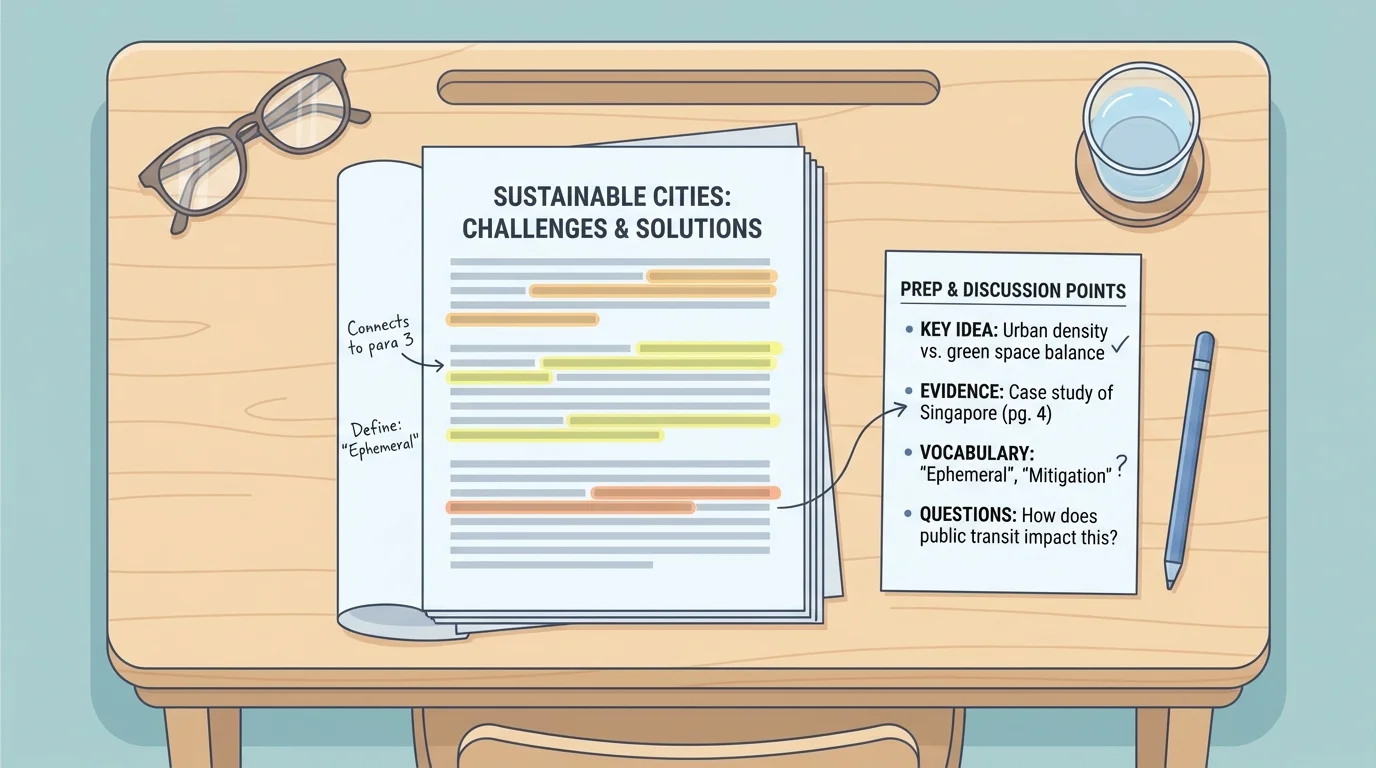
Another part of preparation is reviewing vocabulary. Discussions become clearer when you understand important terms from the material. If you are discussing a science article about ecosystems, for instance, you should know words like producer, consumer, habitat, and organism. If you are discussing a novel, you may need to understand words such as conflict, setting, or narrator.
Writing a few discussion notes can help. These notes do not need to be long. A short list such as "main claim," "two examples," "one question," and "one connection" can be enough. The goal is not to prepare a speech to memorize. The goal is to gather useful ideas so you can think and respond during the discussion.
Preparation is active, not passive. Simply looking at the pages of a text is not the same as preparing. Active preparation means stopping to think, marking places that matter, noticing patterns, and deciding what evidence you may want to mention later.
When students prepare actively, they are more likely to remember details and less likely to drift into unsupported opinions. That matters because good discussion depends on more than participation. It depends on thoughtful participation.
One of the most important discussion skills is using evidence. Evidence is the information that supports an idea or claim. In a classroom discussion, evidence might come from a text, a class experiment, notes from a documentary, a chart, or reliable research.
Suppose your class is discussing whether a character in a novel is brave. Saying "I think she is brave" is only a starting point. To make the comment stronger, you need evidence: "She seems brave because she spoke up even when the crowd disagreed with her," or "On page 47, she volunteers to protect her brother even though she is afraid." The evidence gives your idea weight.
[Figure 2] Strong evidence is specific. It often includes exact details, such as a quotation, a page number, a date, a measured result, or a clear example. Weak evidence is vague. Statements like "everyone knows that" or "I just feel like it" may express a personal reaction, but they do not prove much in an academic discussion.
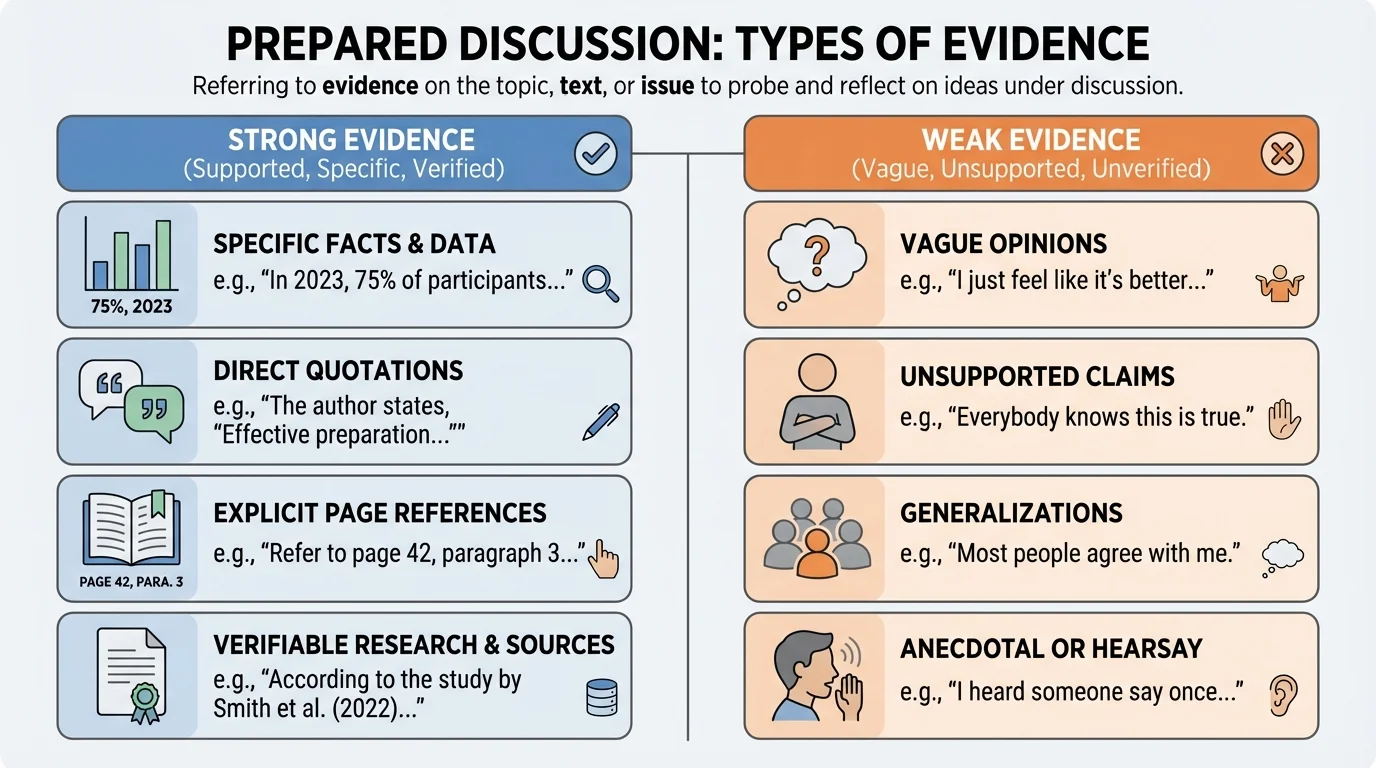
Evidence should also be relevant. This means it should actually connect to the point you are making. If the discussion is about whether renewable energy is practical, a fact about recycling may be interesting, but it may not support your claim unless you explain the connection.
Reliable evidence matters too. If you researched a topic online, not every website is equally trustworthy. Sources from schools, museums, government agencies, respected news organizations, and established educational groups are usually more dependable than random posts or anonymous claims. Prepared students learn to ask, "Where did this information come from?"
| Type of support | What it looks like in discussion | How strong it is |
|---|---|---|
| Opinion only | "I just think that." | Weak unless supported |
| General example | "Something like this happened before." | Medium if explained clearly |
| Specific textual detail | "In paragraph 3, the author states..." | Strong |
| Research fact | "According to the article from the museum..." | Strong if the source is reliable |
| Data or observation | "Our experiment showed that the plant in sunlight grew taller." | Strong when accurate |
Table 1. Levels of support commonly used in classroom discussions.
As you continue discussing, you may discover that one piece of evidence is not enough. Strong thinkers often combine pieces of support. They might use a quotation from a text and then connect it to a pattern seen in another chapter or source. That deeper use of evidence helps the discussion become more thoughtful and convincing.
Using evidence is not only about having it. You also need to refer to it clearly when you speak. This means you should explain where the evidence comes from and how it supports your point. Without that explanation, even good evidence can sound confusing.
You can do this in simple ways. Here are some useful speaking patterns: "In the text, the author says..."; "According to the article..."; "My notes from the video show..."; "One example is..."; "This detail suggests that..." These sentence starters help you connect your ideas to your preparation.
Sometimes you may paraphrase, which means putting the source into your own words. Other times you may quote a short part exactly. Both are useful. Quoting keeps the original wording. Paraphrasing helps show that you truly understand the idea. In many discussions, paraphrasing is especially helpful because it sounds more natural and conversational.
Using evidence clearly in discussion
A student wants to explain why a community should protect a local wetland.
Step 1: Make a clear claim.
"I think the wetland should be protected."
Step 2: Add evidence from preparation.
"In the article we read, the author explains that wetlands help prevent flooding and provide habitats for many species."
Step 3: Explain how the evidence supports the claim.
"That matters because protecting the wetland helps both people and wildlife."
The final comment is stronger because it includes a claim, evidence, and reasoning.
Notice that the student does not simply drop in a fact and stop talking. The student explains why the fact matters. This step is sometimes called reasoning: the thinking that connects evidence to a conclusion.
You should also listen carefully to others when they refer to evidence. Good discussions are not made of separate speeches. They are connected conversations. If another student mentions a detail from the text, you can build on it, ask about it, or compare it to another piece of evidence.
Strong discussions do more than collect answers. They dig deeper. A prepared student can probe an idea by asking questions that test, clarify, or expand it.
[Figure 3] Probing questions often begin with phrases like "What makes you say that?" "Which part of the text supports your idea?" "How does that connect to the author's main point?" "Is there another way to interpret that detail?" or "What evidence might challenge that view?" These questions are respectful, but they also push the thinking further.
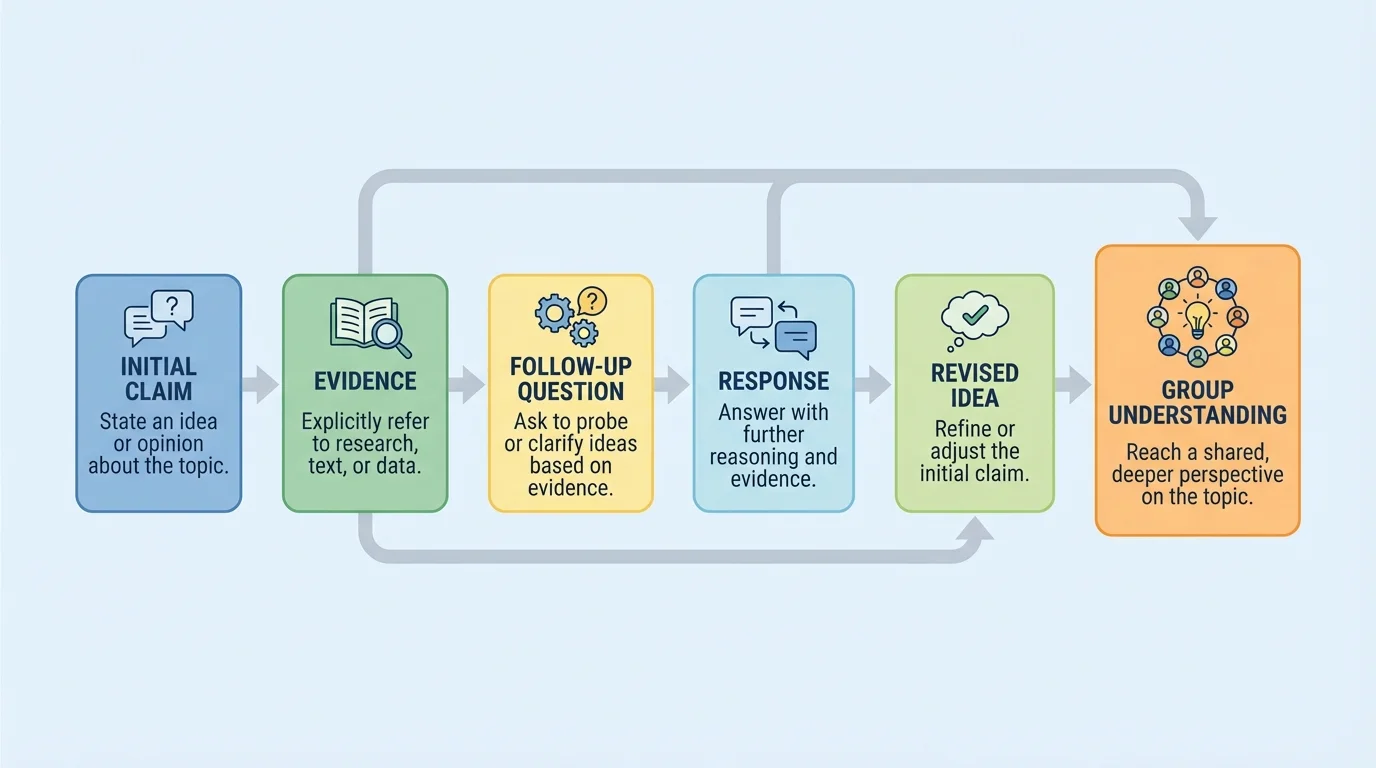
Reflection is just as important. To reflect means to think carefully about your own understanding. During a discussion, reflection may lead you to revise your opinion, notice a weak argument, or recognize a stronger interpretation. Changing your mind after hearing better evidence is not a weakness. It is a sign of learning.
For example, a student may begin by arguing that a character acted selfishly. After hearing classmates point to details showing fear, family pressure, and difficult choices, the student may respond, "I still think the character made a poor choice, but now I see that the situation was more complicated than I first thought." That is reflection in action.
Respect matters here. Probing should not sound like attacking. You are challenging ideas, not people. Helpful discussion language includes: "I see it a little differently because..."; "Can you explain which evidence led you to that conclusion?"; "I agree with part of your point, but the article also says..." This kind of language keeps the conversation focused and civil.
"Be open-minded, but not empty-minded."
— A useful principle for discussion
Later in a discussion, you may return to earlier points and compare them. As [Figure 3] shows, discussion is often a chain of ideas rather than a straight line. A good follow-up question can reveal assumptions, uncover missing evidence, or help the group see a pattern no one noticed at first.
Preparation helps in every kind of collaborative discussion, but the way you use it can change with the setting. The three common formats are one-on-one discussion, small-group discussion, and teacher-led whole-class discussion. Each format asks you to listen, respond, and use evidence in a slightly different way.
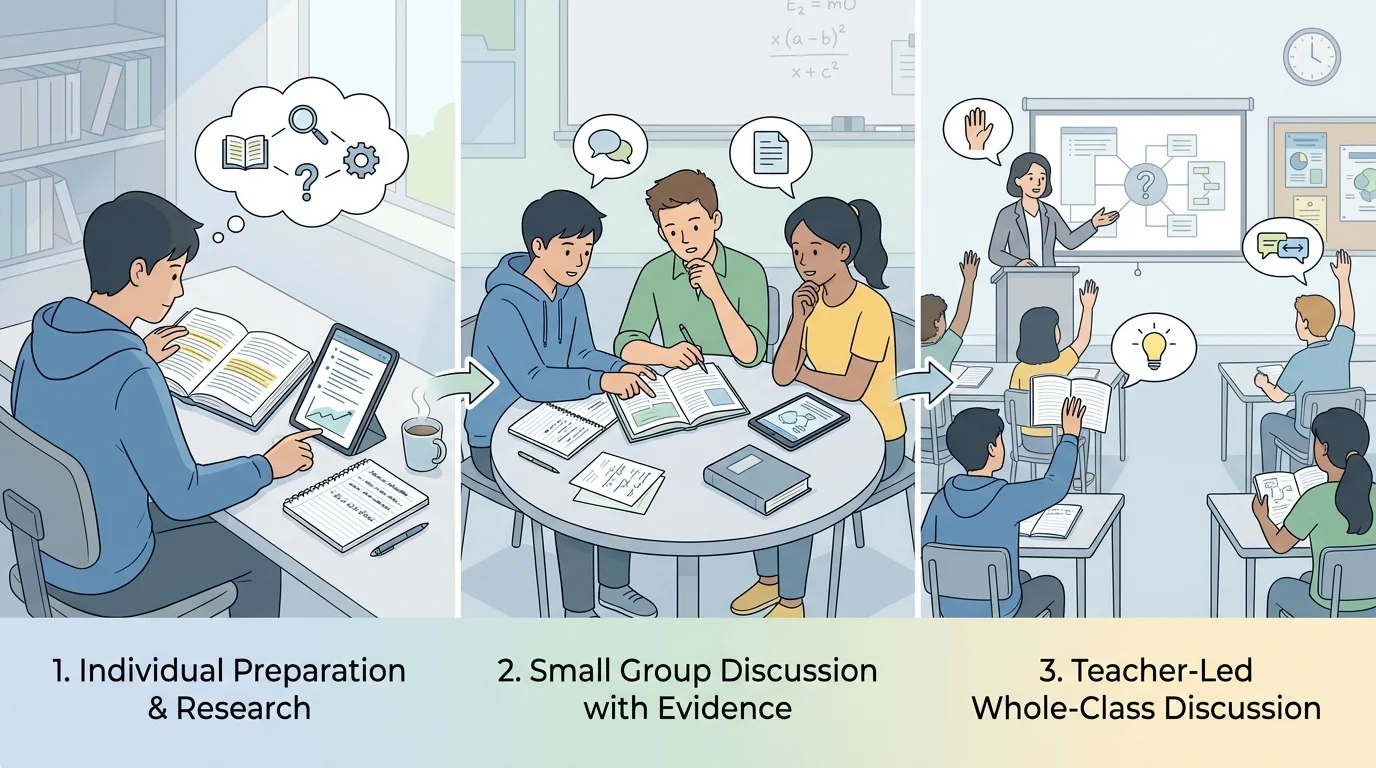
In a one-on-one discussion, you usually have more time to explain your ideas fully. Because only two people are speaking, listening becomes especially important. You should notice exactly what your partner says and respond directly to it. Referring to evidence can sound very natural here: "I noticed in paragraph 6..." or "My notes say..."
In a small-group discussion, students need balance. No one person should dominate the conversation, and no one should disappear into silence. Preparation helps because students can bring different pieces of evidence and compare them. One student may notice a quotation, another may remember a fact from research, and another may raise a question about the author's purpose.
In a teacher-led discussion, the teacher may guide the topic with larger questions. Students still need to be prepared, but they must also be ready to respond to ideas raised by the whole class. Sometimes you may wait longer to speak, so keeping notes nearby helps you remember what you wanted to contribute.
These formats also require different speaking choices. In small groups, you may need to invite others in: "What do you think?" In teacher-led settings, you may need to connect your comment to a classmate's idea before adding your own. In one-on-one conversations, you may need to ask more follow-up questions to keep the exchange moving.
[Figure 4] Across all settings, the goal remains the same: build on others' ideas and express your own clearly. Preparation gives you the tools to do both.
One common mistake is speaking from memory alone when the material is available. Memory can be useful, but it is easy to misremember details. Better habit: keep the text, notes, or research nearby and check your source before making a claim.
Another mistake is confusing strong feelings with strong support. You may care deeply about an issue, but academic discussion still asks for evidence. Better habit: pair your opinion with a fact, quotation, example, or observation.
A third mistake is listening only for your turn to talk. When students do this, they miss chances to respond meaningfully. Better habit: write down a word or short phrase from what others say, then connect your evidence to it.
Some students also make the mistake of overusing evidence without explanation. They may quote a line, but never tell the group why it matters. Better habit: after giving evidence, add a sentence that begins with "This shows..." or "This matters because..."
Discussion is both speaking and listening. Clear expression matters, but so does careful attention to what others say. Preparation supports both because it helps you respond thoughtfully instead of randomly.
Finally, some students fear being wrong and stay silent. But if you prepared carefully, you can still contribute even when you are unsure. You can ask a question, offer a possible interpretation, or invite others to test your thinking. Discussion is a place for learning, not just for showing certainty.
These skills do not stay in English or social studies class. In science, students discuss lab results and must refer to observations and data. In history, students compare sources and support interpretations with evidence. In health, students may discuss nutrition, exercise, or public health claims and need reliable information instead of rumors.
Outside school, evidence-based discussion matters in many careers. Doctors discuss symptoms, test results, and treatment options. Engineers defend design choices with measurements and safety data. Reporters ask questions, verify facts, and compare sources. Community leaders debate policies by using research, budgets, and local needs.
Even everyday life uses these skills. If you are deciding which phone plan, club, team strategy, or community project is best, the strongest discussions do not depend on who speaks the loudest. They depend on who can explain ideas clearly, support them with evidence, and respond thoughtfully to others.
That is why preparation is powerful. It turns discussion from random talk into purposeful thinking. When you read or research before speaking, and when you refer directly to what you learned, you help the whole group understand more.
