Have you ever looked at a long word and felt like it was locked shut? The surprising truth is that many English words are not random at all. They are built from smaller parts that act like clues. If you know what those parts mean, you can often unlock a word you have never seen before. That matters in novels, textbooks, articles, directions, and even online posts, because strong readers do not wait for someone else to define every difficult word for them.
English is packed with words that come from Greek and Latin. That means many words are part of large families. Once you learn one useful part, you can use it again and again. For example, if you know that pre- means before, you already have a clue for words like preview, predict, and precede. If you know that re- means again or back, words like return, replay, and recede become easier to figure out.
This skill is called morphology, the study of word parts and how they form meaning. You do not need to memorize every word in the dictionary. Instead, you learn to notice patterns. That is much more powerful, because reading often brings you new words. A reader who understands word structure can make smart guesses and then check those guesses with the sentence around the word.
root is the core part of a word that carries the main meaning. A prefix is added at the beginning of a word, and a suffix is added at the end. Roots, prefixes, and suffixes are all types of word parts that help shape meaning, but only prefixes and suffixes are affixes.
Knowing word parts also helps across school subjects. In science, history, health, and technology, many words are built from Greek and Latin roots. That means this is not just an English class skill. It is a reading skill for all subjects.
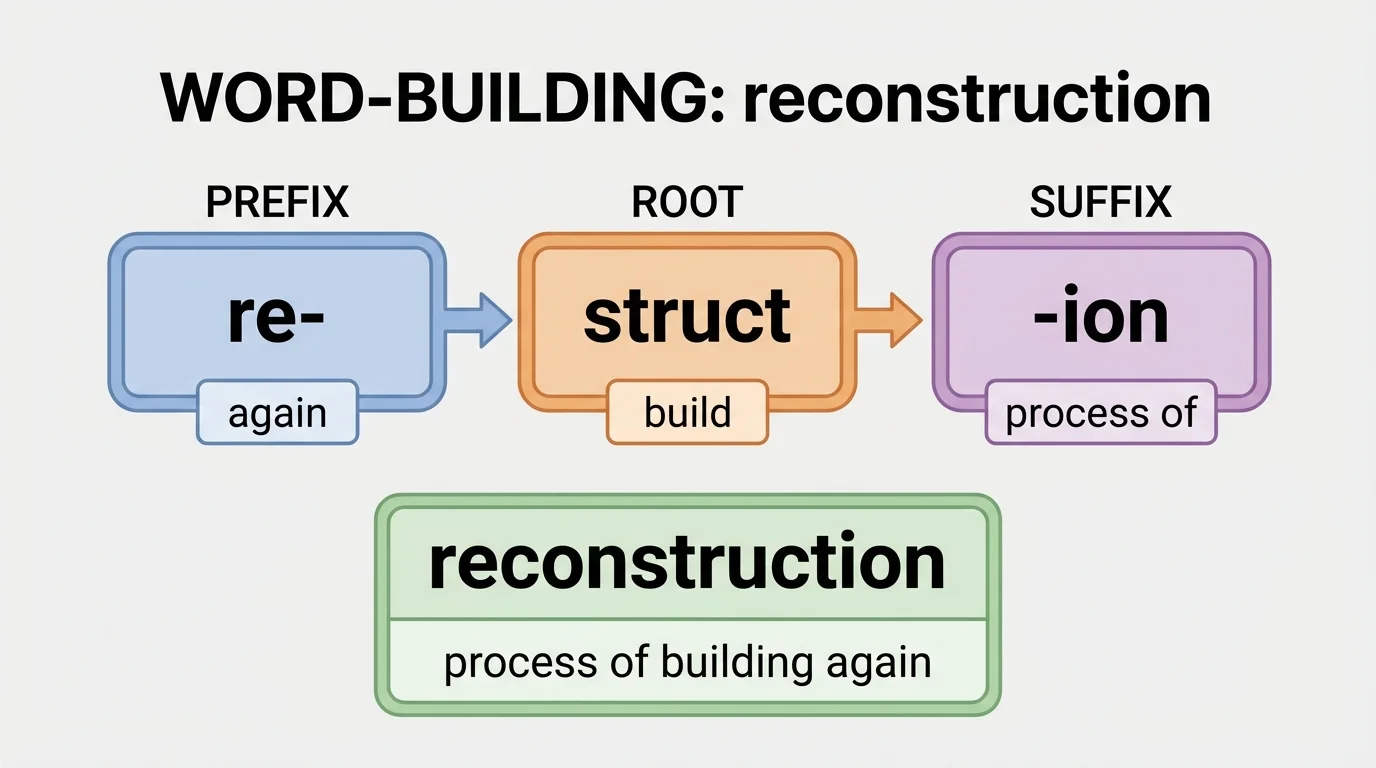
Words often work like building sets, as [Figure 1] shows. One part carries the central idea, and other parts add direction, time, quantity, or function. When readers break a word into parts, they can often get very close to the meaning even before looking at the full sentence.
Take the word reconstruction. You can notice re-, meaning again, and a form of struct, meaning build. The word suggests building again. Even if you do not know the exact dictionary meaning, you can predict that it has something to do with building or putting something back together.
Sometimes a root appears as a full word, and sometimes it does not. For example, port in transport and portable comes from a root meaning carry. In modern English, the whole word may look different from the original root, but the core meaning often stays connected.
Here is a simple way to think about word parts:
| Word Part | Where It Appears | What It Does | Example |
|---|---|---|---|
| Prefix | Beginning | Adds a clue such as time, place, number, or direction | preheat |
| Root | Middle or core | Carries the main meaning | struct in construct |
| Suffix | End | Changes the word's job or adds meaning | -er in teacher |
Table 1. Basic roles of prefixes, roots, and suffixes in word structure.
Later, when you combine these parts with context, the strategy becomes even stronger. The structure in [Figure 1] matters because it reminds us that long words are often made of meaningful pieces, not impossible chunks to memorize all at once.
A root is the core meaning-carrying part of a word. Many roots entered English from Latin and Greek. Latin roots are especially common in words related to law, government, writing, and general academic vocabulary. Greek roots appear often in science, medicine, and technology.
For example, the Latin root scrib/script means write. That helps with describe, script, inscription, and manuscript. The Greek root bio means life, so biology is the study of life, and a biography is a written account of someone's life.
Some common roots are worth knowing because they appear everywhere:
| Root | Meaning | Examples |
|---|---|---|
| bio | life | biology, biography |
| graph | write, draw | autograph, graphic |
| port | carry | transport, portable |
| struct | build | construct, structure |
| spect | look | inspect, spectator |
| dict | speak, say | predict, dictionary |
Table 2. Common Greek and Latin roots with meanings and examples.
When you meet a new word, spotting the root gives you the strongest clue. The other parts help narrow it down.
The word telephone combines Greek parts: tele means far and phone means sound. A telephone is literally a device for sound from far away.
That is one reason learning roots feels like gaining access to a secret code. A single root can open many words at once.
A prefix acts like a sign at the front of a word, and [Figure 2] helps organize these signals. Prefixes often tell you about time, direction, number, or attitude. When you spot one quickly, you can form an early prediction about meaning.
Here are some common, grade-appropriate prefixes:
pre- means before. In prepay, you pay before. In precede, one thing comes before another.
re- means again or back. In rewrite, you write again. In recede, something goes back.
se- can mean apart or away. In secede, a group pulls away from a larger group.
sub- means under or below. A submarine goes under water.
trans- means across or through. To transport is to carry across from one place to another.
anti- means against. An antibacterial substance works against bacteria.
dis- often means not, opposite of, or apart. To disconnect is to separate a connection.
mis- means wrongly or badly. To misread is to read incorrectly.
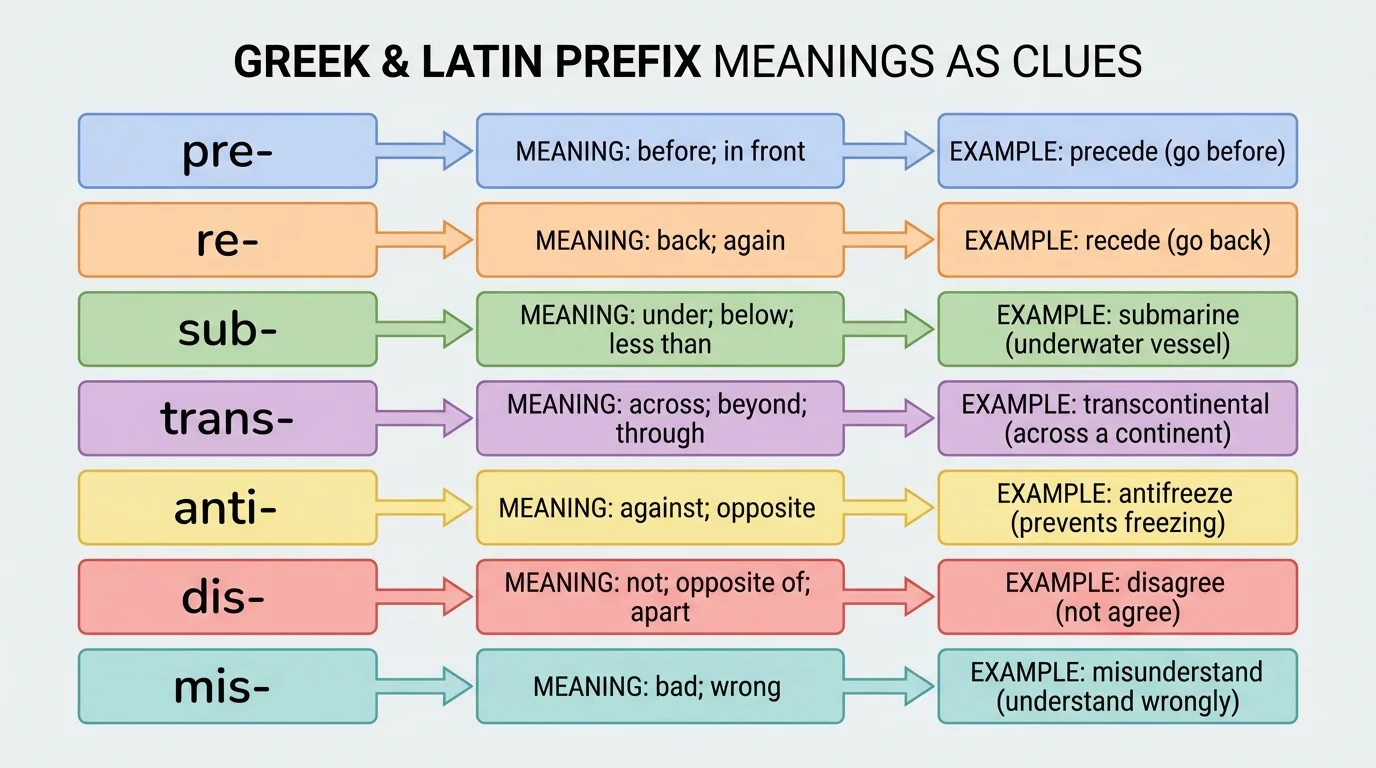
Prefixes are especially useful because they often stay consistent across many words. If you know trans-, you can connect transport, transfer, and transmit. The chart in [Figure 2] shows how one small beginning can point you toward meaning before you even finish reading the word.
A suffix is added to the end of a word. Suffixes often tell you what kind of word it is, such as a noun, adjective, or person who does something. They can also add important meaning.
For example, -er often means a person or thing that does something. A teacher teaches. A viewer views.
-able means able to be. Portable means able to be carried. Predictable means able to be predicted.
-tion often turns a verb idea into a noun. Act becomes action. Invent becomes invention.
-ist often names a person connected to a belief, practice, or field. A scientist works in science. An artist works in art.
-ology means the study of. Geology is the study of Earth. Biology is the study of life.
-ous often means full of or having the quality of. Dangerous means full of danger or likely to cause harm.
Suffixes can help you tell not only what a word means, but also how it functions in a sentence. If you see -tion, the word is probably naming an idea or process. If you see -able, the word is probably describing something.
Example: Using a suffix as a clue
Suppose you read the sentence: "The backpack is portable, so hikers can carry it easily."
Step 1: Notice the root.
The root port means carry.
Step 2: Notice the suffix.
The suffix -able means able to be.
Step 3: Combine the clues.
Portable means able to be carried.
The context about hikers confirms that meaning.
In real reading, roots and suffixes often work together. The more word parts you know, the faster this becomes.
[Figure 3] One especially useful word family centers on cede/ceed/cess and shows how these related forms connect. These forms come from a Latin root connected to the idea of go, move, or yield. Even though the spelling changes, the core idea stays related.
Precede combines pre- meaning before with the root idea of going. So precede means to go before or to come earlier than. In the sentence "Thunder often precedes rain," thunder comes before rain.
Recede combines re- meaning back with the same root. So recede means to go back. In "The floodwaters receded," the waters moved back.
Secede combines se- meaning apart with the same root. So secede means to pull away or to withdraw from a larger group. In history, a state or region may try to secede from a country.
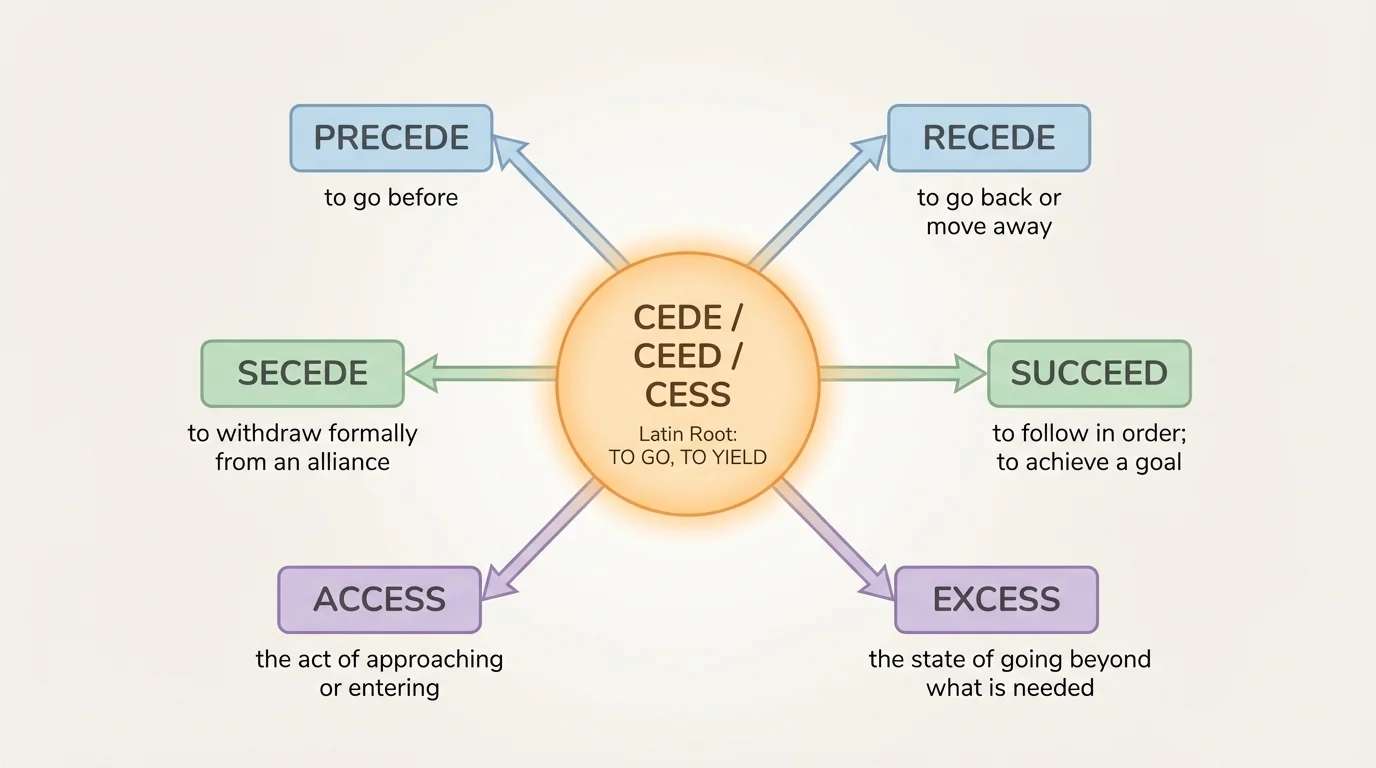
Related words include succeed, which originally carried the idea of come after, and procession, which connects to moving forward. You may also notice words like access and excess, where the spelling has shifted even more over time. English often keeps the meaning connection while changing the spelling shape slightly.
This is important: roots are clues, not magic tricks. The spelling may vary. The meaning may stretch. But the family resemblance is still useful. The network reminds us not to give up just because a root changes form.
Strong readers use more than one strategy at a time, and [Figure 4] lays out a reliable process. Word parts help you make a prediction. Then context clues help you test whether that prediction fits the sentence or paragraph.
Suppose you read: "After the storm, the shoreline began to recede, revealing rocks that had been underwater." If you know re- means back and the root suggests go, you may guess that recede means go back. The words revealing rocks confirm that the water moved away.
Now consider: "The band's performance preceded the awards ceremony." If you know pre- means before, you can predict that the performance happened before the ceremony. The sentence confirms your guess.
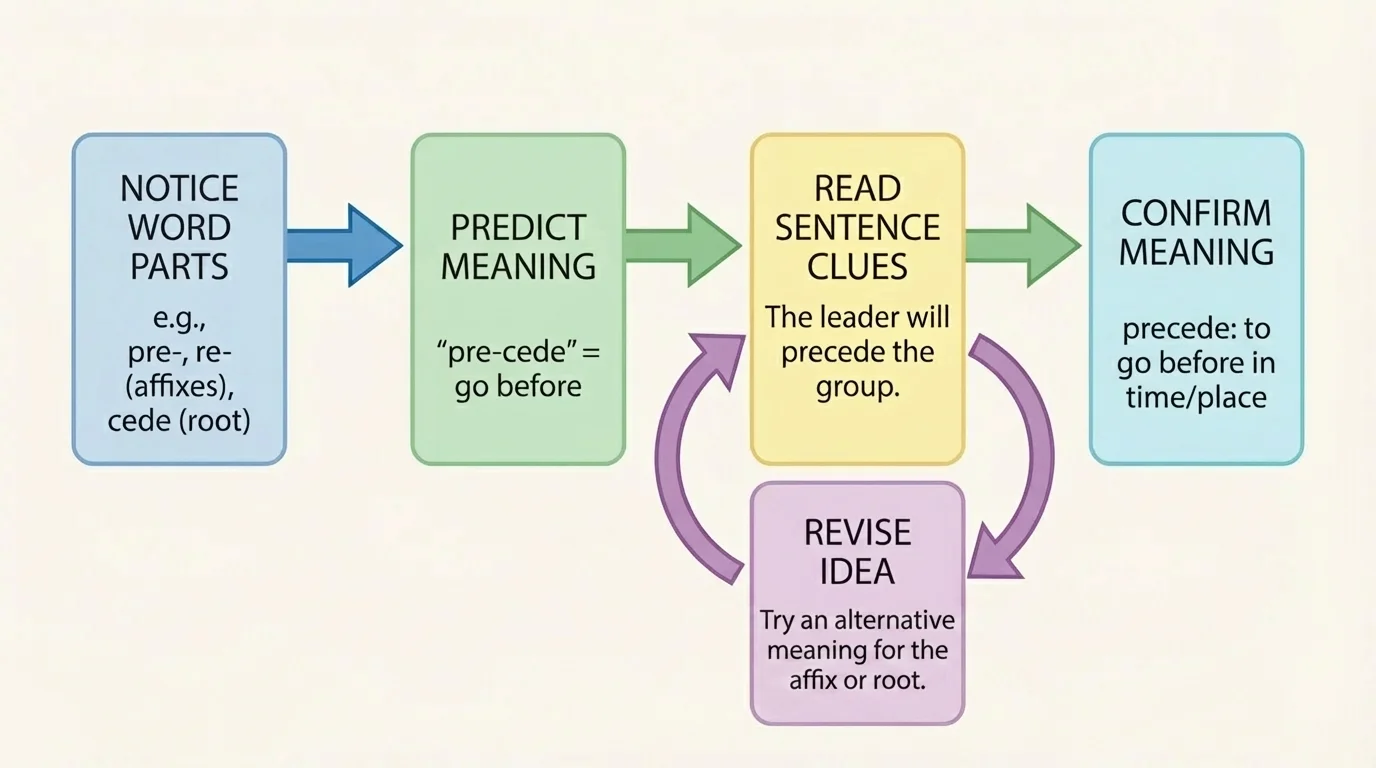
Context is especially important when a word has more than one meaning or when the root clue is only partial. A reader should ask, "Does my guess make sense here?" If not, revise it. The flow in [Figure 4] shows that figuring out a word is a process, not a one-step jump.
Word parts and context work together
Word parts give a likely direction. Context gives proof. If a word-part guess and the sentence do not match, the reader should reread, adjust the guess, and look for stronger clues nearby.
Here are some kinds of context clues that help: a definition in the sentence, an example, a synonym, an antonym, or a description of what is happening.
Not every word can be solved perfectly from roots and affixes alone. Sometimes a word has changed over time. Sometimes it has more than one meaning. Sometimes the connection is loose rather than exact.
For example, the root in a word may point you in the right direction, but not give the full meaning. Succeed is related to the same family we saw in [Figure 3], but in modern English it usually means to do well or to achieve a goal. That meaning grew from older ideas about following after or coming next in a successful way.
Also, some prefixes have more than one job. Re- can mean again in replay, but back in recede. This is why flexible thinking matters. You are using clues, not forcing one exact formula onto every word.
You already know how context clues work from regular reading. This lesson adds another tool: use the sentence and the word parts together, not separately.
The best readers stay open-minded. They predict, test, and revise.
Greek and Latin roots are especially useful in academic vocabulary. In science, biology, geology, and microscope all contain meaningful parts. In social studies, words like democracy, transportation, and secede appear often. In technology, words like transmit, graphic, and audio also come from Greek or Latin sources.
That means recognizing roots is like carrying a tool from class to class. If you know graph means write or draw, then graphic, autograph, and paragraph become less mysterious. If you know spect means look, then inspect, spectator, and spectacles begin to connect.
| Subject | Word | Useful Part | Clue to Meaning |
|---|---|---|---|
| Science | biology | bio | life |
| Science | microscope | scope | look, view |
| History | secede | se- + cede | move apart |
| Technology | transmit | trans- | send across |
| Language Arts | manuscript | script | write |
Table 3. Examples of Greek and Latin word parts across school subjects.
Academic reading becomes easier when you notice these repeating patterns.
When you meet an unfamiliar word, you can follow a practical sequence.
First, look for a familiar prefix, root, or suffix. Even one known part can help.
Second, make a rough prediction. Do not worry about being perfect yet.
Third, read the whole sentence and the sentences around it. Search for clues that confirm or change your guess.
Fourth, ask whether your meaning fits both the word parts and the context. The process in [Figure 4] is helpful because it shows that rereading and revising are normal parts of good reading.
Fifth, connect the word to a family you already know. If you know transport, then portable may connect through the root port. If you know predict, then dictionary may help you remember that dict is related to speaking or saying.
Example: Decoding an unfamiliar word in context
Read the sentence: "The two countries signed an agreement to prevent future conflict and promote cooperation." Suppose the word cooperation feels unfamiliar.
Step 1: Spot a familiar part.
The prefix co- means together.
Step 2: Look at the root idea.
Operate relates to working or acting.
Step 3: Use the suffix.
-tion turns the idea into a noun, naming a process or action.
Step 4: Combine with context.
The sentence talks about preventing conflict, so cooperation likely means working together.
The word parts and the sentence support the same meaning.
This strategy helps even when the exact dictionary wording is unknown. Close understanding is often enough to keep reading successfully.
No reader learns all roots and affixes at once. Word knowledge grows by repetition. You notice a root in one word, then see it again in another, and slowly the pattern becomes automatic. That is how vocabulary becomes stronger and faster.
It helps to stay curious about words. When you see a long word, instead of thinking "too hard," try thinking "What parts do I know?" That shift matters. It turns confusion into investigation.
Over time, you will start seeing connections everywhere: in science terms, historical documents, news articles, and novels. A word that once looked impossible may begin to reveal its structure right away, just like the broken-apart words in [Figure 1].
Reading becomes more powerful when you understand how words are built. Greek and Latin affixes and roots do not just help with one list of vocabulary words. They help you become a more independent reader.
