One of the fastest ways to become a stronger reader is to stop treating every new word like a mystery standing alone. Words usually travel in groups. They lean on nearby words, contrast with them, belong to the same family, or fit into a larger category. Skilled readers notice those relationships. Instead of thinking, "I have never seen this word before," they think, "What does this word seem connected to?" That small shift can unlock meaning in stories, science articles, speeches, and even directions for a game or recipe.
When you read, you do not always have a dictionary nearby, and even if you do, stopping for every unfamiliar word breaks your focus. Understanding relationships between words helps you read more smoothly and more deeply. If a sentence says, "The path was narrow, unlike the broad road beside it," the relationship between narrow and broad helps you understand both words more clearly. One word shines light on the other.
Readers use this skill all the time without realizing it. If you know the word synonym, then a nearby word with a similar meaning can help explain a new one. If you notice a contrast, an opposite word may act as a clue. If you recognize that a word belongs to a larger group, such as fruit, tool, or mammal, you can narrow down its meaning quickly.
Word relationships are meaningful connections between words. These connections include similarity, contrast, category, part-to-whole, function, cause-and-effect, and other patterns that help readers understand what words mean and how they are used.
These relationships matter because meaning is not just about a dictionary definition. Meaning also includes strength, tone, and usage. Two words can be related but not interchangeable. For example, slim and skinny both describe a thin shape, but they do not feel exactly the same. One may sound more positive, while the other may sound more critical.
Readers can organize many word connections into patterns, as [Figure 1] shows. Once you recognize these patterns, unfamiliar vocabulary becomes easier to decode because you are not guessing randomly. You are asking what kind of connection this word has to the others around it.
Some of the most useful relationship types are similarity, contrast, category, part-to-whole, and function. There are also relationships based on degree, cause and effect, and location. For example, glance, stare, and peek all relate to looking, but they describe different kinds of looking.
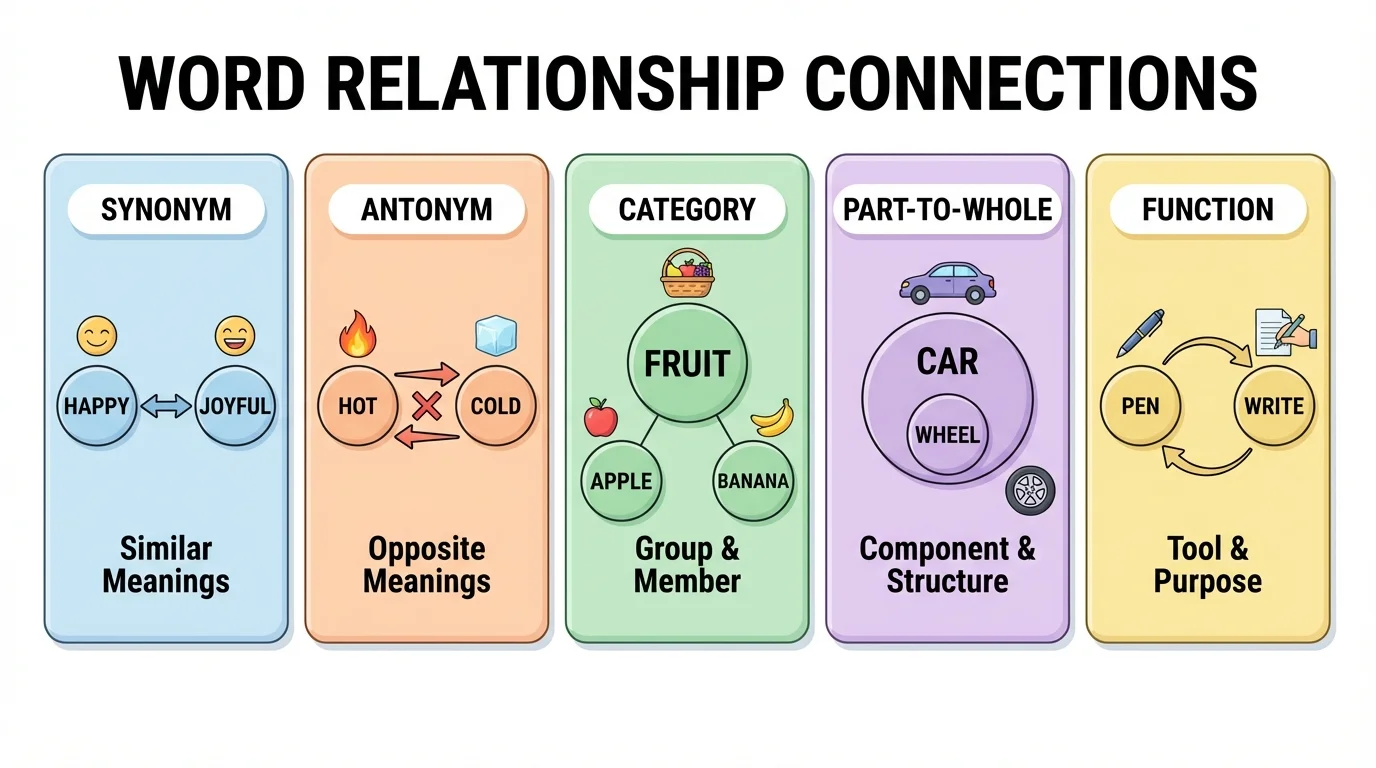
Here is a comparison of common relationships readers use.
| Relationship Type | What It Means | Example Pair | How It Helps |
|---|---|---|---|
| Synonym | Words with similar meanings | happy / joyful | A known word helps explain an unfamiliar one. |
| Antonym | Words with opposite meanings | ancient / modern | A contrast reveals meaning. |
| Category | A general class and a member of it | vehicle / bicycle | The larger group limits possible meanings. |
| Part-to-whole | One word names a part of another | branch / tree | The part gives clues about the whole. |
| Function | One word tells what the other does | thermometer / measure | Purpose helps define the object. |
| Degree | Related words differ in intensity | warm / hot | Shows strength of meaning. |
Table 1. Common word relationships and how each type helps readers infer meaning.
As you continue reading, remember that a word may fit more than one relationship. A word can belong to a category and also have a synonym or antonym nearby. Strong readers combine clues instead of relying on only one.
A near synonym is a word with a meaning close to another word, but not perfectly identical. This is important because many words in English overlap without matching exactly. For example, angry, irritated, furious, and annoyed all relate to the same general feeling, but they differ in strength.
If a text says, "After waiting two hours, Maya was irritated, not enraged," the relationship between irritated and enraged tells you that irritated means somewhat angry, but less extreme. That is more helpful than a simple one-word definition because it tells you where the word sits on a scale of meaning.
Writers choose among near synonyms carefully. A news article may use observed instead of stared because the second word sounds more intense. A novelist may write whispered instead of said because the relationship adds detail about volume and mood. Understanding these relationships helps you notice why one word was chosen over another.
Reading example: using a synonym clue
Sentence: "The cave was gloomy, dark and silent even at noon."
Step 1: Notice the nearby related words.
The words dark and silent help describe gloomy.
Step 2: Ask what kind of relationship appears.
Dark works like a near synonym clue because it points to a similar feeling or condition.
Step 3: Infer the meaning.
Gloomy means dim, dreary, or depressing.
Near synonyms are especially important in literature because authors often avoid repeating the same word. Instead of writing big again and again, a writer might choose large, huge, enormous, or massive. Those words are related, but each one gives a slightly different impression.
An antonym is a word with an opposite meaning. Antonyms are powerful clues because contrast stands out. Words such as but, however, unlike, instead, and on the other hand often signal that a contrast is coming.
Consider this sentence: "Unlike his careless partner, Devin was meticulous with every measurement." Even if you do not know meticulous, the opposite relationship with careless suggests that meticulous means very careful and precise. The sentence itself teaches the word through contrast.
Sometimes the contrast is not direct, but it still helps. "The desert was not lush and green; it was arid and bare." Here, lush and green creates an opposite picture that helps define arid as dry. This kind of clue appears often in science and social studies writing.
Understanding contrast also helps with figurative language. If a poet describes a "deafening silence," the relationship feels surprising because silence is usually the opposite of noise. That tension makes the phrase more powerful.
Some words are easier to understand when you know the larger group they belong to. A category is a class or group of things that share features. If you know a word is a kind of reptile, instrument, or government system, you already know something important about it.
For example, if a sentence says, "The heron, like many wading birds, hunts in shallow water," you can infer that a heron is a kind of bird. You may not know exactly what it looks like, but category information gives you a strong starting point. In science, category clues are everywhere: mineral, mammal, insect, galaxy, and ecosystem all help organize meaning.
Categories work in both directions. A broad category can help explain a specific word, and a specific word can deepen your understanding of a category. If you learn that a cello is a string instrument, the category explains the cello. At the same time, learning about a cello expands your understanding of what kinds of instruments belong in the string family.
How classification helps reading
When readers identify a category, they reduce uncertainty. If an unknown word belongs to the category tool, then it is probably an object used to do a job. If it belongs to the category emotion, it probably describes a feeling. Classification narrows the possibilities before the full meaning is clear.
This strategy is useful in textbooks. A history chapter may mention an alliance, treaty, empire, or colony. Even before reading the precise definition, recognizing the category tells you whether the word names a political agreement, a governing power, or a controlled territory.
Another useful pattern is the part-to-whole relationship, in which one word names a part and another names the larger thing it belongs to. If you know that petals are part of a flower, keys are part of a keyboard, and chapters are part of a book, then the larger whole helps explain the smaller part.
Suppose a text says, "The archaeologist carefully brushed dirt from the shard, one fragment of a larger clay bowl." The word fragment and the mention of a larger bowl help you understand that shard means a broken piece. The relationship between part and whole builds meaning.
Function relationships are also useful. If a sentence mentions a device used to detect smoke, the function gives a clue to the word detector. If a lever is used to lift or move something, function tells you what kind of object it is. Readers often figure out unfamiliar tools, body parts, and technologies this way.
As the earlier comparison chart in [Figure 1] shows, a word's purpose can be just as revealing as its definition. A microscope is understood more clearly when you know that it is used to magnify tiny objects. Function turns an unknown label into something understandable.
An analogy compares relationships between pairs of words. The goal is not simply to match words with similar meanings. The goal is to ask, "How are these two words connected, and is another pair connected in the same way?" Relationship patterns matter here.
For example, bird : nest is related in the same way as bee : hive. In both pairs, the first word names a living thing and the second names the place where it lives or gathers. If you recognize the pattern, you can solve the analogy even if one word is less familiar.
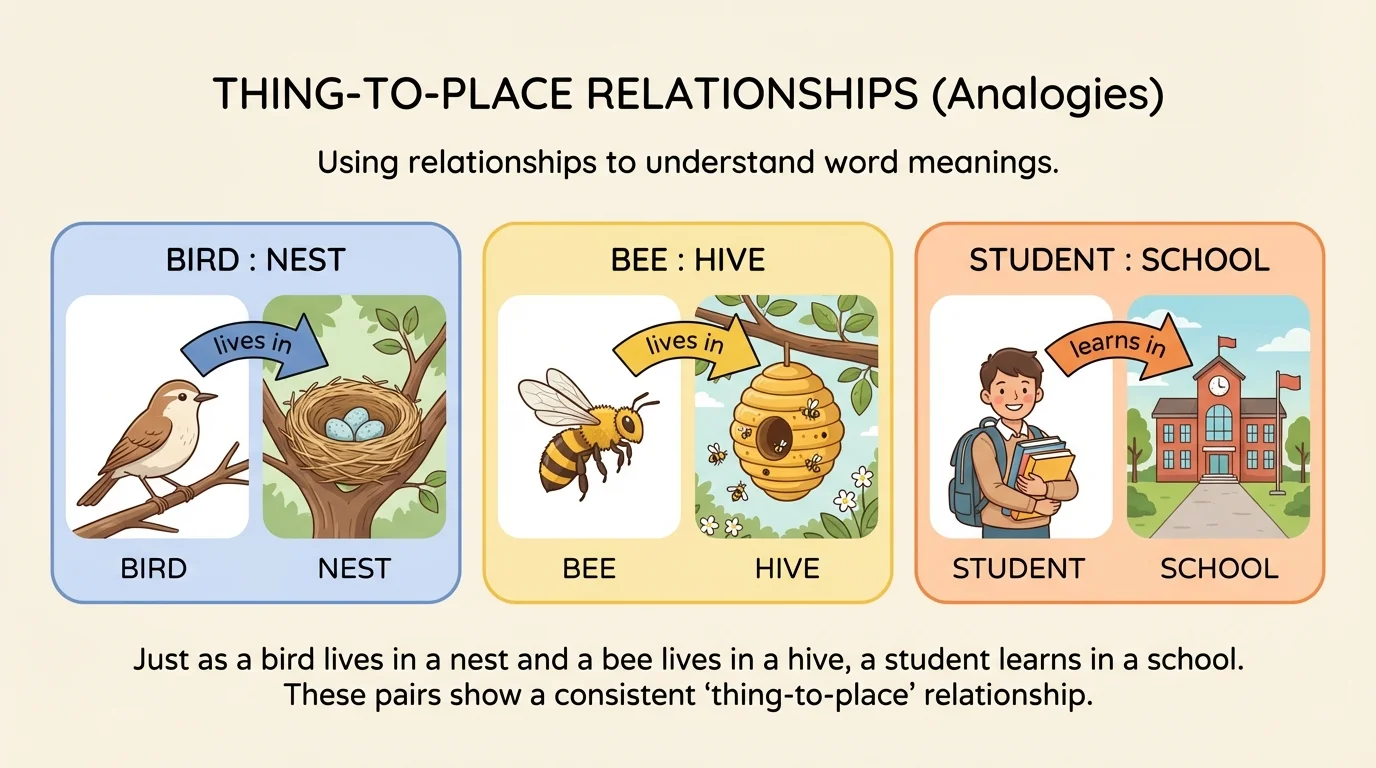
[Figure 2] Other analogy patterns include object to function, part to whole, cause to effect, and item to category. Knife : cut matches pencil : write because each object is linked to a common function. Finger : hand matches toe : foot because each first word is part of the second.
Analogies train you to think in a structured way about meaning. They are especially helpful because they force you to explain the connection, not just guess. If you can say the relationship in a sentence, you understand it more deeply.
Analogy example
Which pair has the same relationship as book : library?
Choices: fish : river, hammer : toolbox, snow : winter, bread : slice
Step 1: Name the relationship in the original pair.
A book is an item commonly kept in a library.
Step 2: Test each choice with the same pattern.
A fish is not an item kept in a river. Snow is not something kept in winter. Bread and slice show whole to part.
Step 3: Choose the best match.
A hammer is an item commonly kept in a toolbox, so hammer : toolbox matches best.
Later, when you meet a new word, this same kind of thinking helps. If a sentence compares an unknown object to a familiar one through use, place, or part-to-whole structure, the analogy-like relationship provides a clue.
[Figure 3] Word relationships also matter in figurative language, where words may mean more than their literal definitions. Related words can suggest mood, exaggeration, comparison, or symbolism. Closely connected words can carry very different feelings.
Nuance is a small difference in meaning, feeling, or tone. Think about the words walk, stride, march, tiptoe, and stagger. All relate to moving on foot, but each paints a different picture. One suggests confidence, another suggests quietness, and another suggests unsteadiness.
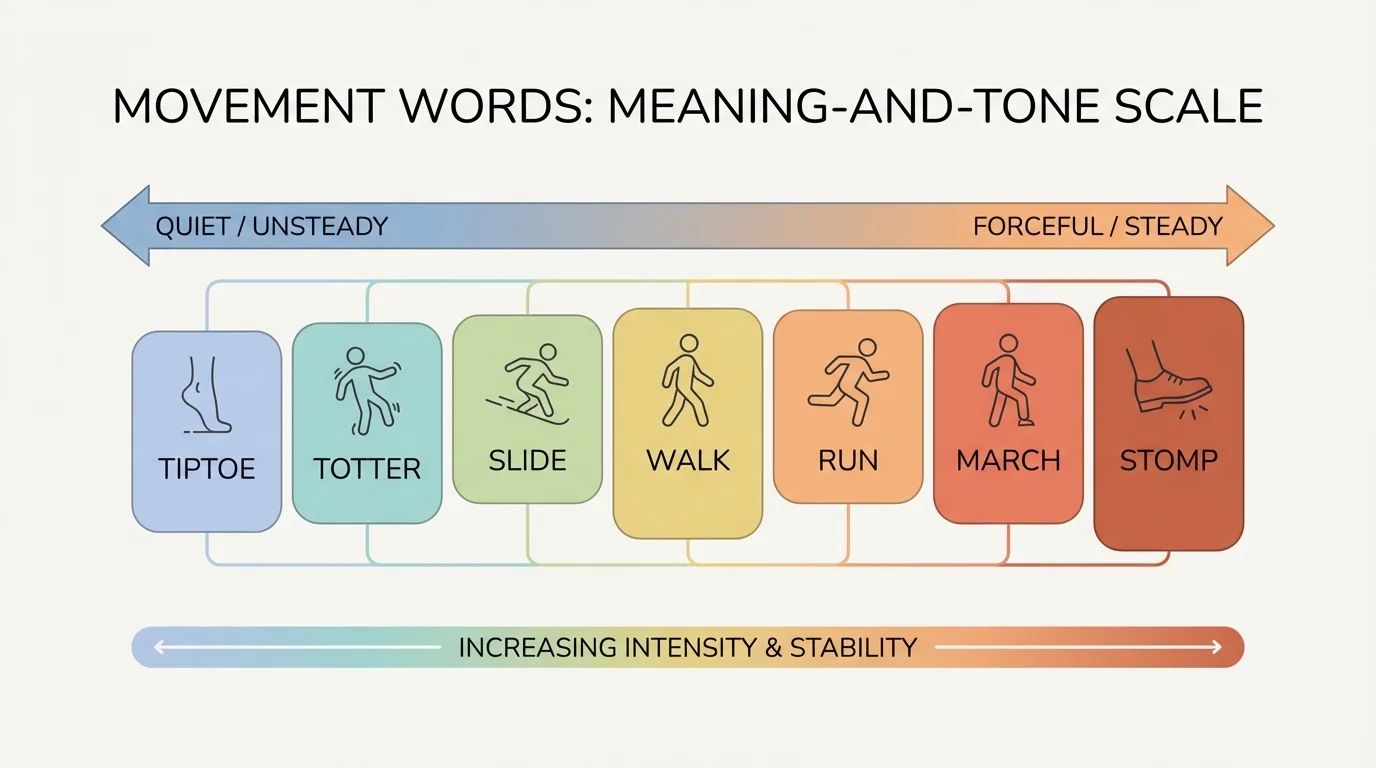
This matters when reading poems, speeches, and fiction. If an author writes, "The wind whispered through the trees," the relationship between whispered and ordinary speaking helps you understand that the wind is being compared to a soft voice. The word choice creates an image and a mood. If the author had written "The wind roared," the relationship would create a completely different feeling.
Idioms also depend on relationship thinking. In the phrase break the ice, the words do not literally describe smashing frozen water in most situations. Instead, the relationship between the phrase and the social situation suggests starting conversation and reducing tension. Readers must connect words to broader meaning, not just literal meaning.
The shades of meaning displayed in [Figure 3] remind us that related words are rarely identical. This is why replacing one word with another can change a sentence's emotional effect, even when the basic topic stays the same.
Many professional writers revise by changing just one related word at a time. Replacing said with whispered or murmured can completely change how a reader imagines a scene.
Learning to hear nuance makes you a better reader and a better writer because you begin to notice not only what words mean, but how they feel.
Word relationships work best when combined with context clues. Context clues are hints in the sentence or paragraph that help reveal meaning. Relationships are one kind of context clue, but not the only kind. Definitions, examples, punctuation, and descriptions also help.
Read this sentence: "The team traveled across rough, jagged terrain filled with sharp rocks and steep slopes." Even if terrain is unfamiliar, the descriptive details tell you it means the land or ground in an area. The words around it create a web of meaning.
Now consider: "Unlike the transparent glass, the new material was opaque." Here, the contrast relationship does most of the work. Because glass is transparent, opaque must mean not see-through. Readers become stronger when they ask which clues are strongest in each case.
When a word is unfamiliar, pause and look around it. Ask: Are there nearby synonyms, antonyms, examples, category words, or descriptions? The best meaning usually comes from combining clues rather than relying on one guess.
This skill is useful in every subject. In science, words like predator and prey form a relationship that explains each term through the other. In geography, words like coast, inland, and peninsula become clearer when compared. In math directions, words such as increase and decrease are understood more sharply when seen as opposites.
One common mistake is assuming that all synonyms mean exactly the same thing. They often do not. Childish and youthful both relate to youth, but one is often negative and the other more positive. If you ignore nuance, you may misunderstand the author's tone.
Another mistake is using only one clue and stopping too soon. If you see a possible synonym, check whether the rest of the sentence supports that idea. If you think a word belongs to a category, ask whether that category fits all the details. Good readers test their guesses.
A smart habit is to explain the relationship in your own words. Instead of saying, "I think this word means something like that other word," say, "This word seems to be the opposite of fragile, so it probably means strong or hard to break." That kind of thinking is clearer and more accurate.
"The difference between the almost right word and the right word is really a large matter."
— Mark Twain
That idea matters because relationships between words are about precision. The closer you pay attention, the more meaning you notice.
This skill is not only for language arts class. In science, if you read that an animal is nocturnal rather than diurnal, the opposite relationship helps you infer that it is active at night instead of during the day. In history, if one government is described as democratic and another as authoritarian, contrast helps you compare systems quickly. In health, words like benign and malignant gain meaning through opposition and category.
Sports announcers, journalists, and online reviews use precise word choices too. A player can be steady, aggressive, cautious, or reckless. These words are related, but each gives a different judgment. Recognizing those relationships helps you read opinions more carefully instead of reacting only to the general topic.
The analogy patterns introduced earlier in [Figure 2] also appear in everyday life. A charger relates to a phone by function, a key relates to a lock by use, and a wheel relates to a bicycle by part-to-whole structure. Once you start looking for relationships, you see them everywhere.
Strong reading is not about memorizing endless lists of isolated words. It is about noticing how words support, oppose, classify, and sharpen one another. The more relationships you see, the more clearly the text speaks.
