Some of the best ideas in school do not begin with one person working alone. They grow when people listen, respond, question, and improve ideas together. A science lab group, a book club, a student council team, and even a sports team strategy meeting all depend on strong discussion skills. When a group knows how to follow rules, set goals, meet deadlines, and share roles, conversation stops being random talk and becomes real teamwork.
In middle school, you are often asked to work with partners or groups. You may discuss a text, solve a problem, plan a presentation, or debate an issue. These tasks are not only about having something to say. They are also about knowing how to say it, when to listen, and how to help the group move forward.
A strong discussion helps everyone learn more. One student may notice a detail in a story, another may ask a useful question, and someone else may connect the topic to a real-world example. When students work together well, they build understanding that is deeper than what any one person might create alone.
Collegial discussion is a respectful, focused conversation in which people work together as learning partners. The goal is not to win or dominate. The goal is to share ideas, listen carefully, and help the group understand the topic more clearly.
Collegial discussions are different from casual conversations. Casual conversations may jump from topic to topic and do not always have a clear purpose. Academic discussions usually have a task, a text, a question, or a problem to explore. That is why groups need structure.
In a collegial discussion, each person has both a right and a responsibility. You have the right to share your ideas. You also have the responsibility to listen to others, respond respectfully, and help the group stay productive.
A collaborative discussion can happen in several ways: one-on-one, in a small group, or in a teacher-led class discussion. In each setting, the same basic habits matter: attention, respect, preparation, and clear communication.
Preparation is especially important. If a class is discussing a text, students should read it and think about it ahead of time. If a group is planning a project, members should come ready with ideas or materials. Good discussions rarely happen by accident. They usually happen because people arrive prepared and ready to participate.
Every productive group follows certain rules, whether the rules are spoken aloud or understood by everyone. Effective discussion behavior, as shown in [Figure 1], includes taking turns, looking at the speaker, and using notes or evidence to support ideas. These habits help a group stay respectful and focused.
One important rule is active listening. Active listening means giving full attention to the speaker, not just waiting for your turn to talk. It includes making eye contact when appropriate, facing the speaker, thinking about what was said, and responding to the actual idea instead of ignoring it.
Another rule is to avoid interrupting. Sometimes students interrupt because they are excited or want to correct a mistake quickly. But interruptions can make others feel unheard. Waiting your turn shows respect and makes discussion more organized.
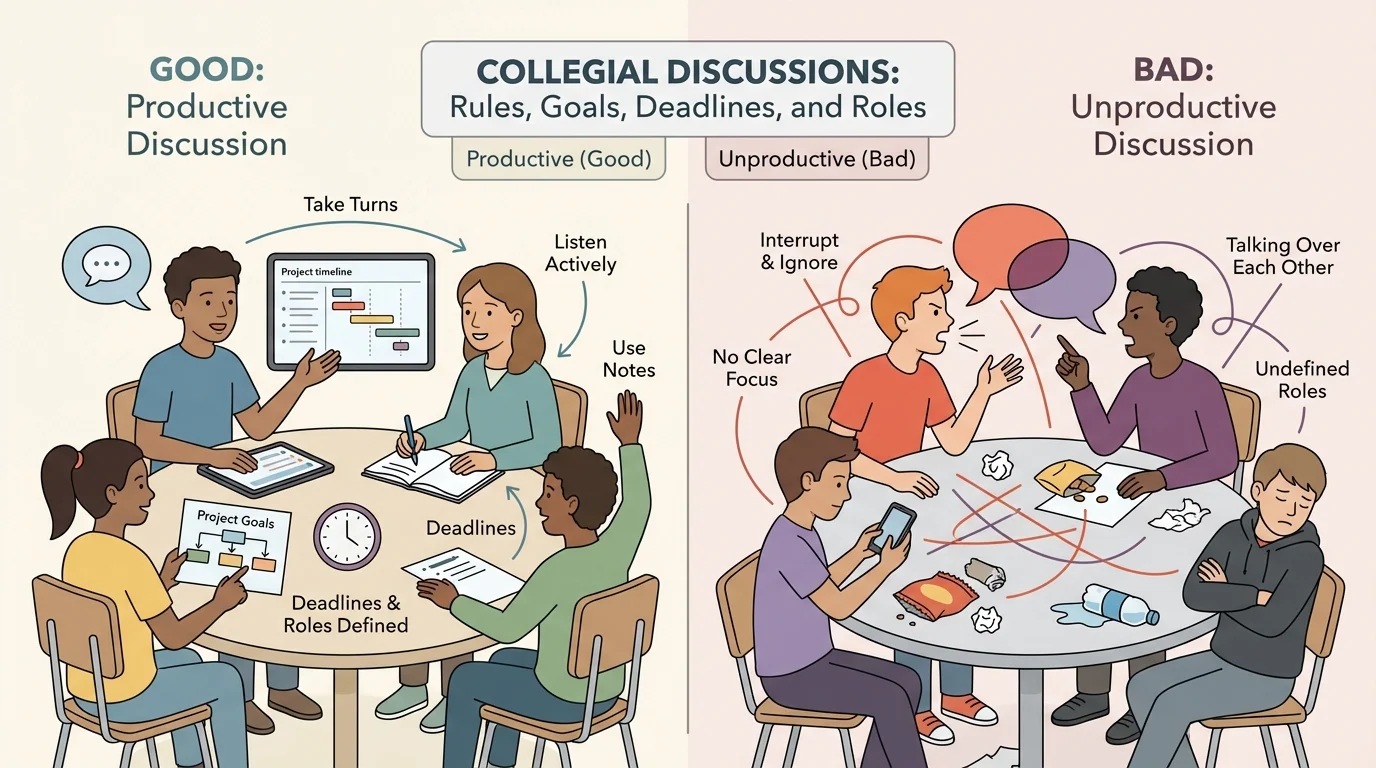
A third rule is to stay on topic. A group discussing renewable energy should not suddenly begin talking about lunch plans or weekend games. Even interesting side topics can pull a group away from its purpose. If the conversation drifts, someone should guide it back.
Students should also support claims with reasons, examples, or evidence. If you say, "I think the character is brave," you should explain why. You might add, "She returns to help her friend even though she is afraid." In academic discussion, ideas become stronger when they are supported.
Respectful disagreement is another key rule. You do not have to agree with everyone. In fact, thoughtful disagreement can improve a discussion. The important part is how you disagree. Instead of saying, "That's wrong," you might say, "I see it differently because the text says..." or "Can you explain that part more?"
Respect does not mean silence. In a strong discussion, respect means speaking honestly without being rude. It also means being open to the possibility that another person's idea may change your thinking.
These rules matter in every setting. The same habits that help in class discussions also help in clubs, jobs, and community work later in life. As we saw in [Figure 1], discussion quality often depends less on how smart people are and more on how well they work together.
Groups work better when they know exactly what they are trying to accomplish. A goal is a clear target. Without a goal, a group may talk a lot without making progress.
A useful goal is a specific goal. "Work on the project" is too vague. "Choose three reliable sources and agree on our main claim by the end of class" is much clearer. Specific goals tell the group what success looks like.
Specific goals help in several ways. They focus attention, reduce confusion, and make it easier to measure progress. They also help group members know what to prepare and what to contribute.
When setting goals, groups should ask questions such as: What are we trying to finish today? What should we know or produce by the end of this discussion? How will we know we are done? These questions turn general plans into clear actions.
Examples of weak and strong goals
Weak goal: "Talk about the article."
This goal does not explain what the group should accomplish.
Stronger goal: "Find the author's main claim, identify two supporting details, and write one question to discuss."
This goal is clearer because it names the tasks the group must complete.
Strongest goal for a timed class: "In the next 15 minutes, identify the main claim, choose the two strongest supporting details, and prepare one group response."
This version is specific about both the task and the time.
Notice that the strongest goal includes not only the task but also the time limit. That leads to another important part of successful collaboration: deadlines.
[Figure 2] Big tasks can feel confusing until they are broken into smaller parts. A deadline is the time by which work should be completed. In group work, deadlines help everyone move at the same pace.
Some deadlines are set by the teacher, such as the date of a presentation. Others are set by the group, such as finishing research by Wednesday or agreeing on speaking parts by Friday. Group deadlines matter because waiting until the last moment often leads to stress, missing work, and weaker results.
Groups also benefit from checkpoints. A checkpoint is a smaller moment to stop and review progress. For example, halfway through a discussion, the group might ask: Have we answered the question? Have all members shared? Are we still on schedule?
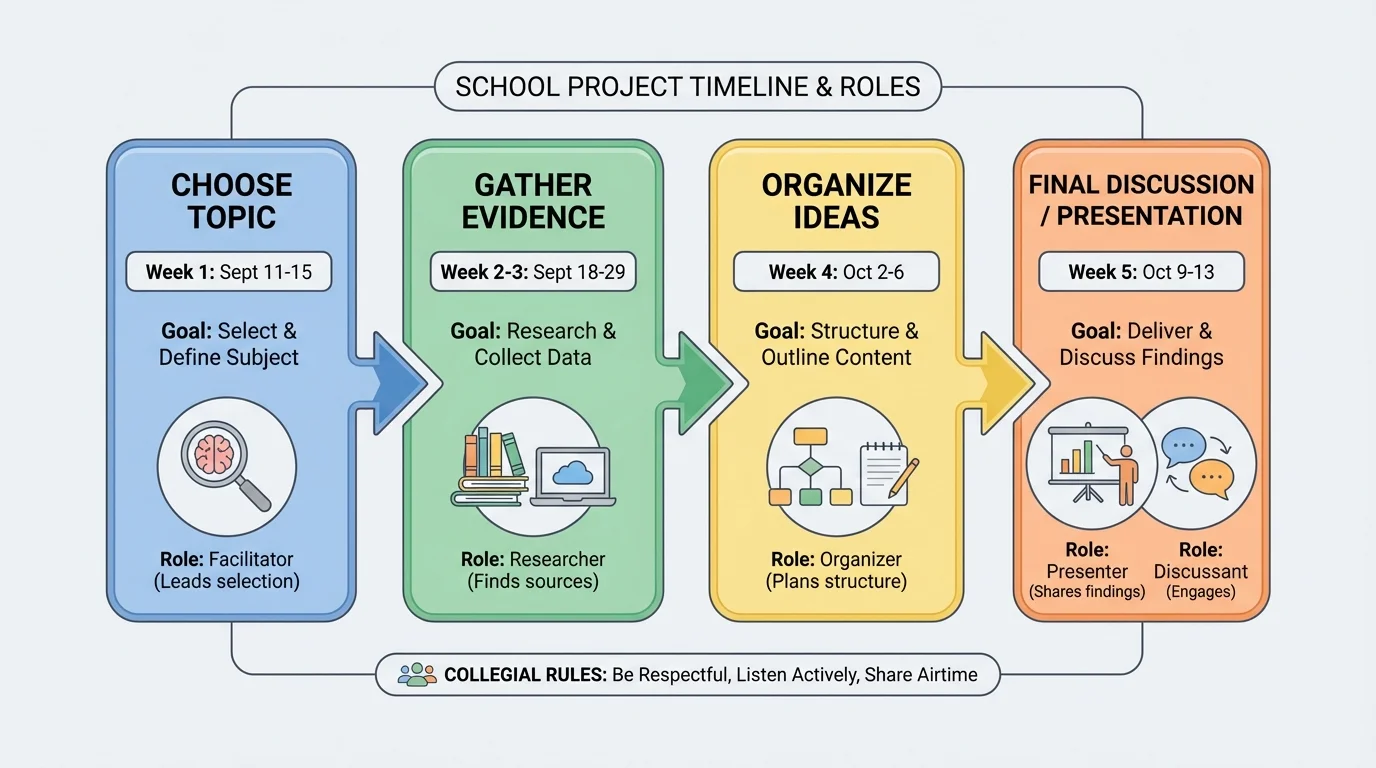
Deadlines should be realistic. If a group needs to read two articles, take notes, and create a visual aid, planning to finish everything in ten minutes is not realistic. Good deadlines match the amount of work and the time available.
Clear deadlines also create accountability. If one person knows they must bring two sources by tomorrow, that expectation is easier to remember and harder to avoid. When deadlines are vague, responsibility becomes blurry.
Later, when a group prepares a final product, the timeline helps explain why early checkpoints matter. A missed first step often creates problems for every step after it.
[Figure 3] Even when everyone is respectful and prepared, groups can still become disorganized if nobody knows who is doing what. Clear roles help groups divide work fairly and keep discussions efficient. A role is a specific job or responsibility assigned to a group member.
Roles are not about making some students more important than others. They are about making sure important tasks are covered. In many middle school discussions, common roles include facilitator, recorder, timekeeper, and reporter.
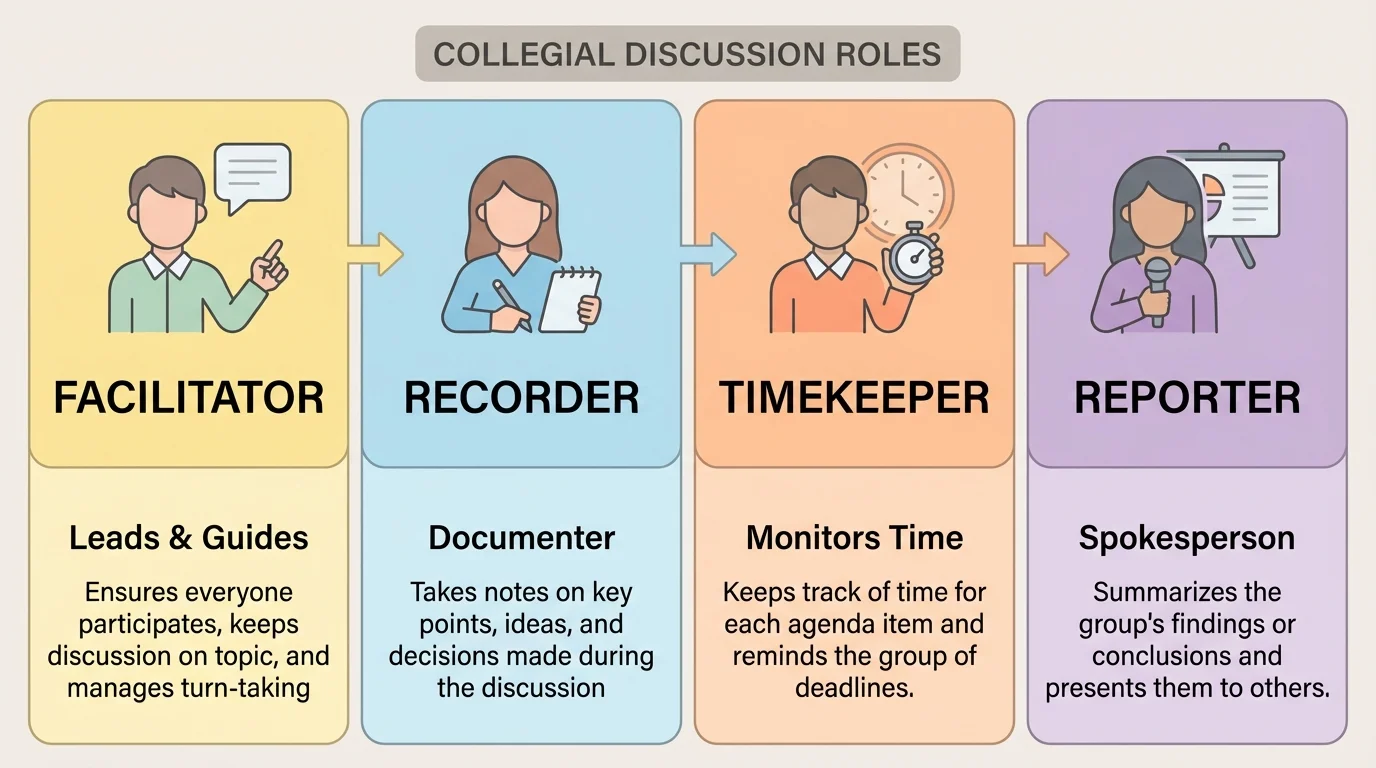
The facilitator helps guide the discussion. This person invites others to speak, keeps the group on topic, and helps the group return to the goal when conversation drifts. The facilitator is not the "boss." Instead, the facilitator supports balanced participation.
The recorder writes down key points, decisions, or evidence the group wants to remember. This role is useful because spoken ideas can disappear quickly unless someone captures them in notes.
The timekeeper watches the clock and reminds the group about deadlines and checkpoints. If the group spends too long on one question, the timekeeper may say, "We have five minutes left. We need to move to the next part."
The reporter shares the group's final ideas with the class or teacher. This person may summarize the discussion, present the group's answer, or explain how the group reached its decision.
Sometimes groups use additional roles, such as materials manager, questioner, or evidence checker. Roles should fit the task. A short partner discussion may not need formal roles, but a long project often does.
In many workplaces, teams still use versions of these same roles. Meetings often include someone who leads the discussion, someone who records notes, and someone who checks deadlines.
Roles can also rotate. If the same student is always the reporter, that student gains lots of speaking practice while others miss out. Rotating roles helps all group members develop different skills. No single role can do everything; successful groups depend on several jobs working together.
A strong discussion is not a series of separate speeches. It is a connected exchange of ideas. That means students should build on what others say instead of ignoring it and jumping to a different point.
One helpful strategy is paraphrasing. Paraphrasing means restating someone's idea in your own words to show understanding. For example, you might say, "So you're saying the article suggests recycling helps, but it is not enough by itself." This confirms understanding and creates a stronger response.
Another useful strategy is asking follow-up questions. Good follow-up questions include: "What evidence supports that?" "Can you explain your example?" "How does that connect to the text?" These questions deepen the discussion instead of ending it.
Students should also use clear sentence starters when responding. Examples include: "I agree with your point because...," "I would like to add...," "I see it differently because...," and "Your idea connects to..." These sentence starters help make communication respectful and organized.
Good speaking and listening work together. Speaking clearly matters, but listening carefully is what allows you to respond in a way that truly fits the conversation.
Building on others' ideas does not mean copying them. It means using them as a starting point for deeper thinking. A student might agree, disagree, expand, connect, or ask for clarification. In each case, the response should connect directly to what was already said.
Even well-planned groups face problems. What matters is how those problems are handled. One common problem is unequal participation. If one person talks the whole time and others stay silent, the group loses valuable ideas. A facilitator can solve this by inviting quieter members to speak: "We've heard two opinions. Let's hear from someone who has not spoken yet."
Another problem is off-topic conversation. This usually happens when students lose focus or the goal is unclear. A quick reminder such as "Our goal is to choose the best evidence before class ends" can bring the group back on track.
Conflict can also happen. Two students may strongly disagree, or one may feel another is not listening. In that case, students should return to the discussion rules: use calm language, refer to evidence, and focus on the idea rather than attacking the person.
Missed deadlines are another challenge. If one group member does not complete a task, the group should respond responsibly. That might mean adjusting the plan, redistributing work, or checking in early next time so problems are noticed before the final deadline.
Sometimes the problem is not behavior but confusion. If no one understands the task, the group should pause and clarify directions instead of pretending to understand. Asking the teacher one focused question can save a lot of time.
Discussion skills change a little depending on the setting. In one-on-one discussions, each person usually has more speaking time. Listening closely matters even more because there are only two voices shaping the conversation.
In small groups, students need balance. Everyone should contribute, but no one should dominate. Roles are especially helpful here because they keep the group organized.
In teacher-led discussions, students often speak to the whole class. This requires strong attention, because you must follow many ideas at once. It also means waiting patiently, speaking clearly enough for others to hear, and responding to comments from both classmates and the teacher.
| Setting | Main Challenge | Helpful Strategy |
|---|---|---|
| One-on-one | Keeping the conversation moving | Ask follow-up questions and respond directly |
| Small group | Balancing participation | Use roles and take turns |
| Teacher-led discussion | Following many ideas | Listen carefully, take notes, and wait to speak |
Table 1. Comparison of discussion settings, common challenges, and helpful strategies.
Although the setting changes, the core habits remain the same: be prepared, listen actively, speak clearly, and help the group reach its purpose.
Suppose a group of four students must discuss whether the school should reduce single-use plastics in the cafeteria and present a recommendation. If they start talking without a plan, they may repeat ideas, forget evidence, or run out of time.
Case study: turning a group discussion into teamwork
Step 1: Set the goal.
The group agrees: "By the end of today, we will choose our claim, find three pieces of evidence, and assign speaking parts."
Step 2: Set deadlines.
They decide to spend the first ten minutes reading notes, the next ten choosing evidence, and the final five assigning presentation parts.
Step 3: Assign roles.
One student is facilitator, one is recorder, one is timekeeper, and one is reporter.
Step 4: Follow discussion rules.
They take turns, support claims with facts, and disagree respectfully when choosing the strongest evidence.
Step 5: Review progress.
At the checkpoint, the timekeeper notices they are behind, so the facilitator helps the group narrow the discussion and make a decision.
This example shows how rules, goals, deadlines, and roles work together. None of these parts is enough alone. A goal without deadlines may lead to delay. Roles without rules may still create conflict. Rules without a goal may produce polite conversation that goes nowhere.
Strong collaborators are not born knowing how to do this perfectly. These are skills that improve with practice. You become better by noticing what helps a discussion succeed and what causes it to break down.
A helpful habit is self-reflection after a discussion. Ask yourself: Did I listen carefully? Did I speak clearly? Did I help the group stay focused? Did I support my ideas with evidence? Did I encourage others to participate?
Another habit is flexibility. Sometimes a group needs you to lead. Other times it needs you to listen more, ask better questions, or help solve a conflict quietly. Good collaborators pay attention to what the group needs, not just what they want to say.
When students follow rules for collegial discussions, set specific goals and deadlines, and define individual roles as needed, they do more than complete assignments. They learn how to think with others, solve problems together, and communicate in ways that are useful far beyond the classroom.
