Two people can say almost the same thing and leave completely different impressions. If someone calls you confident, that may sound like praise. If someone calls you arrogant, it sounds like criticism. The basic idea may be similar, but the feeling attached to each word is not. Strong readers and writers notice that difference. They understand that word choice is not only about dictionary definitions. It is also about attitude, tone, and the message a word sends.
Every word has a denotation, which is its basic dictionary meaning. Many words also have a connotation, which is the feeling, idea, or association people connect to that word. Denotation tells what a word means. Connotation suggests how that word feels.
Denotation is a word's literal, dictionary definition.
Connotation is the set of feelings, ideas, and associations that a word carries beyond its dictionary meaning.
Think of denotation as the core meaning and connotation as the "extra message." For example, the words home and house can refer to a place where someone lives. But home often feels warmer and more personal. House sounds more neutral. That difference matters when you are reading a story, understanding a character, or trying to create a certain tone in your own writing.
Writers choose words carefully because connotations shape how readers react. A news article, a poem, a speech, and a text message may all describe the same event, but each can sound different depending on word choice. A single word can make a person sound kind, rude, smart, proud, sneaky, calm, or cruel.
Words can share a denotation but still differ in strength, tone, and point of view. That means they are not always interchangeable. A thesaurus can help you find related words, but it does not guarantee that those words fit the same situation. If you replace one word with another just because the definitions look close, you may accidentally change the meaning of a sentence.
For example, suppose a student speaks clearly and kindly during a class discussion. Calling that student polite sounds normal and positive. Calling that same student diplomatic suggests something more specific: the student is careful with words, possibly trying to avoid conflict. Calling the student condescending changes everything. Now the student sounds as if they are talking down to others. The denotations may overlap in the area of social behavior, but the connotations are very different.
Why nuance matters
Nuance is a small difference in meaning. Skilled readers notice nuance to understand a character's attitude, and skilled writers use nuance to create exactly the right tone. Without attention to nuance, a sentence may become misleading, too harsh, too weak, or unintentionally funny.
Connotation often answers questions like these: Does the word sound respectful or insulting? Formal or casual? Warm or cold? Honest or suspicious? Gentle or forceful? These shades of meaning help readers infer what a speaker really thinks.
[Figure 1] The words refined, respectful, polite, diplomatic, and condescending all connect in some way to behavior around other people, but they do not create the same picture in a reader's mind. Some suggest kindness, some suggest social skill, and one clearly suggests disrespect disguised as manners.
Refined usually has a positive connotation. It suggests someone has polished manners, good taste, or a graceful way of behaving. If a novel describes a character as refined, readers may picture someone elegant, controlled, and perhaps from a wealthy or highly educated background. The word can carry admiration, but it can also feel a little distant or formal.
Respectful is strongly positive. It suggests genuine regard for other people. A respectful person listens, uses considerate language, and treats others with dignity. This word points more to attitude than to style. Someone can be respectful without sounding fancy.
Polite is also positive, though sometimes more neutral than respectful. It usually means showing good manners, such as saying "please," taking turns, or speaking courteously. However, context can shift it. If someone says, "He was polite, but not warm," then polite sounds correct but emotionally distant.
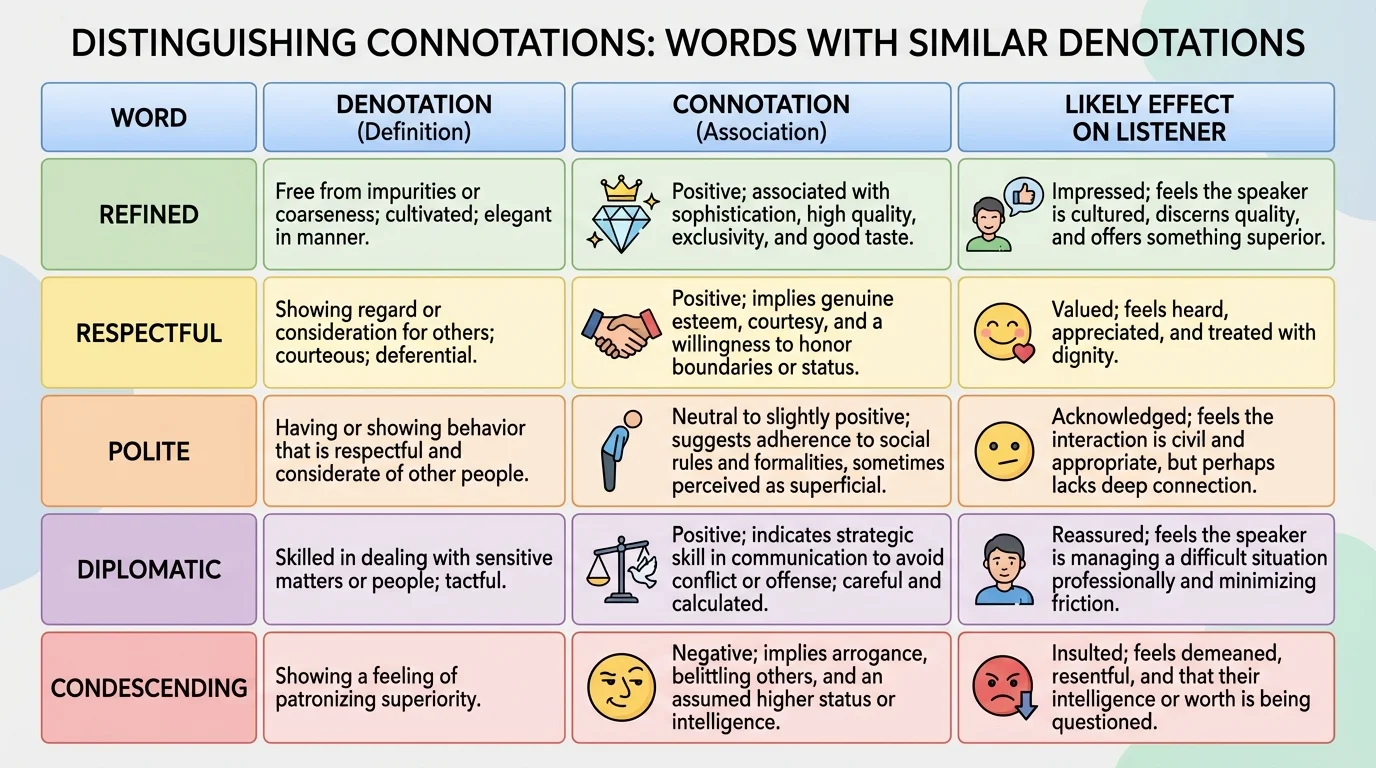
Diplomatic usually has a positive or neutral connotation. It means dealing with people carefully and tactfully, especially in tense situations. A diplomatic person tries not to offend others and may be skilled at solving disagreements. In some contexts, though, diplomatic can suggest that someone is being so careful that they are avoiding a direct answer.
Condescending has a negative connotation. It describes someone who acts as if they are better, smarter, or more important than others. A condescending person may sound calm and polite on the surface, but the attitude underneath is insulting. This is why connotation matters so much: two people may both sound controlled, yet one seems respectful and the other seems rude.
Consider these sentences. "The coach gave respectful feedback" suggests honest guidance and care. "The coach gave diplomatic feedback" suggests careful wording, maybe to avoid hurting feelings. "The coach gave condescending feedback" suggests the coach acted superior. The main action is still feedback, but the connotations change the whole scene.
A word's connotation does not float by itself. Readers discover it through context, which includes surrounding words, the situation, and the speaker's attitude. If a character says, "Thank you for your brilliant suggestion," the word brilliant may sound positive. But if the character rolls their eyes and the plan is clearly terrible, the connotation shifts through sarcasm.
Context clues can come from many places: a character's actions, facial expressions, punctuation, dialogue, and the overall mood of a passage. A narrator might describe someone as thin, which can sound neutral. But if the next sentence says the person looked weak and tired, the word begins to lean toward a negative feeling. If the narrator says the person moved like a trained runner, the word may seem more positive or healthy.
When you use context clues, you look at the words and ideas around an unfamiliar or tricky word to infer meaning. Connotation uses the same reading skill, but now you are inferring not only what a word means, but also what feeling it carries.
Pay attention to who is speaking. One character may use a word to praise, while another may use a similar word to insult. In fiction, this can reveal personality. In nonfiction, it can reveal the author's viewpoint. If an article describes a group as determined, that sounds more approving than calling the same group stubborn.
Notice also that time and culture affect connotation. Some words change over time. Others may sound different in different communities. Readers should stay alert to the specific context in front of them.
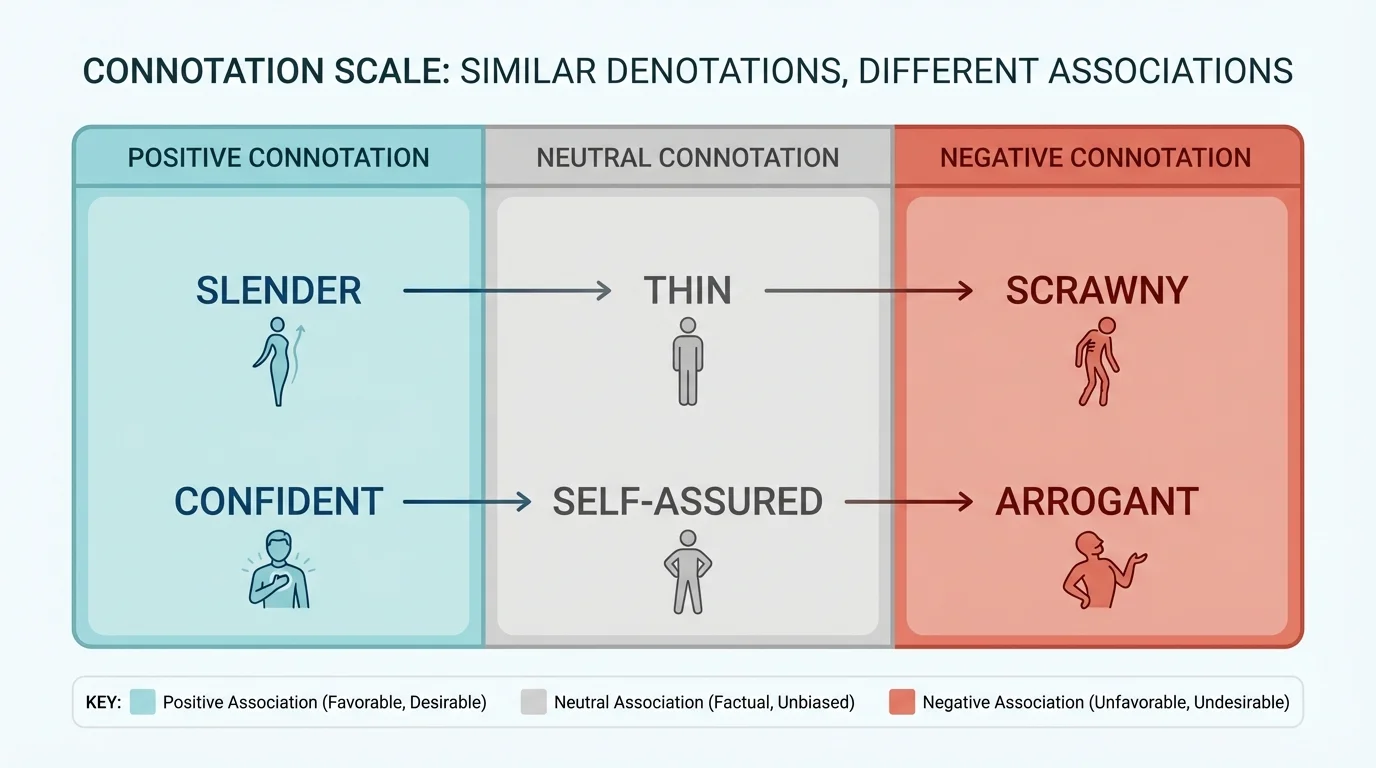
You can think of connotation as a scale of emotional coloring, and [Figure 2] illustrates how related words can slide from positive to neutral to negative. This does not mean every word fits neatly into one box forever. It means many words tend to lean in a certain direction unless context changes them.
Here is a simple way to sort connotations:
| Connotation | What It Suggests | Examples |
|---|---|---|
| Positive | Approval, admiration, warmth | slender, determined, curious, respectful |
| Neutral | Plain description without strong judgment | thin, persistent, interested, polite |
| Negative | Criticism, discomfort, disapproval | scrawny, stubborn, nosy, condescending |
Table 1. Examples of positive, neutral, and negative connotations.
When you sort words this way, you become more precise. For instance, childlike usually sounds positive because it suggests wonder, innocence, or trust. Childish sounds negative because it suggests immaturity. Their denotations are connected, but their connotations push readers in different directions.
The word skinny can sound positive in one conversation and insulting in another. That is a good reminder that connotation depends not only on the word itself, but also on speaker, audience, and situation.
Writers often choose a stronger positive or negative connotation on purpose. Advertisements may use words with positive connotations to make products sound appealing. Critics may use words with negative connotations to shape opinion. Readers should notice these choices instead of accepting them automatically.
Once you understand one set of words, you can apply the same thinking to many others. This skill helps with literature, history, science writing, speeches, and everyday communication. The key is to ask: what emotional or social message comes with this word?
Look at these related sets:
Set 1: slim, thin, scrawny. All can describe a person with a lean or slight build. Slim often sounds positive and attractive. Thin sounds neutral. Scrawny sounds negative and suggests weakness or an unhealthy appearance.
Set 2: confident, proud, arrogant. These words all connect to a strong sense of self. Confident is usually positive. Proud can be positive or neutral depending on context. Arrogant is negative because it suggests superiority.
Set 3: curious, interested, nosy. These words all relate to wanting to know something. Curious is often positive, especially in learning. Interested is more neutral. Nosy is negative because it suggests invading someone's privacy.
Word-choice case study
Read this sentence: "Maya asked three questions about the new student." Now watch how connotation changes the sentence.
Step 1: Use a positive word
"Maya was curious about the new student." This suggests thoughtful interest.
Step 2: Use a neutral word
"Maya was interested in the new student." This gives information without strong judgment.
Step 3: Use a negative word
"Maya was nosy about the new student." This suggests she crossed boundaries.
The action is similar, but the connotation changes how Maya is judged.
Notice that the differences are not tiny details. They affect how readers picture a person, event, or argument. That is why connotation is one of the tools writers use to guide readers without directly stating every opinion.
When you read, do not just ask, "What does this word mean?" Also ask, "Why did the author choose this word instead of another one?" That question often reveals tone. If an author describes a leader as firm, the connotation may be positive, suggesting strength and control. If the author says harsh, the connotation becomes negative, suggesting cruelty or unfairness.
As you saw earlier in [Figure 1], words that seem related can shape a reader's impression in very different ways. In stories, connotation can hint at whether a narrator admires a character, distrusts a character, or feels uncertain. In informational texts, connotation can reveal bias, which is a slant or preference in how information is presented.
Dialogue is especially important. A character may sound diplomatic in one conversation and condescending in another, depending on the exact wording and attitude. If a speaker says, "Let me explain this in a way you can understand," that may sound helpful in one context but insulting in another. The surrounding details tell you which interpretation fits best.
Connotation and tone
Tone is the writer's or speaker's attitude toward a subject or audience. Connotation helps create tone. Positive connotations can make a tone sound admiring or hopeful, while negative connotations can make a tone sound critical, fearful, or mocking.
Strong readers keep gathering clues instead of deciding too quickly. One sentence may not be enough. Sometimes the whole paragraph, chapter, or article reveals the connotation clearly.
Connotation matters just as much when you write. If you want to sound fair, kind, serious, or persuasive, your word choices need to match your purpose. A writer describing a classmate's speech might choose confident to praise, dramatic to suggest strong expression, or boastful to criticize. Each choice guides the reader.
Audience also matters. In a formal essay, a writer may prefer respectful or diplomatic because those words are precise and appropriate. In a personal narrative, more emotional words may fit better. In either case, the writer should think beyond denotation and consider the effect on the audience.
One useful strategy is to test near-synonyms before choosing one. Ask these questions: Which word sounds most positive? Which is most neutral? Which might offend someone? Which matches the tone I want? The connotation scale in [Figure 2] helps you remember that words often carry different levels of approval or criticism.
Another strategy is to read your sentence aloud. Sometimes a word sounds harsher or colder when you hear it. That can help you catch accidental connotations before someone else reads your work.
A common mistake is assuming all synonyms mean exactly the same thing. They do not. Another mistake is depending too much on a thesaurus without checking examples. A thesaurus gives options, but you still need to decide which option fits the context and tone.
Here are smart strategies for handling connotation well:
When you practice these habits, you become a more careful reader and a more powerful writer. You start to notice the hidden layers inside ordinary words. That awareness helps you understand characters more deeply, detect bias more clearly, and express your own ideas more accurately.
