One small word can completely change the meaning of a sentence. If a coach says a player is aggressive, that might sound like praise for strong effort. If a doctor says a disease is aggressive, the meaning is much more serious. Good readers do not stop at a first guess. They make a preliminary determination, then verify it. That means they check whether their guessed meaning is really supported by the text.
Verifying meaning is one of the most useful reading skills you can build. It helps when you read stories, science articles, history textbooks, websites, and directions. It also keeps you from making confident mistakes. Sometimes a word looks familiar but means something different in a new setting. Sometimes a phrase cannot be understood literally. Skilled readers act like detectives: they gather clues, test ideas, and confirm the best answer.
A first guess can be helpful, but it is not always enough. Suppose you read, "The desert plants are adapted to survive long, dry seasons." You might guess that adapted means "changed in some way." That is a strong start, but you still need to verify what kind of change the sentence means. In science, the idea is not just any change. It refers to traits or features that help an organism survive in its environment.
Verification matters because words can shift meaning depending on the subject. In music, a measure is part of a song. In math, to measure means to find length, mass, or volume. In everyday speech, measure can even mean an action taken for a purpose, as in "safety measures." If you verify meaning, you avoid choosing the wrong definition just because the word seems familiar.
Readers already use clues when they meet an unknown word. The next step is stronger: do not just guess. Check your guess against the sentence, the paragraph, the text structure, and a reference source when needed.
Verification is especially important when a text is teaching new information. Academic reading often includes precise vocabulary. If you misunderstand one key term, the rest of the paragraph can become confusing. A careful reader notices this and pauses to confirm the meaning before moving on.
A preliminary determination is your first reasonable idea about what a word or phrase might mean. You do not pull this idea out of nowhere. You build it from the clues in the sentence and the topic you are reading about. This first step is important because it gives you something to test.
For example, read this sentence: "After hiking for two hours in the hot sun, Maya felt fatigued and sat down in the shade." Even if you have never seen fatigued before, you can infer that it probably means "very tired." The situation gives the clue: long hike, hot sun, sitting down to rest. That is your preliminary determination.
Now comes the key part: verification. Ask yourself, "Does 'very tired' fit everything in the sentence?" Yes, it does. "Hungry" would not fit as well. "Excited" would clash with the resting detail. By checking your guess against the full context, you strengthen your understanding.
Verify means to check that something is true, accurate, or correct. In reading, it means testing whether the meaning you inferred really fits the context.
Context clue is a hint in the words, phrases, sentences, or overall situation around an unfamiliar word.
Dictionary entry is the set of information in a dictionary about a word, including pronunciation, part of speech, and one or more definitions.
Sometimes your first guess will be close but not exact. That is normal. Strong reading is not about getting every word instantly. It is about being flexible enough to revise your understanding when the evidence points in a better direction.
The words around an unfamiliar term act like evidence, as [Figure 1] shows. When you verify a meaning in context, you look not only at the sentence with the word but also at the sentences before and after it. Writers often leave hints on purpose, especially in textbooks and articles.
Several kinds of context clues can help. A definition clue directly explains the word. An example clue gives examples that reveal the meaning. A contrast clue shows what the word is not, often with signal words like but, however, or unlike. A restatement clue says the idea again in simpler words. A cause-and-effect clue helps you reason out the meaning from what happens.
Look at these examples. "The path was treacherous, full of loose rocks and hidden holes." The description verifies that treacherous means dangerous. In "Unlike his harsh and abrupt reply, her answer was calm and gentle," the contrast verifies that abrupt means sudden, sharp, or unfriendly. In "Some animals are nocturnal, such as owls and bats that are active at night," the examples verify that nocturnal means active during the night.
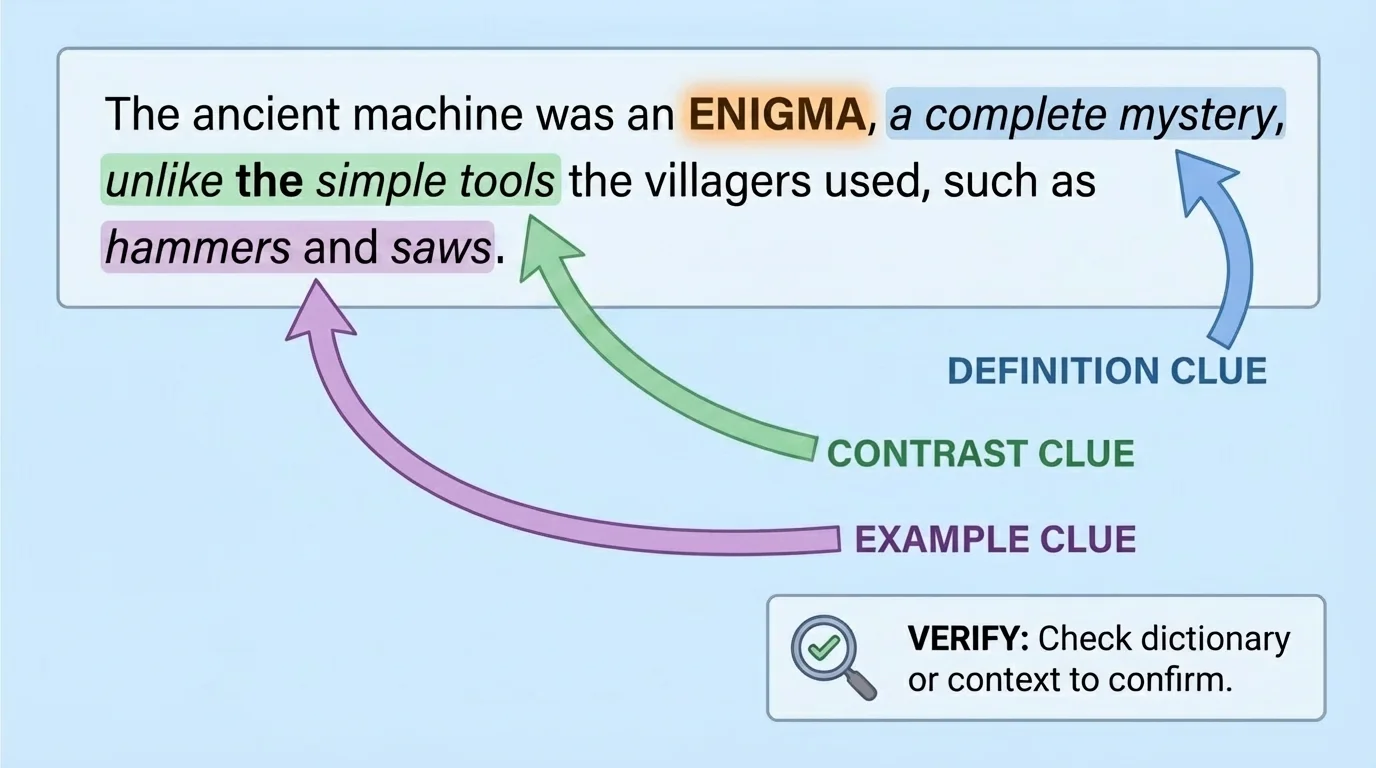
Context also includes tone and situation. If a character whispers, avoids eye contact, and steps back nervously, a word describing that character probably relates to fear, caution, or discomfort. If a science article discusses layers of rock, the word deposition probably has a geologic meaning rather than a legal or conversational one.
When you check context, ask: "Does my meaning fit this sentence?" Then ask a stronger question: "Does it still fit the whole paragraph?" A guess may seem right in one line but fail when you keep reading. That is an important sign that you should revise it.
Verifying a meaning with context
Sentence: "The principal's remarks were concise; she finished speaking in less than two minutes, but everyone understood the message."
Step 1: Make a first guess.
The clue "finished speaking in less than two minutes" suggests that concise means short.
Step 2: Test the guess against the whole sentence.
The phrase "everyone understood the message" shows the remarks were not just short; they were clear and to the point.
Step 3: Verify and refine.
The best meaning is "brief but effective," not merely "tiny" or "rushed."
This matters because verification often leads to a more precise meaning than your first guess. Precision is important in academic reading. A word's exact shade of meaning can affect how you understand a character, an argument, or a scientific explanation.
Sometimes the parts of a word help confirm or challenge your guess, as [Figure 2] illustrates. This strategy is called using morphology, or word structure. You look at prefixes, roots, and suffixes to see what they suggest.
Suppose you read the word preview. The prefix pre- means before, and view relates to seeing. That supports the meaning "a look before something fully happens." If you read disagree, the prefix dis- suggests "not" or "opposite," which helps verify that the word means "to not agree."
Word structure becomes even more helpful with academic vocabulary. In predict, the prefix pre- means before, and the root relates to saying. So predict means to say ahead of time what may happen. In transportation, the root port relates to carrying. That supports the idea of moving people or things from one place to another.
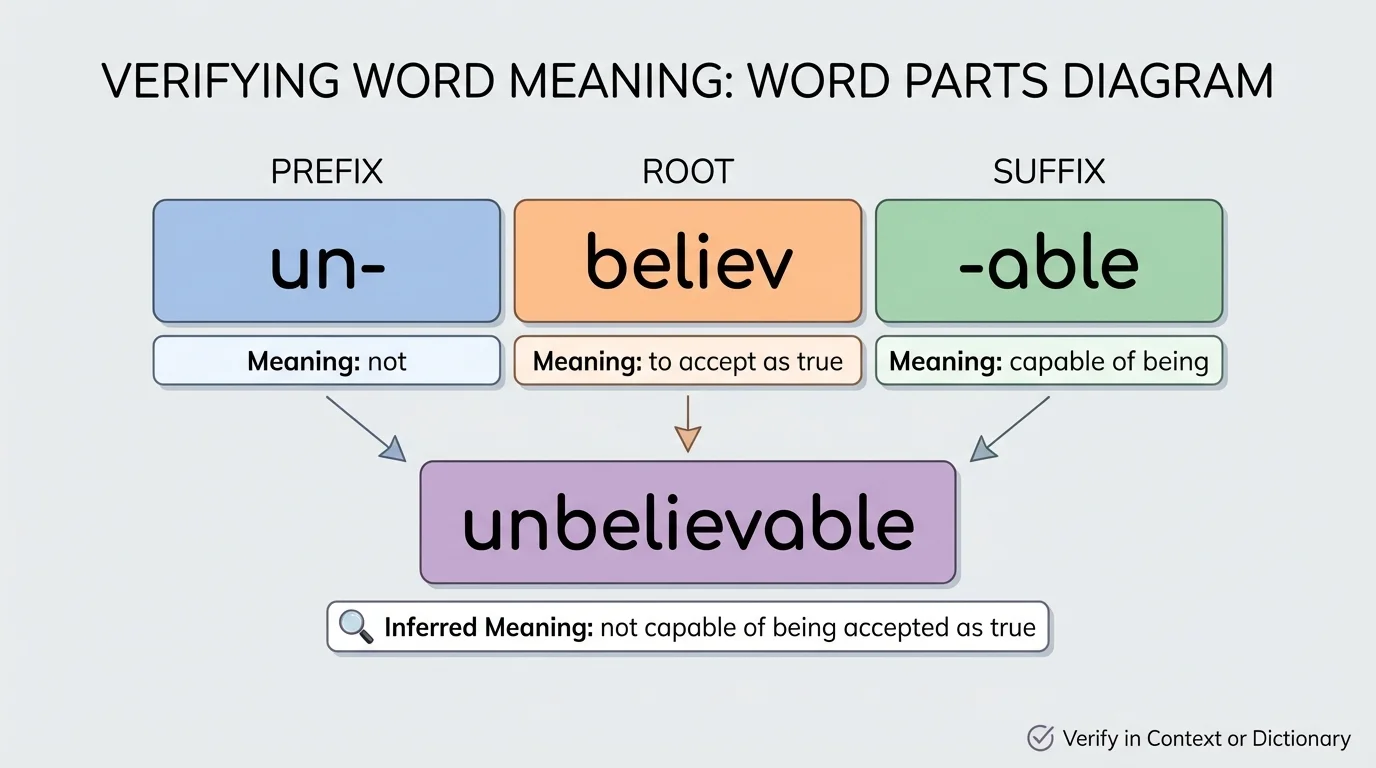
However, word parts are helpers, not magic answers. Sometimes they point you in the right direction, but context still has the final vote. A word may contain familiar parts yet be used in a specialized way. That is why good readers combine strategies instead of trusting only one.
How verification works with word parts
If context suggests one meaning and the word parts suggest another, pause and compare. Often the best answer is the one that fits both. If the two clues seem to clash, keep reading or check a reliable source. Verification is about matching evidence, not forcing a guess to work.
As you saw earlier with context clues in [Figure 1], the strongest understanding usually comes from multiple clues working together. A sentence may suggest the general idea, while the prefix or root sharpens the meaning.
A dictionary entry can confirm meaning, but only if you use it carefully, as [Figure 3] explains. Many words have several definitions. If you choose the first one without checking the context, you can still end up with the wrong meaning.
When you look up a word, begin by noticing its part of speech. Is the word a noun, verb, adjective, or adverb in your sentence? That matters. For example, record can be a noun, as in "a record of events," or a verb, as in "record the data." The correct definition depends on how the word is functioning in the sentence.
Next, read all the definitions, not just the first one. Then compare each definition to your sentence. If you are reading about electricity, the word current likely means the flow of electric charge, not a water current or something happening now. A science textbook glossary can be especially useful because it gives the subject-specific meaning the text intends.
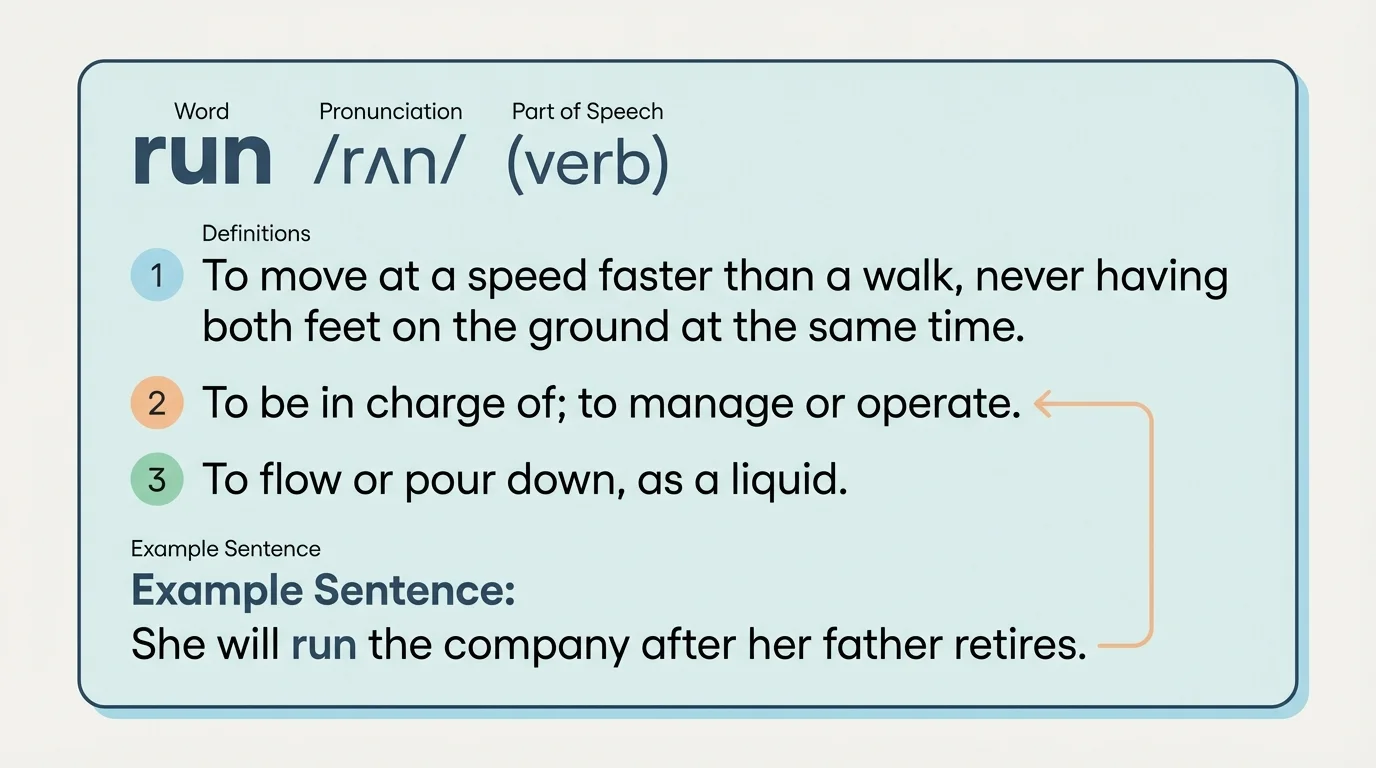
Dictionaries can also help you verify pronunciation, origin, and usage. These details do not just make you sound smarter when reading aloud. They can deepen understanding. If a word comes from a root you recognize, that can support the meaning. If the usage note warns that the word is formal, informal, or technical, that also gives helpful information.
Sometimes a glossary is better than a general dictionary because it is connected to the exact topic you are studying. In a history chapter, a glossary definition of revolution may focus on political change, while a science text might use the same word to mean one complete orbit around another object. Verification means selecting the definition that truly fits the passage.
Using a dictionary to verify, not just to guess
Sentence: "The workers will extract copper from the rock."
Step 1: Infer from context.
Because the sentence talks about copper and rock, extract probably means to take something out.
Step 2: Check the dictionary entry.
If the entry lists meanings such as "to pull out," "to obtain from a source," and "a passage taken from a text," only one meaning fits here.
Step 3: Verify the best match.
The correct meaning is "to obtain from a source" or "to remove from within," because copper is being taken from rock.
This process protects you from a common mistake: finding a real definition, but not the right one for the sentence in front of you.
Some words are tricky because they truly have more than one accepted meaning. These are called multiple-meaning words. The word branch can mean part of a tree, a division of government, or a smaller office of a larger business. The word cell can mean a tiny unit of life, a small room, or a section in a spreadsheet.
To verify a multiple-meaning word, look at the topic, nearby details, and grammar. If a sentence says, "The prisoner sat alone in his cell," the setting confirms one meaning. If it says, "Plant cells have rigid walls," the science context confirms another. If it says, "Enter the number in the highlighted cell," technology context points to the spreadsheet meaning.
Phrases can work the same way. "Breaking point" can refer to a physical limit, an emotional limit, or a critical stage in a process. "On the table" can literally mean resting on furniture, or it can mean "available for discussion." Verification requires you to ask what makes sense in that exact situation.
| Word or Phrase | Possible Meaning 1 | Possible Meaning 2 | How Context Verifies the Meaning |
|---|---|---|---|
| light | not heavy | brightness | "The backpack felt light" points to weight; "Turn on the light" points to brightness. |
| charge | electrical property | cost or fee | Science context supports electricity; shopping or service context supports a fee. |
| draft | first version of writing | current of air | Writing context supports version; weather or room conditions support air flow. |
| table | piece of furniture | organized chart of information | Room setting supports furniture; textbook or data context supports chart. |
Table 1. Examples of words and phrases whose meanings change depending on context.
As the dictionary example in [Figure 3] makes clear, multiple meanings are one reason readers must compare the sentence with all available definitions rather than stopping too soon.
Not every phrase should be read literally. If a character says, "I am all ears," the speaker does not mean the body has changed shape. This is an idiom, a phrase whose meaning is different from the literal meanings of its words. To verify an idiom, ask what idea the speaker is communicating in that moment. Here, the phrase means "I am listening closely."
Figurative language also appears in literature and nonfiction. If a writer says, "The city never sleeps," that does not mean every person stays awake every second. It means the city is active all the time. A literal interpretation would fail, so readers verify the meaning by considering tone, purpose, and common expression.
Technical phrases matter too. In science, "natural selection" does not mean someone in nature is making a choice the way a person chooses a snack. It names a process in which traits that improve survival become more common over generations. In history, "cold war" does not mean a war fought in freezing weather. It refers to intense rivalry without direct full-scale fighting between the major powers involved.
Some idioms make perfect sense only inside a certain language or culture. That is one reason translation can be difficult: a phrase that sounds natural in one language may sound very strange if translated word for word.
When literal meaning seems odd, impossible, or unrelated to the text, that is a strong signal to test a figurative or technical meaning instead.
It helps to have a repeatable method. When you meet an unfamiliar word or phrase, first read the whole sentence. Then form a preliminary determination. After that, look for evidence nearby: examples, contrasts, explanations, and the topic of the paragraph. Next, examine word parts if they help. Finally, check a dictionary or glossary if the meaning still needs confirmation.
You can think of the process this way: guess, test, confirm, revise if needed. That last part matters. Good readers are willing to change their minds. Revising is not failure. It is what careful thinkers do when new evidence appears.
Full verification process
Sentence: "Because the instructions were vague, several students assembled the model incorrectly."
Step 1: Preliminary determination.
Vague probably means unclear.
Step 2: Test with context.
The result is that several students assembled the model incorrectly. That supports the idea that the instructions lacked clarity.
Step 3: Consider alternatives.
Could vague mean short, funny, or strict? Those meanings do not explain why students made mistakes.
Step 4: Verify.
The best meaning is "not clearly expressed or detailed enough."
Notice how each step narrows the possibilities. Even if you had not known the word at first, the sentence gives enough evidence to confirm the meaning.
One common mistake is relying on only one clue. A reader may notice a familiar prefix and decide too quickly. Another may grab one nearby word and ignore the rest of the paragraph. Verification is stronger when several clues point to the same answer.
A second mistake is choosing the first dictionary definition automatically. As you learned earlier, many words have multiple meanings. Always compare the definitions with the sentence and topic. The correct meaning is the one that fits the evidence, not necessarily the one listed first.
A third mistake is ignoring grammar. The role a word plays in the sentence matters. If the unknown word is describing a noun, you are probably looking for an adjective meaning. If it names a thing or idea, it is functioning as a noun. Grammar can eliminate definitions that do not fit.
Finally, some readers stop too early. They make a guess, it seems good enough, and they move on. But a few lines later, the text may reveal that a more precise or different meaning is needed. Staying alert is part of verification.
This skill travels with you into every class. In science, you may verify words such as erosion, organism, or density by using topic clues and a glossary. In history, you may verify terms like alliance, empire, or economy by looking at the events and relationships described. In literature, you may verify figurative phrases, tone words, and character descriptions by studying how language works in the scene.
Even outside school, verification matters. News articles, game instructions, recipes, and online posts often include unfamiliar words or phrases. People who verify meaning carefully are less likely to misunderstand information, directions, or arguments.
"A good reader does not just find a meaning. A good reader proves it fits."
That is the heart of the skill. You begin with a thoughtful guess, but you do not stop there. You test it with context, word structure, grammar, and reference tools until the meaning truly makes sense.
