Have you ever heard someone begin a presentation like a news reporter, then suddenly sound like they are texting a friend, and then end like they are writing a poem? The words may all make sense, but the whole thing feels off. Writing works the same way. Readers expect a piece of writing to sound steady and purposeful. When it jumps around, they may stop trusting the writer, lose the main idea, or feel confused about how they are supposed to react.
Good writing is not only about correct spelling and grammar. It is also about making choices that fit together. Two of the most important choices are style and tone. When a writer keeps these consistent, the writing feels smooth, clear, and intentional. When a writer does not, the piece can seem messy even if every sentence is technically correct.
Style is the way a writer uses language. It includes word choice, sentence length, level of formality, and the overall way of expressing ideas. Tone is the writer's attitude toward the topic or audience. A tone can be serious, excited, respectful, humorous, worried, calm, or many other things.
Consistency means staying steady. In writing, that means your style and tone match your purpose from beginning to end unless you have a clear reason to change them. A science explanation for classmates should not suddenly sound like a silly commercial. A personal narrative about a meaningful moment should not unexpectedly switch into stiff, robotic language.
Style is the way writing sounds because of the writer's language choices.
Tone is the feeling or attitude the writing expresses.
Consistency means keeping those choices steady so the writing feels unified.
Readers notice inconsistency quickly, even if they cannot always explain why. They may think, "This sounds strange," or "This does not feel like the same writer." That reaction matters because writing is communication. If the reader gets distracted by uneven style or tone, the message becomes weaker.
Style is like a writer's clothing choices for ideas. You can dress the same idea in formal language, casual language, short sentences, long sentences, vivid details, or plain explanation. As [Figure 1] shows, the same topic can sound completely different depending on the choices a writer makes.
A formal style uses precise words, complete sentences, and a more serious structure. This style often appears in essays, reports, school emails to teachers, and speeches. An informal style sounds more relaxed and conversational. It may fit a friendly note, a journal entry, or dialogue in a story.
Style also includes sentence patterns. A writer who uses mostly short, direct sentences creates one kind of effect. A writer who uses longer, more detailed sentences creates another. Neither choice is automatically better. The important question is whether the style fits the purpose and stays steady enough for the reader to follow.
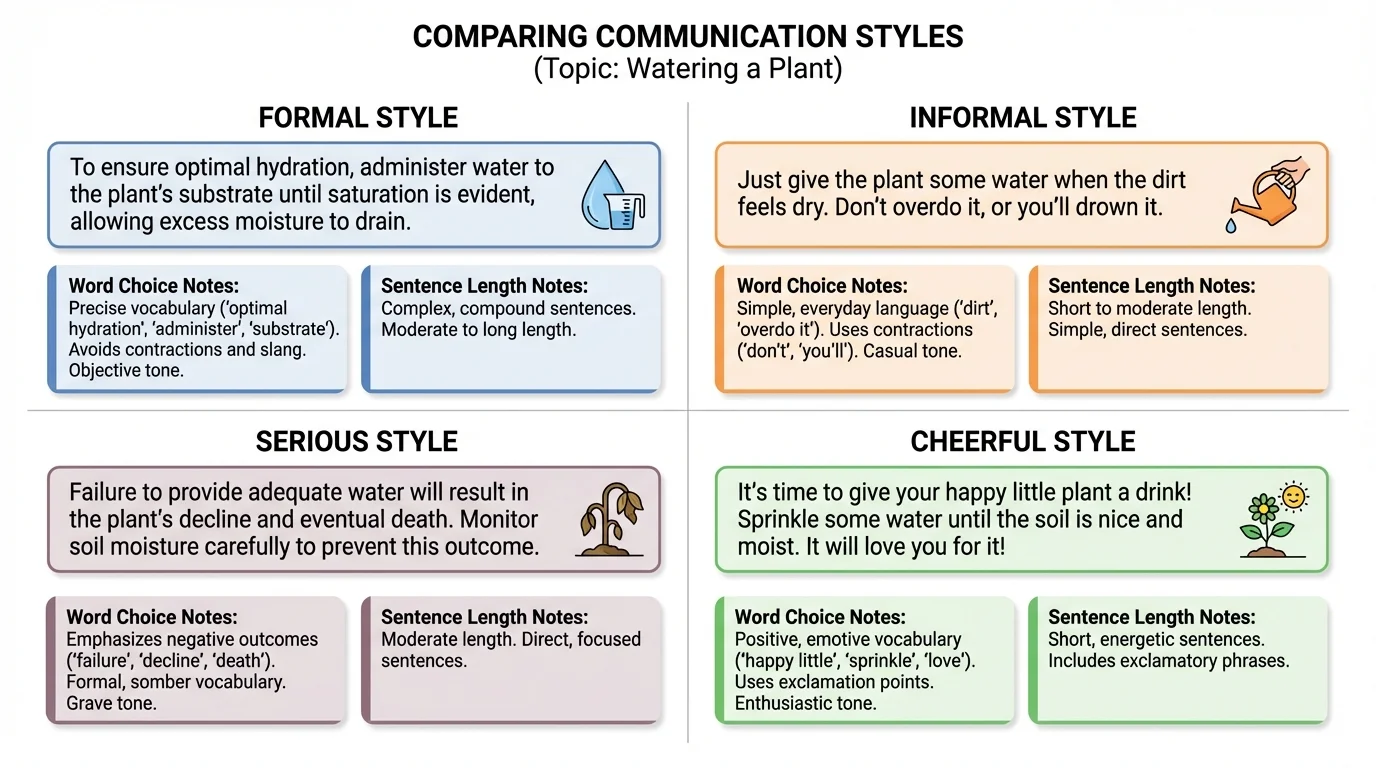
For example, look at these ways of expressing a similar idea:
Formal: "The school garden provides students with an opportunity to learn about plant growth and responsibility."
Informal: "The school garden lets students learn how plants grow while taking care of something real."
Both sentences communicate a similar idea, but they sound different. If a report begins with the formal version, it should probably not drift into slang such as "The garden is super cool and kind of awesome, not gonna lie." That sudden shift changes the style too sharply.
While style is about how the language is built, tone is about the attitude behind it. Tone answers questions such as: Is the writer respectful? Amused? Hopeful? Critical? Nervous? Appreciative?
Writers create tone through many small choices: adjectives, verbs, punctuation, details, and what they choose to emphasize. Compare these two sentences:
"The rain ruined the picnic and left everyone disappointed."
"The rain surprised us, but it turned the picnic into a funny memory."
The event is similar, but the tones are different. The first sounds frustrated. The second sounds cheerful and reflective. If a writer begins a piece with a thoughtful, respectful tone, that tone should usually continue unless the writer signals a clear reason for change.
How tone affects the reader
Tone helps guide the reader's emotions and expectations. A respectful tone builds trust. A playful tone can entertain. A serious tone can show that an issue matters. If the tone changes without warning, the reader may feel unsure about how to understand the message.
Tone is especially important because it can change meaning without changing the main facts. For example, "That was an interesting choice" might sound sincere, curious, or sarcastic depending on the overall tone of the writing. Keeping tone consistent helps the reader interpret your words correctly.
Before writing, a strong writer asks two questions: Why am I writing? and Who will read this? Your answers help shape your style and tone.
Your audience is the person or group you are writing for. Your purpose is your reason for writing. Are you trying to inform, persuade, entertain, reflect, or explain? These choices affect what kind of language will work best.
| Type of writing | Likely style | Likely tone |
|---|---|---|
| Essay for class | Clear, organized, fairly formal | Serious, thoughtful |
| Email to a teacher | Polite, direct, formal | Respectful |
| Personal narrative | Descriptive, expressive | Reflective or emotional |
| Story dialogue | Depends on character | Depends on scene |
| Speech to classmates | Clear, engaging, slightly conversational | Confident, appropriate to topic |
Table 1. Common combinations of style and tone for different writing situations.
If you are writing to persuade the principal to support a recycling program, your style should be clear and respectful. Your tone might be confident and responsible. If you write the same topic as a funny comic scene, the style and tone can change, but they still need to fit each other.
This is why writers cannot simply choose "good words." They must choose words that belong together. A formal purpose with a sarcastic or sloppy tone can weaken the message. A light, entertaining purpose with overly stiff language can feel unnatural.
Readers often sense uneven writing when there are sudden changes in language level, attitude, or point of view. [Figure 2] illustrates how even one short paragraph can feel confusing when slang, formal words, and pronoun shifts all appear together.
One common problem is changing formality. A writer may begin with careful academic language and then switch to casual expressions. Another problem is changing point of view, such as starting with "I," moving to "you," and ending with "they" for no reason. A third problem is using punctuation and sentence patterns inconsistently, such as mixing complete, polished sentences with sentence fragments that do not serve a purpose.
Writers can also become inconsistent by mixing tones. For example, a paragraph about a serious community problem may suddenly include jokes that make the issue seem unimportant. Sometimes writers use dramatic language in one sentence and plain, flat language in the next, making the piece feel unbalanced.
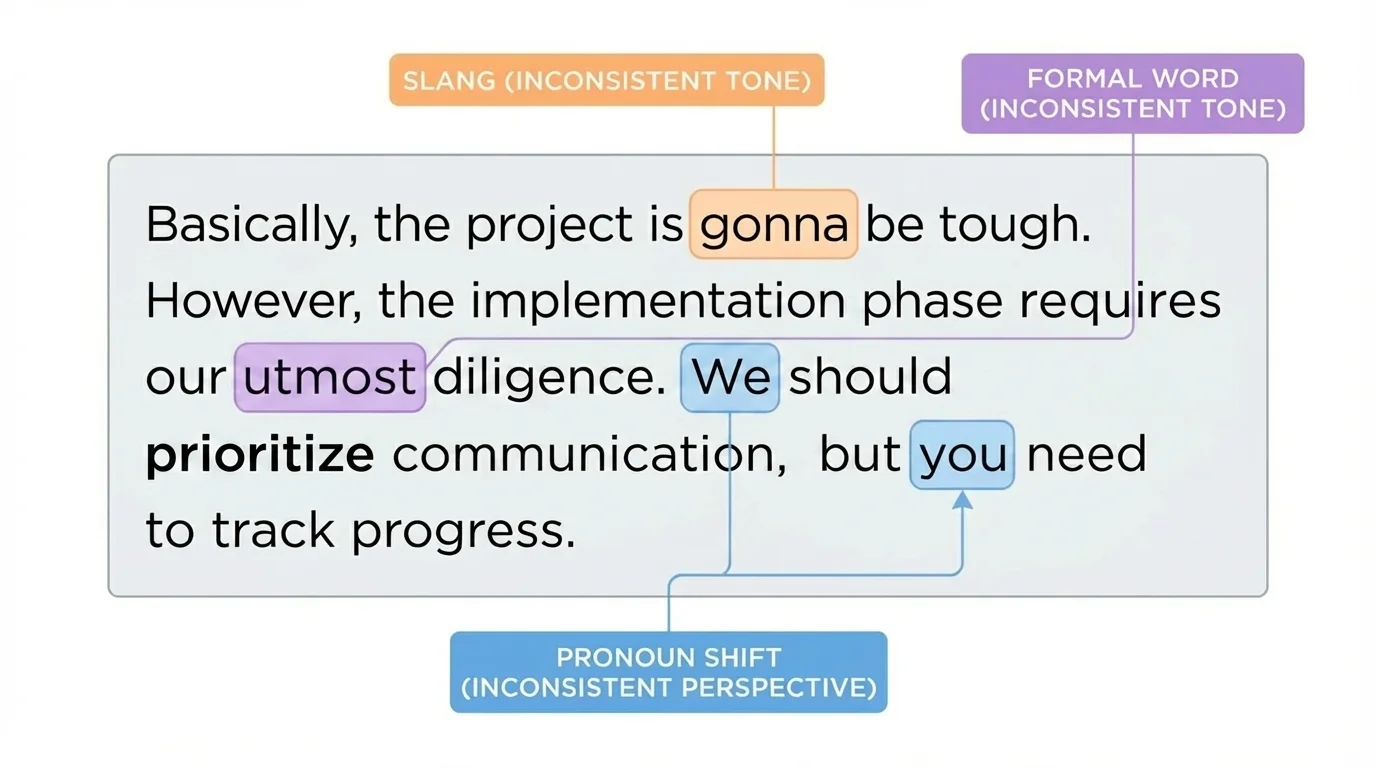
Here are some frequent kinds of inconsistency:
Not every change is wrong. In dialogue, different characters may speak differently. In a narrative, a serious moment may be followed by a lighter one. The key question is whether the change feels intentional and understandable, or accidental and confusing.
Professional writers often revise specifically for tone. Even journalists, novelists, and speechwriters reread drafts to make sure the writing sounds steady and believable from start to finish.
A useful test is this: if a sentence sounds like it belongs to a completely different piece of writing, it probably needs revision.
Consistency becomes easier when you make decisions early. Before drafting, choose your audience, purpose, and general tone. You do not need a perfect plan for every sentence, but you should know whether your writing should sound formal, friendly, urgent, reflective, or something similar.
A simple revision checklist can help even before revision begins. You might ask: What level of formality do I want? What feeling should the reader get? Will I use first person, second person, or third person? What kinds of words fit this piece?
It also helps to write a "model sentence" at the start of your draft. This is one sentence that captures the voice you want. When later sentences start to drift, compare them to your model sentence. Do they sound like they belong in the same piece?
Planning example
A student is writing a letter to the city council asking for safer crosswalks near school.
Step 1: Choose the audience and purpose.
The audience is city leaders. The purpose is to persuade them to make a change.
Step 2: Choose a fitting style.
The style should be organized, clear, and respectful rather than casual.
Step 3: Choose a fitting tone.
The tone should be serious and responsible, not joking or sarcastic.
Step 4: Keep later sentences matched to those choices.
Instead of writing "Cars fly by like it's a racetrack, which is wild," the student might write, "Cars often travel too quickly near the school, creating an unsafe situation for students."
Notice that the second version is not "better" because it uses longer words. It is better because it matches the purpose and audience more effectively.
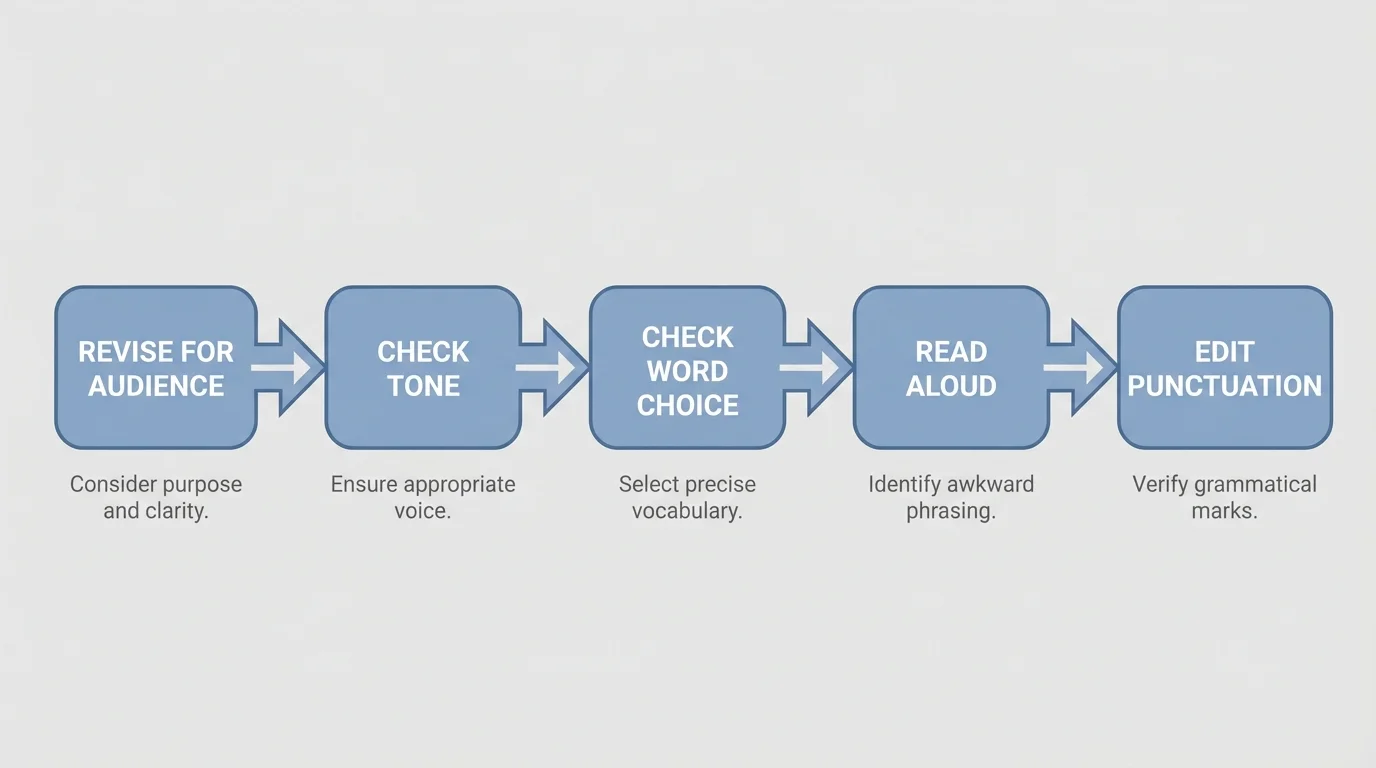
Many students think revision means checking spelling at the end. Real revision is bigger than that. It means re-seeing your writing. As [Figure 3] shows, strong revision works like a sequence of checks: audience first, then tone, then word choice, then sentence flow, and finally editing details.
One of the best revision tools is reading your work aloud. Your ears often catch shifts that your eyes miss. If one sentence sounds as if it wandered in from a different assignment, you will usually hear it right away.
Another strong method is to check the beginning, middle, and end separately. Sometimes a writer starts with one tone, drifts in the middle, and then returns to the original tone at the end. Looking at each part helps you spot those changes.
You can also highlight certain features in different colors. For example, underline slang, circle pronouns, or box emotional words. This makes patterns easier to see. If one paragraph has five jokes and the others have none, the mismatch becomes clear.
Peer feedback can help too, but the question matters. Instead of asking, "Is this good?" ask, "Does this sound like one piece of writing?" or "Where does the tone change?" Specific questions lead to useful answers.
The clearest way to learn consistency is to see uneven writing and improve it.
Example 1: Formality mismatch
Before: "Our class conducted an investigation of water quality, and the results were pretty awesome because the creek was not gross."
Step 1: Identify the problem.
The sentence begins with formal academic language but suddenly switches to casual words such as "awesome" and "gross."
Step 2: Revise to keep the style steady.
After: "Our class conducted an investigation of water quality, and the results showed that the creek was cleaner than expected."
The revised version stays clear and appropriate for a school report.
That kind of revision matters because the reader no longer has to adjust to two different styles in one sentence.
Example 2: Tone mismatch
Before: "Losing the championship game was painful for the team. Anyway, at least the snacks were good."
Step 1: Identify the problem.
The first sentence sounds serious and emotional. The second suddenly becomes flippant, which weakens the mood.
Step 2: Revise to keep the tone consistent.
After: "Losing the championship game was painful for the team, but it also motivated the players to train harder for next season."
The revised version keeps a reflective tone instead of undercutting the moment.
As with the highlighted paragraph in [Figure 2], even a short phrase can change how the whole piece feels. Small words have big effects.
Example 3: Point-of-view mismatch
Before: "When I started middle school, you feel nervous because they do not know where anything is."
Step 1: Identify the problem.
The sentence begins in first person with "I," shifts to second person with "you," and then moves to third person with "they."
Step 2: Choose one point of view.
After: "When I started middle school, I felt nervous because I did not know where anything was."
The revised sentence sounds unified and easier to follow.
Writers often improve consistency not by making writing fancier, but by making it steadier.
Sometimes a skilled writer does shift tone intentionally. A speech may begin solemnly and end hopefully. A narrative may move from humor to seriousness as the conflict grows. A persuasive article may include a light opening before turning to a more urgent appeal.
The difference is that intentional change feels guided. The writer prepares the reader. There is a clear reason for the shift, and the new tone still fits the overall purpose. Random change feels like a mistake; purposeful change feels like design.
For example, a memoir might begin with a funny childhood memory and later become reflective when explaining what the memory taught. Because the story develops naturally, the shift works. The writer does not jump without warning.
"A writer's choices should feel intentional, not accidental."
This idea is useful far beyond school assignments. Advertisements, speeches, podcasts, articles, and social media posts all depend on voice. People are more likely to listen when the voice sounds clear and controlled.
Some students worry that consistency means sounding boring or all the same. It does not. You can still have personality, energy, and creativity. In fact, consistency helps your own voice stand out because readers can recognize it.
Your voice is the individual flavor of your writing. It grows from your natural interests, your sentence rhythms, the details you notice, and the way you think. A consistent voice does not mean every sentence is identical. It means the piece sounds like one person communicating one clear message.
Think of a song. It can include louder and softer moments, but it still remains the same song. Writing works in a similar way. Variation can make writing interesting, but consistency keeps it coherent.
When you revise, ask yourself these questions: Does this piece sound like it belongs together? Does the tone fit my purpose? Will my audience know how to read my words? If the answer is yes, your writing is more likely to feel polished and strong.
And if the answer is no, that is not failure. It simply means you have found the next thing to improve. Good writers are not people who magically get every sentence perfect the first time. They are people who notice their choices and shape them carefully.
