Have you ever said, "That's not what I meant," after someone repeated your idea back to you incorrectly? That small moment reveals a big truth: good discussions are not just about speaking. They are also about listening carefully, thinking about what was said, and responding in a way that shows real understanding. In school, on teams, in families, and online, people work together better when they can review key ideas, reflect on them, and paraphrase them accurately.
These skills matter in one-on-one conversations, small-group projects, and teacher-led discussions. If you miss the main point, you may answer the wrong question. If you ignore another person's perspective, you may think a disagreement means someone is "wrong" when the issue is actually more complicated. Strong listeners and speakers learn to pause, notice what is most important, and respond clearly.
Collaborative discussion means people are not just taking turns talking. They are building meaning together. To do that, each person needs to understand the ideas already shared. When students can explain another person's point before giving their own, the conversation becomes more thoughtful, fair, and productive.
This is especially important when discussing topics that do not have one simple answer. A class might discuss whether homework should be limited, whether phones help or hurt learning, or how a character in a novel should have acted. In each case, students need to understand the main ideas and recognize that more than one perspective may make sense.
Reviewing key ideas means identifying the most important points in what someone says or writes.
Reflection means thinking carefully about those ideas and what they mean.
Paraphrasing means restating an idea in your own words while keeping the original meaning.
Perspective means a particular way of seeing or thinking about something, often shaped by a person's experiences or role.
When these skills work together, discussion becomes stronger. First, you listen for the most important ideas. Then you reflect on them. Finally, you respond by paraphrasing, asking a question, agreeing, disagreeing, or adding evidence. That sequence helps conversations move forward instead of becoming confusing or repetitive.
To review key ideas, a listener has to sort information. Some parts of a message are central, and some parts are extra details. In a class discussion, the central message may be one claim or explanation, while examples, reasons, and stories support it. This structure, as [Figure 1] shows, helps you separate the main point from details that explain it.
For example, suppose a student says, "I think school should start later because middle school students need more sleep, and when students are tired, they focus less in class and may feel stressed." The key idea is that school should start later. The supporting details are the reasons: students need more sleep, tiredness reduces focus, and stress may increase.
A good listener does not try to repeat every word. Instead, the listener identifies the message that matters most. This is useful in discussions about stories, science topics, social issues, and classroom procedures. If you can name the main point and at least a few supporting details, you are showing active understanding.
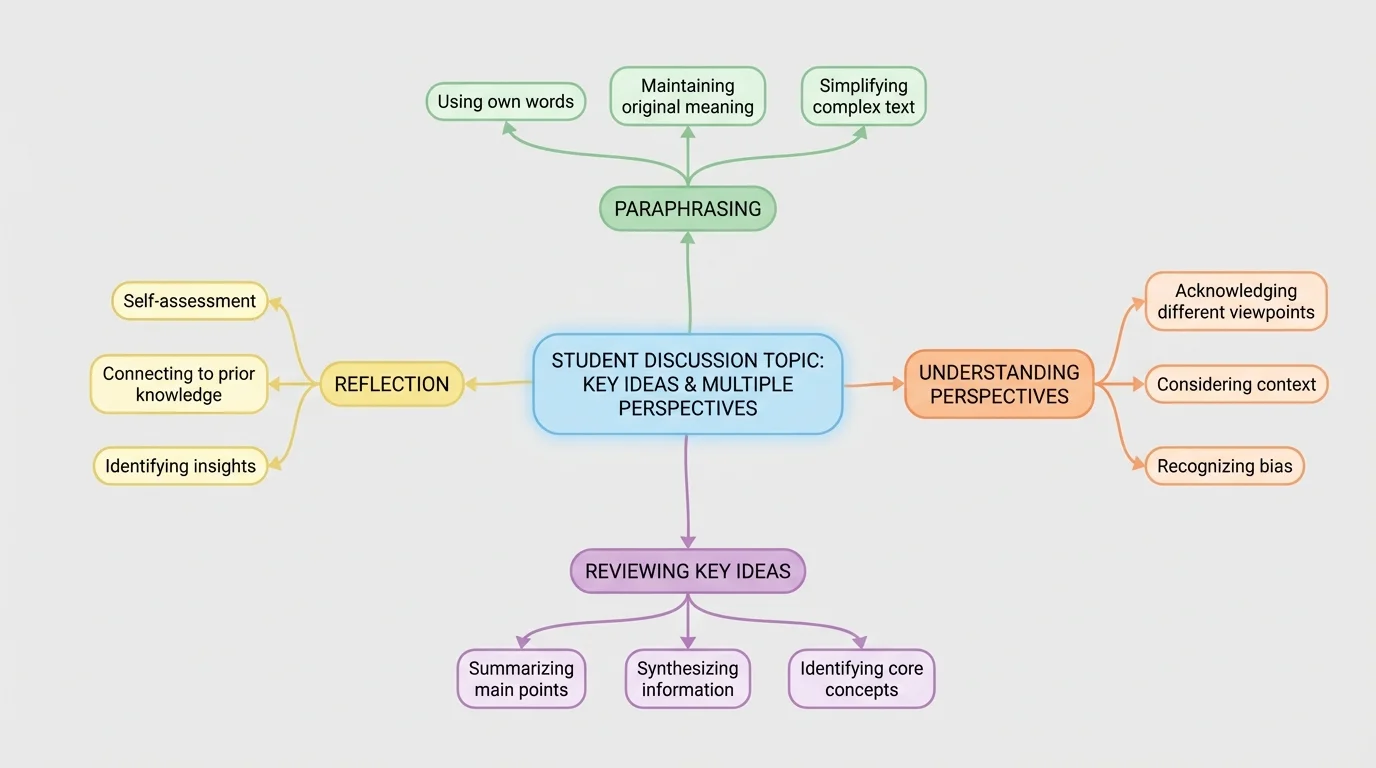
One way to review key ideas is to ask yourself silent questions while listening: What is this person mostly trying to say? What reasons or examples support that point? Is there a conclusion, a problem, or a solution? These questions keep your attention on meaning instead of only on words.
Reviewing key ideas also helps when information is complex. During a teacher-led discussion, several classmates may speak in a row. If you track only isolated comments, you may lose the bigger picture. But if you notice the main idea of each speaker, you can connect those ideas and respond in a more thoughtful way.
Reflection is more than remembering. It means thinking about what was said, why it matters, and how it connects to your own understanding. Reflection often includes noticing what surprised you, what questions you still have, or what idea changed your thinking.
Paraphrasing is one of the clearest ways to show that reflection has happened. When you paraphrase, you are not simply repeating. You are processing the message and restating it accurately in new words. If you can paraphrase well, you prove that you understand the idea rather than just copying the original wording.
Why paraphrasing matters
Paraphrasing slows the conversation down in a good way. It gives the speaker a chance to confirm or correct your understanding. It also helps prevent arguments based on misunderstanding. In respectful discussion, paraphrasing often comes before giving an opinion: first understand, then respond.
Consider this statement: "Recycling programs work best when people know exactly what materials belong in each bin." A weak response would be: "So recycling is good." That is too broad and loses the key idea. A stronger paraphrase would be: "You're saying recycling programs are more effective when instructions are clear about what can be recycled." That version keeps the original meaning while using different words.
Reflection can be spoken or silent. You might think, "This idea connects to what we read yesterday," or "I understand the point, but I wonder if the evidence is strong enough." Then, when it is your turn to speak, you can turn that reflection into a useful response.
The same issue can look very different depending on a person's experiences, needs, or responsibilities, as [Figure 2] illustrates. Perspective is not just opinion with no reason behind it. A perspective often grows from what someone knows, values, or has experienced.
Suppose a class discusses whether school should begin later in the morning. One student may support the idea because more sleep helps health and focus. Another may worry that later dismissal times would interfere with sports, jobs, or family schedules. Both perspectives are real. Understanding multiple perspectives does not mean you must agree with every side. It means you can explain each side fairly.
This skill is important in literature too. In a novel, two characters may react differently to the same event. One may see an action as brave, while another sees it as reckless. In social studies, different groups may have different views about a law or event. In science discussions, students may agree on facts but disagree about the best solution to an environmental problem.
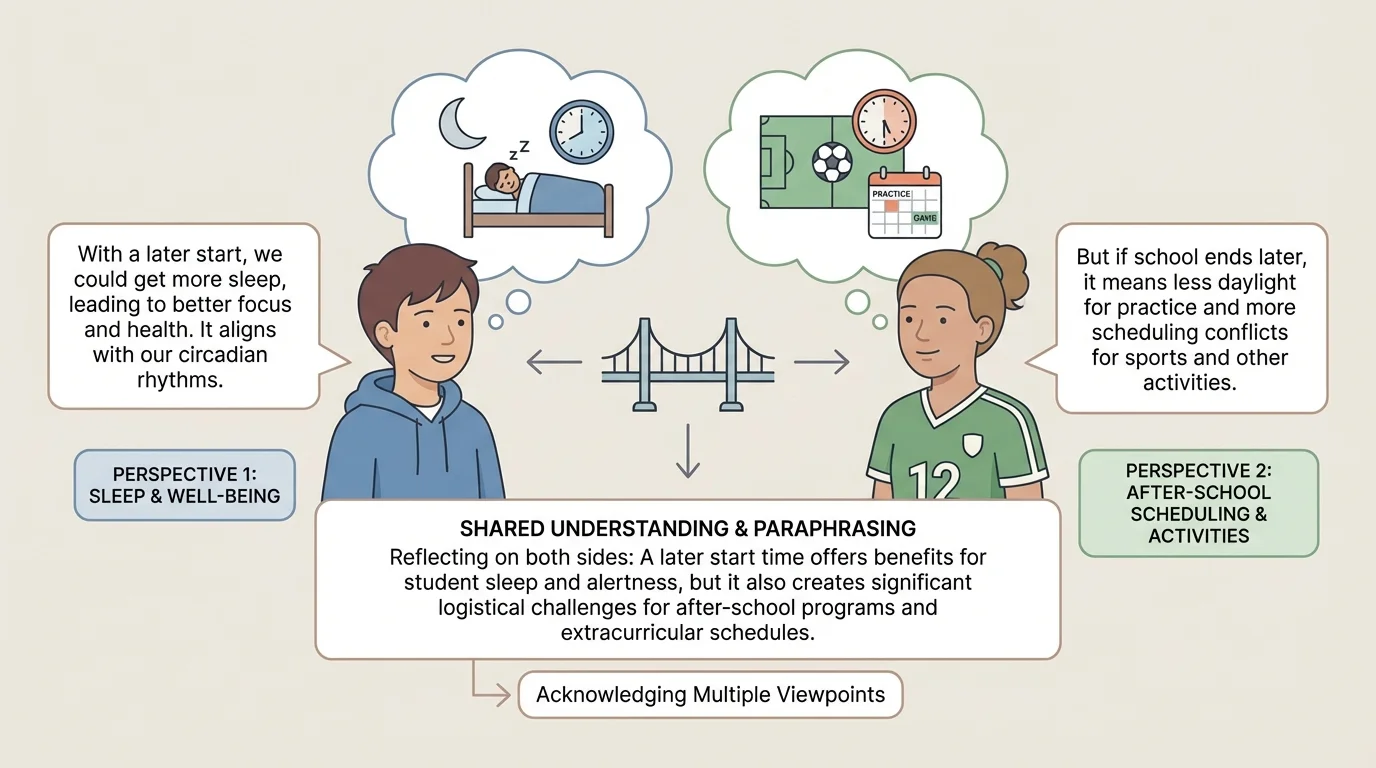
When you show understanding of multiple perspectives, you avoid unfair shortcuts. You do not say, "They think that because they are wrong," or "That side makes no sense." Instead, you ask: What reasons support this perspective? What concerns does it address? What evidence might someone use for this view?
Notice that multiple perspectives are not the same as "anything goes." Some perspectives are better supported by facts than others. Respectful discussion includes listening carefully to all sides, but it also includes evaluating evidence. Fairness and critical thinking belong together.
In many professional settings, people are expected to restate another person's argument accurately before disagreeing with it. This practice builds trust and reduces conflict caused by misunderstanding.
Later in a discussion, that comparison remains useful because it reminds us that one issue can involve health, scheduling, fairness, and practical consequences all at once. Good discussion often improves when students ask not only "What do I think?" but also "Why might someone else see this differently?"
Paraphrasing follows a process, and [Figure 3] lays out that process clearly. First, listen or read carefully. Next, identify the key idea. Then replace the original wording with your own words. Finally, check that the meaning has stayed the same.
Good paraphrasing keeps the message accurate. It does not add ideas the speaker never said. It also does not leave out an important part of the message. A paraphrase should usually be shorter and clearer than the original, but it must still capture the main point.
Here are some helpful moves in paraphrasing: change sentence structure, use synonyms when they truly fit, combine repeated details, and keep important terms if changing them would distort the meaning. For example, if someone says, "Social media can spread information quickly, but it can also spread rumors," a strong paraphrase is: "You mean online platforms can help news travel fast, but false information can spread quickly there too."
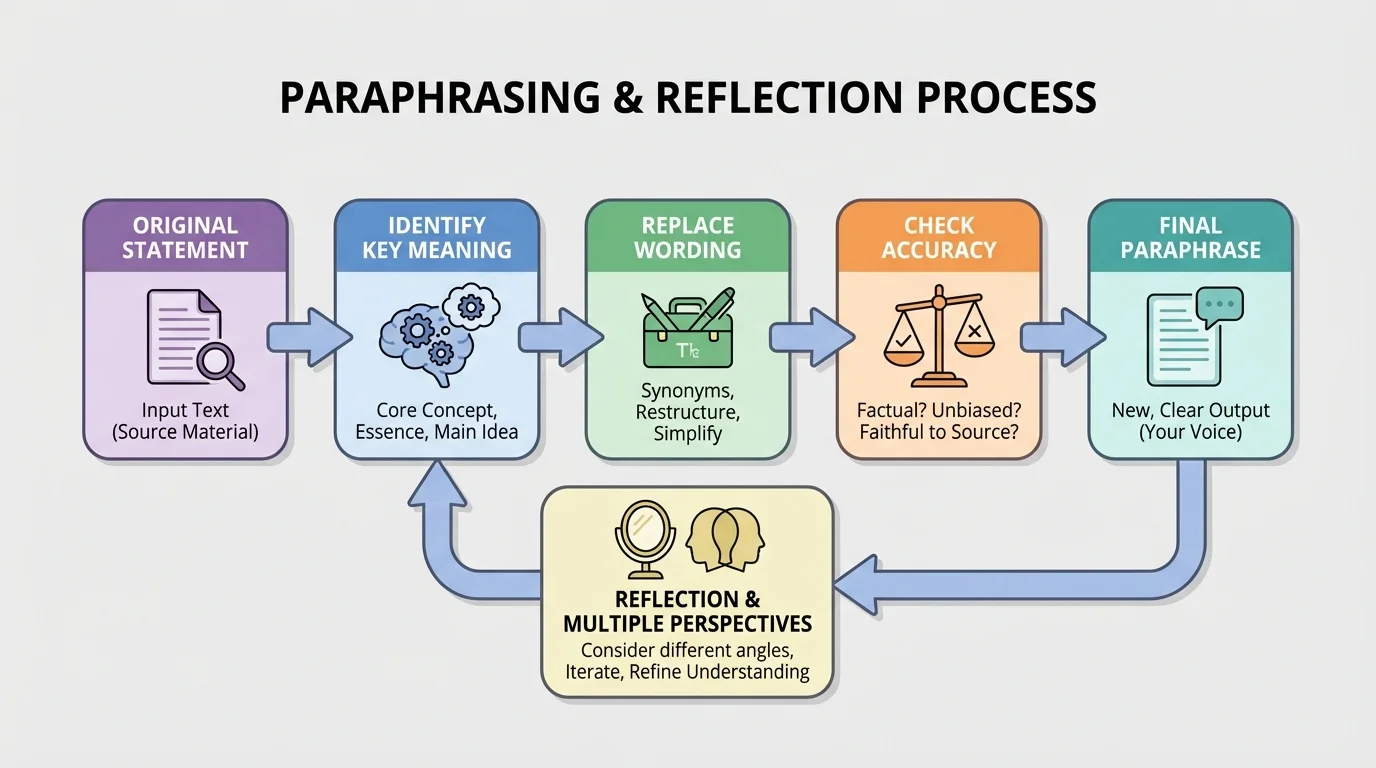
A weak paraphrase often changes too much or too little. If it changes too little, it sounds like copying. If it changes too much, it may become inaccurate. The goal is balance: new wording, same meaning.
The pattern from [Figure 3] also helps when taking notes. Instead of writing every sentence word for word, you can identify the key message, shorten it, and restate it. This makes your notes more useful because they reflect understanding, not just transcription.
Example: Turning a spoken comment into a paraphrase
Original comment: "Community gardens help neighborhoods because they provide fresh food, bring people together, and make empty spaces useful."
Step 1: Identify the main idea.
The speaker believes community gardens benefit neighborhoods.
Step 2: Notice the supporting details.
The reasons are fresh food, stronger community connections, and better use of empty spaces.
Step 3: Restate the idea in new words.
Paraphrase: "You're saying community gardens improve neighborhoods by giving people healthy food, helping neighbors connect, and turning unused land into something valuable."
This paraphrase is accurate because it keeps the original idea and reasons while changing the wording and structure.
Sometimes paraphrasing includes a check for understanding. You might say, "So are you saying...?" or "If I understand correctly, your point is..." These phrases are useful because they invite confirmation. They show respect and reduce confusion.
Discussion looks different depending on the setting. In a one-on-one conversation, reflection may happen quickly. You listen, paraphrase, and ask a follow-up question. In a small group, you have to track several voices, compare ideas, and notice how one comment connects to another. In a teacher-led discussion, you may need to respond to a classmate while also keeping the main topic in mind.
Strong collaborators do not only wait for their turn. They actively connect ideas. A student might say, "Jamal's point about sleep connects to Ava's point about attention in class," or "I agree with part of what you said, but I think the evidence from the article suggests something different." These responses show listening, reflection, and original thought together.
Good listening includes facing the speaker, paying attention, not interrupting, and noticing both words and meaning. These habits make reviewing key ideas much easier.
Reflection also helps students respond with depth instead of speed. Quick answers are not always better answers. If you pause, think, and then paraphrase before responding, your comment will often be clearer and more accurate.
In many classrooms, students discuss grade-level texts and issues that may include disagreement. Reflection makes disagreement stronger, not weaker, because it helps you respond to what someone actually said. That creates a more respectful learning environment.
Sometimes students understand ideas but need language tools to express that understanding clearly. Sentence frames can help. These are not scripts to memorize permanently, but they are useful supports while building discussion skills.
Examples of helpful discussion moves include: "I heard you say that...," "So your main point is...," "I agree with your idea that..., and I want to add...," "I see it differently because...," and "Can you explain what you mean by...?" These phrases show attention, respect, and clear thinking.
| Purpose | Useful sentence frame |
|---|---|
| Paraphrase | "So you're saying that..." |
| Build on an idea | "I'd like to add to that by saying..." |
| Show partial agreement | "I agree with part of your point, especially..., but I also think..." |
| Ask for clarification | "Can you explain what you mean by...?" |
| Compare perspectives | "One perspective is..., while another perspective is..." |
Table 1. Sentence frames that help students paraphrase, clarify, and respond during discussion.
Using these moves does not make a discussion robotic. Instead, it gives structure to clear thinking. Athletes practice plays, musicians practice scales, and speakers practice useful language patterns. Discussion is a skill, and skills improve with deliberate habits.
One common mistake is misinterpretation, which happens when a listener changes the meaning of another person's idea. This often occurs when someone listens for a chance to respond instead of listening to understand. Slowing down and paraphrasing first can help prevent this.
Another mistake is oversimplifying. If someone gives a complex idea with several reasons, and you reply with only one weak detail, your response may miss the real point. Reviewing key ideas means noticing the full shape of the message, not just one part of it. This connects back to the main-idea-and-details pattern shown earlier in [Figure 1].
A third mistake is judging too quickly. Hearing a perspective you disagree with can make you want to reject it immediately. But strong discussion requires you to understand before you evaluate. Fairness first, then critique.
"Seek first to understand, then to be understood."
— A widely used principle in communication
Interrupting is another problem. When students interrupt, they may miss key information and make others feel unheard. Waiting, taking notes, and using a response frame can make the conversation more respectful and more accurate.
These skills are useful far beyond one classroom discussion. In English class, you may paraphrase a classmate's interpretation of a character before offering your own. In science, you may compare different proposed solutions to pollution or energy use. In social studies, you may explain how different groups viewed the same event in different ways.
They also matter in everyday life. If a friend is upset, paraphrasing can show that you listened. If your group is planning a project, reviewing key ideas can keep everyone organized. If you read comments online about a current issue, recognizing multiple perspectives can help you think more carefully instead of reacting too fast.
Real-world discussion example
A group is planning a school fundraiser. One student wants an online fundraiser because it reaches more people quickly. Another wants an in-person event because it builds school spirit.
Step 1: Review the key ideas.
The first student values speed and wider reach. The second values community involvement and school spirit.
Step 2: Paraphrase each perspective fairly.
"One view is that online fundraising is efficient and can reach more supporters. Another view is that an in-person event brings people together and creates excitement."
Step 3: Reflect and build on both ideas.
A thoughtful response might be: "Both ideas have strengths. Maybe we could combine them by having an event at school and also using an online donation page."
This response works because it shows understanding of multiple perspectives before proposing a solution.
When students can review key ideas, reflect thoughtfully, and paraphrase accurately, they become stronger collaborators. They help discussions stay focused, respectful, and meaningful. They also become better readers, writers, and problem-solvers because they learn how to handle ideas carefully.
