Think about the difference between a messy bedroom floor and a well-organized backpack. Both may contain the same things, but one makes it much easier to find what you need. Informational texts work the same way. Authors do not just collect facts and drop them onto the page. They arrange ideas in a certain order so readers can understand what matters, how ideas connect, and why the topic is important.
When you read a science article, a history chapter, or a news report, you are not only learning what the text says. You are also noticing how it is built. Strong readers pay attention to structure because structure guides meaning. If you can explain how a text is organized, you can better explain the author's purpose, the main ideas, and the effect of each section.
An author's text structure is the way the author organizes information. This matters because organization is never random. A writer who wants to explain the steps in a process may use one structure, while a writer who wants to compare two ideas may use another. The structure helps the reader know what to expect.
Structure also affects how clearly ideas develop. If an article about volcanoes begins by describing what volcanoes are, then explains how pressure builds, and then shows the effects of eruptions, the order helps the reader build understanding step by step. If the same information were mixed up, the reader might feel confused even if the facts were correct.
Text structure is the way an author arranges information in a text. Major sections are the larger parts of a text, such as the introduction, body sections with headings, and conclusion. Development of ideas refers to how the author builds and expands ideas across the text.
Good readers ask questions such as: Why did the author put this part here? What job does this section do? How does this section connect to the one before it? Those questions move you beyond simple summary and into analysis.
A text can be organized on two levels. First, it has an overall pattern, such as cause and effect or compare and contrast. Second, it has parts within that pattern: headings, paragraphs, examples, charts, and conclusions. To analyze structure well, you need to look at both levels.
For example, an article about recycling might be organized as problem and solution. The introduction presents the problem of waste. A middle section explains how too much trash harms land and water. Another section describes solutions such as reducing plastic use and reusing materials. A final section encourages communities to act. The overall structure is problem and solution, but each major section also has a specific role in supporting that pattern.
Authors make these choices for reasons. They may want readers to understand a process in order, see relationships between ideas, or be persuaded by a logical argument. Your job as a reader is to notice those choices and explain how they work.
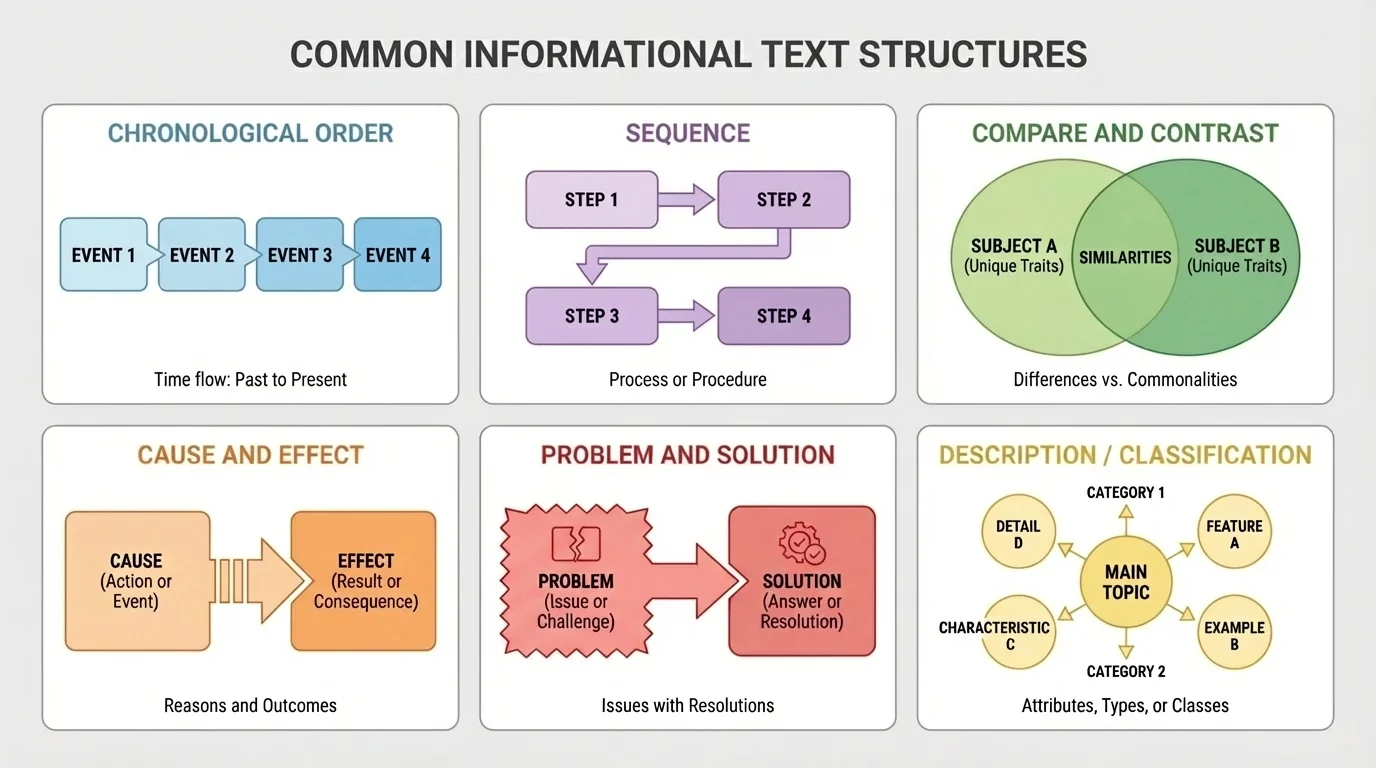
Readers can spot recurring patterns across articles, textbook chapters, and essays, as [Figure 1] illustrates through several common structures. Learning these patterns helps you recognize what the author is doing even before you finish reading the text.
One common pattern is chronological order, in which events are arranged by time. History texts often use this pattern to show what happened first, next, and later. Signal words include before, after, later, and meanwhile.
Another pattern is sequence, which explains steps in a process. A recipe, lab procedure, or directions for using an app often follows sequence. Signal words include first, next, then, and finally.
Compare and contrast shows similarities and differences between two or more subjects. An author might compare desert and rainforest climates or contrast two inventions. Words such as similarly, unlike, both, and however often appear.
Cause and effect explains why something happens and what results from it. A text may describe how drought affects crops or how exercise affects the body. Clue words include because, therefore, as a result, and due to.
Problem and solution introduces an issue and then explains one or more ways to solve it. A text about traffic congestion, polluted rivers, or school food waste might use this pattern.
Description or classification organizes information by characteristics, features, or categories. A science text might classify animals into groups, or an article might describe the parts of a hurricane.
Many texts do not announce their structure directly. You have to infer it by noticing how ideas are arranged. For example, if each section of a text explains a different reason for water scarcity and then the final section describes consequences, the text may mostly use cause and effect even if that phrase never appears.
Later, when you evaluate a text, [Figure 1] remains useful because it reminds you that organization affects understanding. A compare-and-contrast structure helps when the goal is to examine differences, but it may not be the best choice for explaining steps in a process.
[Figure 2] shows how a whole text works like a building with connected rooms through the layout of an informational article. Each major section has a purpose, and understanding those purposes helps you see how the entire text functions.
The introduction often presents the topic, grabs attention, and prepares the reader for what is coming. In informational writing, it may include a surprising fact, a question, a brief anecdote, or the main idea. A strong introduction gives readers a clear starting point.
Body sections usually appear under headings or subheadings. Each section often focuses on one subtopic or one stage of the author's explanation. In a text about renewable energy, one section might explain solar power, another might explain wind power, and a third might discuss challenges. Each part contributes a piece of the whole topic.
The conclusion brings the writing to a close. It may summarize key points, show why the topic matters, suggest future action, or connect back to the introduction. A conclusion is not just the ending; it helps readers leave with a final understanding.
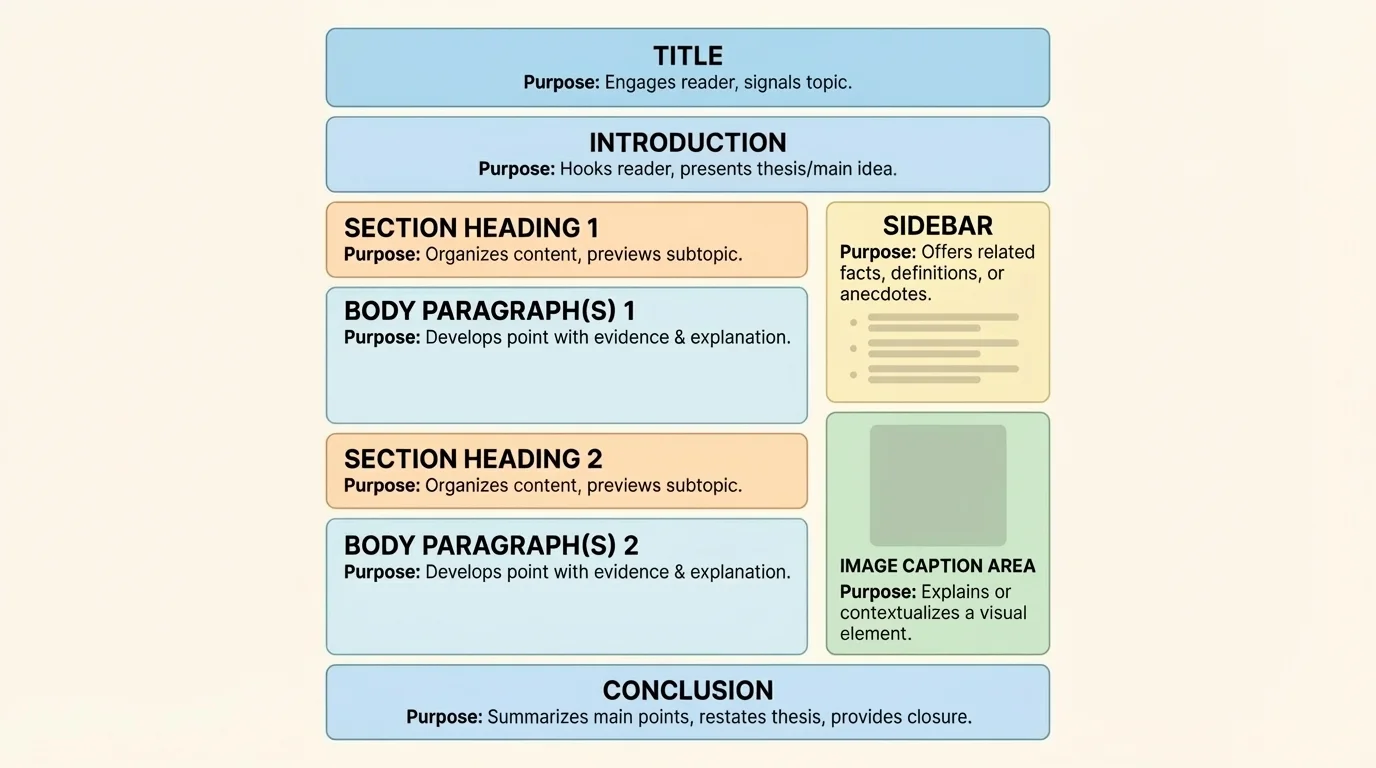
Some texts also include sidebars, captions, maps, charts, and text features such as bold terms. These features are not extra decoration. They often support the main body by adding examples, definitions, or visual evidence. A sidebar about endangered sea turtles, for instance, may provide statistics that strengthen the article's main point about ocean pollution.
When you analyze major sections, avoid simply listing them. Explain what each one does. For example, instead of saying, "The text has three body sections," say, "The first body section defines the problem, the second gives evidence, and the third explains possible responses." That kind of explanation shows real understanding.
Thinking about contribution
When a section contributes to the whole, it adds something the full text needs. A section might define a key term, provide an important example, present evidence, explain a cause, or guide the reader toward the author's conclusion. If you removed that section, the text would become less clear, less convincing, or less complete.
Even a short section can be important. A single paragraph that introduces a key term may make every later paragraph easier to understand. A short conclusion may change the way readers interpret all the details that came before it.
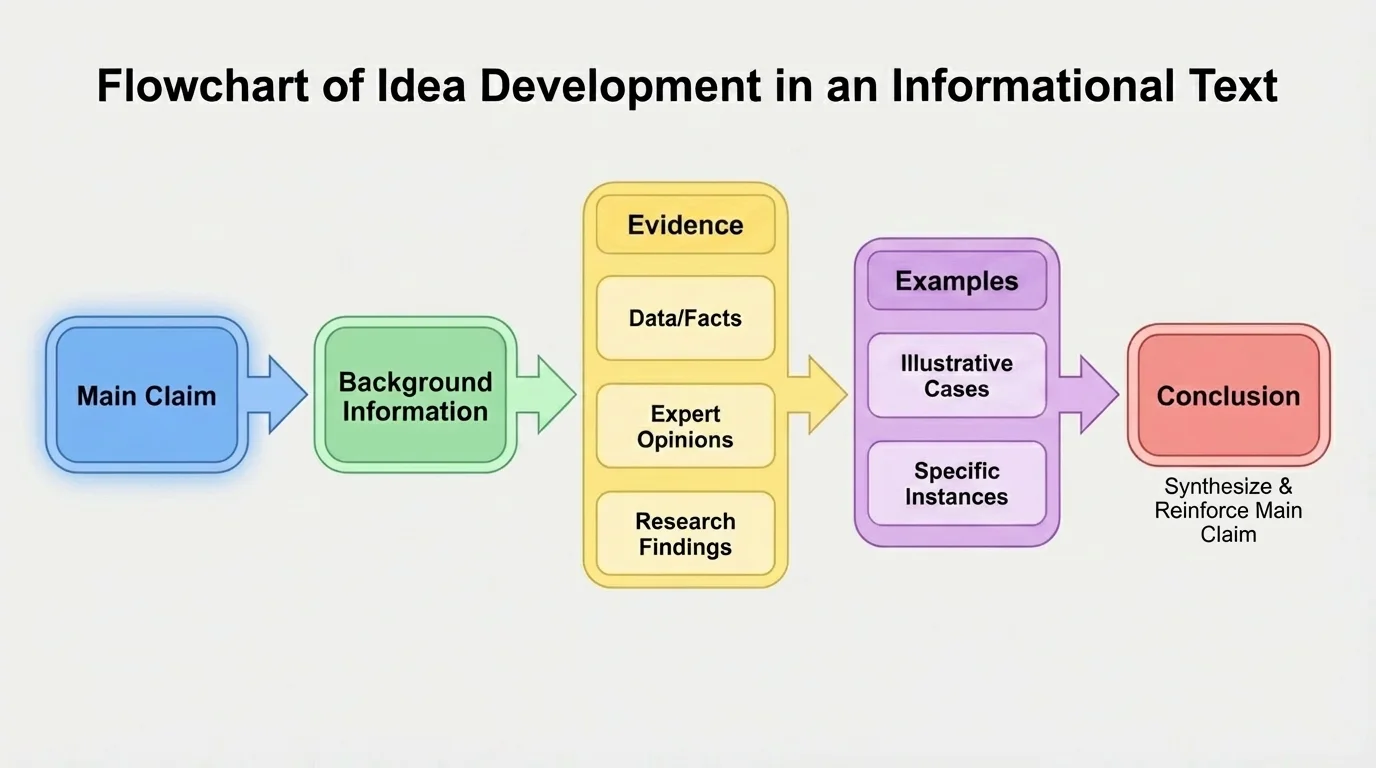
To trace the path of an author's thinking, readers should notice how one idea leads to another, as [Figure 3] illustrates with a flow from claim to evidence to conclusion. Structure is not only about where sections begin and end. It is also about how ideas grow.
Authors often begin with a main idea or claim. Then they add background information, definitions, examples, facts, quotations, and explanations. Each section builds on the one before it. The development of ideas is the path the author creates so the reader can move from initial understanding to deeper understanding.
Suppose an article argues that school start times should be later for middle school students. The introduction may present the issue. The next section may explain how sleep affects the brain. Another section may give research about student focus and health. A final section may respond to possible objections, such as bus schedules or after-school sports. In this text, the author is not just listing facts. The ideas are arranged to make an argument stronger step by step.
Transitions also help develop ideas. Words and phrases such as for example, in addition, however, and as a result signal how one idea connects to the next. These signals are like road signs in the text. They show whether the author is adding information, shifting to a contrast, or explaining a result.
When you analyze development, look for order and purpose. Ask: Does the author start broad and then move to specific details? Does the author begin with a problem and then build toward a solution? Does the author first explain what something is and then explain why it matters? Those patterns reveal how the writing is designed.
As the author's reasoning unfolds, [Figure 3] helps you picture that ideas are connected, not separate. A detail matters most when you can explain how it supports the section and how that section supports the whole text.
[Figure 4] outlines the section-by-section organization of a sample article called Why School Gardens Matter, making it easier to see how the whole text works rather than reading it as a pile of facts.
The introduction opens with a real-world observation: many students know food comes from stores, but not how it grows. This introduction does two things. It interests the reader and introduces the topic of school gardens as a way to connect students to food sources.
The first body section explains what a school garden is and describes common features such as raised beds, compost bins, and student teams. This section gives background knowledge. Without it, readers might not fully understand the later sections.
The second body section explains benefits. It discusses science learning, responsibility, healthy eating, and teamwork. This section contributes the main reasons the topic matters.
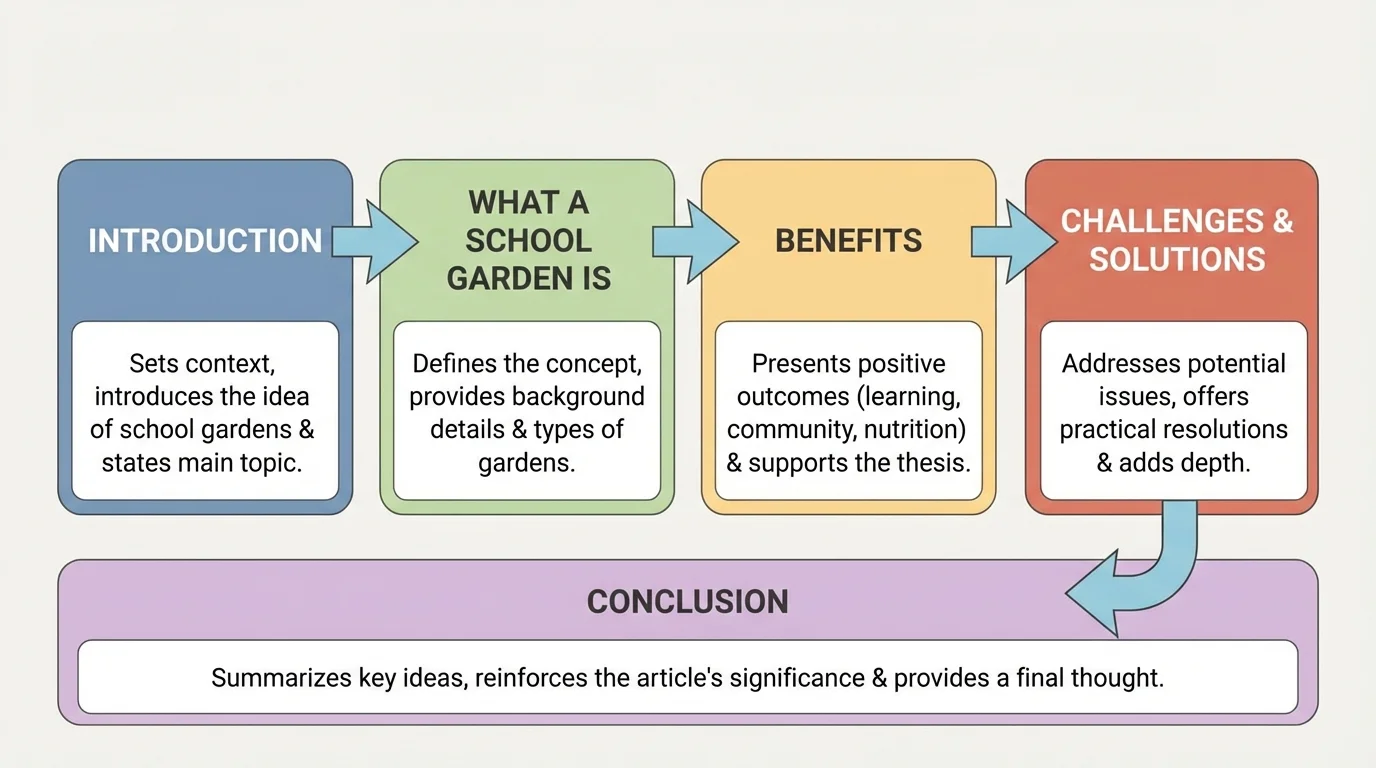
The third body section shifts to challenges, such as cost, maintenance, and weather. It then offers solutions, such as community volunteers and seasonal planting plans. Here the structure shifts from explanation to problem and solution. That shift helps the author address concerns readers may have.
The conclusion argues that school gardens are more than beautification projects; they are hands-on learning spaces. This conclusion leaves readers with the author's final message and ties the earlier sections together.
Analyzing the sample article
Step 1: Identify the overall structure.
The article mostly follows an explanatory structure: it introduces the topic, defines it, explains the benefits, addresses challenges, and concludes by showing its significance.
Step 2: Explain how sections contribute.
The definition section gives needed background, the benefits section provides the strongest support for the author's main idea, and the challenges section strengthens the article by making it more balanced and realistic.
Step 3: Describe idea development.
The text moves from basic understanding to deeper evaluation. Readers first learn what school gardens are, then why they matter, and finally why they are worth supporting even when obstacles exist.
This kind of analysis goes beyond retelling. It explains how organization shapes meaning.
Notice that a reader who says, "The article is about school gardens," has only identified the topic. A stronger reader can say, "The article develops the idea that school gardens are valuable by first defining them, then showing benefits, then answering possible objections." That response explains structure and development.
Later in your reading, [Figure 4] still matters because the outline shows how an author can combine explanation and problem-solution thinking inside the same text.
Many informational texts do not fit into just one neat box. A science article might begin with description, use sequence to explain an experiment, and end with cause and effect to explain results. A history chapter might be mostly chronological but pause to compare two leaders or examine the causes of a conflict.
This is why analysis requires flexibility. You should identify the main structure, but you should also notice smaller structural moves inside sections. An author may choose one pattern for the whole text and another pattern for one part of it. That does not make the structure confusing; it often makes the explanation more effective.
For example, a text about hurricanes might begin by describing the parts of a hurricane, then explain step by step how hurricanes form, and finally discuss the effects on coastal communities. Description, sequence, and cause and effect all appear, but each serves a different purpose.
Professional writers often reorganize nonfiction drafts many times before publishing. The facts may stay the same, but changing the order of sections can make the writing much clearer and more persuasive.
When you see mixed structures, ask which one dominates the text and why the author switches patterns in certain places. Usually the switch happens because a different kind of explanation is needed.
To analyze structure well, it helps to read actively. Strong readers ask questions while they move through the text. They do not wait until the end.
Useful questions include: What is the overall organizational pattern? What does the introduction prepare me to understand? How does each heading add a new part of the topic? Which section gives evidence? Which section explains causes, effects, problems, or solutions? Why does the conclusion end the text this way?
These questions help you connect parts to the whole. They also help you write stronger responses about informational texts. Instead of saying, "The article is organized well," you can say, "The author uses cause and effect to show how air pollution harms health, and the final section offers solutions, which makes the text both informative and practical."
When you summarize a text, you state the main ideas clearly and briefly. When you analyze structure, you go a step further: you explain how the author arranged those ideas and why that arrangement helps the reader understand them.
This difference matters. Summary tells what the text says. Structural analysis explains how the text is built.
Analyzing structure does not stop at identification. You can also evaluate whether the author's choices are effective. A strong structure makes ideas clear, logical, and easy to follow. A weak structure may repeat information, jump around, or place important details where readers are likely to miss them.
Suppose an article about climate change gives many statistics before ever explaining the basic issue. Some readers may feel lost. In that case, you might say the structure is less effective because important background information should have appeared earlier. On the other hand, if a text begins with a clear definition, then presents causes, then provides evidence, and finally discusses responses, the structure likely helps readers understand a complex topic.
You can also evaluate whether a section is necessary. If a paragraph repeats information without adding a new idea, its contribution is weak. If a section introduces a key example that makes the main point easier to understand, its contribution is strong.
Good analysis uses specific language. You might say the author introduces, explains, contrasts, builds, supports, shifts, or concludes. These verbs show what the author is doing structurally.
Once you begin reading this way, informational texts become easier to understand. You start to notice that structure is not hidden. It is one of the most important tools writers use to shape meaning and guide readers from the first sentence to the last.
