You probably do not speak exactly the same way when texting a friend, answering a question in class, and writing a report. That is not artificial—it is a real language skill. Strong communicators know how to notice when language is casual, regional, or personal, and they also know how to shift into a more conventional form when the situation calls for it. Learning to do that gives you more control over your words, which means more power to explain, persuade, and be understood.
English is not used in only one way. People speak and write differently depending on where they live, who they are with, what community they belong to, and what they are trying to do. A conversation at lunch may sound very different from a speech, a job interview, or an essay. These differences are called language variation. Variation is a normal part of language.
For example, one person might say, "I'm gonna do it later," while another might say, "I am going to do it later." Both sentences communicate the same basic idea, but they fit different situations. The first is casual and conversational. The second is more conventional and usually better for formal speaking or writing.
Standard English is the form of English commonly expected in school, formal writing, public speaking, and many professional settings. Conventional language means language that follows widely accepted rules for grammar, usage, mechanics, and style in a particular situation.
It is important to understand that a home language, dialect, or informal speaking style is not automatically "bad English." It may follow patterns that make sense in a family, region, or community. The key skill is learning when a certain style fits the moment and when a more standard form is expected.
When teachers ask for standard English, they are usually asking for language that is clear, widely understood, and appropriate for an academic audience. This includes correct sentence structure, accurate verb forms, clear pronouns, proper punctuation, and word choices that match the purpose.
Conventional language is not only about following rules. It is also about making communication easier for the reader or listener. If your message is full of unclear wording, missing punctuation, or expressions that only a few people understand, your audience may get lost. Conventional language helps your ideas travel farther.
Why standard conventions matter
Using standard conventions does not erase your personality. Instead, it gives you a shared set of tools. Just as athletes follow the same rules so everyone understands the game, writers and speakers often use common conventions so readers and listeners can focus on the meaning instead of struggling to decode the language.
Think about directions for assembling a bike or safety instructions in a science lab. Those directions need to be precise. The same is true for school writing. If you write, "Them pieces goes over there maybe," the reader has to guess. If you write, "Place the two long pieces on the left side of the frame," the meaning is much clearer.
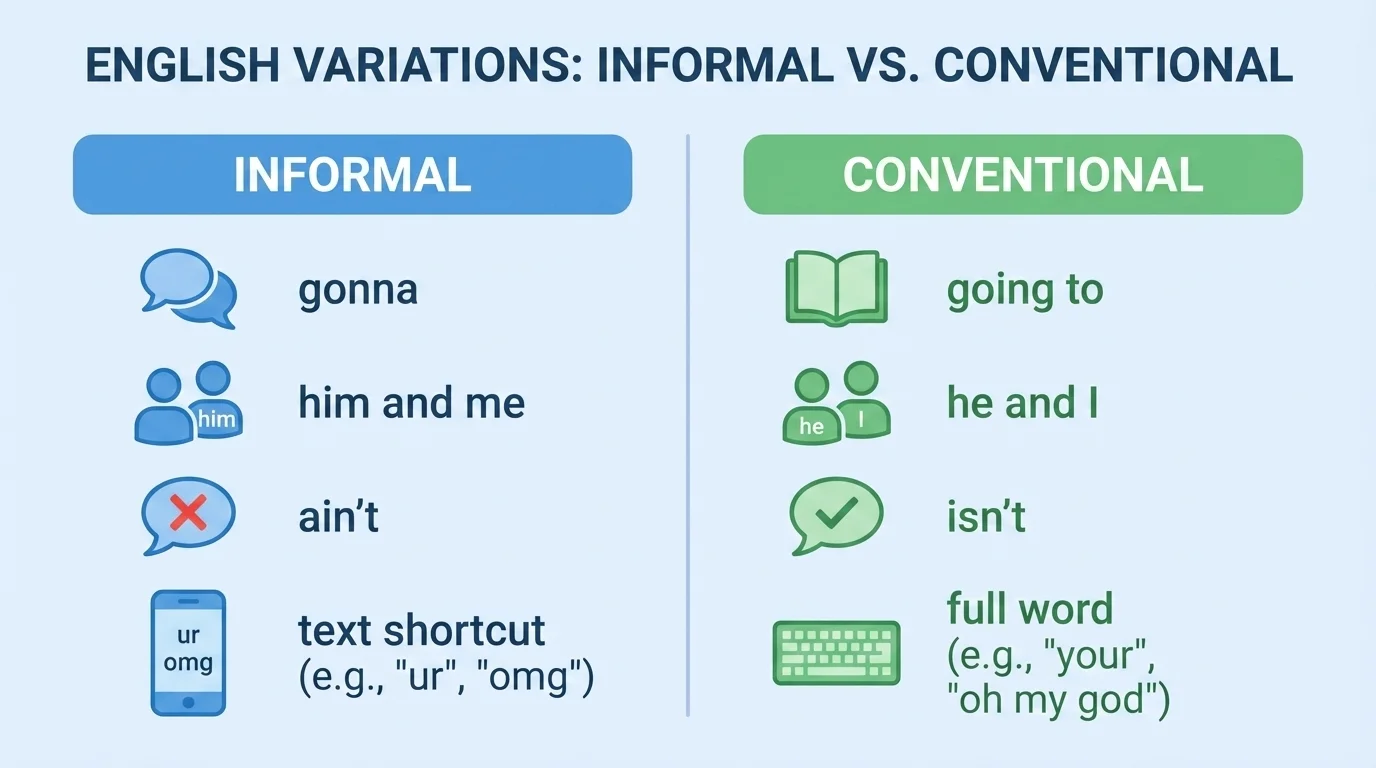
Many differences between informal English and conventional English appear in everyday speech and student writing, and the comparison in [Figure 1] helps show how one idea can be shaped for different contexts. Some variations come from slang, some from regional dialects, some from fast conversation, and some from habits picked up through texting or social media.
One common variation is dialect, a form of language used by a particular group or region. A dialect may have its own pronunciation, grammar patterns, and vocabulary. Another common variation is slang, which includes very informal words or expressions that may sound current and expressive in conversation but often do not belong in formal school writing.
Here are some frequent examples of variation:
These features are not all the same. Some belong to speaking more than writing. Some belong to specific language communities. Some are simply mistakes. A strong writer learns to tell the difference.
Another important area is subject-verb agreement. This means the verb must match the subject. We say "She runs," not "She run," and "They were," not "They was" in standard English. Errors in agreement can distract the reader because the sentence sounds unfinished or incorrect in a formal setting.
Pronoun use also matters. A pronoun is a word that takes the place of a noun, such as "he," "she," "they," or "it." If a pronoun is unclear, the audience may not know who or what you mean. In the sentence "Jordan told Alex that he was late," the word "he" could refer to either person. A clearer revision is "Jordan told Alex, 'You are late,'" or "Jordan, who was late, told Alex."
Contractions are another example. Words like "don't," "isn't," and "we're" are acceptable in many kinds of writing, but extremely casual forms such as "ain't" are usually not considered standard in formal school work. Choosing whether to use contractions depends on your tone, audience, and purpose.
Punctuation and capitalization also affect expression. A sentence like "lets eat grandma" means something very different from "Let's eat, Grandma." The comma changes everything. Mechanics may seem small, but they guide the reader through your meaning.
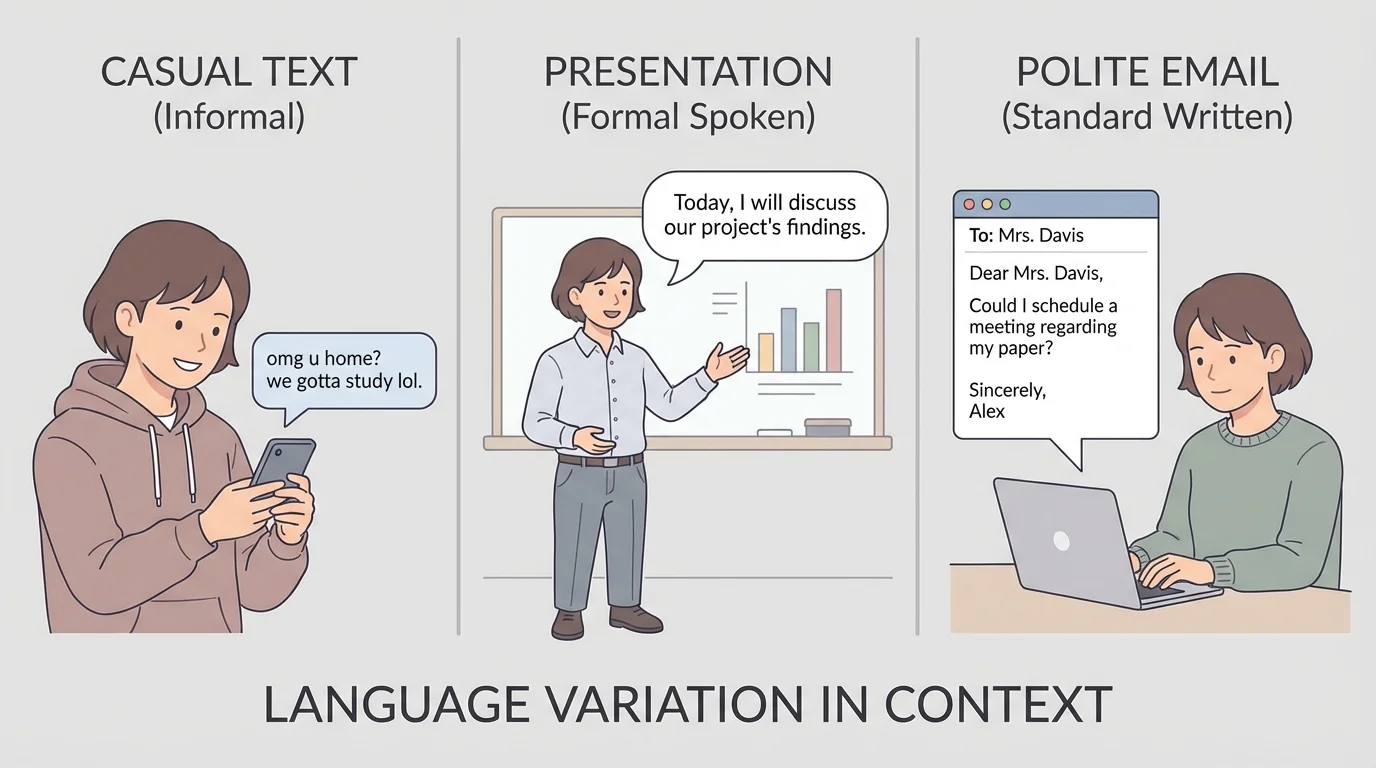
Good communicators think about audience and purpose before they choose words, and [Figure 2] illustrates how the same person may shift language in different situations. Audience means the people who will read or hear the message. Purpose means the reason for communicating: to explain, persuade, entertain, inform, or request.
If you text a friend, "u coming 2 practice?" that may be perfectly effective. If you email a teacher, "u coming 2 practice?" would probably sound careless. A more appropriate version might be, "Are you coming to practice today?" or "Will practice still be held today?" The meaning is similar, but the style changes to fit the situation.
This skill of shifting language for different situations is called code-switching. It does not mean changing who you are. It means choosing the language style that works best in a particular context. Many people code-switch every day without even noticing.
For example, a student might say to a friend, "That movie was wild." In a film review, the same student might write, "The movie was exciting and full of surprising plot twists." The second version is more specific and more useful to a wider audience.
Audience and purpose also affect spoken language. During a presentation, mumbling, filler words, and unfinished thoughts can make ideas harder to follow. Saying "like," "you know," and "um" occasionally is normal, but too much can weaken a speaker's message. A speaker who pauses, chooses precise words, and finishes each thought sounds more confident and clear.
| Situation | Language Style | Example |
|---|---|---|
| Texting a friend | Very informal | "I'll be there soon. Save me a seat." |
| Class discussion | Clear but conversational | "I think the character changed because he learned from his mistakes." |
| Essay | Formal and organized | "The character changes over time as a result of his mistakes and new understanding." |
| Email to a teacher | Polite and respectful | "Could you please explain the homework directions again?" |
Table 1. Examples of how language style changes based on situation and audience.
Improving expression is not magic. It is a process, and [Figure 3] shows that revision works best when you move through clear steps instead of just guessing. Strong writers and speakers listen to how their language sounds, check whether it fits the audience, and revise for clarity.
One useful strategy is revision. Revision means more than fixing a few commas. It means rethinking how ideas are expressed. You may add detail, remove repetition, replace weak words, or change sentence structure so the message becomes clearer and stronger.
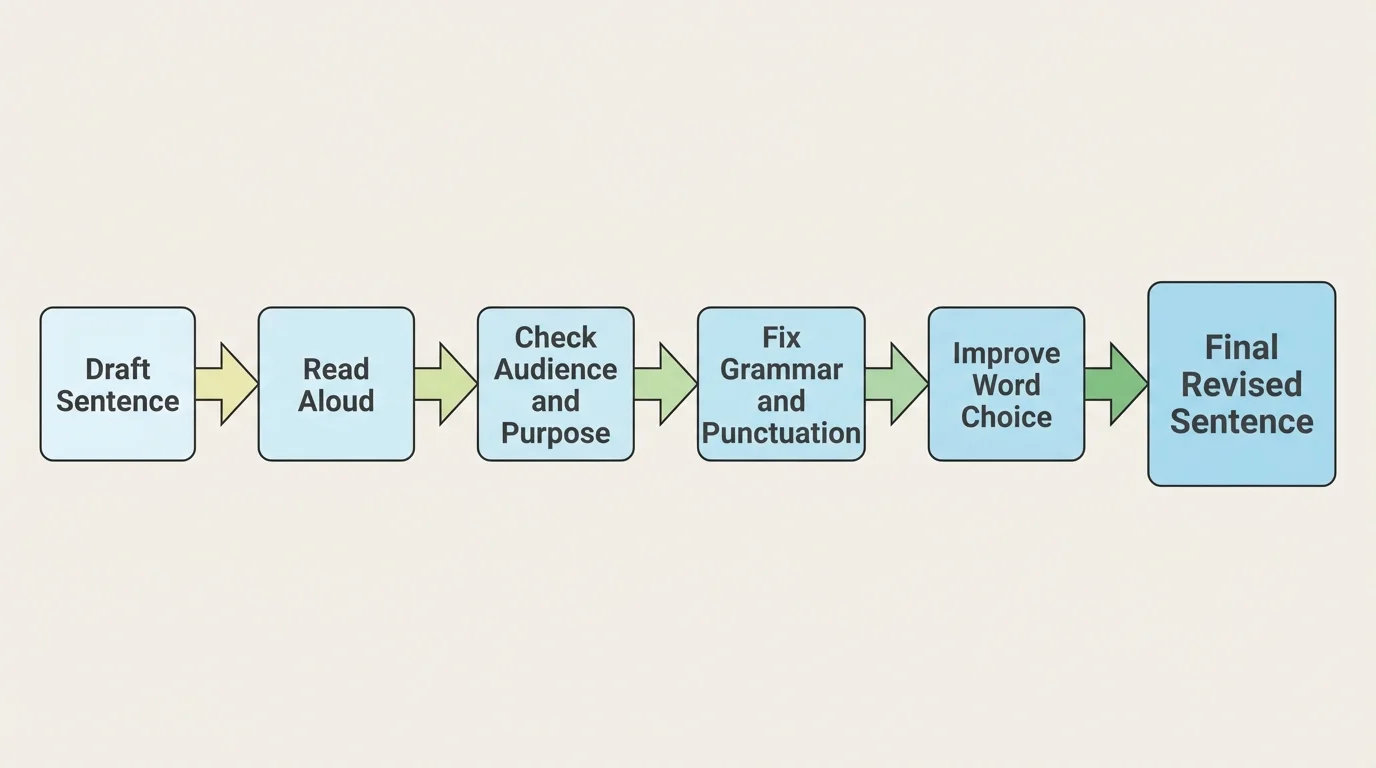
Another strategy is reading aloud. When you hear your own words, you notice missing words, confusing phrasing, and awkward grammar more easily. A sentence that looks fine on paper may sound strange when spoken.
Checking for sentence completeness is also important. Every sentence needs a complete thought. "When the bell rang" is not a complete sentence by itself because the reader is left waiting for what happened. "When the bell rang, the class packed up quietly" is complete.
Improving word choice can make a big difference. Compare these two sentences: "The game was good and the team did stuff better." "The game was intense, and the team passed more carefully in the second half." The second version is clearer because the words are more exact.
Combining short, choppy sentences can also improve flow. "The storm started. The sky got dark. We went inside." can be revised to "When the sky grew dark and the storm started, we went inside." This sounds smoother and shows how the ideas connect.
Breaking up run-on sentences matters too. A run-on happens when ideas are pushed together without correct punctuation or structure. "I finished my project it took three hours and I was exhausted" should be revised into separate sentences or joined correctly: "I finished my project. It took three hours, and I was exhausted."
Example: Revising an informal sentence for a school report
Original sentence: "Me and Jayden was kinda late cause the bus didn't come."
Step 1: Fix the pronoun use.
"Me and Jayden" changes to "Jayden and I."
Step 2: Fix subject-verb agreement.
"was" changes to "were."
Step 3: Replace very informal words.
"kinda" changes to "somewhat" or is removed, and "cause" changes to "because."
Step 4: Read the whole sentence for clarity.
Revised sentence: "Jayden and I were late because the bus did not arrive on time."
Notice that the revised sentence is not just "more correct." It is also more precise. The phrase "did not arrive on time" gives clearer information than "didn't come."
Many professional authors write messy first drafts. Clear final writing usually comes from revising, not from getting every sentence perfect on the first try.
Speaking can be revised too, even though it happens in real time. Before a presentation, you can practice key sentences, replace vague words, and plan transitions such as "First," "In addition," and "Finally." These choices help listeners follow your ideas.
Looking closely at sentence pairs helps you recognize what changes improve conventional language. The chart in [Figure 1] compares informal and conventional forms, and the same idea can be extended to full sentences.
Informal: "He don't got no notebook."
More conventional: "He does not have a notebook."
Informal: "Them shoes is nice."
More conventional: "Those shoes are nice."
Informal: "I was like super tired."
More conventional: "I was extremely tired."
Informal: "The experiment was cool and stuff."
More conventional: "The experiment was interesting because the liquid changed color."
The revised versions usually do three things: they follow standard grammar, they remove vague language, and they give more exact information. That is why conventional language often sounds stronger in school and formal settings.
Example: Improving a spoken response
Original response: "Um, I think the article was, like, about pollution and stuff, and it was saying we should help more."
Step 1: Remove filler words.
Take out "um" and "like."
Step 2: Replace vague words.
Change "stuff" to a specific idea.
Step 3: Make the claim clearer.
Revised response: "The article explains how pollution harms ecosystems and argues that people should reduce waste and conserve resources."
This revised answer sounds more confident because it is direct and specific. It also gives the listener more useful information.
Understanding conventional English should never lead you to insult the way other people speak. Different communities use language in rich, meaningful ways. Regional speech, family expressions, and cultural patterns all add variety to English. These forms can express identity, belonging, humor, and history.
At the same time, certain settings expect standard conventions. A scholarship essay, science report, formal presentation, or letter to a principal usually needs a more conventional style. That does not mean your everyday language is worthless. It means you are adding another communication tool to your toolbox.
Think of it like clothing. You might wear one outfit to play basketball and a different one to attend a concert or ceremony. The change does not mean one outfit is universally better; it means each fits a different situation. Language works in a similar way, as [Figure 2] shows through different communication settings.
When editing your own work or listening to others, ask useful questions instead of making quick judgments. What is the audience? What is the purpose? Which words or patterns are informal? Which parts might confuse a wider audience? What small changes would make the message clearer while keeping the writer's or speaker's meaning?
You already know that good writing needs clear ideas and organization. This topic adds another layer: those ideas also need language choices that fit the audience and follow standard conventions when required.
As you revise, the process in [Figure 3] remains useful: listen for clarity, check the situation, fix grammar and mechanics, and choose stronger words. Over time, noticing variation and making purposeful language choices becomes a habit.
