A great idea can be ignored if it is presented poorly. Think about two students who researched the same topic: one mumbles, reads every word from a paper, and includes every tiny fact; the other speaks clearly, focuses on the strongest points, and helps the audience understand why those points matter. Even if both students conducted strong research, the second presentation is much more likely to be remembered. Learning how to present claims and findings clearly is not just a school skill. People use it in science reports, debates, job interviews, speeches, videos, and even team meetings later in life.
When you give a formal presentation, your job is not to say everything you know. Your job is to help the audience understand the most important ideas. That means speaking in a focused, organized way, choosing useful evidence, and delivering your words so listeners can follow you easily.
Claim is a statement, opinion, or position that a speaker wants the audience to accept. Finding is information discovered through research, observation, reading, surveys, or experiments. A claim often answers a question such as "What do I believe?" while a finding helps answer "What did I learn?"
A presentation may include one or both of these. For example, if a student says that schools should start later in the morning, that is a claim. If the student explains that many studies show teenagers need more sleep and learn better when they are rested, those are findings that support the claim.
Sometimes a presentation shares findings without trying to persuade. A student reporting the results of a water-quality test may simply explain what was discovered. Other times, the findings support an argument. In that case, the evidence helps the audience decide whether the claim makes sense.
Strong presentations make the relationship between the claim and the findings easy to follow. The audience should never have to guess, "Why are you telling me this fact?" Every major piece of information should connect clearly to the main point.
One of the most important speaking skills is choosing salient points, or the ideas that matter most, as shown in [Figure 1]. In a formal presentation, strong speakers do not dump all of their notes onto the audience. They select only the points that best explain the topic. This helps listeners remember the message instead of getting lost in too many details.
Ask yourself: What does my audience absolutely need to know? Which facts are strongest? Which details truly help explain my point? If a detail is interesting but does not support the main idea, leave it out. Focused speaking is not about saying less because you know less. It is about saying what matters most because you understand your purpose.
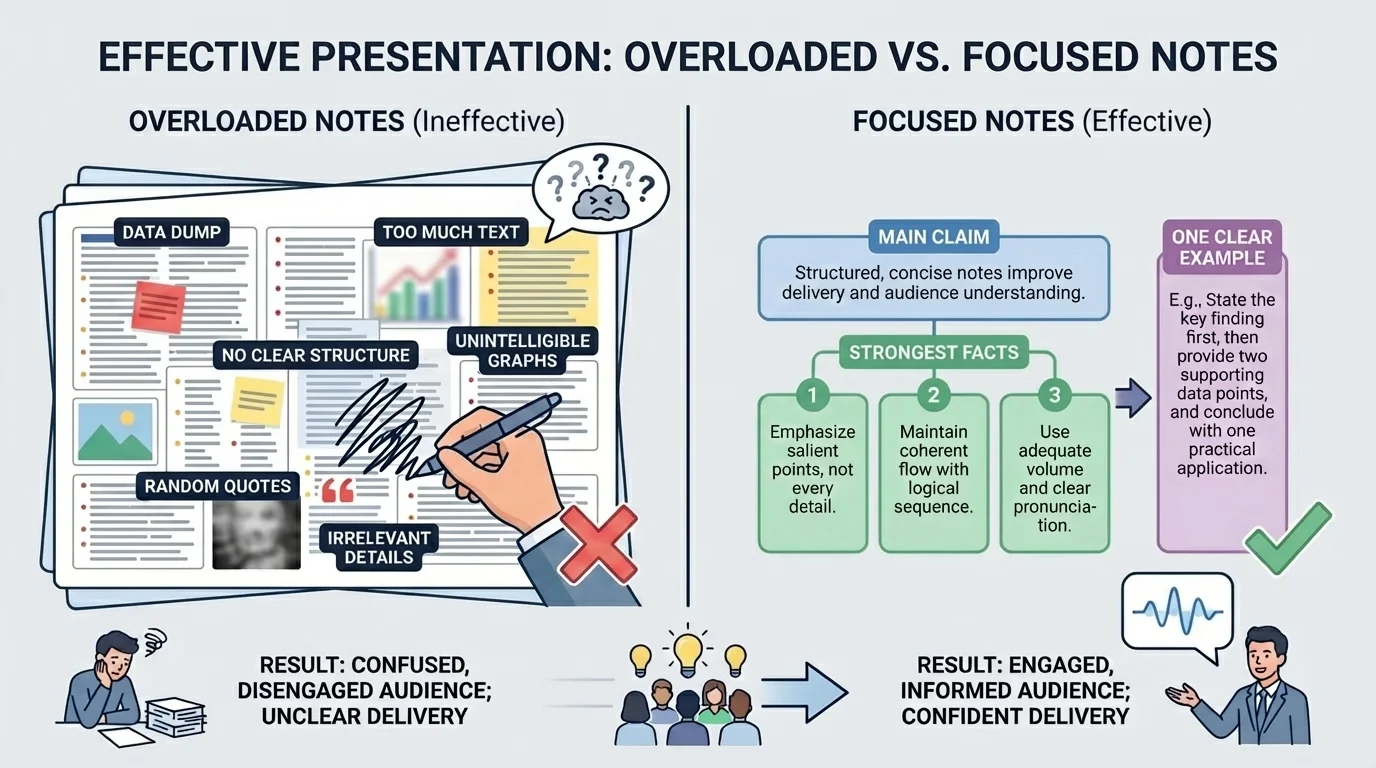
Suppose you are presenting findings about plastic waste in oceans. You may have read ten articles, collected many statistics, and found several examples. But your audience probably does not need every number. A focused version might include these key points: plastic harms marine animals, much of it comes from single-use items, and communities can reduce waste through better habits and policies. Those are the ideas listeners can hold onto.
Salient points are usually the points that are most relevant, most convincing, or most useful for understanding the topic. A speaker who spends too much time on side facts can weaken the presentation. A speaker who highlights the strongest points makes the presentation sharper and more memorable.
Professional speakers often spend more time cutting information than adding it. Removing weak or repeated points usually makes a speech stronger, not smaller.
Another way to stay focused is to group information into a small number of main ideas. Many effective presentations for middle school students use about three main points. That number is large enough to develop a topic but small enough for listeners to remember.
A clear presentation is coherent, which means the ideas are organized in a logical order, as shown in [Figure 2]. Your audience should be able to follow your thinking from beginning to end. If your ideas jump around, even good evidence may become confusing.
Most formal presentations have a simple structure. First, the speaker opens by introducing the topic and purpose. Next, the speaker presents the main point or points with support. Finally, the speaker closes by reinforcing the most important takeaway. This shape helps listeners know where they are in the presentation.
Transitions are also important. A transition is a word or phrase that connects one idea to the next. Phrases such as "First," "Another reason," "For example," "As a result," and "In conclusion" guide the audience through your ideas. Without transitions, the presentation may sound choppy or unfinished.
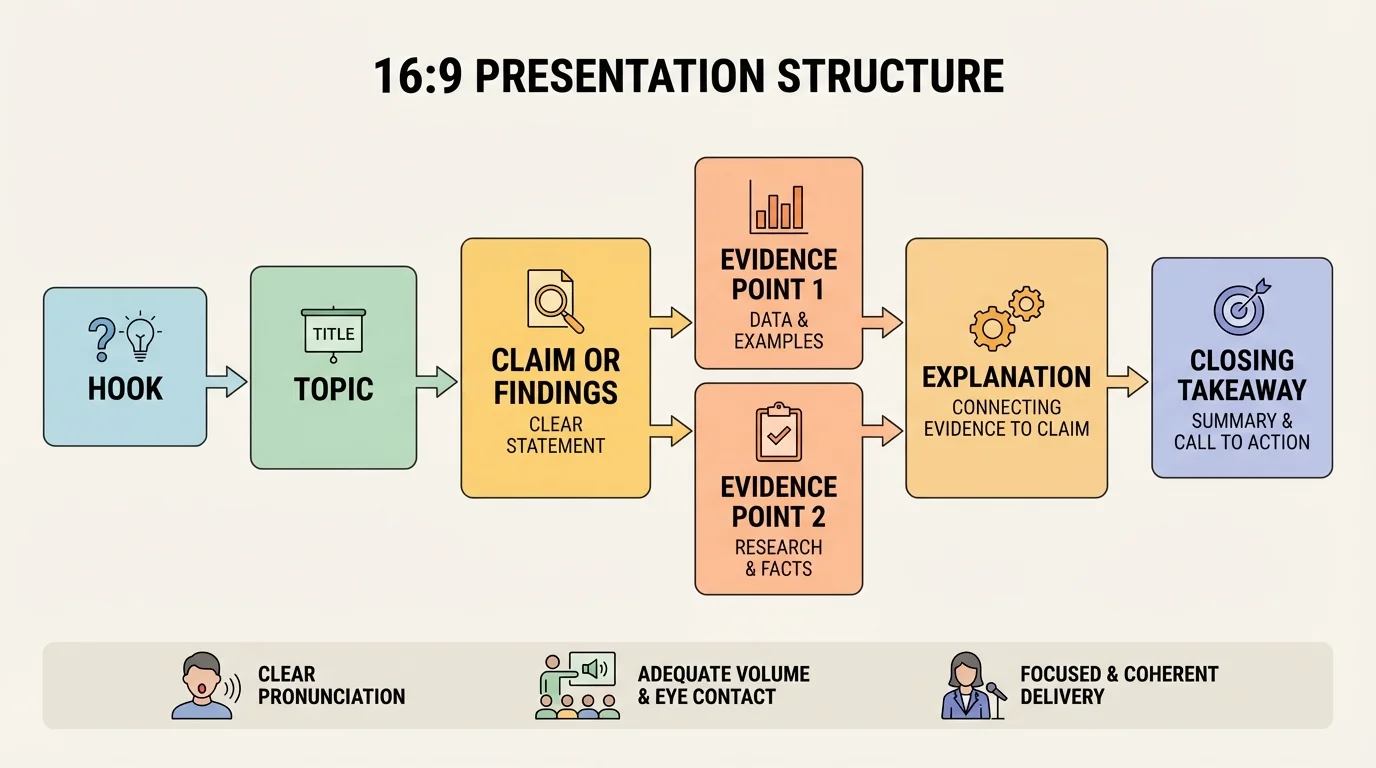
Here is one useful pattern for a short presentation: start with a topic sentence, state your claim or central finding, explain your first main point, support it, move to the second main point, support it, and then end with a strong final statement. This does not mean every presentation must sound exactly the same, but it gives you a dependable structure.
For example, a presentation about school gardens might begin by stating that school gardens improve learning and health. Then the speaker could explain that gardens teach science through real observation, encourage students to try fresh foods, and build responsibility through teamwork. Because each point connects to the main idea, the presentation stays coherent.
Later, when you return to the idea of focus, [Figure 1] still matters. A logical structure works best when each section contains only the most important information rather than too many side details.
A strong presentation is not made of opinions alone. It uses support that helps the audience understand and trust the speaker's message. Four especially useful kinds of support are descriptions, facts, details, and examples.
How support strengthens a presentation
Descriptions help the audience picture or understand something clearly. Facts provide information that can be checked. Details add specific pieces of information that deepen understanding. Examples show what an idea looks like in a real situation. The strongest presentations choose support that is directly connected to the main point.
Descriptions are useful when the audience needs a clear mental image. If you are presenting findings about a polluted stream, saying the water was "bad" is vague. Saying it was cloudy, had a strong smell, and had trash caught near the bank gives the audience a much clearer picture.
Facts are especially important when you want your message to sound informed and credible. If you say that many students feel stressed by too much homework, that is broad. If you cite a survey done in your school and explain what students reported, your idea becomes stronger because it is supported by actual information.
Details make your presentation more precise. Instead of saying a recycling program helped the school, you might explain that clearly labeled bins were placed in the cafeteria and that students sorted paper, plastic, and cans during lunch. Specific details help the audience understand how something happened.
Examples help listeners connect abstract ideas to real situations. If your claim is that exercise improves focus, you could describe a student who feels more alert in first period after walking to school. One clear example can make a point much easier to understand.
Good speakers also make sure their support is pertinent, meaning relevant and closely connected to the topic. A fact may be true but still not belong in your presentation. If you are speaking about the benefits of reading every day, a long detail about the history of printing may not be pertinent unless it directly helps explain your point.
Balance matters too. Too little support makes a presentation weak. Too much support can bury the main idea. Choose the best support, explain it clearly, and connect it to your message.
Example: Turning a weak statement into a strong one
Weak version: "School gardens are good."
Step 1: Add a clear claim.
"School gardens improve learning and student health."
Step 2: Add pertinent facts and details.
"In many schools, gardens are used during science lessons to study plant growth, soil, and insects. Students also help grow vegetables they can taste later."
Step 3: Add an example that makes the point concrete.
"For example, a class that grows lettuce and tomatoes can observe plant changes over time and then use the harvest in a healthy salad."
The stronger version gives the audience a claim, facts, details, and a clear example.
When you listen to effective speakers, you can often hear this pattern: point, support, explanation. They do not just present evidence. They also explain why that evidence matters.
Even a well-organized presentation can fail if the delivery is hard to follow, as shown in [Figure 3]. Delivery includes how you use your voice and body while speaking. It involves eye contact, posture, volume, pace, and pronunciation.
Eye contact means looking at your audience instead of staring down at notes or only at one person. In a formal presentation, you do not need to lock eyes with someone for a long time. Instead, look at one section of the room for a moment, then another, and then another. This makes your presentation feel more confident and more engaging.
Good posture also supports eye contact. Stand upright, keep your paper or note cards low enough that your face stays visible, and avoid turning your back to the audience. When your body looks alert and prepared, your words seem stronger too.
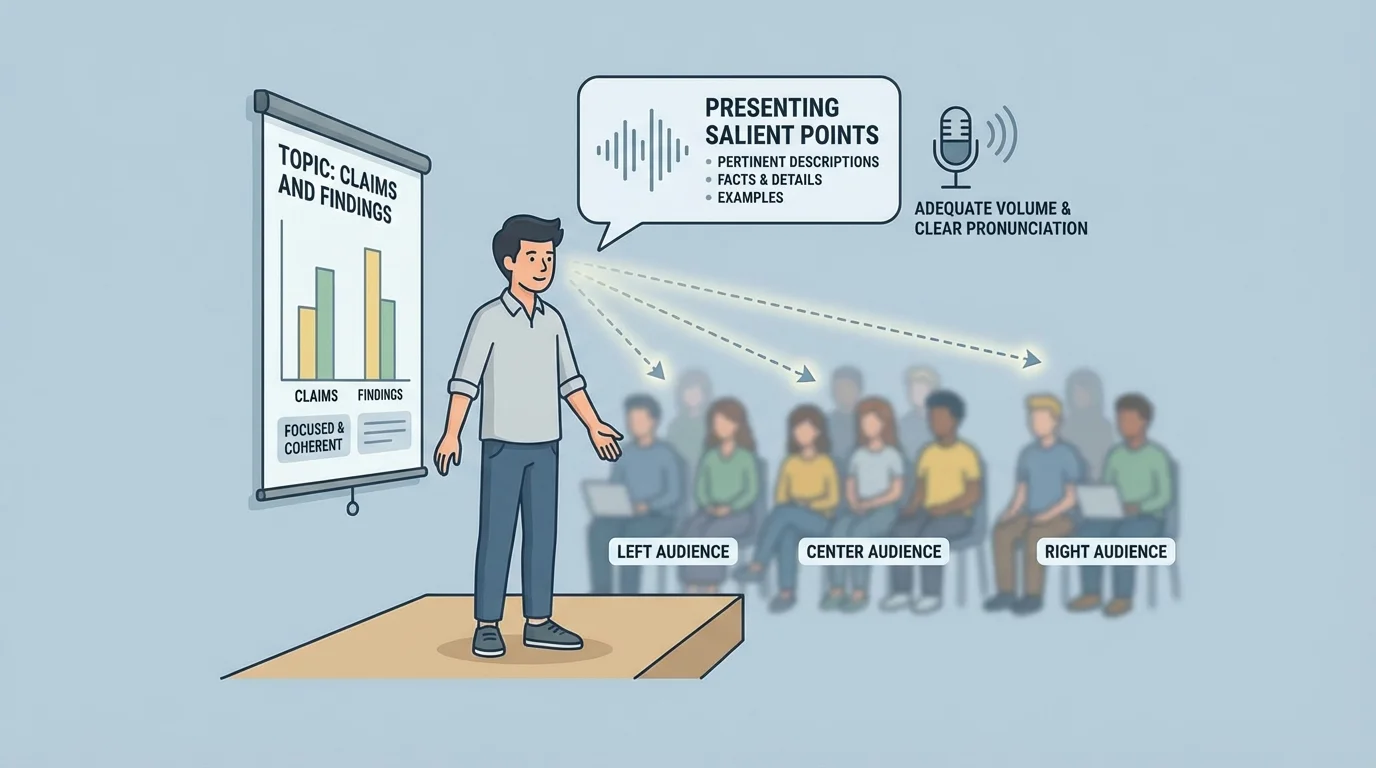
Volume is how loudly or softly you speak. Adequate volume means your whole audience can hear you without strain. In a classroom, the students in the back should be able to hear every sentence. Speaking too softly makes listeners work too hard. Speaking too loudly all the time can sound harsh. A strong speaker adjusts volume to fit the room and the purpose.
Pronunciation is the way words are spoken. Clear pronunciation helps your audience understand every idea. If you rush, mumble, or drop the ends of words, listeners may miss important information. Slowing down slightly, opening your mouth clearly, and practicing difficult words ahead of time can help a lot.
Pace matters as well. Some students speak too fast because they are nervous. A fast pace can make even correct pronunciation hard to understand. A useful trick is to pause briefly after an important point. That pause gives the audience time to think and gives you time to breathe.
When presenting findings from research, clear delivery is especially important because the audience may be hearing new information for the first time. The organized pattern in [Figure 2] works best when your voice and eye contact help the audience stay with you from point to point.
Speaking skills improve with preparation. Reading over your presentation silently is helpful, but saying it aloud is what reveals where you are too quiet, too fast, or unclear.
If you must use notes, treat them as reminders rather than a script. Glance down briefly, then look back up and speak to the audience. Reading every word in a flat voice makes the presentation feel less direct and less confident.
A formal presentation should match both its purpose and its audience. If you are presenting to classmates, your language can still be natural, but it should remain respectful and clear. If you are speaking to teachers, family members, or community guests, you may need an even more polished tone.
Think about what your audience already knows and what they still need explained. For example, if you are presenting findings on renewable energy to students your age, you may need to define terms and use simple examples. If your audience already knows the basics, you can spend more time on comparisons or new information.
You should also adjust your examples to fit the audience. Middle school listeners are likely to connect with examples from school life, sports, technology, health, or local issues. A presentation about reducing food waste may become more effective if it includes examples from a cafeteria rather than from a distant place the audience cannot picture.
Purpose matters too. If your goal is to inform, focus on accuracy and clarity. If your goal is to persuade, make sure the claim is clear and the support is convincing. In both cases, the presentation should stay focused and coherent.
"Say the important thing first, support it well, and make it easy to understand."
That principle is simple, but it is powerful. Audiences appreciate speakers who respect their attention and guide them clearly through the message.
One common mistake is including too much information. This often happens when a student confuses research with presentation. Research may involve many pages of notes, but a presentation should highlight the strongest parts. Returning to the idea in [Figure 1], focused notes lead to stronger speaking.
Another mistake is weak organization. If the audience hears facts in random order, they may not understand how the ideas connect. Using a clear structure and transitions can solve this problem.
A third mistake is failing to explain evidence. Some students list facts quickly but never tell the audience why those facts matter. After each important detail, add a sentence that connects the evidence back to your claim or central finding.
Reading directly from slides or papers is also a problem. It reduces eye contact and often makes the speaker sound less natural. Instead, use short note cards, key phrases, or a simple outline.
Finally, many speakers struggle with delivery because of nervousness. Nervousness is normal. It can be reduced by practicing aloud, standing still before beginning, taking a breath, and focusing on helping the audience understand rather than on trying to sound perfect.
Here is a short model: "Our school should add more refill stations for water bottles. First, refill stations help reduce plastic waste from single-use bottles. Second, they make it easier for students to drink water during the day. For example, when refill stations are placed near the gym and cafeteria, students can use them quickly between activities. This change would support both health and the environment."
This model works because it begins with a clear claim, includes two salient points, and gives a relevant example. It is focused, coherent, and easy to follow. If the speaker says it with steady eye contact, adequate volume, and clear pronunciation, the message becomes even stronger.
Now consider a findings-based version: "Our class survey showed that most students want more shaded areas outside. Many students said they avoid sitting outdoors at lunch because there is too much sun. These findings suggest that adding shade structures could make outdoor spaces more useful." This version presents findings and then explains what those findings suggest.
Whether you are presenting a claim, findings, or both, the goal is the same: help your audience understand the most important ideas and why they matter. Strong presentations are clear in content and clear in delivery.
