Every day, people try to convince you of something: that a snack is "healthier," that a video is "true," that a rule should change, or that a product is "the best." Some of those messages are thoughtful and well supported. Others fall apart the moment you ask one simple question: How do they know? Learning to trace and evaluate an argument gives you a powerful skill. It helps you separate strong thinking from weak thinking.
An argument in informational writing is not just a fight or disagreement. It is a set of ideas meant to convince the reader that a claim is true or reasonable. You see arguments in news articles, editorials, science writing, websites, speeches, reviews, and even advertisements. When you evaluate an argument, you are not just deciding whether you agree. You are deciding whether the writer's thinking makes sense and whether the support is strong enough.
This matters because people often make confident statements without giving solid proof. A social media post may sound convincing because it is short and dramatic. A commercial may use exciting music or celebrity voices to make a product seem trustworthy. But strong arguments are not built on volume, popularity, or emotion alone. They are built on clear claims, sound reasoning, and useful evidence.
When you read informational text, you are already looking for main ideas and supporting details. Evaluating an argument takes that skill one step further: now you ask whether the supporting details actually prove the main point.
Good readers become careful thinkers. They notice not only what a writer says, but also how the writer tries to prove it.
A strong argument has connected parts, as [Figure 1] shows in a chain from main point to support. The first part is the claim, which is the statement the author wants the reader to accept. For example, an author might claim that middle schools should start later in the morning.
Next come the reasons. A reason explains why the author believes the claim is true. For the later-start claim, one reason might be that students need more sleep to learn well. Another reason might be that students are more alert later in the morning.
Then comes the evidence. Evidence is the information used to support a reason. It may include facts, statistics, examples, quotations from experts, results from studies, or observations. If the author says students learn better with more sleep, useful evidence might include research about sleep and attention.
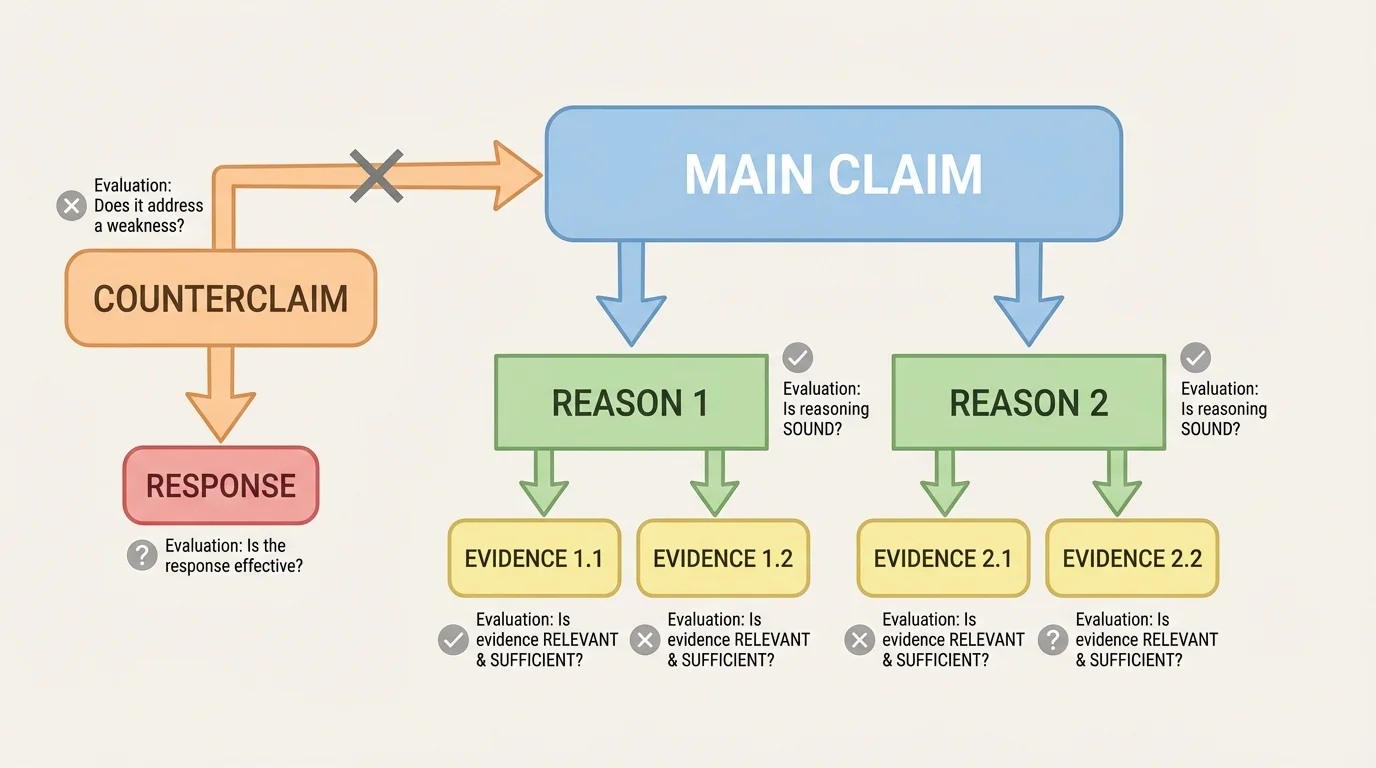
Some arguments also include a counterclaim. A counterclaim is an opposing idea. For example, someone might argue that starting school later would make after-school sports and clubs harder to schedule. Strong writers often mention counterclaims and answer them. Doing this can make the argument more complete and more believable.
Claim is the main point an author wants you to believe. Reason is an explanation for why the claim should be accepted. Evidence is the proof or support used to back up a reason. Counterclaim is an opposing viewpoint that challenges the main claim.
When you evaluate a text, one of your first jobs is to identify these parts clearly. If you cannot find the claim, reasons, and evidence, the argument may already be weak or unclear.
To trace an argument means to follow the author's thinking step by step. You are asking: What is the author trying to prove? What reasons are given? What evidence supports each reason? Does each part connect logically to the next?
Think of tracing an argument like following a trail through the woods. If the trail is clear, you can see where it begins, where it leads, and why each turn makes sense. If the trail suddenly disappears, the argument may have missing steps. A reader should not have to guess how the writer moved from one idea to another.
Suppose an article says, "Our town should build more bike lanes." You might trace it this way: the claim is that more bike lanes should be built; one reason is that bike lanes improve safety; the evidence is that towns with bike lanes have fewer bike-related accidents. Another reason is that bike lanes encourage exercise; the evidence is that more students and adults ride bikes when roads feel safer.
Tracing a short argument
Text: "Schools should add more recess time because movement helps students focus. A study of several schools found that students paid attention better after physical activity. Teachers also reported fewer off-task behaviors after longer breaks."
Step 1: Find the claim.
The claim is that schools should add more recess time.
Step 2: Find the reason.
The main reason is that movement helps students focus.
Step 3: Find the evidence.
The evidence includes a study of schools and teacher reports about attention and behavior.
Step 4: Check the connection.
The evidence connects to the reason because it gives information about focus after physical activity.
This argument is easy to trace because each part leads clearly to the next.
As you saw earlier in [Figure 1], arguments are easier to judge when you can map the parts and see how the support is arranged.
Reasoning is the thinking that connects a claim to its support. Reasoning is sound reasoning when the ideas connect in a logical, sensible way. If the reasons actually support the claim and the evidence fits the reasons, the reasoning is more likely to be sound.
Consider this claim: "The cafeteria should offer more fruit choices." A sound reason might be that students need access to healthier options during lunch. That reason connects clearly to the claim. But an unsound reason might be: "The cafeteria walls are painted blue." Even if that statement is true, it does not logically support adding more fruit choices.
Sound reasoning avoids jumps in logic. It does not assume that one example proves everything. It does not twist facts to fit a conclusion. It does not depend only on feelings, threats, or popularity. Instead, it uses ideas that genuinely help prove the point.
How reasoning works
Reasoning acts like a bridge between the claim and the evidence. If the bridge is weak, even strong evidence may not lead to a convincing conclusion. For example, a writer may present a real statistic, but if that statistic does not connect logically to the claim, the argument still fails.
One useful question is: If the reason is true, does it actually help prove the claim? If the answer is no, the reasoning is not sound.
Evidence must do more than simply appear in the paragraph. It must be relevant, meaning it directly relates to the claim or reason. It also must be sufficient, meaning there is enough of it, and it is strong enough, to support the claim.
Relevant evidence matches the topic and helps answer the question the claim raises. If the claim is that later school start times improve student focus, a sleep study is relevant. A fact about the school mascot is not relevant. Both may be true, but only one helps prove the point.
[Figure 2] Sufficient evidence means the author gives enough support to make the argument convincing. One student saying, "I feel more awake later," is a piece of evidence, but it may not be enough by itself. A stronger argument might include student surveys, sleep research, and expert opinions from doctors or education specialists.
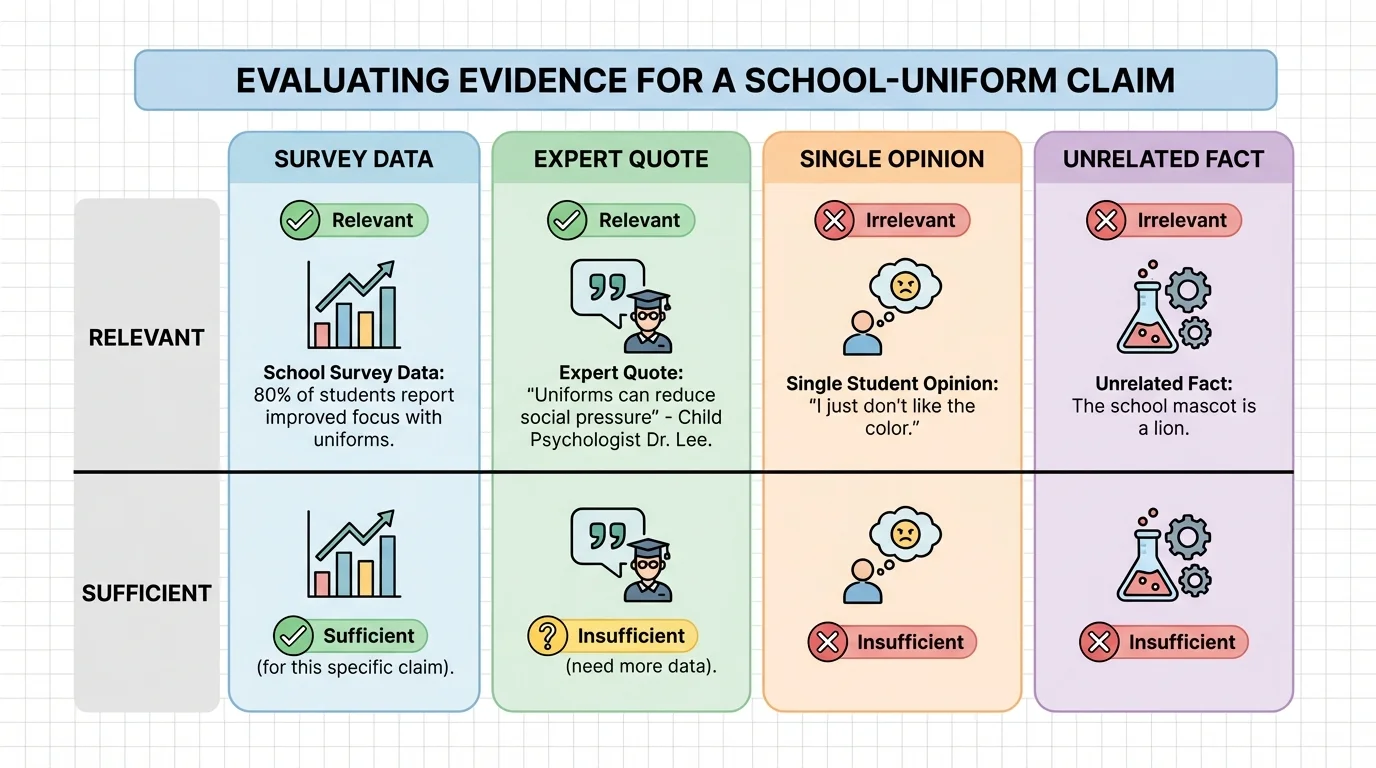
Strong evidence is often specific, trustworthy, and varied. Specific evidence includes exact facts instead of vague statements. Trustworthy evidence comes from reliable sources. Varied evidence may combine data, expert explanation, and real examples.
| Type of support | How useful it is | Why |
|---|---|---|
| Statistic from a school district report | Usually strong | It offers measurable information from an official source. |
| Quote from a sleep scientist | Strong | An expert can explain research clearly. |
| One student opinion | Limited | It may be relevant, but it is only one example. |
| Unrelated fun fact | Weak | It does not support the claim. |
Table 1. Comparison of different kinds of support and how well they help an argument.
One true fact can still be weak evidence. Truth alone is not enough; the fact must also connect directly to the claim and provide meaningful support.
When you evaluate evidence, ask two questions: Does this evidence fit the claim? and Is there enough of it to be convincing? Those two questions often reveal whether an argument is solid or shaky.
Some arguments sound impressive at first, but close reading reveals problems. One problem is overgeneralization. This happens when a writer uses too little information to make a broad claim. If one student dislikes homework and the writer concludes that all students hate homework, that is too broad.
[Figure 3] Another problem is relying only on emotion. Feelings matter, but emotion alone is not proof. A speaker might say, "If you really care about students, you must support this rule." That statement tries to pressure the audience emotionally instead of giving evidence.
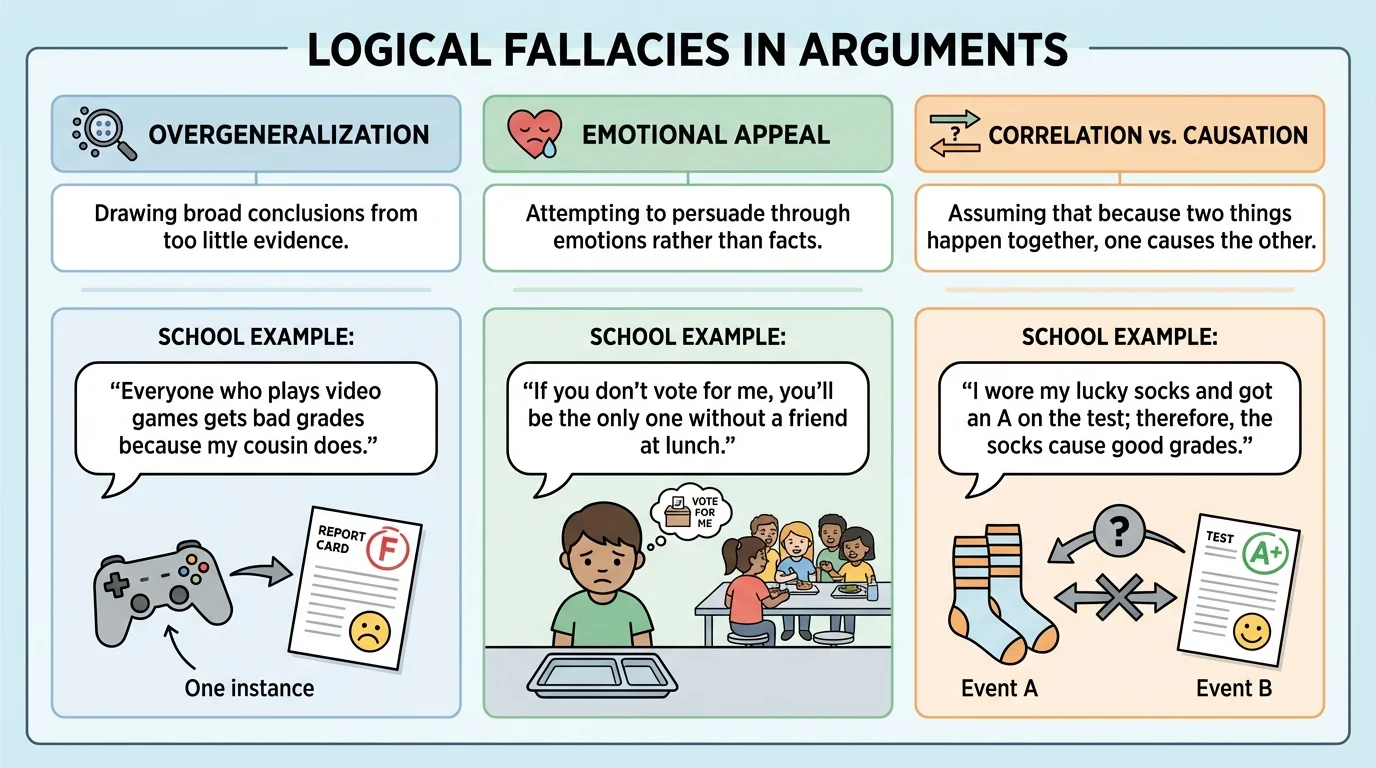
A third problem is confusing correlation with cause. Correlation means two things happen together. But that does not always mean one caused the other. For example, if more students bring water bottles during test week, and test scores also rise, that does not prove water bottles caused higher scores. Another factor, such as extra studying, may explain the change.
Writers may also use weak comparisons, ignore strong counterclaims, or choose only the evidence that helps them while leaving out important facts that do not. A fair reader stays alert for these moves.
Checking for faulty reasoning
Claim: "Everyone should use this study app because the top student in school uses it."
Step 1: Identify the support.
The support is that one high-performing student uses the app.
Step 2: Test the reasoning.
This is weak reasoning because one example does not prove the app works for everyone.
Step 3: Ask what evidence is missing.
The argument needs broader evidence, such as results from many students or research on study habits.
The claim may turn out to be true, but the argument as written is not strong enough.
The difference between sound and faulty reasoning often becomes clearer when you compare examples side by side, just as in [Figure 3].
Here is a weak argument: "Our school should ban all cell phones because phones are distracting." The claim may address a real issue, but the word all makes the claim broad, and the argument gives only one reason without much support.
Now consider a stronger version: "Our school should limit cell phone use during class time because phones can interrupt learning. Teachers at three grade levels reported more off-task behavior when phones were visible, and a school survey found that many students checked messages during lessons. Emergency contact would still be possible through the front office." This version gives clearer evidence and responds to a possible concern.
A strong argument does not have to be perfect. It simply needs to make sense, stay focused, and include enough appropriate support. A weak argument may include true statements, but if the logic is weak or the evidence is thin, the argument is still weak.
"A strong reader asks not only 'What does the author say?' but also 'How well is it proved?'"
That question is at the heart of evaluation.
You can use these skills with many kinds of texts. In a news article, look for whether the writer separates facts from opinion and cites trustworthy sources. In an opinion piece, look for clear claims, reasons, and evidence. On a website, pay attention to who published the information and whether the evidence can be checked.
Advertisements deserve special attention. Ads often make claims quickly, such as "This drink boosts energy" or "This cleaner works best." Sometimes the ad includes evidence, but sometimes it depends mostly on excitement, famous people, or dramatic images. Those features may grab attention, but they are not the same as proof.
Science and history texts also require careful evaluation. In science writing, evidence might include data from experiments and explanations from researchers. In history writing, evidence may include primary sources, dates, quotations, and records from the time period being studied. Different subjects use different kinds of evidence, but the same questions still apply: Is the reasoning sound? Is the evidence relevant? Is it sufficient?
Reliable evaluation language
When discussing an argument, use precise words. You might say that a claim is clearly stated, partly supported, weakly supported, logically developed, or unsupported. You might describe evidence as relevant, irrelevant, sufficient, limited, credible, or anecdotal. These words help you explain your judgment clearly.
As with the argument map in [Figure 1], identifying each part first makes your evaluation more accurate no matter what type of text you are reading.
When you explain your evaluation, be specific. Do not simply say, "This is a good argument," or "This is bad." Instead, say why. Point to the claim, describe the reasons, and discuss the evidence.
A strong evaluation might sound like this: "The author's claim that schools should start later is supported by sound reasoning because the reasons connect directly to student focus and health. The evidence is relevant because it includes sleep research and expert opinion. The evidence is mostly sufficient, though more local school data would make the argument stronger."
Notice that this kind of response does three things. First, it identifies the claim. Second, it judges the reasoning. Third, it comments on the evidence. This creates a full evaluation rather than just an opinion.
Model evaluation of a short text
Text: "The town should build a new skate park because it would give teens a safe place to practice. Police reports show repeated skating in unsafe parking lots, and a nearby town saw fewer complaints after opening a skate park. Some people worry about noise, but the proposed location is far from houses."
Step 1: State the claim.
The claim is that the town should build a new skate park.
Step 2: Evaluate the reasoning.
The reasoning is mostly sound because the author connects the skate park to safety and addresses a counterclaim about noise.
Step 3: Evaluate the evidence.
The evidence is relevant because police reports and the nearby town example both relate to safety and public complaints.
Step 4: Judge sufficiency.
The evidence is fairly sufficient, though cost information and community survey results would strengthen the argument.
This evaluation is balanced because it recognizes both strengths and areas for improvement.
Careful readers do not accept or reject claims too quickly. They test the logic, inspect the support, and decide whether the argument earns their trust.
