A confident voice can make almost anything sound true. A class speech, a video review, a campaign talk, or even a morning announcement may seem convincing at first simply because the speaker sounds sure. But strong listening means more than hearing words. It means figuring out exactly what the speaker is arguing, what claims support that argument, and whether the reasons and evidence really hold up.
When you evaluate a spoken argument, you are doing careful thinking in real time. You listen for the main point, notice how the speaker builds the case, and decide whether the presentation deserves your trust. This matters in school and far beyond it. People use spoken arguments to persuade others about rules, products, community issues, health choices, and public decisions.
Oral presentations are different from printed texts because they happen live. A speaker uses voice, pace, emphasis, eye contact, and sometimes images or slides. These techniques can help an audience understand an idea, but they can also distract listeners from weak reasoning. That is why careful listeners do two jobs at once: they follow the speaker's message and they test the strength of the argument.
If a student says, "Our school should add more recycling bins because students care about the environment," that sounds positive. But a strong listener asks questions such as: What exactly is the claim? What reasons are given? What evidence supports those reasons? Is the evidence enough? Could there be another side?
Argument is a set of claims meant to convince an audience of a position. A claim is a statement the speaker wants the audience to accept. Reasoning is the logical connection between the claim and the support. Evidence is the information used to back up the claim, such as facts, examples, statistics, observations, or expert opinions.
Good listeners are fair. They do not reject an idea just because they disagree with it at first. They examine whether the speaker builds the case well. That makes your response stronger, more respectful, and more accurate.
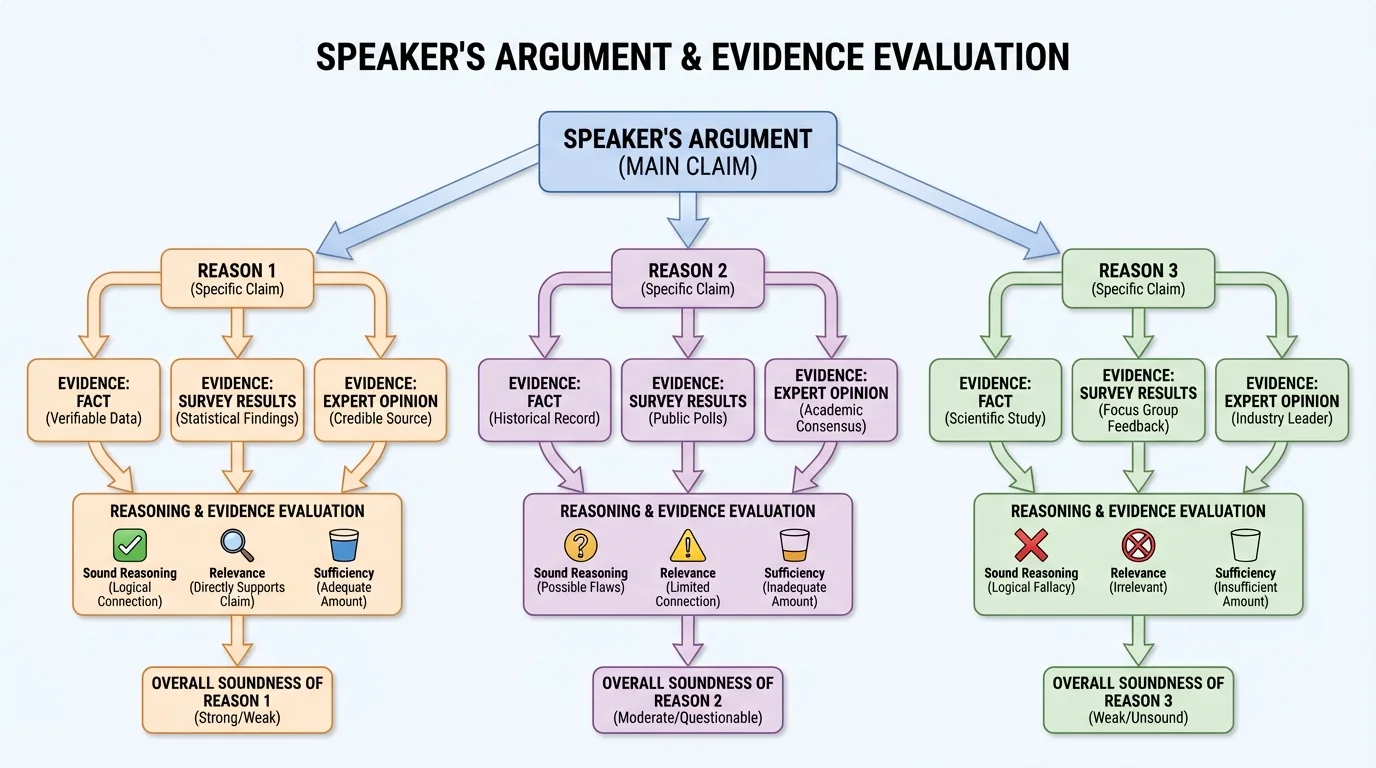
[Figure 1] A spoken argument usually has a central idea and supporting parts. The main claim is the speaker's overall position. Under that, the speaker may present smaller claims, often called specific claims, that help support the larger one. These specific claims connect to reasons, and those reasons should be supported by evidence.
For example, suppose a speaker argues, "Middle school students should start school later." That is the main claim. Specific claims might include: students learn better when they are rested, later start times reduce tiredness, and better rest improves mood and focus. To support those claims, the speaker needs evidence such as sleep research, school comparisons, or survey results.
You can often outline an argument by asking four questions: What does the speaker want me to believe? What reasons are given? What evidence supports each reason? How do the parts connect?
Some spoken arguments also include a counterclaim, which is an opposing viewpoint. A strong speaker may mention a counterclaim and explain why the main argument is still stronger. This often makes the presentation more believable because it shows the speaker has considered more than one side.
Purpose and audience also matter. A speaker addressing classmates may choose school-based examples, while a speaker addressing a city council might use community data. The same basic argument can sound different depending on who is listening.
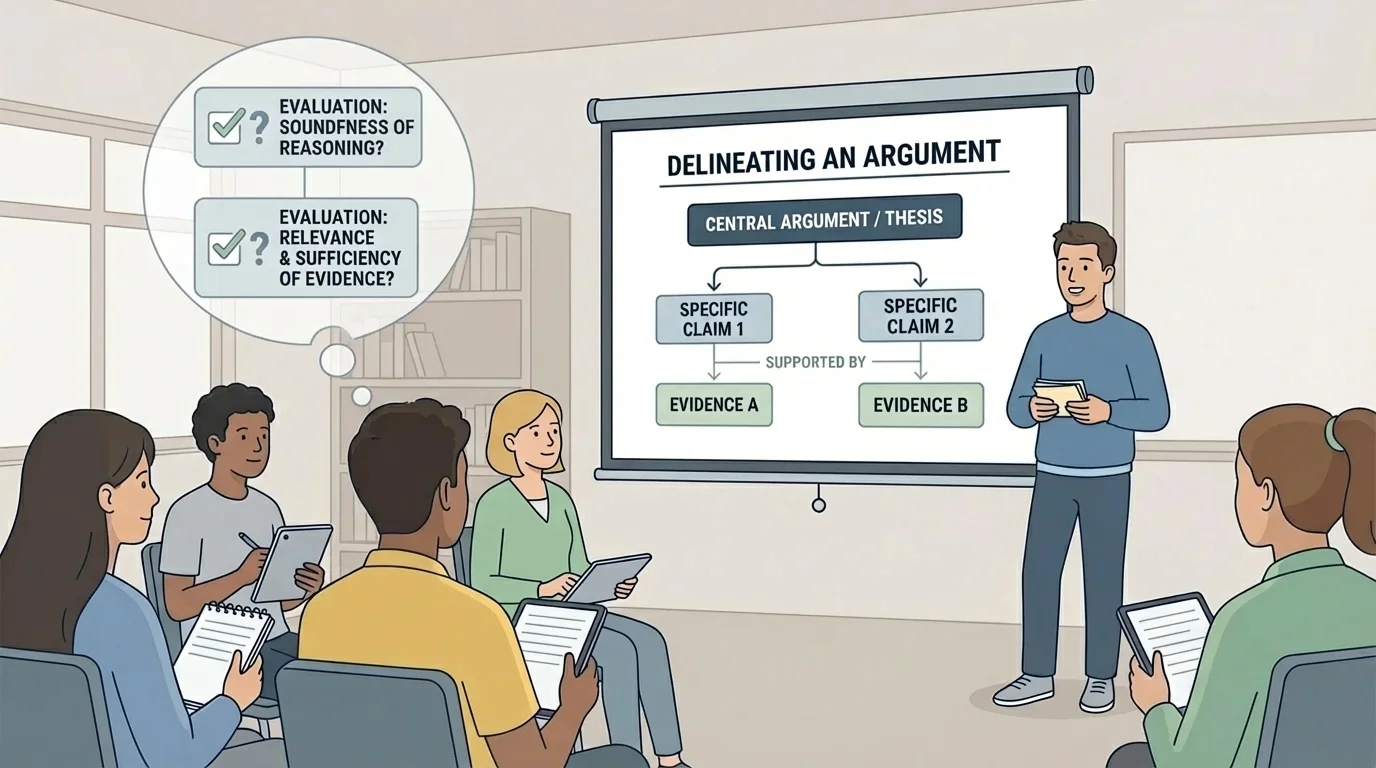
To delineate an argument means to trace or map it clearly. You separate the parts instead of hearing the speech as one long stream of words. This is especially important in oral presentations because spoken language moves quickly.
Start by identifying the topic. Then listen for the main claim, which is often stated near the beginning or end. After that, sort out the specific claims. These are the smaller points that build the speaker's case. Finally, match each claim with its reasons and evidence.
Signal words can help. A speaker may say "because," "for example," "research shows," "another reason," "however," or "some people argue." These clues reveal how ideas are connected. If you hear many examples but no clear claim, the speaker may be giving information rather than making an argument. If you hear a clear claim but very little support, the argument may be weak.
Tracing the line of thinking
When you delineate a speaker's argument, think of following a path. The claim is the destination. The reasons are the roads leading there. The evidence is the proof that the roads are real and useful. If the path jumps suddenly, skips steps, or relies on unrelated details, the argument becomes harder to trust.
Sometimes speakers repeat an idea in different words. That does not automatically mean they have added support. Repetition can make a point memorable, but repeated claims are still just claims unless the speaker provides reasons and evidence.
Once you identify the parts of the argument, the next question is whether the reasoning is sound. Sound reasoning means the speaker's reasons truly support the claim in a logical way. Unsound reasoning contains gaps, false assumptions, or faulty logic.
Consider this statement: "We should ban all homework because homework is sometimes stressful." The reasoning is weak because the fact that something is sometimes stressful does not automatically prove it should be banned entirely. There is a leap from one idea to a much bigger conclusion.
Now consider: "Our cafeteria should offer more fruit choices because students need nutritious options at lunch, and a recent student survey shows many students want healthier choices." This reasoning is stronger because the reason connects clearly to the claim, and the evidence supports the reason.
As you evaluate reasoning, ask these questions:
A speaker may also rely on assumptions. An assumption is something the speaker treats as true without proving it. For instance, "Everyone will participate if we make the event mandatory" assumes that forced attendance leads to real participation. That may not be true.
Some of the most convincing-sounding arguments fail not because the speaker lacks confidence, but because the logic between ideas is weak. Skilled listeners notice those hidden gaps.
Reasoning can also be too simple for a complicated issue. Real problems often have more than one cause. If a speaker blames a single cause for everything, be cautious.
Not all evidence is equally helpful. A strong listener judges whether the evidence is relevant, credible, and sufficient. Relevant evidence directly connects to the claim. Credible evidence comes from trustworthy sources or careful observation. Sufficient evidence means there is enough support, not just one thin example.
[Figure 2] Suppose a speaker says, "Our school needs more shaded outdoor seating." Relevant evidence might include temperature measurements, observations of crowded indoor lunch spaces, or student survey results. Irrelevant evidence would be something like, "Many students like blue backpacks." That fact may be true, but it does not support the claim about shade and seating.
Different kinds of evidence work in different ways. Facts and statistics can show patterns. Expert opinion can add specialized knowledge. Examples can make a point understandable. Anecdotes, which are brief personal stories, can be powerful but should not stand alone.
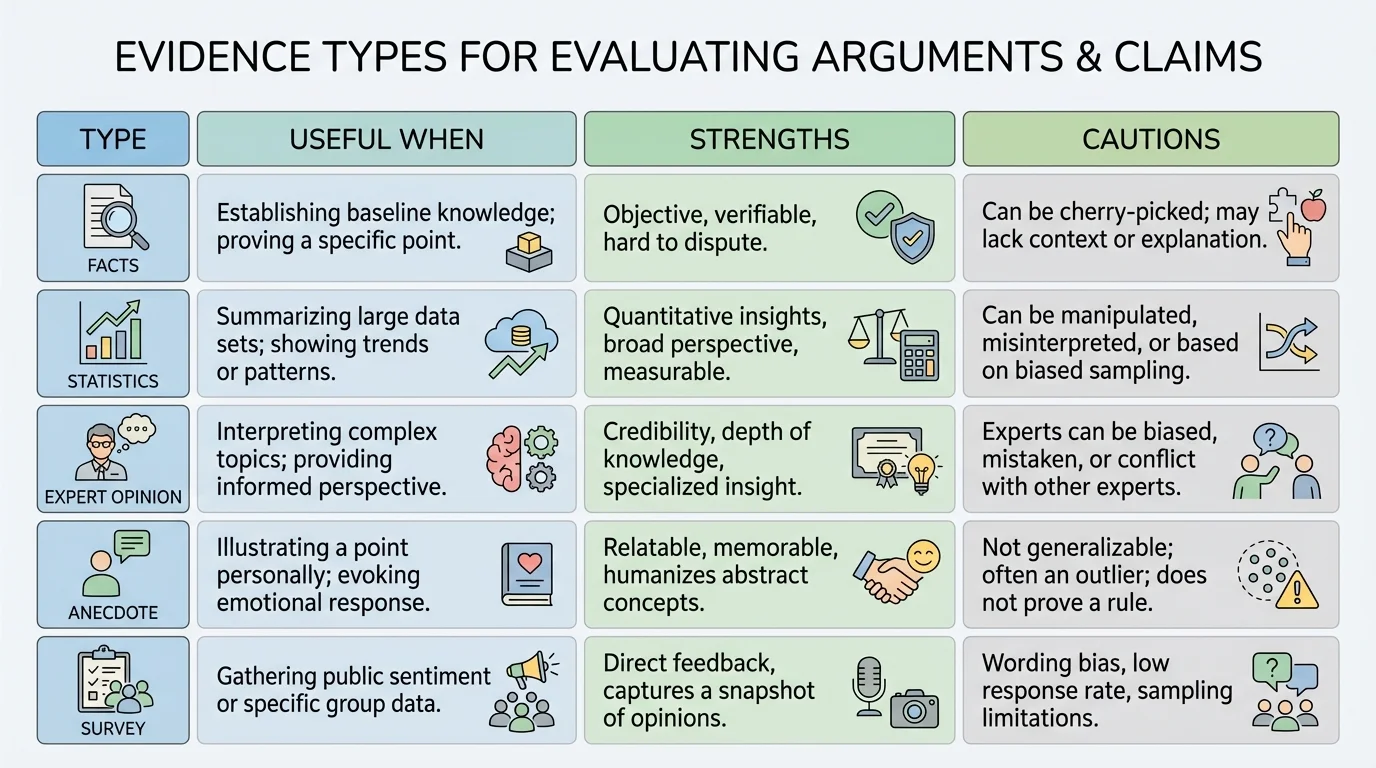
A single personal story might sound emotional and memorable, but it may not represent a larger pattern. If one student says, "I felt much better when school started later during a special schedule," that matters, but it is not enough by itself to prove what would happen for everyone.
Think about sufficiency this way: if a speaker makes a large claim, the evidence should also be strong and broad. A claim about an entire school, community, or country usually needs more than one example. It may require multiple sources or several kinds of evidence working together.
| Type of evidence | How it can help | Possible weakness |
|---|---|---|
| Fact | Provides verifiable information | May be too limited if only one fact is given |
| Statistic | Shows patterns or scale | May be misleading if the sample is small or unclear |
| Expert opinion | Adds specialized knowledge | Depends on whether the expert is qualified and relevant |
| Example | Makes an idea concrete | May not represent the whole situation |
| Anecdote | Creates emotional connection | Too personal to prove a broad claim alone |
Table 1. Common kinds of evidence and the strengths and limits of each.
Source matters, too. A speaker who says "research proves it" should ideally name where the information comes from. Evidence from a trained expert or a reliable study is usually stronger than a random online comment.
Remember that strong support is not just about having many details. The details must fit the claim. Five unrelated facts are weaker than two facts that directly connect to the argument.
As we saw earlier in [Figure 1], evidence must connect to a reason, not just sit beside it. A pile of information is not the same as a well-supported claim.
Some arguments sound strong because they use shortcuts that appeal to emotion or pressure instead of logic. These weak patterns are often called fallacies. Learning to notice them helps you stay thoughtful instead of simply being swept along.
[Figure 3] One common fallacy is the bandwagon idea: "Everyone wants this, so it must be right." Popularity does not prove truth. Another is an ad hominem attack, where the speaker criticizes someone instead of addressing the idea. For example, "Don't listen to Maya's plan for longer library hours; she forgets her homework sometimes." That attacks Maya rather than evaluating the plan.
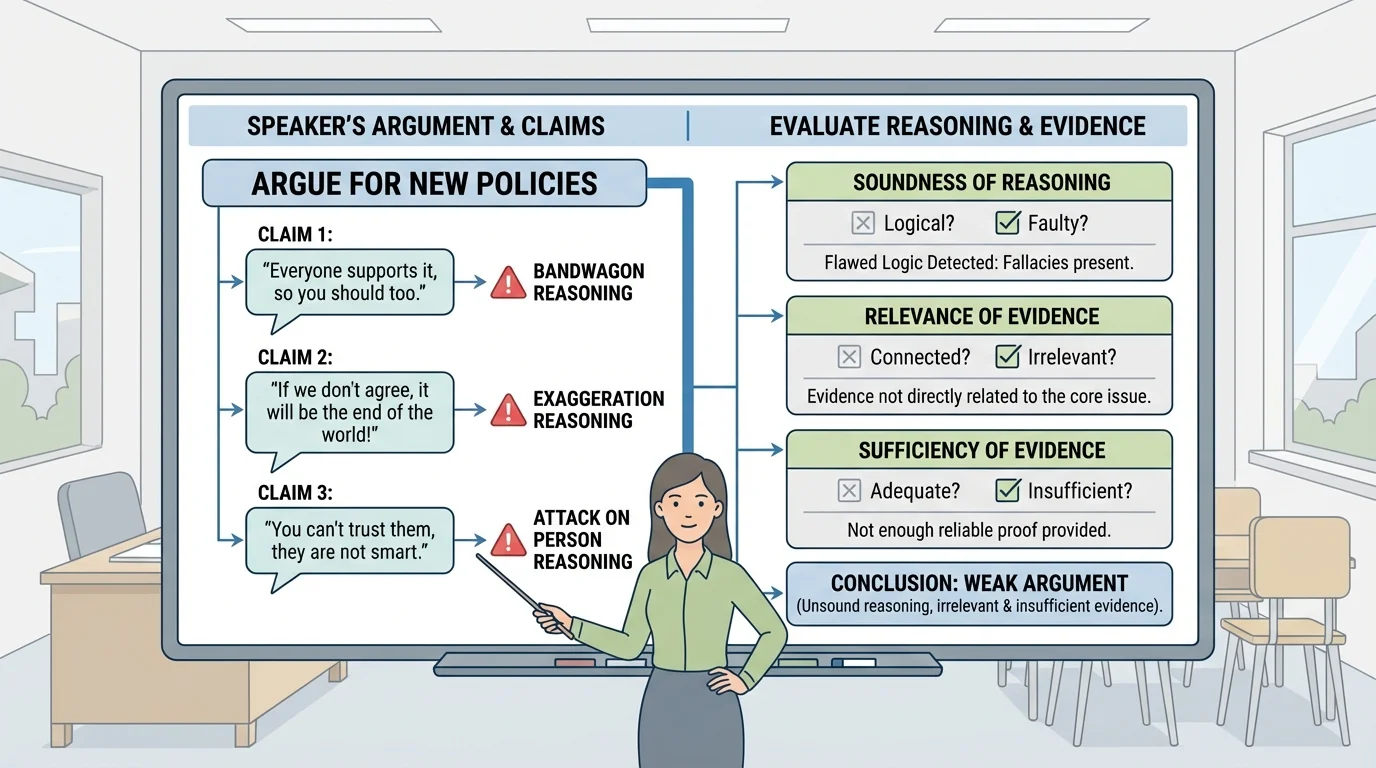
Another weak move is exaggeration, such as "If we allow phones during lunch, school rules will completely collapse." This predicts an extreme result without enough proof. A speaker may also use loaded words to trigger strong feelings while avoiding real support.
This does not mean emotion has no place in speaking. A thoughtful speaker may care deeply about a topic, and emotion can help an audience understand why it matters. But emotion should work with evidence, not replace it.
Case study: A weak spoken argument
A student speaker says, "We must cancel all group projects because they are unfair."
Step 1: Identify the main claim.
The main claim is that all group projects should be canceled.
Step 2: Find the support.
The speaker mentions that one student did most of the work in a recent project.
Step 3: Evaluate reasoning.
The reasoning is weak because one bad experience does not prove that every group project is unfair.
Step 4: Evaluate evidence.
The evidence is relevant, but it is not sufficient. One anecdote is too limited for such a broad claim.
A stronger version would include multiple examples, survey data, and possible solutions such as clearer group roles instead of canceling all projects.
Later, when you hear a dramatic claim, think back to the misleading shortcuts in [Figure 3]. Ask whether the speaker is proving the point or only making it sound urgent.
A strong oral presentation does more than state ideas. It uses clear language, organized structure, and techniques that fit the audience. These features can make an argument easier to follow, but they do not automatically make it true.
[Figure 4] For example, a speaker may use formal words, a calm tone, and neat slides. That helps the audience understand the message. Good eye contact, clear volume, and a steady pace show preparation and respect for listeners. Still, even polished delivery must be backed by solid reasoning and relevant evidence.
Audience awareness matters, too. A speaker should choose examples, vocabulary, and tone that suit the listeners. A presentation to classmates should be understandable and specific to their experience. A speaker who uses confusing jargon or unrelated examples may lose the audience, even if the topic is important.
Transitions also matter in oral arguments. Phrases like "my first reason," "on the other hand," and "according to the survey" help listeners track the structure. In spoken communication, organization is especially important because the audience cannot easily reread what they missed.
When evaluating a speaker, separate delivery strength from argument strength. A polished speaker may still present a weakly supported argument. A nervous speaker with careful logic may still have a strong argument.
The best way to understand argument evaluation is to see it in action. These examples show how a listener can identify claims, test reasoning, and judge evidence.
Example 1: School water bottle stations
A speaker says, "Our school should install more water bottle filling stations."
Step 1: Main claim
The school should install more filling stations.
Step 2: Specific claims
Students wait too long at current stations, reusable bottles reduce plastic waste, and easier access encourages hydration.
Step 3: Evidence
The speaker reports lunch-period observations, counts of student lines, and a comparison with a nearby school that added stations.
Step 4: Evaluation
The reasoning is mostly sound because the reasons connect clearly to the claim. The evidence is relevant, though the argument would be stronger with cost information and more than one comparison school.
This is a fairly strong argument because the speaker links a clear need to several types of support.
Notice that this example succeeds because the speaker does more than repeat "students want it." The argument builds a chain from need to support to solution, much like the structure shown earlier in [Figure 1].
Example 2: Longer lunch period
A speaker says, "Lunch should be fifteen minutes longer because my friends are always rushed."
Step 1: Main claim
Lunch should be longer.
Step 2: Specific support
The speaker gives one reason: some students feel rushed.
Step 3: Evidence
The only evidence is the speaker's personal observation about friends.
Step 4: Evaluation
The claim may be reasonable, but the evidence is too limited. The speaker should include broader observations, time data, or survey results from many students.
This argument is not automatically wrong, but it is under-supported.
As the evidence comparison in [Figure 2] suggests, personal experience can start an argument, but it rarely finishes one.
Example 3: No homework on weekends
A speaker says, "Teachers should assign no homework on weekends because students need rest, family time, and time for activities."
Step 1: Main claim
No weekend homework should be assigned.
Step 2: Specific claims
Rest supports learning, family time matters, and extracurricular activities build skills.
Step 3: Evidence
The speaker includes a student survey, quotes from two teachers, and one article about stress and sleep.
Step 4: Evaluation
The argument is stronger than one based only on opinion, but it still needs balance. A thoughtful listener should ask whether the speaker addressed possible counterclaims, such as time needed to practice or complete long-term assignments.
This example shows that even a strong argument can become stronger by addressing opposing views.
Strong evaluation is not about labeling speeches as simply "good" or "bad." It is about identifying where support is strong, where it is thin, and what would improve it.
After listening, you should be able to explain your judgment clearly. A strong response names the claim, comments on reasoning, and discusses evidence. For example, you might say, "The speaker's main claim was clear, and the reasons connected logically. However, most of the evidence came from personal stories, so the support was relevant but not fully sufficient."
This kind of response is stronger than saying, "I liked it," or "I didn't agree." Personal reaction is not the same as evaluation. Careful listeners support their own judgments with observations from the speech.
You can also compare strengths and weaknesses. A speech may be well organized but weakly supported. It may use strong evidence but ignore an important counterclaim. It may fit the audience well, as in the presentation techniques shown in [Figure 4], yet still depend too much on emotion.
"A convincing speaker is not just someone who sounds sure. A convincing speaker is someone whose ideas, reasons, and evidence fit together."
Being an active listener helps you in discussions, presentations, debates, and everyday decisions. It teaches you to pay attention not only to what is said, but also to how and why it is said.
