A discussion can fall apart surprisingly fast. One person gives a short answer, someone else changes the subject, another repeats a point that was already made, and suddenly the group is talking without really learning anything. But strong discussions do something different: they help people think more deeply, notice evidence, and build ideas together. That is why asking thoughtful questions and giving relevant responses are not just classroom skills. They matter in team sports, science labs, student government, workplace meetings, and even everyday conversations.
When people discuss a topic well, they do more than take turns talking. They build on ideas, ask for explanation, and help the group stay focused on the main question. This takes practice, but it is a skill anyone can learn. Good discussion is not about talking the most. It is about helping the conversation become clearer, deeper, and more useful.
In school, discussions help students understand texts, solve problems, and compare viewpoints. If a class is discussing a novel, a science article, or a historical event, the goal is not only to share opinions. The goal is to explain thinking, support ideas, and respond in a way that moves the conversation forward. A strong discussion often helps everyone understand the topic better than they would alone.
These skills also matter outside school. On a robotics team, for example, members may need to ask why a design failed and what evidence supports a new plan. In a community meeting, people need to listen carefully, ask follow-up questions, and avoid getting pulled into unrelated issues. People who can ask useful questions and respond thoughtfully are often seen as strong leaders because they help groups think clearly.
Elaboration means adding more detail, explanation, examples, or evidence to an idea. In discussion, a question that elicits elaboration invites someone to say more than a one-word or very short answer.
Relevant means closely connected to the topic or purpose of the discussion. A relevant response adds something useful instead of changing the subject.
One important part of good discussion is knowing the difference between a question that shuts thinking down and a question that opens thinking up.
A question that elicits elaboration encourages a speaker to explain more fully, as [Figure 1] shows through the contrast between a short yes-or-no question and a follow-up question that invites detail. If you ask, "Did you like the article?" the answer might be only "yes" or "no." But if you ask, "What part of the article was most convincing, and why?" the other person has to think, choose evidence, and explain.
Questions that elicit elaboration are often open-ended questions. These cannot be answered with a single word. They often begin with words like how, why, what explains, what evidence supports, or can you say more about. They help discussions move past the surface and into the reasoning behind an idea.
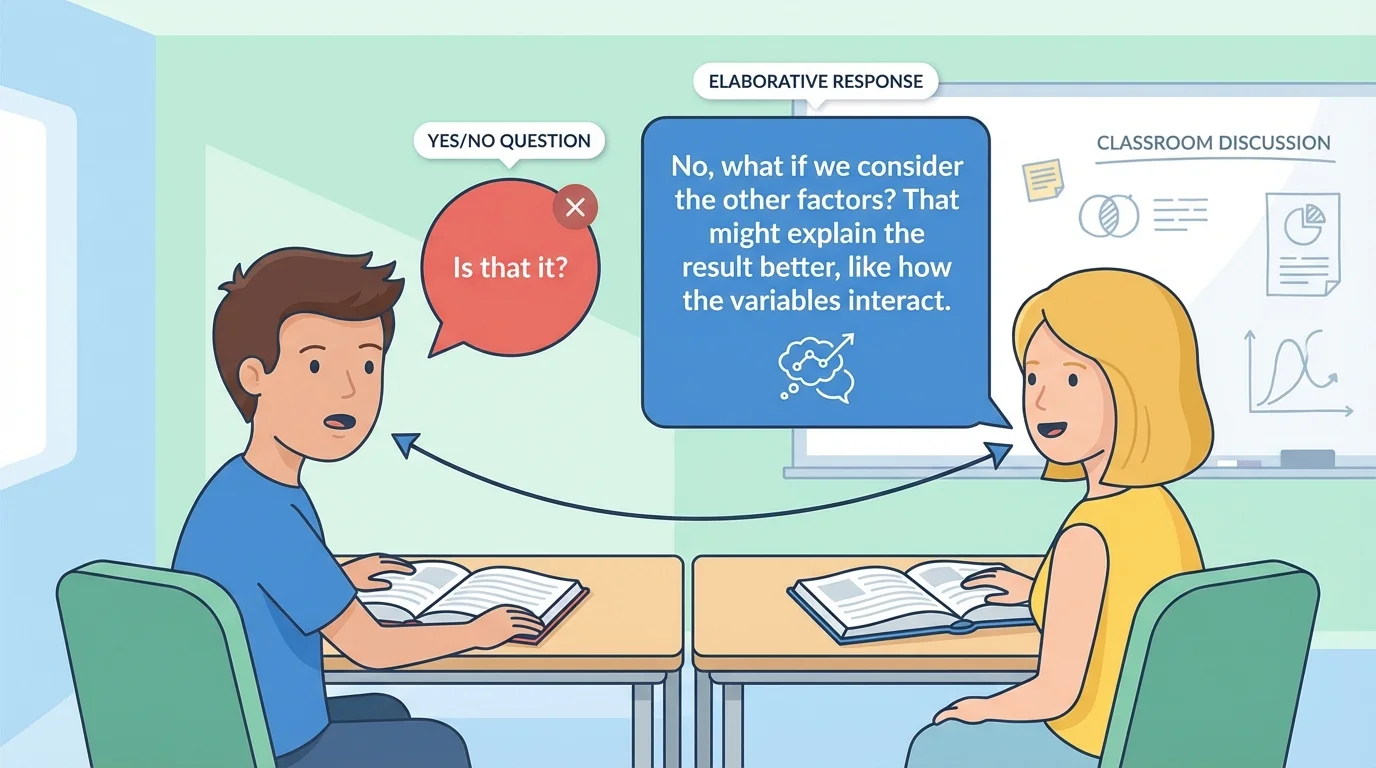
Compare these two exchanges:
Weak question: "Was the main character brave?"
Weak response: "Yes."
Stronger question: "What actions show that the main character is brave, and are there any moments that challenge that idea?"
Stronger response: "The character is brave when she warns the village even though she knows people may not believe her. But later she hesitates before entering the forest, which suggests her bravery is real because she feels fear and acts anyway."
The stronger question asks for examples and complexity. It does not just ask for an opinion; it asks for the thinking behind the opinion. Later in a discussion, the same pattern from [Figure 1] still matters: better questions usually lead to richer answers.
Why elaboration matters
Elaboration improves understanding because it reveals reasoning. When someone explains why they think something, other people can agree, disagree, ask about the evidence, or connect the idea to another point. Without elaboration, discussion stays shallow and important thinking remains hidden.
Not every good question sounds the same. Different questions help a discussion in different ways.
A useful clarifying question helps everyone understand what a speaker means. For example: "What do you mean by 'unfair' in this situation?" or "Can you explain that part again in a different way?" Clarifying questions are helpful when an idea is interesting but not yet clear.
A probing question digs deeper into someone's reasoning. It might sound like: "Why do you think that happened?" or "What led you to that conclusion?" These questions are important because they move beyond the claim and ask about causes, reasons, or patterns.
An evidence-based question asks for support from a text, event, experiment, or observation. Examples include: "What detail from the article supports that idea?" and "Which part of the data makes you think that?" This matters because strong discussions are not built only on opinions. They are strengthened by proof.
Some questions help compare or connect ideas. For instance: "How is this character similar to the one from the earlier chapter?" or "How does this experiment connect to what we learned about energy?" These questions help students see relationships between ideas instead of treating each point separately.
Other questions extend the discussion. They move the group forward by asking about effects, solutions, or broader meaning. Examples include: "What might happen next?" "Why does this issue matter today?" and "What is another possible solution?" Extension questions are especially helpful when a conversation has become repetitive and needs a new direction while still staying on topic.
| Question Type | Purpose | Example |
|---|---|---|
| Clarifying | Make an idea easier to understand | "Can you explain what you mean by that?" |
| Probing | Ask for reasoning | "Why do you think that is true?" |
| Evidence-based | Ask for proof or support | "What detail in the text supports your claim?" |
| Comparing | Show similarities or differences | "How is this idea different from the earlier one?" |
| Extending | Move the discussion forward | "What new question does this raise?" |
Table 1. Common question types that help deepen and organize discussion.
The best discussions often use several kinds of questions, not just one. A student might first ask for clarification, then ask for evidence, and finally ask how the idea connects to the larger topic.
Asking strong questions is only half of the skill. The other half is responding in a way that actually helps the discussion. A good response does at least one of these things: answers the question directly, adds an observation, connects to earlier ideas, includes evidence, or helps the group think more clearly.
A relevant response stays connected to the topic and to what the other speaker actually said. If someone asks, "Why do you think the inventor kept testing new designs?" a relevant answer might be, "I think the inventor believed the earlier models were unsafe, because the article says two prototypes broke during testing." That answer directly addresses the question and supports the point with evidence.
An irrelevant response may not be wrong, but it does not help the current discussion. Suppose a group is discussing whether a new school garden should be built. If one student says, "My cousin has a dog that likes digging holes," that comment may be true, but it does not clearly connect to the discussion unless the speaker explains why it matters. Relevant comments are useful because they help everyone stay focused on the same purpose.
Example: weak response and strong response
Question: "What makes the article's argument convincing?"
Step 1: Notice the weak response
"It is just convincing because it sounds smart."
Step 2: Improve it with evidence and explanation
"The argument is convincing because the author includes results from multiple studies and explains how the findings connect. That gives the reader evidence, not just opinion."
The stronger response adds a clear observation and explains why the point matters.
Relevant responses often begin by connecting to someone else's idea. Phrases such as "I agree with your point about...," "I want to add to what you said...," "A detail that supports that is...," and "Another way to look at it is..." help speakers build on one another's thinking instead of starting over each time.
Sometimes a good response respectfully disagrees. Discussion does not mean everyone must think the same thing. But disagreement should still be connected, respectful, and specific. A strong disagreement sounds like, "I see your point, but I interpret the scene differently because the character's actions suggest fear rather than confidence." That keeps the discussion thoughtful instead of turning it into an argument about people instead of ideas.
Even a good discussion can drift. One comment leads to another, and soon the group is talking about something only loosely connected to the main question. A skillful speaker notices that drift and helps redirect the conversation, as [Figure 2] illustrates by showing how a discussion can move away from the central question and then return to it through a polite refocus.
To bring a discussion back on topic, first remember the purpose. What is the group trying to figure out? Are you discussing the theme of a story, the causes of an event, the results of an experiment, or the best solution to a problem? Once the purpose is clear, it becomes easier to recognize when a comment no longer supports it.
Polite redirection is important. Instead of saying, "That has nothing to do with this," a stronger move is to say, "That is interesting, but how does it connect to our main question?" or "Let's return to the article's main claim." Another useful response is, "I think we may be moving away from the topic. What evidence do we have for the original question?" These statements are respectful because they focus on the discussion goal, not on embarrassing the speaker.
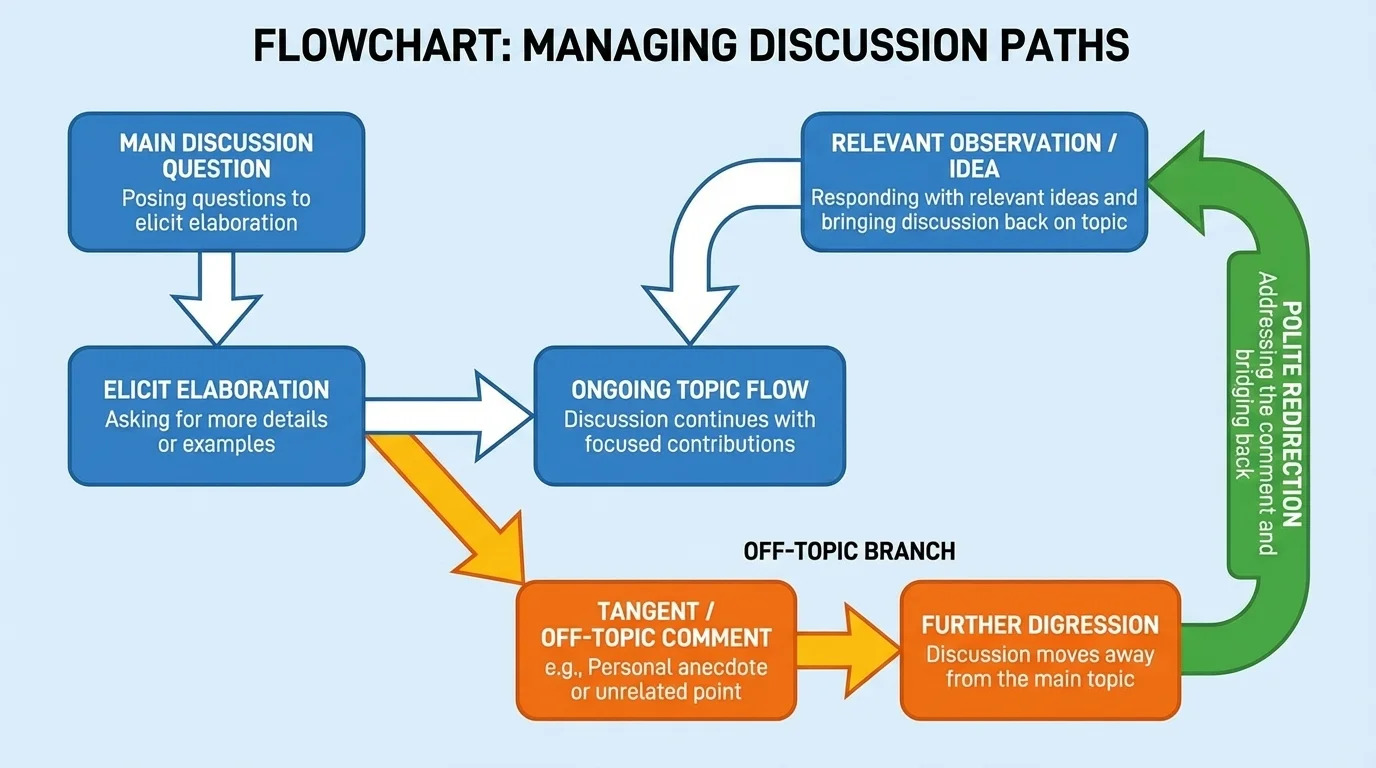
There are times when an off-topic comment contains a useful idea hidden inside it. In that case, a speaker can help connect it back. For example, if a student says, "This reminds me of a game where teamwork matters," another student might respond, "That connection to teamwork is helpful. How does it relate to the way the characters depend on one another in the chapter?" Instead of rejecting the comment completely, the response turns it into something relevant.
Remember that staying on topic does not mean repeating the same point. A discussion can grow in new directions as long as those directions still connect to the central question, text, or issue.
Later in a conversation, the pattern in [Figure 2] remains useful: identify the main focus, notice the drift, and redirect with a respectful sentence that names the purpose.
Students often know what they want to do in a discussion but not how to phrase it. Sentence starters can help. These are not scripts to memorize word for word every time, but they are useful tools for building confidence.
To ask for elaboration, try phrases such as: "Can you say more about that?" "What makes you think that?" "What example supports your idea?" "How does that connect to the text?" "Why is that important?"
To respond with relevant observations, try: "I noticed that...," "A detail that supports that is...," "I want to add...," "That connects to...," "Another example is...," and "I see it differently because..."
To bring a discussion back on topic, use language like: "How does that connect to our question?" "Let's return to the main issue." "What evidence relates to the topic we are discussing?" "That is an interesting point, but I think our focus is..." These phrases help keep the conversation productive without sounding rude.
Many professional interviewers, lawyers, coaches, and scientists rely on follow-up questions more than first questions. The first answer often gives only a starting point, while the follow-up reveals the real reasoning, evidence, or problem.
Good sentence starters are especially helpful when students are nervous, when the topic is complicated, or when the group has many different viewpoints.
One common mistake is asking questions that are too broad or too simple. For example, "What did you think?" is not always bad, but it may be too general to produce a detailed answer. A better version might be, "What did you think about the author's use of examples, and which one was strongest?" That gives the speaker a clearer direction.
Another mistake is giving vague responses. Saying "I agree" or "That is good" adds almost nothing unless the speaker explains why. A stronger response gives a reason, evidence, or example. Instead of "I agree," a student could say, "I agree that the solution is practical because it costs less and can be done quickly."
A third mistake is interrupting or preparing your next comment instead of listening. Good discussion depends on active listening. If you do not truly listen, your response may miss the point or repeat what someone already said. Listening carefully also helps you ask better follow-up questions.
Another problem is changing the subject too quickly. Sometimes students make a connection in their minds but do not explain it aloud. They jump from one idea to another, and the group gets confused. In that situation, the speaker should slow down and make the connection clear: "This relates to the topic because..." That single phrase can make a response much more useful.
[Figure 3] Discussion skills look slightly different depending on whether you are speaking with one partner, a small group, or the whole class through three classroom settings. The core skills stay the same: listen, ask strong questions, respond with relevant ideas, and maintain focus. But the way you use them changes with the audience and situation.
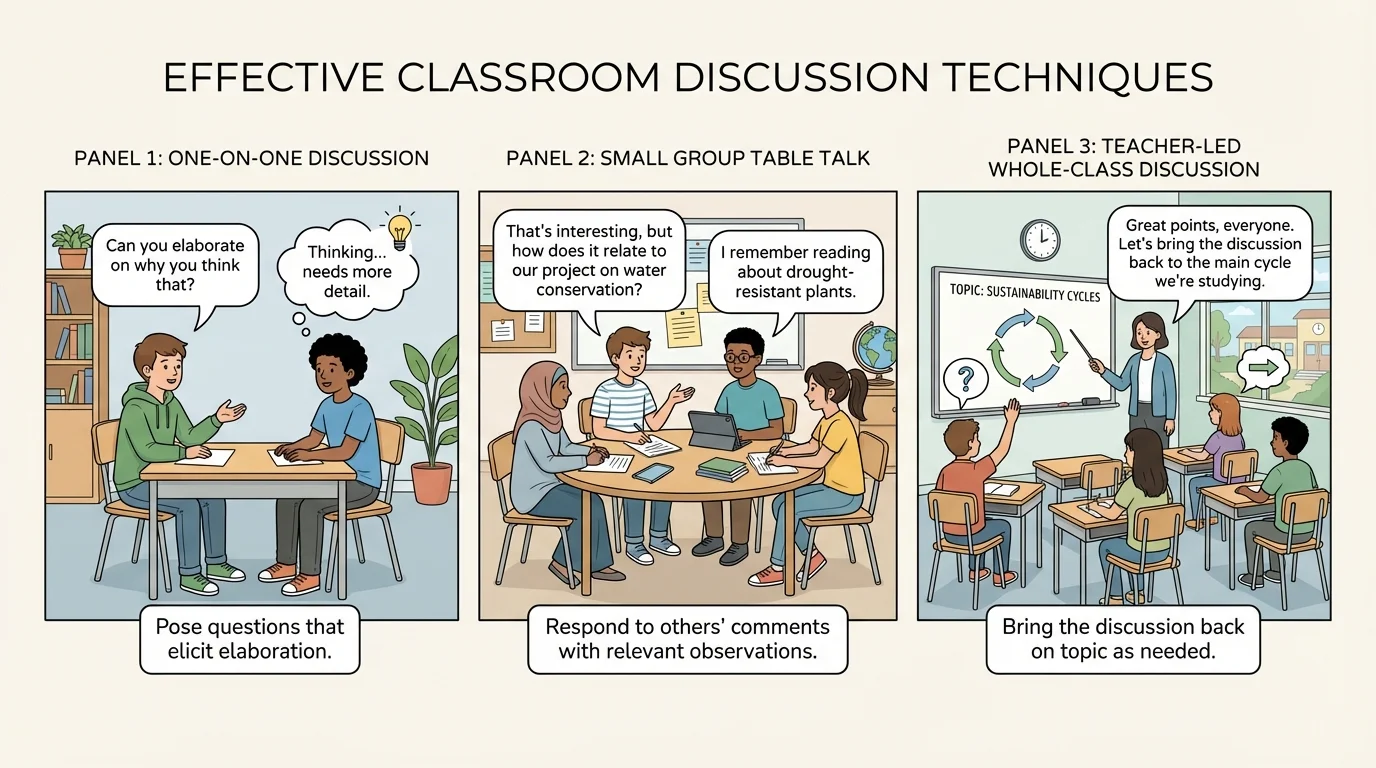
In a one-on-one discussion, you usually have more time to ask follow-up questions and explore one person's ideas in depth. This setting is great for clarifying and probing because each speaker gets more space to explain.
In a small group, students need to balance speaking and listening more carefully. It becomes important not only to contribute your own thoughts but also to invite quieter group members in. A helpful move might be, "We have heard two ideas so far. What do you think?" Small-group discussions also require stronger attention to staying on topic because more voices can lead to more drift.
In a teacher-led discussion, students often need to connect their ideas to earlier comments and to class materials more clearly. A response like "Building on Maya's point about the experiment, I think the results were affected by temperature" shows awareness of the larger conversation. The comparison shows that each setting changes the pace and structure, but not the need for clear and relevant participation.
These same skills also support formal presentations. If you present information to a class and then answer questions, you need to listen carefully, respond directly, and keep your answers tied to the topic and audience. Strong presenters do not panic when asked a question. They clarify, answer, and if needed, guide the audience back to the main point.
Good discussions do not happen by accident. They depend on habits of respect. Speakers should avoid mocking, eye-rolling, dismissive comments, and side conversations. A respectful environment makes it easier for people to share ideas honestly, especially when the topic is challenging or when opinions differ.
Wait time matters too. Some students think quickly out loud, while others need a moment to organize their thoughts. A productive discussion allows time for thinking. That pause is not a problem; it is often where the best ideas begin.
Diverse perspectives also make discussion stronger. People may notice different evidence, bring different experiences, or interpret the same event in different ways. Asking elaboration questions helps uncover those differences in a useful way. Instead of assuming one answer is enough, the group learns by examining several viewpoints carefully.
"Seek first to understand, then to be understood."
— Stephen R. Covey
When students ask thoughtful questions, answer with relevant ideas, and redirect discussion respectfully, they do more than complete a class task. They create conversations where learning actually happens.
