Have you ever been completely sure about something, then heard one detail that changed everything? Maybe you thought a rule in a sport was unfair until someone explained why it keeps players safe. Maybe you believed a character in a novel was selfish, then noticed a line that revealed a different motive. Strong thinkers do not cling to an idea just because they said it first. They listen, weigh new information, and, when the evidence is strong, they adjust. That is not weakness. It is intellectual strength.
Class discussions are not contests to see who talks the longest. Good discussions help people understand a topic better than they did before. In school, this skill matters when you talk about a science claim, a historical event, a current issue, or the meaning of a text. Outside school, it matters when you work with teammates, solve problems with friends, or decide whether something online is trustworthy.
When you can acknowledge new information, you show that you are paying attention to others and taking their ideas seriously. When you modify your view when warranted, you show good judgment. That phrase means you do not change your mind just because someone speaks loudly or confidently. You revise your thinking when there is a real reason to do so.
Acknowledge means to recognize and respond to an idea, fact, or perspective someone else has shared.
New information is a detail, explanation, example, or piece of evidence that adds to what you already know.
Modify your view means to change, refine, or partly adjust what you think based on better understanding or stronger evidence.
When warranted means when the new information is relevant, reliable, and important enough to justify a change.
These skills are part of mature communication. In a strong discussion, students do more than wait for their turn. They build on one another's ideas. They may agree, disagree, combine ideas, or revise an earlier claim into something more accurate.
To acknowledge information, you first have to show that you understood it. That often means restating the idea in your own words before reacting to it. If a classmate says, "School uniforms can reduce social pressure because students do not compare brands as much," a weak response would be, "No, uniforms are boring." A stronger response would be, "So you're saying uniforms might reduce pressure about clothing brands. I had not considered that."
Acknowledging does not automatically mean agreeing. You can recognize another person's point and still disagree with it. For example, you might say, "I understand your point that uniforms may reduce competition over clothes, but I still think they limit self-expression." That response shows listening and clear thinking at the same time.
Sometimes acknowledging new information leads to a full change of opinion. More often, it leads to a more precise opinion. Instead of moving from "I completely disagree" to "I completely agree," you might move to "I still disagree overall, but I now see one benefit." That kind of revision is often more realistic and more thoughtful.
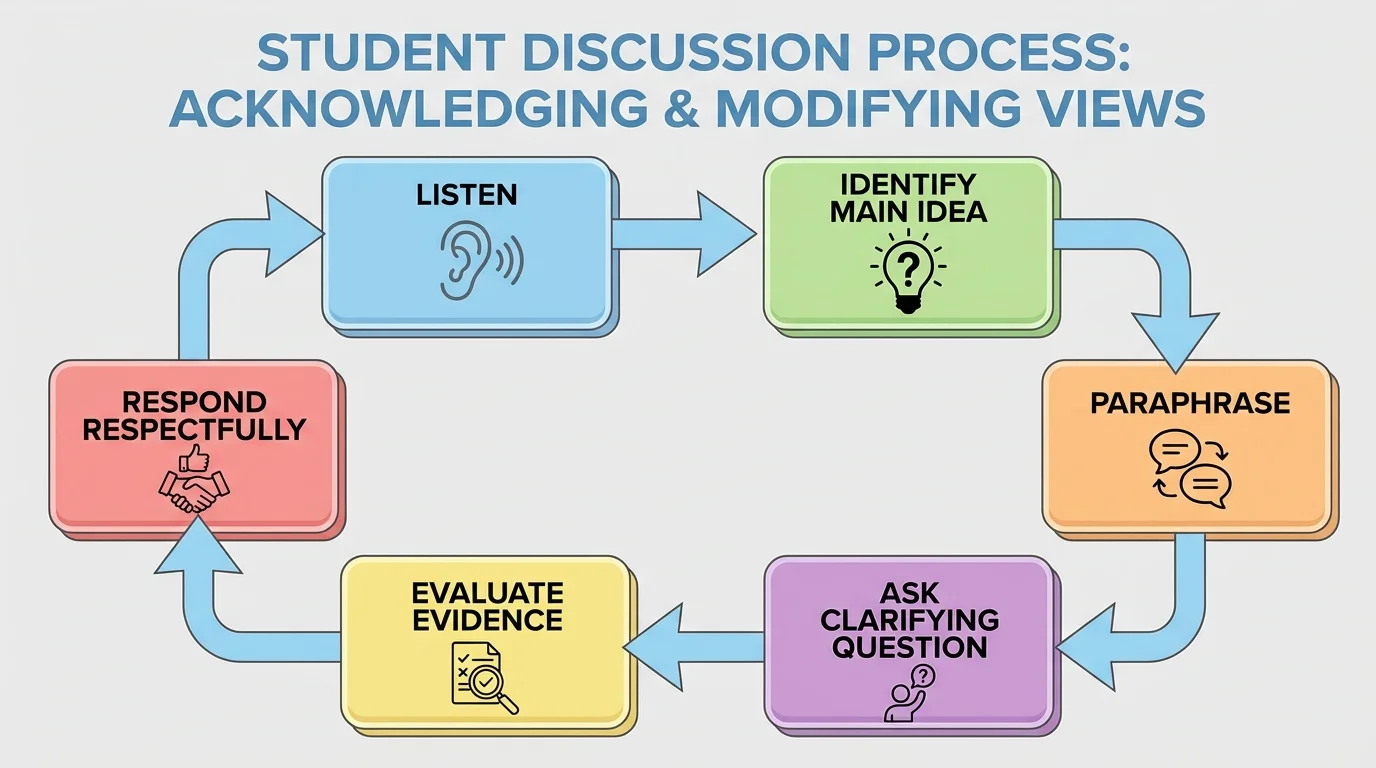
Effective active listening is the foundation of strong discussion, and [Figure 1] shows that good listeners usually move through a clear process rather than jumping straight to an answer. They hear the speaker's main idea, identify the reason or evidence, check that they understood it correctly, and only then respond.
One useful strategy is paraphrasing. Paraphrasing means saying another person's idea in your own words without changing the meaning. It helps in two ways: it proves you were listening, and it gives the speaker a chance to correct misunderstandings. A student might say, "If I understand you correctly, you think the main character lies because he is afraid, not because he is cruel."
Another strategy is asking clarifying questions. If a point is confusing, do not guess. Ask. You could say, "What evidence in the article makes you think that?" or "Can you explain what you mean by 'effective' in this situation?" Clarifying questions make discussions deeper and more accurate.
Listening also means noticing the difference between a claim and the support for that claim. A claim is what a speaker believes or argues. The support might be facts, examples, reasons, or quotations. If you only listen for the claim and ignore the support, you may miss the strongest part of the speaker's thinking.
Body language matters too. Facing the speaker, not interrupting, and showing attention with eye contact or note-taking can make a discussion more respectful and more productive. In teacher-led discussions, these habits help everyone feel heard. In small groups, they prevent conversations from turning into overlapping opinions with no real exchange.
Researchers who study communication often find that people remember conversations more accurately when they paraphrase what they heard before responding. Slowing down for a few seconds can actually make a discussion smarter.
Later in a discussion, the process in [Figure 1] still matters. If new evidence appears, strong listeners cycle back: they listen again, test the new point, and then decide whether their response should stay the same or change.
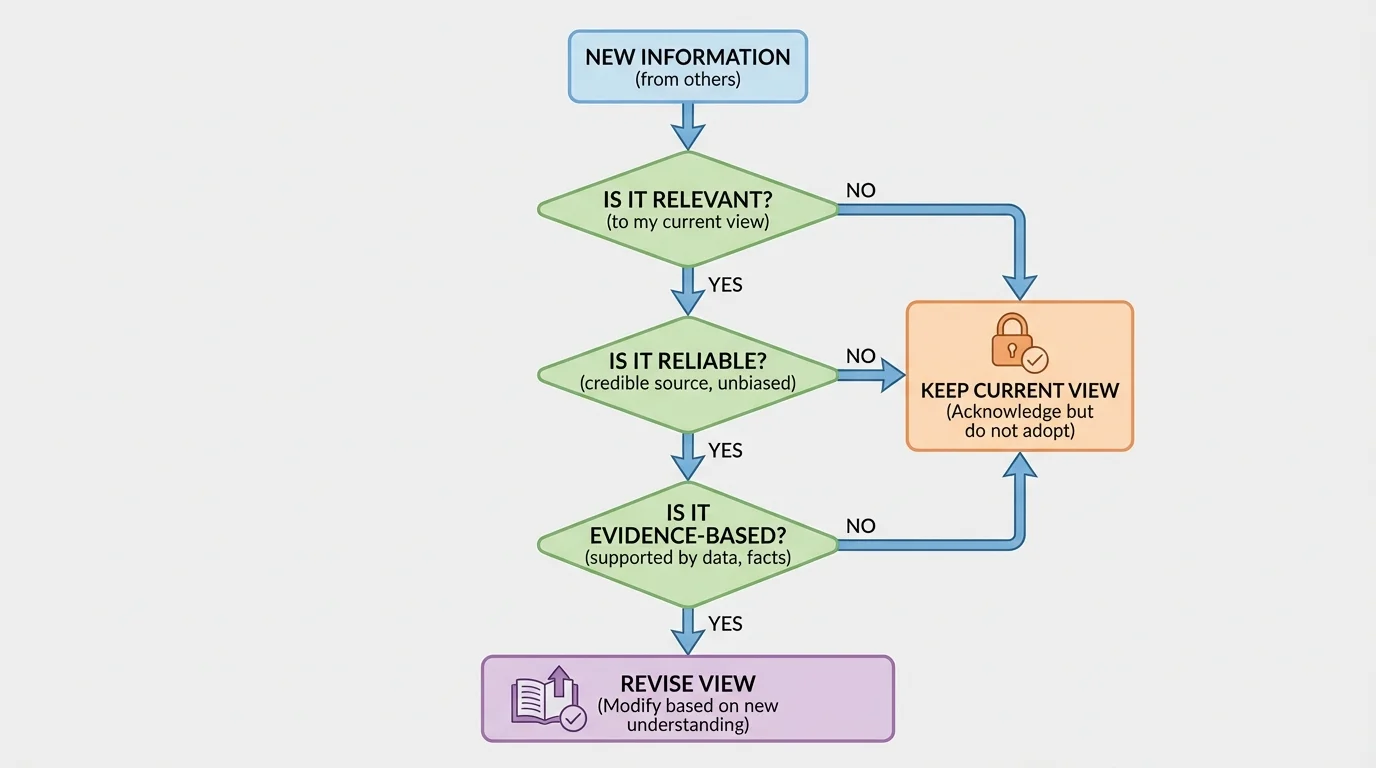
[Figure 2] Not every new detail should instantly change your opinion. Thoughtful speakers test information before revising a view, and this process can be understood as a simple decision path. You can ask four main questions: Is it relevant? Is it reliable? Is it supported? Is it strong enough to affect the original claim?
Relevance means the information actually connects to the topic. If your class is discussing whether homework improves learning, a comment about whether homework folders look neat is probably not relevant. It does not address the main issue.
Reliability means the source is trustworthy. A random social media post is not as reliable as a well-researched article, a textbook, a direct observation, or data collected carefully. In discussion, students should learn to notice where information comes from, not just what it says.
Evidence is the support behind a claim. One personal story can be interesting, but several examples, facts from a text, or data from an experiment are usually stronger. If someone presents better evidence than what you used before, that may be a reason to revise your view.
Fairness also matters. Are you giving the same careful attention to another person's evidence that you give to your own? Sometimes people reject strong information because they do not like what it suggests. That is not critical thinking. It is bias.
A view can change in different ways. You might completely change your mind. You might partly change it. You might keep your original position but improve it with a new exception. For example, "I still think phones should usually be off during class, but I now think there should be exceptions for learning apps during teacher-approved activities."
Revision is not the same as surrender. Revising a view means your thinking becomes more accurate after you consider stronger ideas or evidence. It is a sign that your goal is understanding, not just winning. Good discussants are flexible with their opinions but firm about using reasons and evidence.
When students return to the decision process shown in [Figure 2], they avoid two extremes: changing their minds too quickly and refusing to change at all. The strongest position is usually the most carefully tested one.
Students often know what they think but are not sure how to say it politely. Respectful language helps you acknowledge another person's idea while still speaking clearly. Sentence frames can help, especially during formal presentations, seminars, and group work.
Here are several useful discussion moves:
These responses do two important things: they show respect for the other speaker, and they make your own thinking visible. Instead of simply saying "okay" or "you're wrong," you explain how the new information affected your reasoning.
This matters in different kinds of discussions. In a one-on-one conversation, these phrases prevent arguments from becoming personal. In small groups, they help everyone follow how ideas are changing. In teacher-led discussions, they show the class how to connect speaking and listening in a meaningful way.
"Wise people change their minds when they have a good reason."
— Discussion principle
Respectful language does not make your thinking weaker. It makes it clearer. A strong speaker can disagree without being rude and can change course without sounding unsure.
Some students worry that changing their mind makes them seem weak or unprepared. In reality, refusing to learn from others is what weakens a discussion. Confidence is not pretending you know everything. Confidence is being able to say, "Here is what I thought before, here is what I learned, and here is how my view changed."
This kind of change often leads to nuance, which means a more detailed and precise understanding. A nuanced opinion is often better than a simple one. Instead of saying, "Group projects are bad," you might say, "Group projects can be effective when roles are clear, but they can feel unfair when one student does most of the work."
Notice how that second statement is more useful. It does not erase your concern. It improves it. Many important issues are not solved by simple yes-or-no answers. Mature discussion allows room for complexity.
Earlier speaking and listening skills still matter here: make eye contact, wait for your turn, speak clearly, use evidence from texts or observations, and stay focused on the topic. Revising your thinking works best when these basics are already strong.
You can also revise in stages. First, you may acknowledge a point. Next, you may admit that it weakens part of your argument. Finally, you may develop a new position that includes both your original thinking and the new information. That is growth in action.
One common mistake is interrupting before the other person finishes. When you interrupt, you often respond to an incomplete idea. Another mistake is pretending to listen while planning your next reply. That usually leads to repeating your own point instead of building on the discussion.
A third mistake is bias, especially the kind that makes you trust information that supports your view and ignore information that challenges it. Everyone has some bias, so the goal is not perfection. The goal is to notice it and keep it from controlling your judgment.
Some students make the opposite mistake: they agree too quickly just to avoid conflict. Real discussion is not fake agreement. If the new information is weak, unclear, or unrelated, you do not need to change your view. You can respectfully say, "I see your point, but I do not think that evidence is strong enough to change my position."
Another mistake is changing your claim without explaining why. If your view shifts, say what caused the shift. That helps listeners follow your reasoning and learn from it.
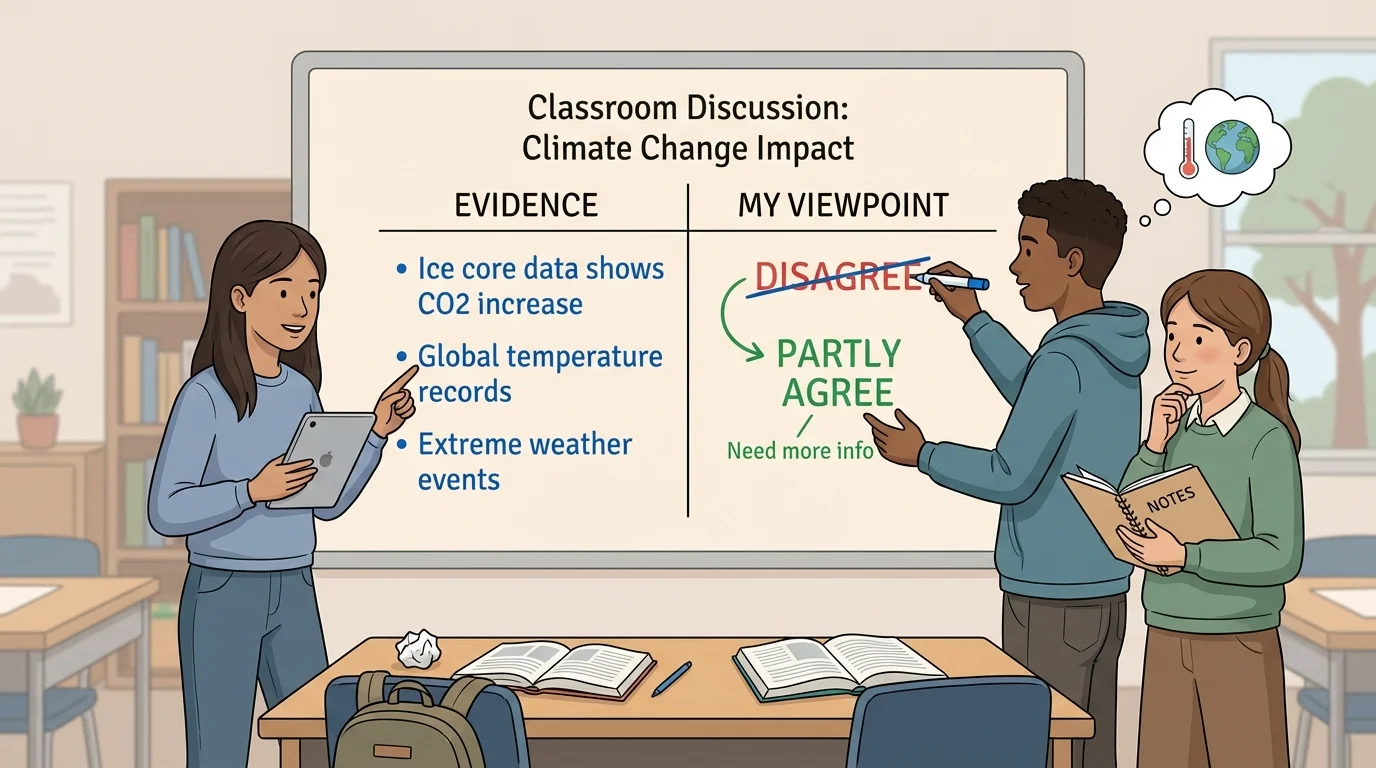
[Figure 3] Discussion becomes more powerful when you can see it in action. This section illustrates a classroom moment in which a student moves from a simple opinion to a more thoughtful one after hearing others speak. These examples show that revising a view is a normal part of strong collaboration.
Suppose a class is discussing whether a city should build more bike lanes. One student begins by saying bike lanes are unnecessary because not enough people bike to school. Then another student shares local safety data and points out that more protected lanes often lead to more riders because people feel safer. A thoughtful response might be: "I started out thinking bike lanes were not needed, but the safety information changes my view. I still think cost matters, yet I now support adding lanes in high-traffic areas."
In literature, a student may first argue that a character is dishonest and selfish. During discussion, a classmate points to scenes showing the character is hiding the truth to protect someone. The first student might then say, "I still think the character made a wrong choice, but I now think fear and loyalty influenced that choice." That is not giving up an argument. It is strengthening it.
In science, a group may predict that a plant near a window grows best simply because it is tallest. Another student notices that the tallest plant is also leaning sharply and has weaker leaves. After measuring and comparing all the plants, the group changes its claim to focus on healthy growth, not just height. That is a better conclusion because it uses better evidence.
Case study: revising a claim in discussion
A student begins with the claim, "Later school start times are a bad idea because they would make sports end too late." During discussion, classmates add information about sleep, learning, and scheduling.
Step 1: State the original view clearly.
The student identifies the first concern: after-school activities might run later.
Step 2: Listen to new information.
Other students cite research about teen sleep and mention districts that adjusted activity schedules successfully.
Step 3: Weigh the new evidence.
The student decides the new information is relevant and stronger than the original assumption.
Step 4: Revise the claim.
The student responds, "I still think scheduling could be difficult, but I no longer think later start times are simply a bad idea. The sleep evidence makes me think they may help students if schools plan carefully."
The revised claim is more balanced, more informed, and more credible.
Online discussions make this skill even more important. People often react quickly without verifying information or evaluating the reliability of sources. A thoughtful digital citizen pauses, checks whether a post is accurate, and is willing to say, "I shared that idea too quickly. After reading more, I think the situation is more complicated."
Later, when students think back to the classroom scene in [Figure 3], they can see that the real success is not who spoke first. The success is that the group reached a stronger, more informed understanding together.
Students who do this well tend to have a few habits in common. They listen all the way through. They ask for evidence. They refer to what others said accurately. They stay open to being surprised. They use respectful language even when disagreement is strong.
They also know that discussion is a shared task. Your job is not only to express your own ideas clearly, but also to help the group think better. Sometimes that means offering a new point. Sometimes it means asking a question that helps someone else explain more clearly. Sometimes it means admitting that another person's idea improved your own.
That is one of the most powerful communication skills you can build in middle school. It helps in speaking, listening, reading, writing, teamwork, and decision-making. More importantly, it helps you become the kind of person who values truth over pride and understanding over stubbornness.
