A detective does not solve a case by saying, "I just have a feeling." A detective points to clues. Strong readers do the same thing. When you make a statement about a story, poem, or drama, you need proof from the text. That proof is called textual evidence. The best analysis does more than repeat the story. It shows exactly how the words on the page support an idea.
Textual evidence matters because different readers may notice different things. If two students disagree about why a character made a choice, the text becomes the shared source of proof. By returning to the author's words, readers can test ideas, compare interpretations, and build stronger understanding.
When you analyze literature, you are not only answering "what happened?" You are also answering "why does it matter?" and "what does it show?" Evidence helps you move from opinion to analysis. Saying "The main character is brave" is only a claim. Saying "The main character is brave because she returns to the burning house to help her brother, even though the narrator says her hands are shaking" is analysis supported by evidence.
Explicit means stated clearly and directly in the text.
Inference is a conclusion a reader makes by combining text clues with thinking.
Analysis is close thinking about how details in a text create meaning.
Readers in middle school are expected to use several pieces of evidence, not just one. One detail can be useful, but several details usually create a more convincing explanation. This is especially important when a text is complex or when a character develops over time.
Sometimes the author tells you something directly. A narrator may state that a character is exhausted. A poem may name the season as winter. A drama may include stage directions showing that a speaker whispers. These are explicit details. A careful reader notices them first, because they provide a solid base for interpretation. As [Figure 1] shows, readers can separate what the text directly states from what they conclude from clues.
Look at this short passage: Marcus dropped his backpack by the door and stared at the unopened science fair poster. "Tomorrow," he muttered, walking straight past it to his room. An explicit detail is that Marcus leaves the poster unopened. The text directly says that he does not work on it right away.
Another explicit detail is that he says, "Tomorrow." The author gives his exact words. These details are not guesses. They are plainly written in the passage.
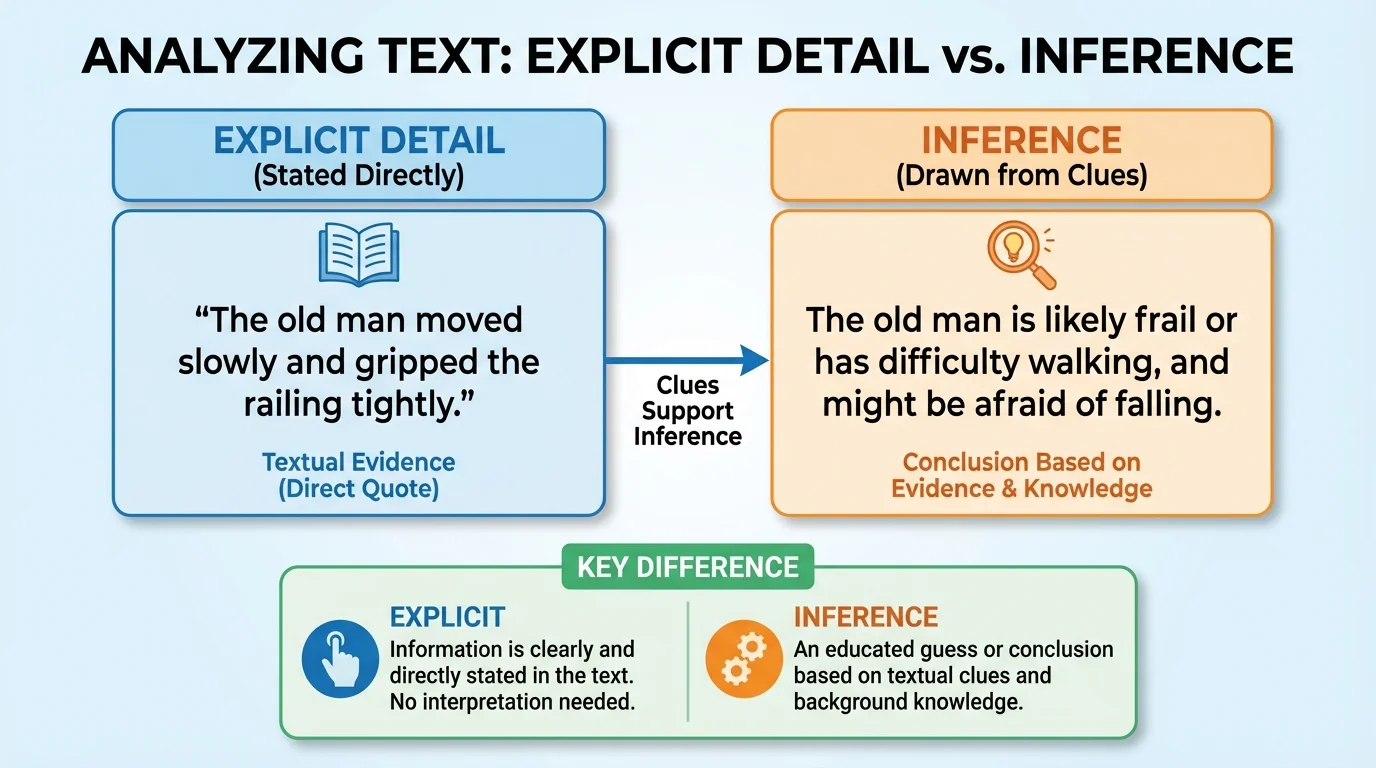
Now move one step deeper. The passage does not directly say, "Marcus is avoiding his project," but a reader can infer it. Why? He stares at the poster, mutters "Tomorrow," and walks away. Those clues suggest procrastination, stress, or lack of motivation. An inference is not a random guess. It must grow out of evidence in the text.
Readers often use a simple thinking pattern: text clues + reasoning = inference. If a character avoids eye contact, answers with one-word replies, and leaves the room quickly, you may infer that the character is upset, nervous, or hiding something. The exact inference depends on the context, which is why multiple pieces of evidence matter.
Good readers also know that more than one inference can be reasonable at first. Then they compare the possibilities with the text. If later details reveal that Marcus forgot the project deadline, the better inference may be that he is overwhelmed. If later details show he goes outside to play basketball for hours, the stronger inference may be that he is avoiding responsibility.
Explicit meaning and inferred meaning work together. Strong analysis usually begins with explicit details and then explains what those details suggest. The text gives the clues; the reader connects them. If your inference cannot be traced back to clear words, actions, images, or events in the text, it is probably too weak.
This is why evidence-based reading feels a little like solving a puzzle. You look at what is there, notice patterns, and support your thinking with details. In stories, small clues often reveal big ideas about character, conflict, and theme.
Not every detail is equally useful. Strong evidence is relevant, specific, and sufficient. Relevant evidence connects directly to your point. Specific evidence points to exact words, actions, or descriptions. Sufficient evidence means you have enough proof to support your idea.
Evidence can appear in different forms. You might use a short quotation, a paraphrase, or a summary of a small but important moment. A quotation repeats the author's exact words. A paraphrase restates the idea in your own words. Both can be effective when used accurately.
Suppose you are analyzing whether a character feels isolated. Strong evidence might include that the character eats lunch alone, watches other students laughing from across the room, and thinks, "Their jokes belonged to a world with a locked door." Those details all connect to the same idea. A weak detail would be something unrelated, like the color of the character's shoes, unless that color somehow matters to the analysis.
| Type of evidence | What it does | Example use |
|---|---|---|
| Direct quotation | Uses the author's exact words | Shows precise language or tone |
| Paraphrase | Restates a detail in your own words | Explains an event clearly and briefly |
| Specific summary | Condenses a key moment | Connects several events to one claim |
Table 1. Common types of textual evidence and how each supports analysis.
The word relevant is important here. Relevant evidence fits your claim. If your point is about theme, choose details that reveal a message or lesson. If your point is about mood, choose words and images that create a feeling.
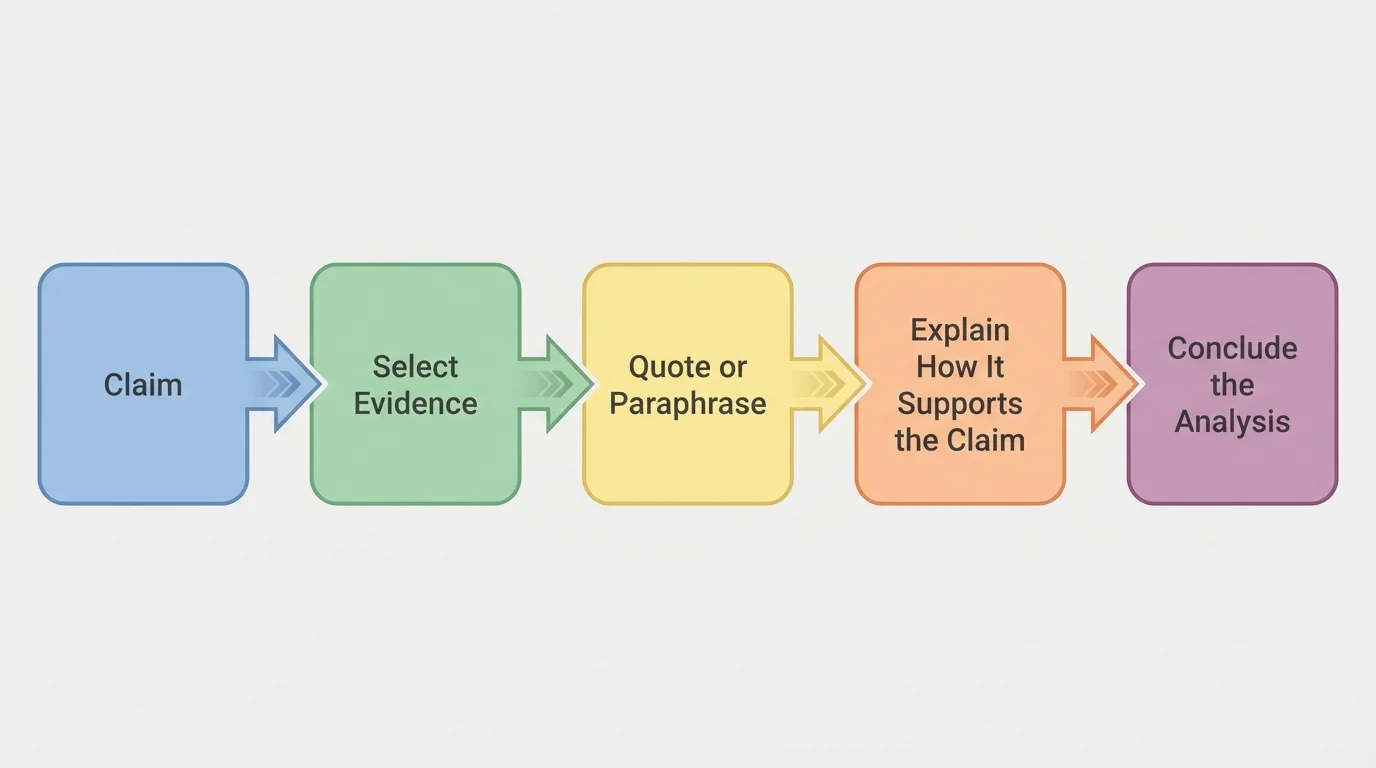
Strong analysis usually follows a clear pattern. As [Figure 2] illustrates, a reader makes a claim, presents evidence, and explains how the evidence supports the claim. Many students stop too early. They give a quotation and assume it speaks for itself. But quotations need explanation.
A useful structure is claim → evidence → reasoning. The claim is your main idea. The evidence is the proof from the text. The reasoning explains how the proof supports the idea. Without reasoning, the reader has to guess why the evidence matters.
For example, a student might write: Nina feels guilty after the argument. After her brother leaves, she "scrubbed the already clean counter until her fingers ached" and avoids looking at his empty chair. These details suggest guilt because her repeated cleaning shows nervous energy, and the empty chair reminds her of the person she hurt. Notice that the evidence is followed by interpretation.
You do not always need a long quotation. In fact, shorter quotations are often stronger because they keep the focus on your explanation. Choose the exact words that matter most, then connect them to your thinking.
Modeled analysis of a short passage
Passage: The rain had stopped, but Elena stayed under the awning, turning the house key over and over in her palm.
Step 1: Make a claim.
Elena is anxious about going inside.
Step 2: Choose evidence.
She stays under the awning even though the rain is over, and she keeps turning the key in her palm.
Step 3: Explain the evidence.
Because she no longer needs shelter from the rain, her choice to remain outside suggests hesitation. Repeatedly turning the key shows nervousness and delay.
The evidence supports the inference that Elena is emotionally uneasy, not simply waiting for the weather to change.
When you write about a longer text, you may need to gather evidence from different parts of the story. One quotation from the beginning, one event from the middle, and one line from the end can reveal how a character changes.
The standard asks for several pieces of textual evidence because complex ideas usually need more than one proof. If you claim that a character matures, show the beginning, middle, and end of that journey. If you claim that a theme develops over time, trace it through repeated images, choices, or conflicts.
Suppose you are reading a story about a boy named Devon who dislikes helping at his family's restaurant. Early in the story, he complains that serving customers is embarrassing. In the middle, he notices how hard his grandmother works without resting. At the end, he arrives early to set tables before anyone asks. One detail alone might not prove growth, but together the details show a clear change.
This kind of evidence is especially powerful because it shows a pattern. Literature often creates meaning through repetition, contrast, and development over time. The more clearly you can trace those patterns, the stronger your analysis becomes.
Professional critics and historians also rely on evidence. Whether they are studying a novel, a speech, or a diary, they support their ideas by pointing to specific details rather than personal opinion alone.
Several pieces of evidence can also help you test your own interpretation. If one detail supports your idea but three others do not, you may need to revise your thinking. Good readers are flexible. They let the text guide the interpretation.
Evidence becomes even more meaningful when you connect it to literary elements. These are the parts that make up a literary work, such as character, setting, plot, conflict, mood, and theme. As [Figure 3] shows, one detail can affect several elements at once. A stormy setting, for example, may shape the mood, increase the conflict, and reflect a character's emotions.
Consider this line: The porch light flickered over the flooded yard as Mrs. Alvarez folded the eviction notice into a perfect square. This detail tells us about setting because the yard is flooded. It also develops conflict because the eviction notice suggests a serious problem. It may also build mood by creating tension and unease. Strong analysis notices these connections.
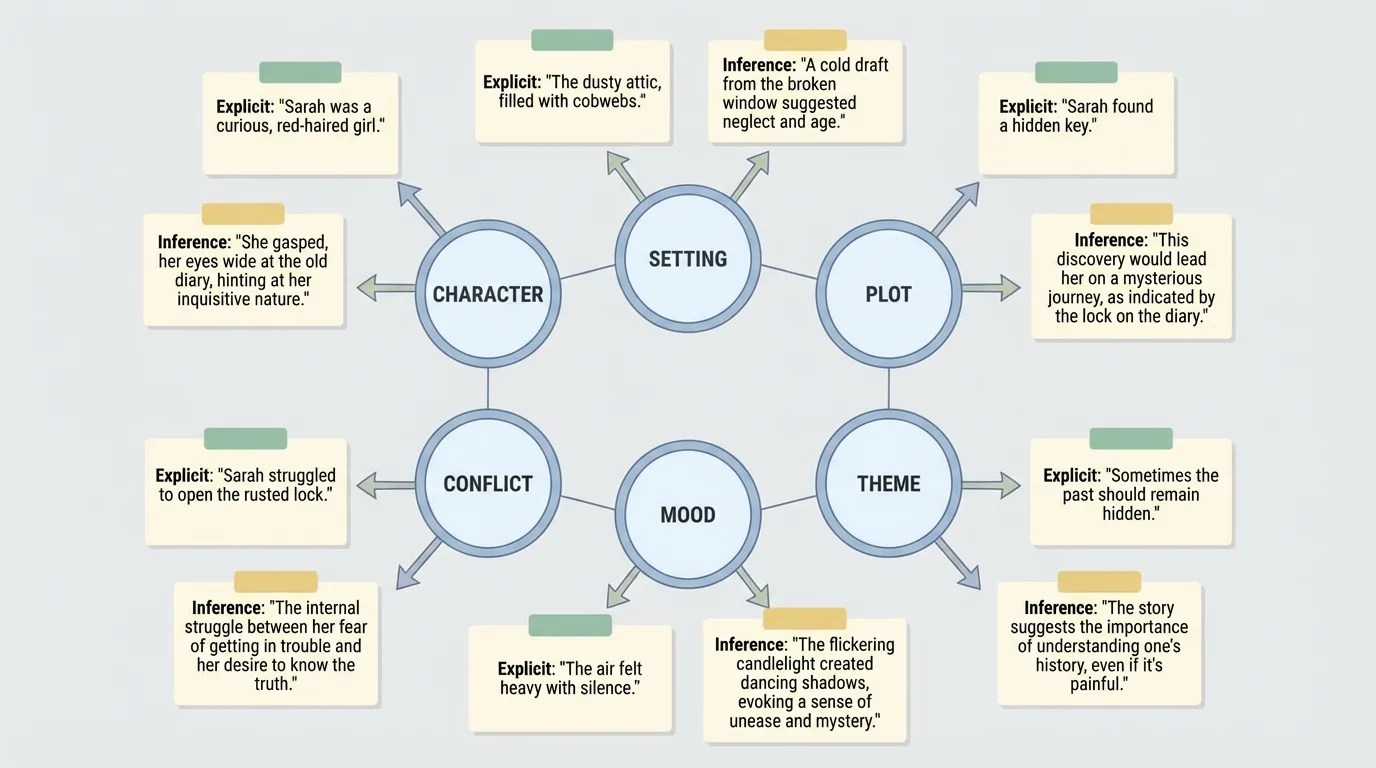
Character analysis often depends on actions, dialogue, and thoughts. Setting analysis may use sensory descriptions, weather, time period, or place. Theme analysis often requires several details spread across the whole text, because a theme usually develops gradually rather than appearing in one single line.
Later in your reading, the visual pattern from [Figure 3] still applies: the same piece of evidence may help explain more than one idea. If a character tears up a winning ticket, that action could reveal personality, develop conflict, and support a theme about guilt or sacrifice.
From earlier reading work, remember that theme is not just one word like "friendship" or "courage." A theme is a message or insight about life, such as "Courage often means acting despite fear." Evidence should support that fuller idea.
When analyzing a poem, evidence may look different from evidence in a story. You might focus on repeated images, line breaks, word choice, or figurative language. In drama, you may also use dialogue and stage directions. The kind of text changes the kind of evidence you notice, but the basic job stays the same: use details from the text to prove your thinking.
One common mistake is giving a personal reaction instead of an analysis. Saying "I liked this part because it was sad" does not explain how the text creates sadness. A stronger statement would identify words, images, or events that build the mood.
Another mistake is using evidence that is too vague. Writing "the author shows this many times" is not enough. Which times? Which words? Which actions? Specificity matters. Instead of saying "the character is nice," point to exact moments: she shares her food, stays after school to help, and defends a classmate.
A third mistake is dropping in a quotation without context or explanation. Readers need to know who is speaking, what is happening, and why the line matters. Evidence should fit smoothly into your own sentence and be followed by reasoning.
Finally, avoid over-summary. Summary tells what happened. Analysis explains why it matters. A little summary may be necessary to set up evidence, but the main focus should be interpretation.
Strong evidence is not the same as a long quotation. A long passage can actually weaken analysis if it includes extra information you do not discuss. Choose the most useful part, then explain it carefully. Precision is stronger than length.
When you revise your writing, ask yourself three questions: What is my claim? What exact evidence supports it? Have I explained how the evidence proves my point? If any answer is unclear, your analysis can be stronger.
Here is a short literary passage: By the time the last bus left, Jamal was still on the bench outside school, pretending to tie his shoe each time a teacher passed. The sky darkened. In his pocket, his phone buzzed twice, then went silent.
A possible analysis is that Jamal is avoiding going home. Several pieces of evidence support this inference. First, he remains at school after the last bus leaves, which suggests he has no urgency to leave. Second, he pretends to tie his shoe whenever a teacher passes, showing that he wants an excuse to stay without answering questions. Third, the phone buzzes twice and then stops, hinting that someone may be trying to reach him, but he does not respond. Together, these details suggest avoidance and anxiety.
Notice that the passage never directly says, "Jamal fears going home." That idea is inferred from multiple clues. This makes the interpretation stronger than a simple guess because each clue points in the same direction.
Comparing weak and strong analysis
Weak: Jamal does not want to go home. This is obvious from the passage.
Step 1: Identify the problem.
The claim is not supported by specific evidence, and the word obvious does not explain anything.
Step 2: Strengthen with evidence.
Jamal stays after the last bus leaves, pretends to tie his shoe when teachers pass, and ignores the buzzing phone in his pocket.
Step 3: Add reasoning.
These actions suggest he is delaying his departure and does not want adults to question him, which supports the inference that he is uneasy about going home.
Strong: Jamal appears anxious about going home because he stays after the last bus leaves, fakes tying his shoe to avoid attention, and does not answer the calls reaching his phone.
Try another example. Passage: Grandfather polished the old trumpet every Sunday, though he had not played in years. When Lina asked why he kept it, he smiled and said, "Some promises shine longer than music."
An analysis might state that the trumpet symbolizes memory and loyalty. The evidence includes the weekly polishing, the fact that he no longer plays, and his statement about promises. These details suggest the object matters for emotional reasons, not practical ones. The text explicitly says he polishes the trumpet and has not played in years. A reader infers that the instrument is connected to an important promise or relationship.
As you saw earlier in [Figure 1], the strongest interpretations begin with direct details and move toward supported inference. And the step-by-step pattern from [Figure 2] still guides the writing: claim, evidence, reasoning.
Careful reading is powerful because it teaches you to notice, connect, and prove. Whether you are discussing a poem's mood, a character's motivation, or a story's theme, the key is the same: return to the text and let the evidence do the work.
