Two news articles can describe the same event, use some of the same facts, and still leave readers with very different ideas. One article might make the event sound hopeful. Another might make it sound dangerous or unfair. That difference does not happen by accident. Authors shape what readers notice by choosing which facts to include, which details to highlight, and what those facts seem to mean.
When two authors write about the same topic, they are not just copying facts onto a page. They are making decisions. They choose where to begin, what background information to include, which examples matter most, and what conclusion readers are likely to draw. Even when authors try to be accurate, their writing can still feel different because they organize and explain information in different ways.
A topic is the subject both texts discuss. For example, two texts may both be about recycling, space exploration, social media, or changes in school schedules. But the shared topic does not guarantee a shared message. One author may focus on benefits, while another focuses on costs, risks, or unanswered questions.
Readers need to move beyond saying, "These texts are both about the same thing." Strong readers ask deeper questions: What does each author want me to understand? What evidence does each author use? What facts are emphasized? What facts are left in the background? Does one author explain the facts differently from the other?
Evidence is the information an author uses to support a point. Evidence can include facts, statistics, examples, quotations, observations, or results from studies.
Interpretation is the meaning or explanation an author gives to facts. Two authors may agree on the facts but disagree on what those facts show.
Claim is the main point or position an author is trying to support.
These ideas matter in school and in everyday life. People compare sources when they read about health advice, sports debates, environmental issues, technology, and current events. Learning to compare authors helps you become a more thoughtful reader who notices not only what is said, but also how it is presented.
One important idea is the central idea. In an informational text, the central idea is the main understanding the author wants the reader to carry away. Two texts can share a topic but have different central ideas. A text about video games might argue that they improve problem-solving skills, while another argues that too much gaming can harm sleep and focus.
Another important idea is author's purpose. An author may want to inform, warn, persuade, explain, or encourage action. Purpose affects presentation. If an author wants to persuade readers, the author may choose evidence that strongly supports one side. If an author wants mainly to explain, the author may include a wider range of details and viewpoints.
You should also notice emphasis, which means the ideas or details an author gives the most attention. Emphasis can appear through repeated points, strong examples, dramatic word choice, placement in the introduction or conclusion, and the amount of space given to one detail instead of another.
Finally, readers should pay attention to point of view. In informational writing, point of view is not just about first person or third person. It is also about the angle from which the topic is presented. A scientist, a business owner, a student, and a community leader may all write about the same issue from different positions and concerns.
A single fact can sound very different depending on context. Saying that a city planted 10,000 trees sounds impressive, but if the city cut down 12,000 old trees first, the same topic takes on a different meaning.
That is why comparing texts is not only about collecting matching facts. It is about seeing how choices in selection and explanation shape understanding.
Authors often shape readers' understanding by selecting different kinds of evidence, as [Figure 1] illustrates. One author may rely on statistics and expert studies. Another may rely on personal stories, interviews, or historical examples. Both kinds of evidence can be useful, but they do not affect readers in exactly the same way.
Suppose two authors write about whether students should have less homework. Author A includes survey results, sleep data, and research about stress. Author B includes stories from students who learned discipline and time management because of homework. The topic is the same, but the authors spotlight different evidence. Because of that, readers may come away with different impressions.
Authors also differ in how much space they give certain facts. If a writer spends three paragraphs on benefits and one sentence on drawbacks, that author is signaling what seems most important. This is part of emphasis. The facts may all be true, but their arrangement affects the message.
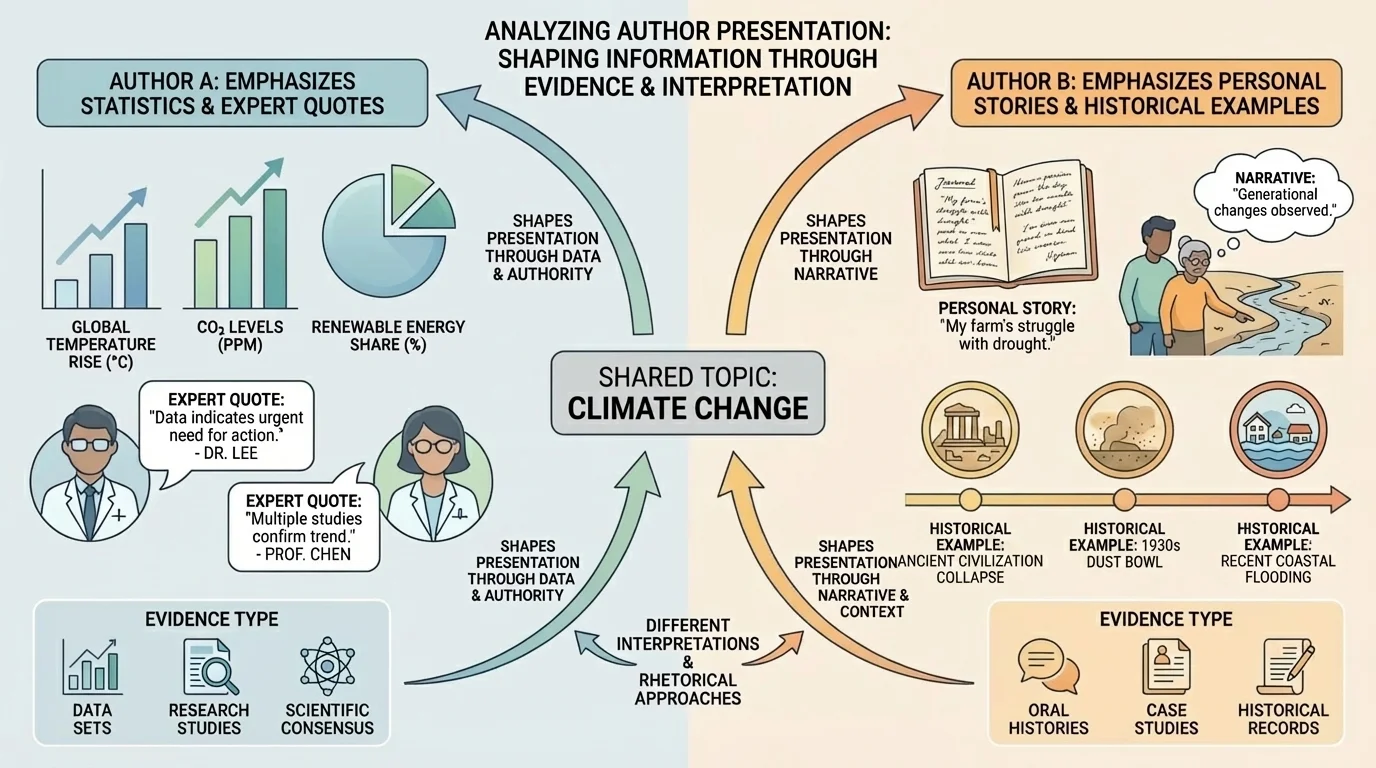
Another way authors shape presentation is by choosing vivid or emotionally powerful details. A statistic may appeal to logic, while a personal story may create sympathy. For example, in an article about severe weather, one author might focus on yearly storm data. Another might open with the story of one family whose home was damaged. Both present information, but they lead readers into the topic differently.
This does not mean one author is automatically wrong. It means readers must ask whether the chosen evidence is relevant, sufficient, and balanced. A text with only emotional stories may feel powerful but leave out important larger patterns. A text with only numbers may be informative but may not show how people are affected in real life.
Sometimes authors use many of the same facts but explain them in different ways. That is where interpretation becomes especially important. Facts do not always speak for themselves. Authors connect facts to ideas, causes, consequences, and judgments.
For example, imagine that both authors report that teen use of a certain app increased by 40 percent in one year. One author may interpret that as proof that the app is useful and widely trusted. Another may interpret the same number as a sign that screen time is becoming too dominant in daily life. The fact is the same. The meaning attached to it is different.
Interpretation also appears when authors explain cause and effect. If test scores rise after a new school program begins, one author may say the program caused the improvement. Another may argue that the rise happened because of several factors, such as more tutoring, smaller class sizes, or changes in the test itself. Careful readers notice when authors move from facts to conclusions.
Facts and meanings are not always the same thing. A fact is something that can be checked. An interpretation is the explanation built from those facts. Readers should ask, "What is the fact?" and then, "What does the author say this fact means?"
Good comparison involves separating the evidence from the interpretation. If students mix them together, it becomes harder to understand where the authors truly differ.
A clear process makes comparison easier, and [Figure 2] shows a useful sequence. First, identify the shared topic. Then find each author's claim or central idea. Next, list the evidence each author uses. After that, notice what each author emphasizes, what each author leaves out, and how each author interprets the facts.
You can also ask a set of guiding questions. What details appear in both texts? Which details appear in only one text? Does one author sound more certain? Does one author include counterarguments or opposing views? Does one author use stronger language to push readers toward a conclusion?
Comparison works best when you stay organized. Many readers use notes, a chart, or a table. The goal is not just to collect differences but to explain why those differences matter. If one author leaves out key information, that affects trust. If one author uses stronger and more relevant evidence, that affects how convincing the text is.
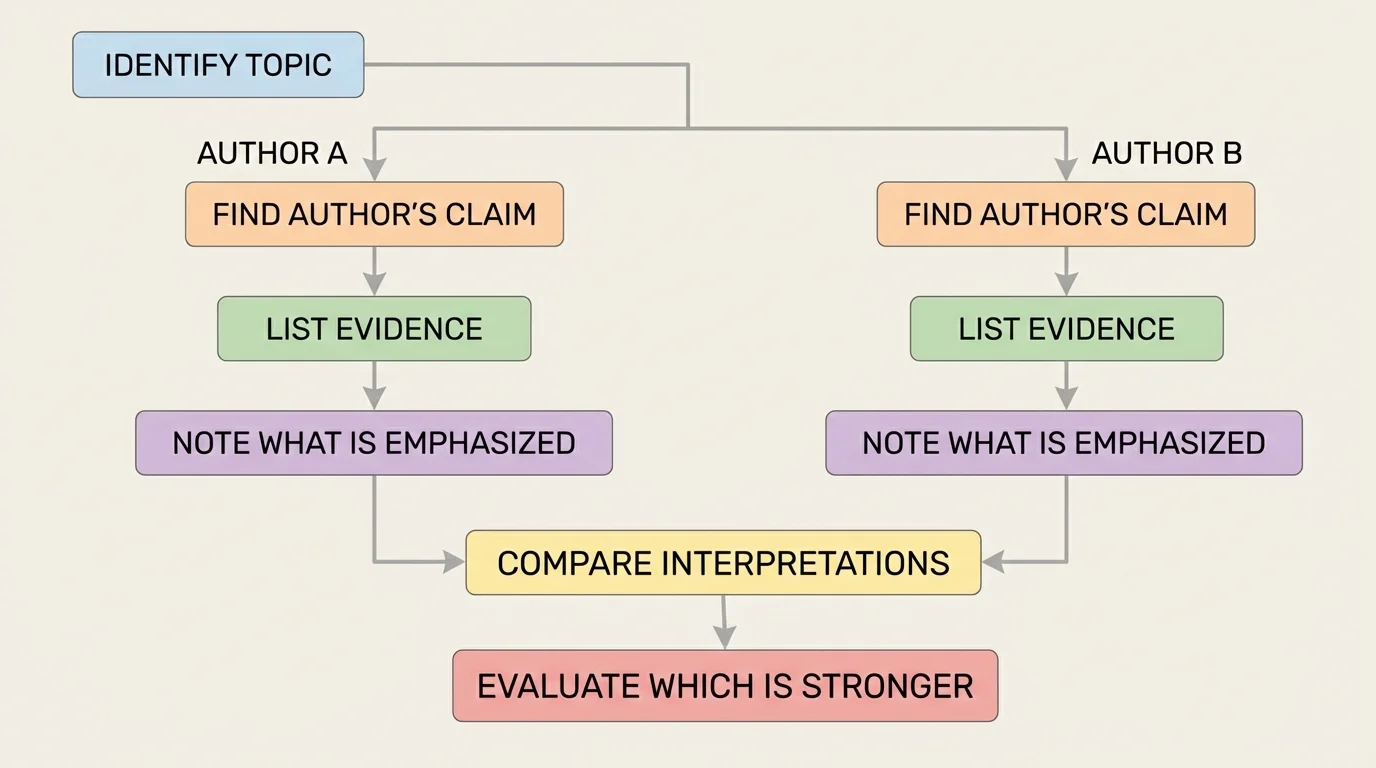
A helpful sentence frame is: "Both authors discuss ___, but Author A emphasizes ___ while Author B emphasizes ___." Another useful frame is: "Although both texts include the fact that ___, Author A interprets it as ___, whereas Author B interprets it as ___." These structures help you move from simple summary to real analysis.
As you compare, be careful not to confuse style with strength. A dramatic voice does not automatically make a text more reliable. A calm tone does not automatically make a text more complete. The strongest judgments come from examining evidence, explanation, and fairness.
Consider two articles about whether middle schools should start later in the morning. A side-by-side comparison makes the differences easier to see. Both authors discuss sleep, learning, and school schedules, but they shape the topic differently.
Author A argues that schools should begin later because students' bodies naturally need more sleep during adolescence. This author cites sleep researchers, data on attention during early classes, and studies connecting sleep to mood and memory. The article emphasizes health and learning.
Author B argues that later start times create transportation problems, interfere with after-school sports, and make family schedules harder to manage. This author includes interviews with bus coordinators, coaches, and parents. The article emphasizes logistics, cost, and community routines.
Notice that both articles may include the fact that teenagers often do not get enough sleep. But Author A interprets that fact as a strong reason to change the school day, while Author B treats it as only one factor among many. This is not just a difference in facts. It is a difference in importance and interpretation.
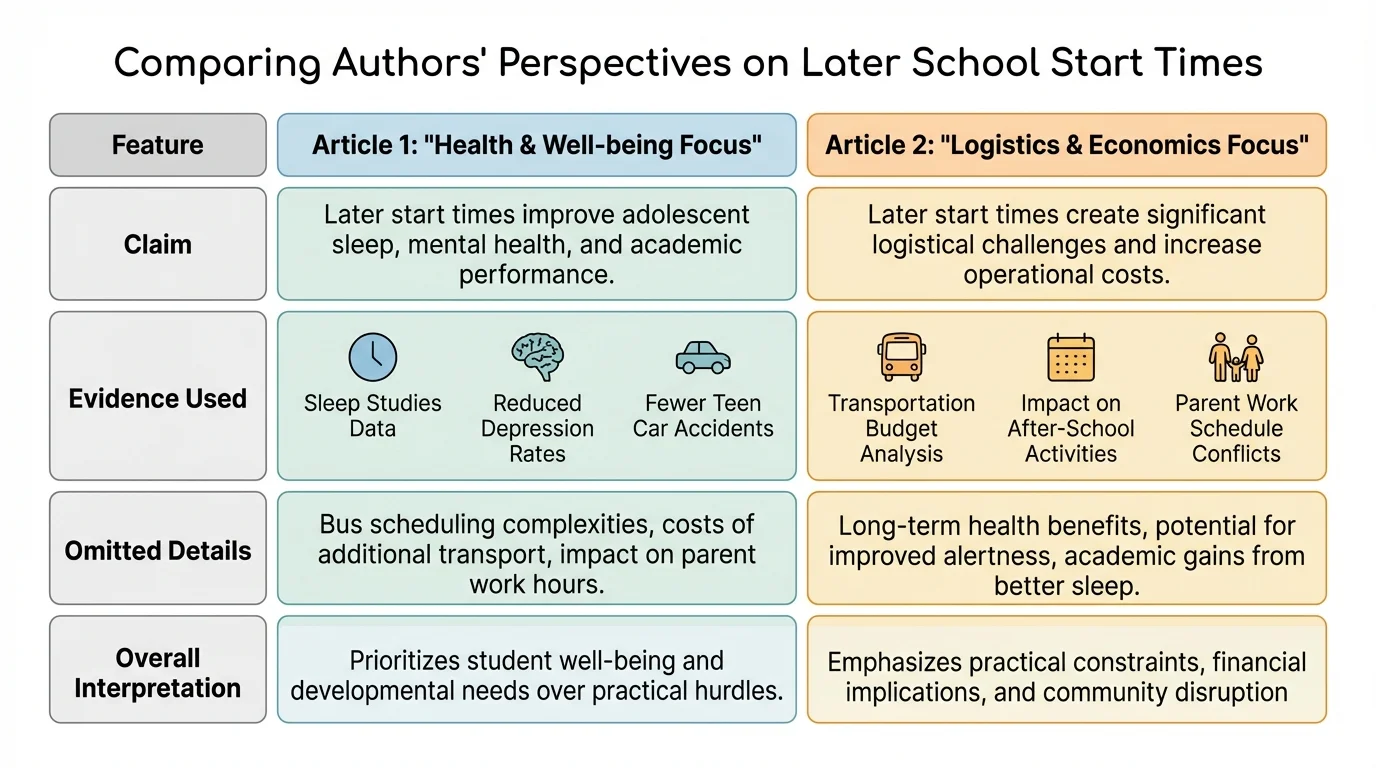
Now think about what each author leaves in the background. Author A may spend little time discussing bus schedules or sports. Author B may spend little time discussing the science of adolescent sleep. The omission does not always prove bias, but it can make one side of the issue seem stronger than it would if more information were included.
If you were evaluating which article is stronger, you would ask: Which author uses more relevant evidence? Which article addresses the opposing view more fully? Which interpretation seems better supported? Looking back at the side-by-side features in [Figure 3], you can see that strength depends on more than simply having a clear opinion.
Case study: comparing the two school start time articles
Step 1: Identify the shared topic.
Both texts focus on whether schools should start later.
Step 2: State each author's claim.
Author A supports later start times for health and learning. Author B warns that later start times create practical problems.
Step 3: Compare evidence.
Author A uses scientific studies and student performance data. Author B uses interviews and scheduling details.
Step 4: Explain the effect on readers.
Author A makes the issue seem like a medical and academic need. Author B makes it seem like a complicated community decision.
A strong comparison explains not only what is different, but how those differences shape the reader's understanding.
This kind of analysis works in science, history, health, and current events, not just school policy debates.
The same real-world issue can be framed through environmental or economic lenses. Imagine two authors writing about wolves returning to a national park region.
Author A focuses on ecosystem balance. This author explains that wolves can reduce overgrazing by controlling deer or elk populations, which may help plants recover and affect other species. The article emphasizes biodiversity and long-term environmental health.
Author B focuses on ranchers' concerns. This author explains that wolves may threaten livestock and create financial stress for families who depend on ranching. The article emphasizes local livelihoods, safety concerns, and the cost of protection measures.

Both authors may agree that wolves have returned and that their presence changes the region. But the interpretation differs. Author A presents the return as an ecological benefit. Author B presents it as a serious challenge that requires careful management.
This comparison is useful because it shows that authors do not only differ when one is right and the other is wrong. Sometimes they focus on different consequences of the same event. Looking again at [Figure 4], you can see how one issue touches many groups in different ways.
When readers compare these texts, they should ask whether each author includes enough information to represent the issue fairly. A complete understanding often requires reading across sources, not depending on only one article.
After comparing authors, the next step is evaluation. Evaluation means judging how well a text supports its ideas. A stronger text usually has credible sources, relevant evidence, clear explanations, and fair treatment of the topic.
Credible source means a source that is trustworthy and likely to provide accurate information. Experts, research institutions, historical documents, and well-reported journalism can all be credible, depending on the situation. But readers should still ask whether the source fits the topic and whether the information is current.
You should also look for balance. A text does not have to treat all sides as equally strong, but it should not ignore major facts that would challenge its claim. If an author avoids important counterevidence, the presentation may be incomplete.
| Question to Ask | Why It Matters |
|---|---|
| What is the author's main claim? | It helps you identify the position being supported. |
| What evidence is used? | It shows how the author tries to prove the claim. |
| What is emphasized or repeated? | It reveals what the author wants readers to focus on. |
| How are the facts interpreted? | It shows the author's explanation or conclusion. |
| What is left out? | Missing information can make a text less complete or fair. |
Table 1. Questions readers can use to compare and evaluate authors writing about the same topic.
Stronger evaluation sounds like this: "Author A uses more scientific evidence, but Author B addresses real-life obstacles more fully." That kind of statement is better than simply saying one article is "better." Good evaluation names specific reasons.
When you summarize informational text, you explain the main ideas accurately and briefly. When you compare authors, you go one step further by examining how different writers build those ideas in different ways.
That step from summary to evaluation is what makes close reading powerful.
One common mistake is focusing only on surface details. A student may say, "Author A uses charts and Author B does not," without explaining how that changes the message. The important question is not only what each author includes, but why it matters.
Another mistake is assuming that different means false. Two authors can disagree in emphasis or interpretation while still using accurate facts. The task is to understand the disagreement clearly, not to declare one author wrong without evidence.
A third mistake is retelling each article separately without connecting them. Real comparison requires linking the texts: both, however, similarly, in contrast, while, whereas, on the other hand. These words help show relationships between ideas.
Some readers also confuse personal opinion with text-based analysis. Saying "I like Author B more" is not enough. A stronger response would be, "Author B is more convincing because the article includes multiple perspectives and explains limitations in the data."
When you explain how authors shape presentations of information, be precise. Use the language of analysis. Name the topic, state each author's claim, identify the evidence, and explain the effect of each author's choices on the reader.
Useful verbs include emphasizes, highlights, downplays, interprets, supports, suggests, and frames. These words help show that authors actively shape information rather than merely list facts.
For example, you might say: "Both authors discuss recycling in cities. Author A emphasizes environmental benefits by using pollution data and expert quotes. Author B emphasizes cost and convenience by describing city budgets and resident complaints. As a result, Author A frames recycling as a necessary public good, while Author B frames it as a difficult policy choice."
"Good readers do not just gather information. They examine how information is built."
That habit will help you in every subject area. In history, you compare accounts of events. In science, you compare explanations and interpretations of data. In everyday life, you compare sources before deciding what to believe.
