A single punctuation mark can change the way a sentence sounds in your head. Compare these two lines: Let's eat, Grandma and Let's eat Grandma. One invites a grandmother to dinner; the other turns Grandma into dinner. That tiny comma matters because punctuation is not decoration. It tells readers when to pause, when to expect more, and when a writer's thought suddenly shifts direction.
Writers use punctuation to guide readers in the same way that road signs guide drivers. Some marks create a light pause. Others signal hesitation or missing words. Others create a sharp break, almost like a sudden turn in conversation. Learning how to use these marks well helps your writing sound clear, natural, and purposeful.
Punctuation is the system of marks writers use to organize sentences and show pauses, emphasis, relationships, and meaning. In this lesson, the main marks are the comma, the ellipsis, and the em dash.
These three punctuation marks are all connected to the idea of a pause or break, but they do not do the same job. A comma usually creates a light, controlled pause. An ellipsis suggests something trailing off or being left out. A dash creates a stronger, sharper break. Choosing the right one helps your writing match your message.
When people speak, they do not say every word in one flat stream. They pause to breathe, emphasize important ideas, interrupt themselves, or let suspense build. Writing has to show those shifts without a voice, so punctuation becomes the reader's guide.
A pause can do several things. It can separate ideas so a sentence is easier to understand. It can slow the reader down. It can reveal emotion, such as uncertainty, excitement, or tension. It can also show how formal or informal a piece of writing is. A science report, a story, a text message, and a speech all use pauses differently.
You already know that a sentence needs to be clear and complete. Punctuation does not replace strong sentence structure; it supports it. First make sure your sentence says what you mean. Then choose punctuation that helps the reader hear that meaning correctly.
Good writers think about both clarity and style. If punctuation is missing, a sentence may become confusing. If punctuation is overused, a sentence may feel dramatic, messy, or hard to follow. Effective writing finds the balance.
The comma is the most common mark for a pause, and it usually signals a light pause rather than a full stop. It helps separate parts of a sentence so readers can follow the writer's meaning clearly.
[Figure 1] One major use of the comma is to separate items in a series. For example: We packed water, snacks, flashlights, and maps. The commas keep the list from blurring together. Without them, the sentence becomes harder to read quickly.
Another common use is after an introductory word, phrase, or clause. For example: After the storm ended, the streets slowly filled with people again. The comma marks the point where the introduction ends and the main part of the sentence begins.
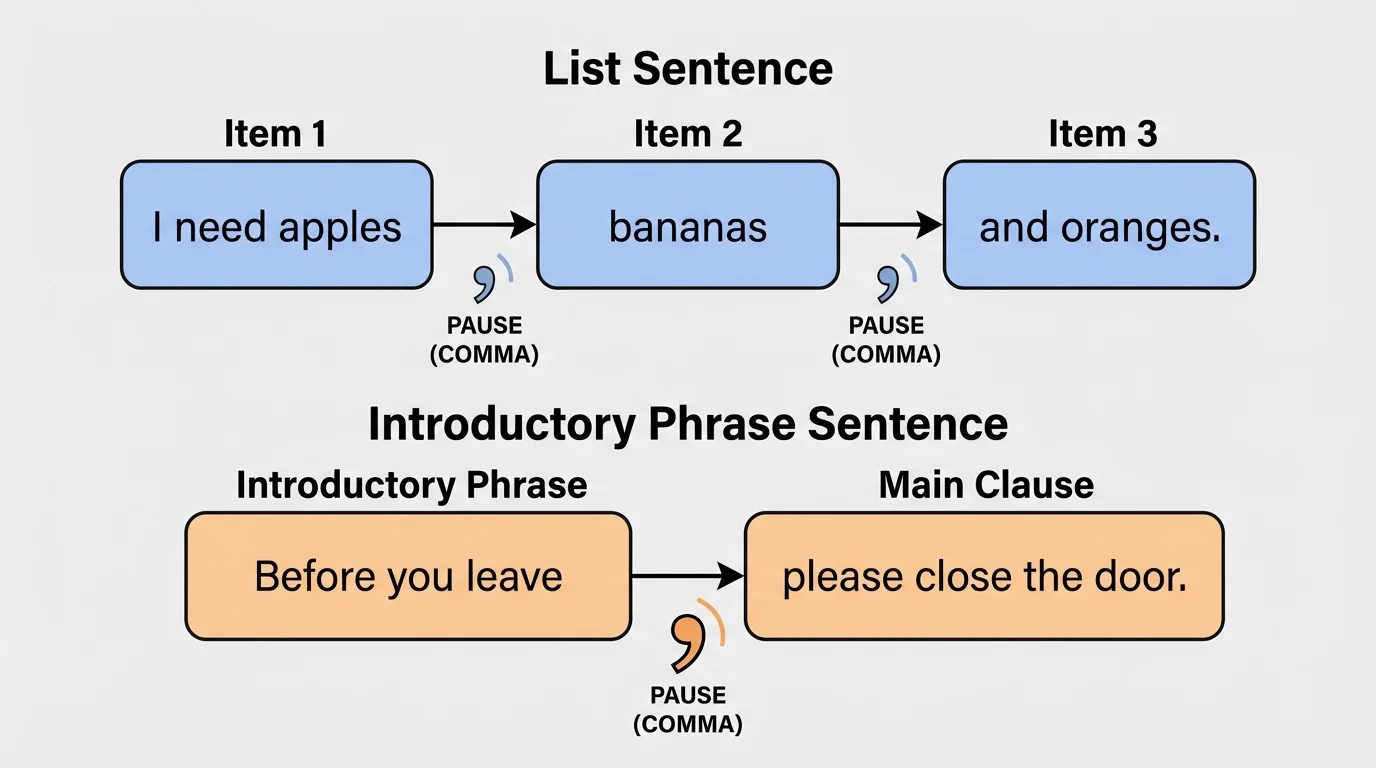
Commas are also used to set off direct address, which means speaking to a person by name. In Maya, please bring your notebook, the comma shows that Maya is the person being spoken to. Without the comma, the sentence looks less clear and may briefly confuse the reader.
Writers also use commas to separate extra information from the main sentence. In My brother, who loves robotics, built a small model rover, the words who loves robotics add information. The commas show that the sentence would still work without that extra detail.
Another important use is before a coordinating conjunction such as and, but, or so when it joins two complete sentences. Example: I wanted to stay outside, but the rain started again. Each side could stand alone as a sentence, so the comma helps connect them smoothly.
Comma examples in context
Step 1: Read the sentence without commas.
Before the game started the team stood quietly and listened.
Step 2: Find the introductory part.
Before the game started introduces the main action.
Step 3: Add the comma after the introduction.
Before the game started, the team stood quietly and listened.
The comma signals a natural pause and makes the sentence easier to understand.
As you continue writing, remember that commas are helpful but not unlimited. A comma should not be dropped into a sentence just because you feel a pause when reading aloud. Writers use commas according to grammar and meaning, not just breathing.
That is why a comma splice is a mistake. A comma splice happens when two complete sentences are joined with only a comma, as in I finished my homework, I turned on the game console. This is incorrect because each clause is a complete sentence. You need a period, a semicolon, or a comma with a conjunction.
An ellipsis is a set of three dots that shows either that words have been left out or that speech or thought trails off. These two main jobs are easy to mix up, but they create different effects.
[Figure 2] In quoted material, an ellipsis can show that some words from the original passage have been omitted. This is useful when a writer wants to shorten a quotation while keeping the important part. For example: The article states, "The new library will open in September ... and serve students across the district." The dots show that some words from the middle are missing.
In dialogue or informal writing, an ellipsis often shows a voice fading away, hesitation, uncertainty, or an unfinished thought. For example: I thought I knew the answer, but now I'm not so sure... The sentence feels as if the speaker's voice slowly trails off instead of ending firmly.
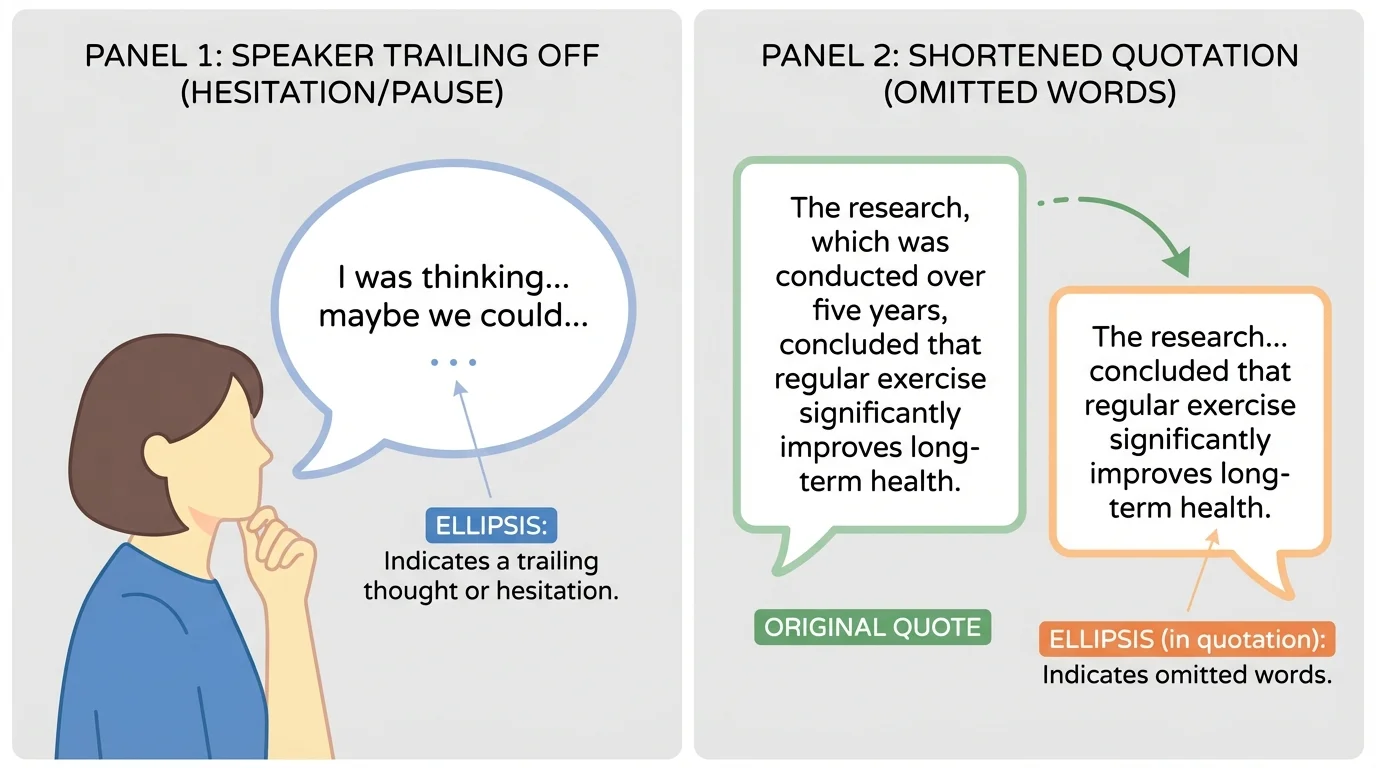
This matters because the ellipsis affects tone, the feeling or attitude a piece of writing creates. A period sounds final. A question mark sounds direct. An ellipsis can sound uncertain, thoughtful, awkward, suspenseful, or even mysterious depending on the context.
Writers should use ellipses carefully. If every sentence ends with dots, the writing may sound overly dramatic or unclear. In formal school writing, ellipses are usually limited to quotations or to specific stylistic choices in narratives. In casual texting, people may use them more often, but overuse can still make the message sound strange.
In digital communication, an ellipsis can create very different impressions. One reader may see it as thoughtful and calm, while another may read it as awkward, annoyed, or mysterious. That is why punctuation choices can affect not only meaning but also social tone.
Notice the difference between these endings: I'm coming. I'm coming! I'm coming... The words are almost the same, but the punctuation changes the feeling completely. The ellipsis suggests hesitation or a fading voice rather than certainty.
When you use an ellipsis to show omitted words, make sure the shortened quotation still keeps the original meaning. Leaving out words should make the quotation shorter, not misleading. Accuracy matters as much as style.
The em dash creates a stronger break than a comma. It can signal a sudden shift, an interruption, or strong emphasis within a sentence.
[Figure 3] One useful job of the em dash is to mark an interruption in thought. Example: I was about to answer—but the fire alarm went off. The em dash makes the break feel quick and sharp, almost as if the sentence is cut in half by an event.
The em dash can also set off extra information, much like commas do, but with stronger emphasis. Compare these two sentences: The final speaker, our science teacher, entered the auditorium. and The final speaker—our science teacher—entered the auditorium. Both are correct, but the em dashes shine a brighter spotlight on the added information.
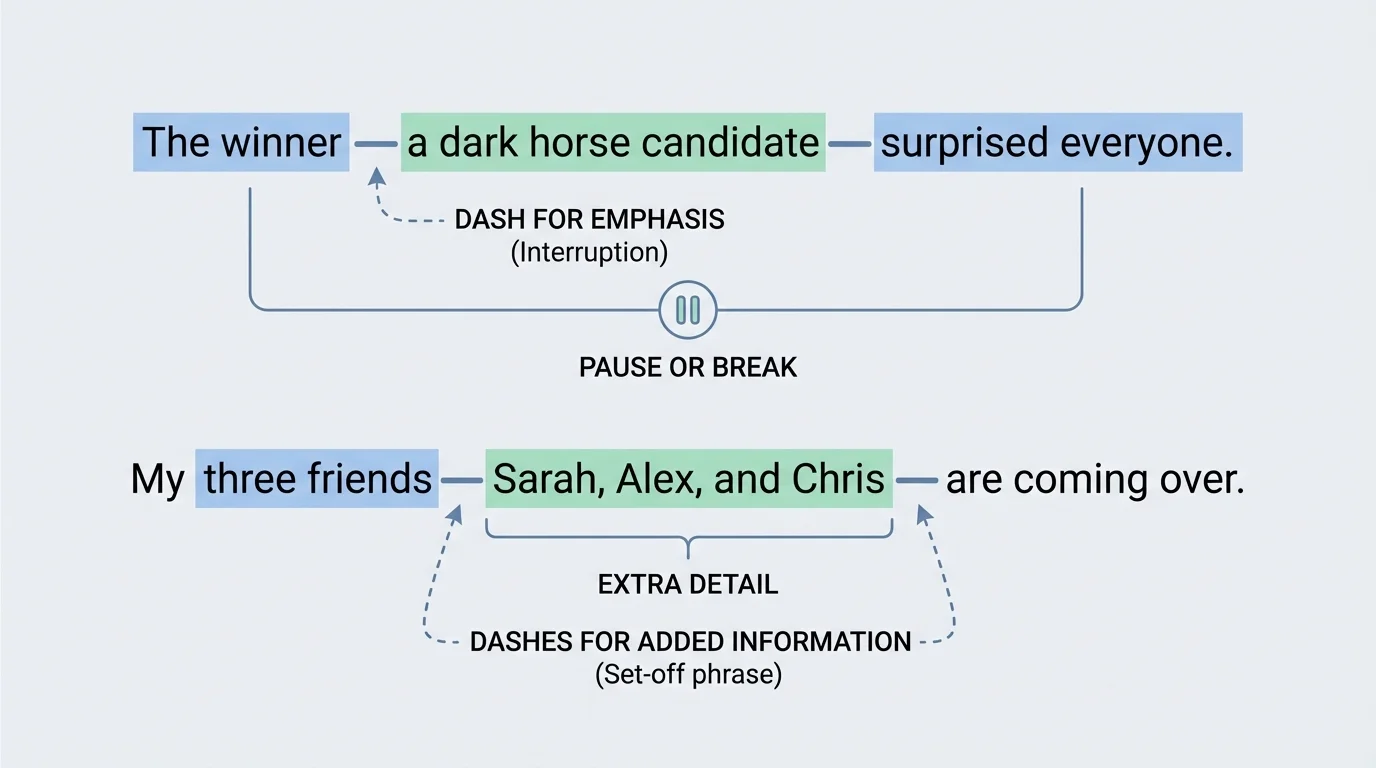
Em dashes are especially useful in narratives and personal writing because they can sound energetic and dramatic. They help a writer capture the rhythm of real thought, which is not always neat and predictable. An em dash can feel like a quick turn of the head, a surprise, or a sudden realization.
However, the dash should not be confused with the hyphen. A hyphen joins words, as in well-known author or eighth-grade class. A dash separates or interrupts parts of a sentence. They are not interchangeable.
Also, if every sentence uses em dashes for excitement, the effect becomes weak. Strong punctuation is powerful because it stands out. If it appears constantly, it no longer feels special or helpful.
Comma, ellipsis, and em dash are not levels of the same mark. They all relate to pauses, but they signal different kinds of pauses. A comma usually organizes sentence parts. An ellipsis suggests missing words or a voice fading away. An em dash creates a break that feels sudden, emphatic, or interrupted.
As you saw earlier with ellipses, punctuation affects tone. The em dash often sounds more dramatic or conversational than the comma. That makes it useful, but it also means writers should think carefully about audience and purpose before using it.
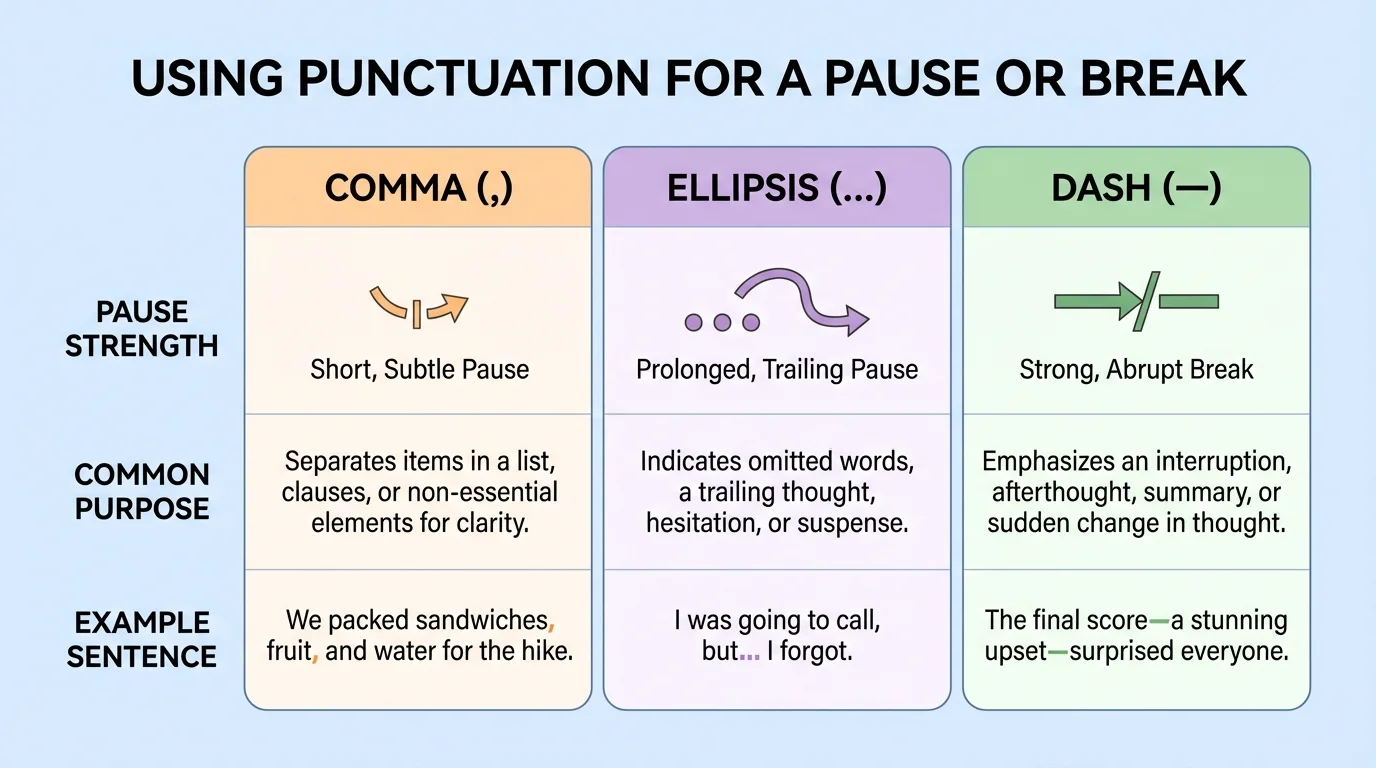
Writers often have to decide not just whether to pause, but how to pause. The three marks in this lesson create different effects, as the comparison chart shows.
[Figure 4] If the sentence needs organization and clarity, a comma is usually the best choice. If the sentence suggests fading speech, omission, or uncertainty, an ellipsis may fit. If the sentence needs a sudden break or special emphasis, a dash may work better.
| Punctuation mark | Type of pause or break | Common uses | Effect on the reader |
|---|---|---|---|
| Comma | Light pause | Lists, introductions, direct address, extra information, joining sentence parts | Creates clarity and smooth flow |
| Ellipsis | Trailing-off pause or omission | Missing words in quotations, fading speech, hesitation | Creates uncertainty, suspense, or incompleteness |
| Dash | Strong break | Interruptions, sudden shifts, emphasized extra information | Creates energy, emphasis, or surprise |
Table 1. Comparison of comma, ellipsis, and dash by pause type, purpose, and effect.
Suppose you write: I wanted to tell her the truth. Now try adding each mark in a meaningful way. I wanted to tell her the truth, but the moment passed. This version flows smoothly. I wanted to tell her the truth... This version feels hesitant or unfinished. I wanted to tell her the truth—but I froze. This version sounds more sudden and dramatic.
Choosing punctuation by purpose
Step 1: Identify the effect you want.
Do you want smooth clarity, fading uncertainty, or a sharp break?
Step 2: Match the punctuation to that effect.
Use a comma for smooth organization, an ellipsis for trailing off or omission, and a dash for interruption or emphasis.
Step 3: Read the sentence aloud.
If the punctuation makes the sentence sound the way you intend, it is probably a good choice.
Good punctuation supports your meaning instead of distracting from it.
The comparison in [Figure 4] is useful whenever you revise a sentence. If you are unsure which mark to use, think about the kind of pause the reader should hear.
Writers do not choose punctuation only for grammar. They also choose it for voice. This is especially true in stories, speeches, and personal narratives, where rhythm and emotion matter.
Look at these examples: Well, I guess we can try. Well... I guess we can try. Well—I guess we can try. The first sounds calm and ordinary. The second sounds doubtful or uneasy. The third sounds interrupted or sharply self-corrected.
This is why punctuation is part of style. In a mystery story, an ellipsis may build suspense. In a fast-moving action scene, a dash may capture a sudden interruption. In an informational essay, commas usually appear more often because the goal is clear organization rather than dramatic effect.
"Punctuation is a tool that helps writing speak."
— Writing principle
The examples with the dash in [Figure 3] help show why this mark feels more forceful than a comma. A reader does not just see the punctuation; the reader hears it internally. Strong writers pay attention to that inner sound.
Similarly, the contrast shown in [Figure 2] reminds us that ellipses are not simply "fancy dots." They create a specific effect, and that effect should match the situation.
One common mistake is using commas wherever a natural breathing pause happens. Reading aloud can help, but grammar matters more than breath. A sentence may contain a pause in speech without needing a comma in writing.
Another mistake is overusing ellipses. If too many thoughts trail off, the writing may seem incomplete or overly dramatic. Ellipses work best when they highlight a meaningful hesitation or omission, not when they appear out of habit.
A third mistake is replacing every comma with a dash because the dash looks exciting. The dash is stronger and more noticeable. If used too often, it can make writing feel jumpy and unfocused rather than powerful.
Fixing punctuation mistakes
Step 1: Spot the problem.
I was late, the bus never came.
Step 2: Identify the error.
This is a comma splice because both sides are complete sentences.
Step 3: Revise correctly.
I was late because the bus never came. or I was late, and the bus never came. or I was late; the bus never came.
The fix depends on the relationship between the ideas, but a comma alone is not enough.
Writers also sometimes confuse a dash with a hyphen. Remember: a hyphen joins words; a dash breaks or separates sentence parts. That difference may seem small, but it affects clarity and correctness.
The sentence-flow idea from [Figure 1] helps here too. Punctuation should guide the reader through the sentence, not trip the reader with random stops and jumps.
The best punctuation choice depends on who will read the writing and why you are writing it. In a formal essay, commas often do most of the work because the goal is precision and order. Ellipses may appear in quotations, but they are usually limited. Dashes may appear occasionally for emphasis, but too many can make formal writing sound casual.
In a narrative or personal reflection, you may have more freedom. A dash can capture interruption in dialogue. An ellipsis can show a character hesitating. Commas can shape the rhythm of description and explanation. The punctuation still needs to be correct, but the style may be more expressive.
Even in digital writing, such as emails or messages, punctuation sends signals. A short reply with a period can sound firm. An ellipsis can sound uncertain. A dash can sound abrupt or dramatic. Because readers cannot hear your voice, punctuation often carries more emotional weight than you expect.
Professional writers often revise punctuation late in the writing process. After ideas and sentence structure are in place, they adjust punctuation to improve rhythm, clarity, and tone.
Strong final drafts show control. That means the punctuation is not accidental. Each comma, ellipsis, and dash has a purpose, and that purpose matches the audience, task, and message.
