Have you ever read a headline like "Mistakes Were Made" and wondered who actually made them? That tiny difference in how the verb is written can hide or reveal the person responsible 🔍. Learning how to control verb voice and mood gives you power over what your writing highlights: the person, the action, or even an imagined world that is completely unreal.
Before you can choose the best verb form, you need a few key ideas:
Verb voice shows whether the subject of the sentence is doing the action or receiving it. The two main types are active voice and passive voice.
Verb mood shows the writer's attitude toward the action: is it real, a question, a command, a wish, or something imaginary? In this lesson we focus on the conditional and subjunctive moods.
A subject is the person or thing the sentence is mainly about, and the verb is the action or state of being. Often there is also an object that receives the action.
Look at these basic patterns:
The active voice is usually the clearest and most direct way to write. In active voice, the subject does the action of the verb.
Basic pattern (you do not have to label it in your writing, just recognize it):
Subject → Verb → Object
Examples:
Active voice is especially helpful when you want to:
Compare these two:
In many school assignments—especially narratives and arguments—teachers prefer active voice because it is straightforward and strong 💪.
The passive voice is used when the subject of the sentence receives the action instead of doing it.
Basic pattern:
Subject → form of "to be" + past participle (often with "by" + doer)
Examples:
Here, "the shot," "the fundraiser," and "the new medicine" are the subjects, but they are not doing the actions. They are having something done to them.
Passive voice can be useful when:
Notice how the focus shifts. In "Scientists tested the new medicine," the focus is on the scientists. In "The new medicine was tested," the focus is on the medicine and the testing process, not on who did it.
In real writing, the smart move is not "always use active" or "never use passive." Instead, you decide which one helps you aim attention at the right place. The comparison in [Figure 1] shows how the same sentence parts move to change that focus.
Look at these pairs:
Sometimes you want to highlight results instead of people. For example, in a lab report, you might write, "The liquid was stirred for two minutes" because the process matters more than who stirred it.
| Feature | Active Voice | Passive Voice |
|---|---|---|
| Who is subject? | Doer of the action | Receiver of the action |
| Typical word order | Subject – Verb – Object | Subject – "to be" – Past Participle – (by + doer) |
| Main focus | Who did it | What happened / to what |
| Best for | Stories, clear explanations, arguments | Science writing, formal tone, unknown doer |
Table 1. Comparison of active and passive voice.
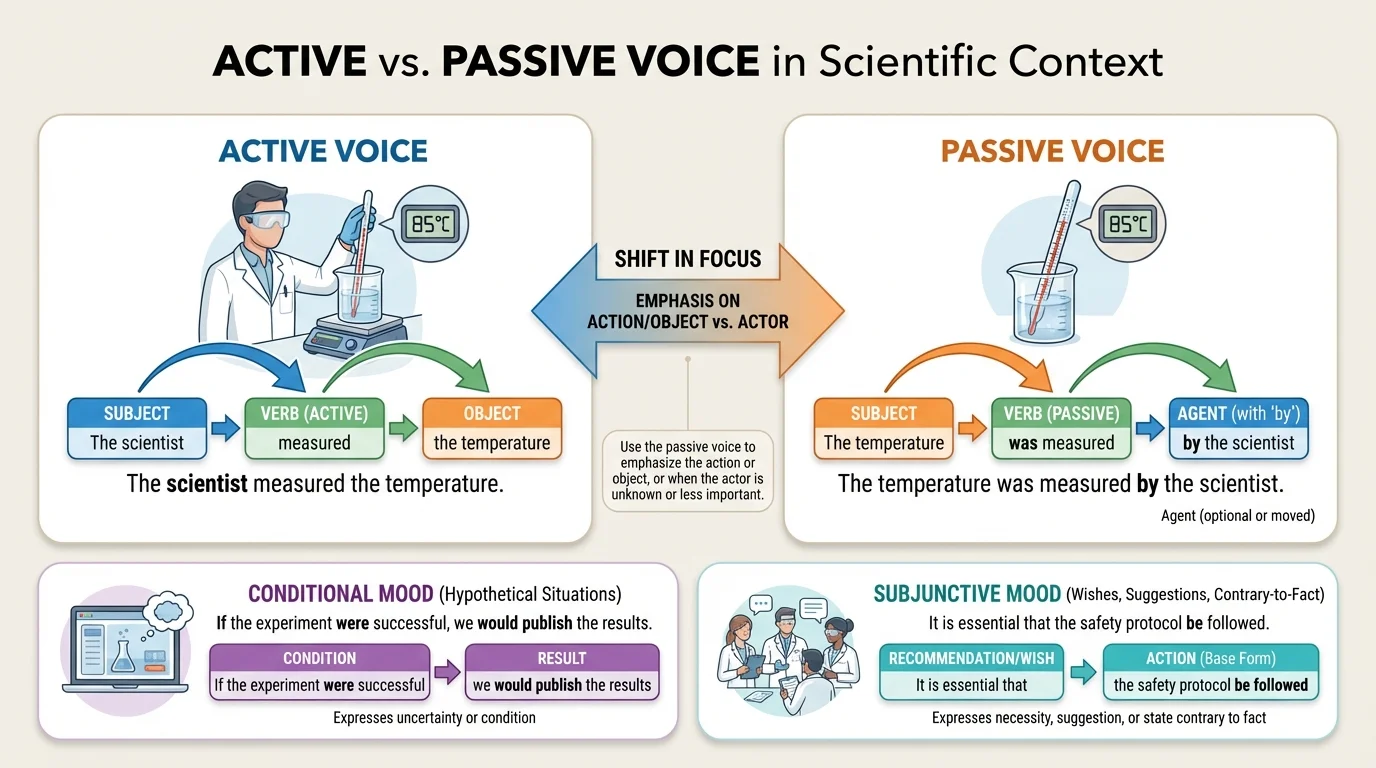
When you revise your own writing for a final draft, ask: "What do I want readers to notice most—the person doing the action or the action/result itself?" Then choose the voice that makes that focus clear, like the shift in [Figure 1].
The conditional mood lets you talk about what would, could, or might happen, often depending on a condition. It is great for expressing uncertainty, plans, and imagined results.
Common helping verbs for the conditional mood are:
Examples:
Notice how many conditional sentences come in two parts:
Writers use conditional mood to:
By choosing conditional mood, you signal that the action is possible, not guaranteed. This helps you avoid sounding too extreme or absolute.
The subjunctive mood is used less often, but it is powerful. It shows that something is not real right now—maybe it is a wish, a suggestion, or a situation that is the opposite of the truth.
There are three major patterns you should recognize in middle school:
When you talk about a wish that is not true now, English often uses "were" instead of "was," especially after "if" and "wish."
This use of "were" shows that the situation is imaginary or different from reality.
After certain verbs—like recommend, suggest, insist, or demand—English sometimes uses the base form of another verb without adding "s" or "to."
This pattern sounds a little formal, and you will see it often in academic writing, rules, and directions.
The subjunctive often appears in "if" clauses that are not real, especially when combined with conditional results:
The combination of subjunctive ("were") and conditional ("would change," "could go") helps the reader understand that this is an imaginary situation, not a plan for something that is already true.
Now that you have the tools, the key is using them on purpose 🎯. Different tasks and audiences expect different choices.
In a personal narrative, a teacher might want you to show clear, bold action. Active voice works well:
In a science lab report, your purpose is to describe a process that anyone could repeat. Passive voice and process-focused language, like in [Figure 1], keep attention on the procedure, not on you:
In an argument about school rules, you might choose active voice to make responsibility clear:
In persuasive writing, you rarely can promise the future with 100% certainty. Conditional mood helps you be honest and precise:
You can also use conditionals to show different possible results:
Your audience will trust your writing more when they see you understand that some ideas are only possibilities, not guarantees.
In stories, the subjunctive mood helps you explore characters' wishes and regrets:
In speeches, debates, or formal writing, the subjunctive mood makes suggestions and demands sound serious and official:
These patterns show your audience when you are talking about reality and when you are talking about ideas, wishes, or recommendations.
Example 1: Science vs. Narrative
Sentence idea: A student heats water in a beaker.
Step 1: Narrative, active focus on the person
"I heated the water in the beaker until it boiled."
Step 2: Lab report, passive focus on the process
"The water in the beaker was heated until it boiled."
Both are correct, but the first fits a story about what you did, while the second fits a scientific description where the process, not the person, is most important.
By changing voice, you shift what readers pay attention to—just like the structure shift you can see in [Figure 1].
Example 2: Argument with Conditional and Subjunctive
Topic: Should the school add a homework-free day each week?
Step 1: Plain statement
"The school should add a homework-free day."
Step 2: Add conditional to show possible results
"The school should add a homework-free day, because students would have more time to rest and could return to class with better focus."
Step 3: Add subjunctive for a formal recommendation
"We recommend that the school add a homework-free day so that students would have more time to rest and could return to class with better focus."
The conditional verbs ("would have," "could return") clearly mark these as possible benefits, not guarantees. The subjunctive pattern "recommend that the school add" makes the suggestion sound formal and thoughtful.
Example 3: Reality vs. Contrary to Fact
Idea: A student did not study and failed a test, but imagines a different outcome.
Step 1: Real situation
"I did not study, so I failed the test."
Step 2: Conditional + subjunctive (imaginary, opposite situation)
"If I had studied, I would have passed the test."
This second sentence describes a state contrary to fact: in real life, the student did not study and did not pass. The combination of "If I had studied" and "would have passed" clearly signals a regretful, imaginary version of events.
Writers in grades 6–8 often run into a few predictable problems. Here is how to avoid them 🙂.
1. Overusing Passive Voice
Sometimes students think passive voice sounds "fancier," so they use it all the time:
Often, active voice is shorter and clearer:
Use passive voice only when it truly helps your focus or tone.
2. Mixing Up "Was" and "Were" in Subjunctive
In casual speech, people often say "If I was…" even when they are imagining something unreal. In careful writing, use "were" for unreal or contrary-to-fact situations:
3. Forgetting the Helping Verb in Passive Voice
Passive voice needs a form of "to be" plus a past participle. Leaving out "to be" makes the sentence wrong:
4. Confusing Conditional with Simple Future
The future tense uses "will," while the conditional uses "would," "could," or "might."
Pay attention to whether the action is a plan or just a possibility.
Many professional writers, from journalists to novelists, consciously switch between active and passive voice, and between indicative, conditional, and subjunctive moods, to control what readers notice and how certain or uncertain their statements sound.
When you revise, ask yourself questions like these:
