Some of the most powerful stories you will ever read are true. A person crossing the ocean alone, a young activist giving a speech, a scientist writing about a dangerous expedition, or an athlete describing the moment before a championship game can all become unforgettable reading. These texts are not made up, but they still use the same kind of careful writing that makes stories vivid and meaningful.
Literary nonfiction is writing about real people, real events, and real ideas that uses storytelling techniques to make the subject engaging and meaningful. As [Figure 1] shows, literary nonfiction stands between fiction and plain informational writing. It is true like informational text, but it often feels story-like because the author may use scenes, dialogue, description, pacing, and strong word choice.
In fiction, the characters and events are invented. In literary nonfiction, the people and events are real. The author may still organize the writing in a dramatic way, focusing on important moments, feelings, and lessons. Readers must understand both the facts and the way the author shapes those facts into a meaningful experience.
Not every nonfiction text is literary nonfiction. A textbook chapter about volcanoes gives information directly. A personal essay about surviving a volcanic eruption tells true information too, but it also creates mood, describes the setting, and reveals the writer's thoughts and emotions. That second text belongs more clearly to literary nonfiction.
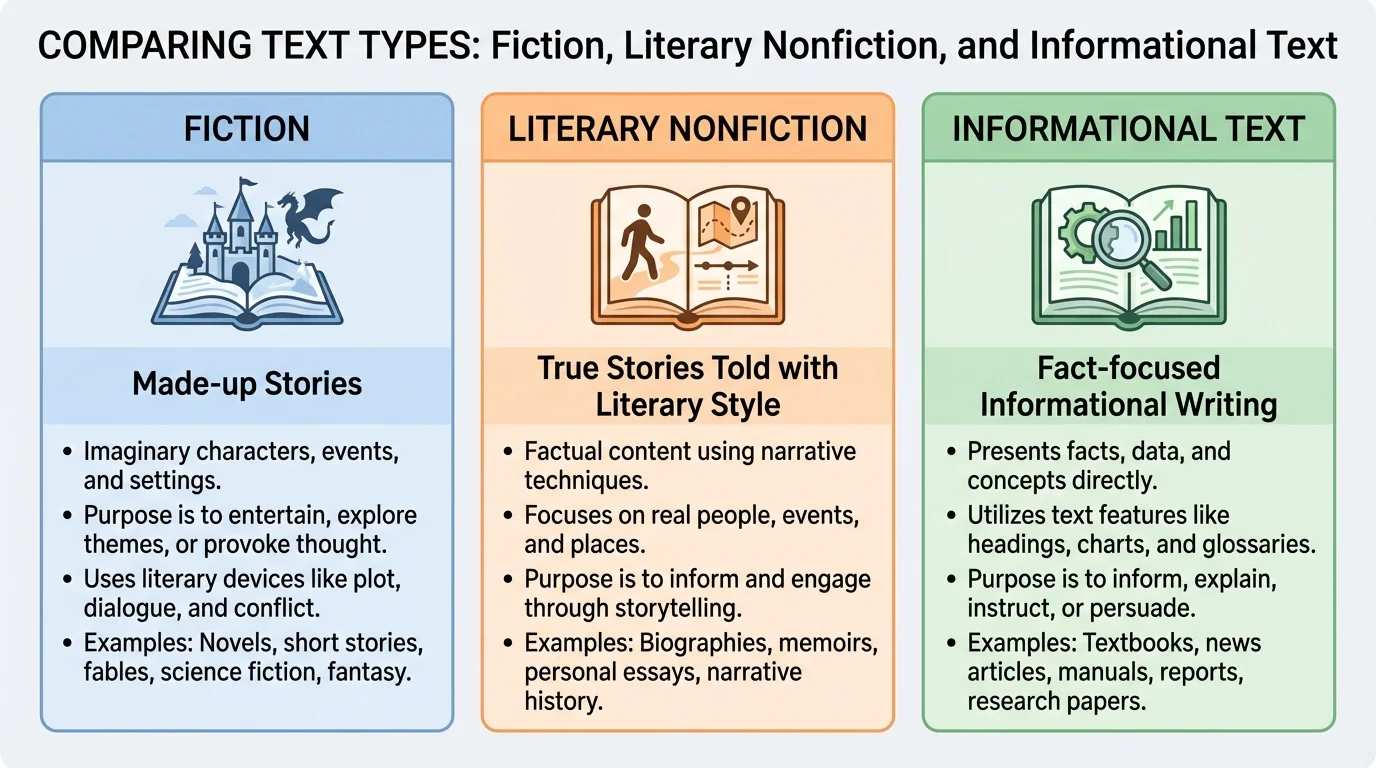
Literary nonfiction is true writing that uses some of the same techniques found in literature, such as description, voice, structure, and imagery.
Comprehend means to understand what a text says, what it means, and how its ideas are developed.
When readers comprehend literary nonfiction well, they do more than collect facts. They notice the author's purpose, the central idea, the important details, and the choices that make the true story powerful. This kind of reading asks you to think carefully about both information and craft.
Literary nonfiction comes in many forms. A memoir is a true account of part of a person's life, usually focused on a specific experience or period. An autobiography tells the story of a person's life written by that person. A biography tells the story of someone's life but is written by another author.
Other forms include personal essays, speeches, journals, diaries, travel writing, and narrative nonfiction articles. A speech by a civil rights leader can be literary nonfiction because it uses powerful language, repetition, and emotional appeal. A magazine article about a rescue mission can also be literary nonfiction if it tells the true event as a dramatic narrative.
Each type has a slightly different purpose. Memoirs often explore memory, identity, or change. Biographies often help readers understand the importance of a person's actions. Speeches aim to persuade or inspire. Narrative nonfiction articles often explain events while also keeping readers interested through suspense and detail.
Many books students read about explorers, inventors, athletes, and young activists are literary nonfiction. Even when the facts are carefully researched, the writing may still use scene-building and strong voice to hold your attention.
This variety matters because strong readers adjust their approach. You would not read a speech exactly the same way you read a diary entry. You look for different clues depending on the type of text.
When you read literary nonfiction, you are looking for both information and artistry. As [Figure 2] illustrates, a reader pays attention to text features and literary elements together. Text features may include titles, subtitles, headings, captions, dates, and paragraphs. Literary elements may include setting, character, conflict, point of view, and theme.
Point of view tells who is speaking or from whose perspective the events are presented. In a memoir, the writer often uses first person, saying "I," which helps readers hear the writer's own voice. In a biography, the author usually uses third person and describes the subject from the outside.
Central idea is the main message, insight, or understanding the text develops. In literary nonfiction, the central idea is often supported by scenes, reflections, facts, and examples. A memoir about moving to a new country might develop the central idea that change is difficult but can lead to growth.
The structure of a text also affects meaning. Some texts are arranged in chronological order, moving from one event to the next in time. Others may begin with an exciting moment and then flash back to earlier events. An essay may move from one idea to another rather than telling a full story in time order.
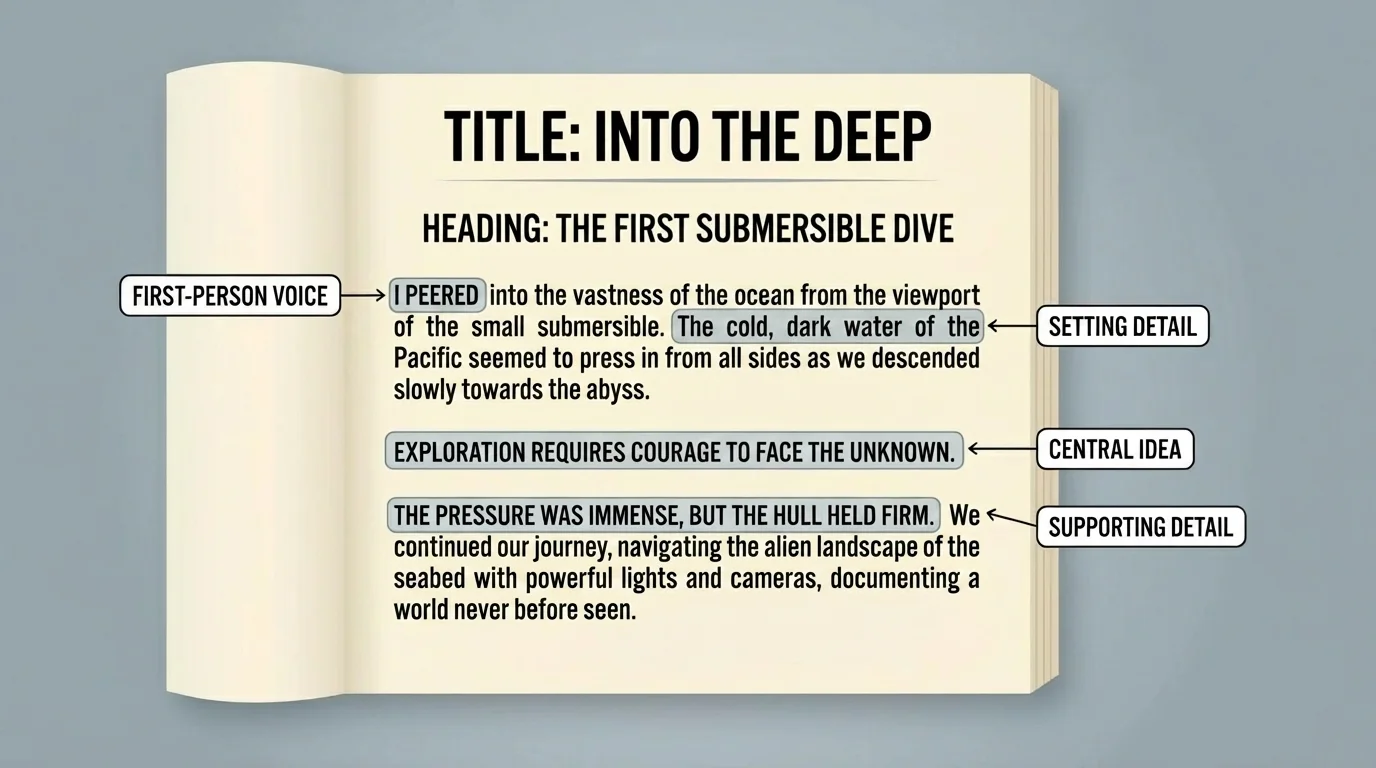
Writers also use details to shape how readers feel and think. Specific details about weather, sounds, expressions, and actions help create setting and mood. Important facts help build trust. Reflections, or the writer's thoughts about events, often help readers see why those events matter.
Literary elements in true writing matter because facts alone do not always create meaning. An author chooses what to include, what to leave out, where to begin, and how to describe events. These choices guide the reader toward certain ideas, emotions, and understandings.
For example, a biography of Harriet Tubman could list dates and places. But a literary nonfiction account might describe the darkness of the woods, the danger of silence, and Tubman's courage. Those details do not change the truth. They help readers experience the truth more deeply.
Good readers are active, not passive. They ask questions while they read. Who is speaking? What happened? Why is this detail included? What does the author want me to understand? These questions help readers stay connected to the text.
Close reading means slowing down enough to notice how the text works. You may reread an important paragraph, pause after a confusing sentence, or trace how one idea connects to the next. In literary nonfiction, close reading is especially important because authors often combine facts, description, reflection, and message in the same passage.
One useful strategy is to notice when the text shifts. A shift can happen in time, place, mood, or focus. A writer may move from describing a scene to explaining its meaning. A speech may shift from a problem to a call for action. These changes often reveal important parts of the author's purpose.
Example: Reading a memoir excerpt closely
A student reads a passage in which a young writer describes arriving at a new school for the first time.
Step 1: Notice key details
The writer describes a heavy backpack, unfamiliar voices in the hallway, and hands shaking while opening the classroom door.
Step 2: Ask what the details suggest
These details suggest nervousness and uncertainty, even if the writer never directly says, "I was afraid."
Step 3: Connect to the central idea
The passage may help develop a central idea about facing change, finding courage, or feeling like an outsider before belonging.
Close reading turns details into understanding.
Another useful habit is to summarize in short parts. After a paragraph or section, stop and tell yourself what happened and why it mattered. This keeps you from reaching the end of a page and realizing you do not remember what you just read.
By the end of the year, you are expected to read and understand literary nonfiction in the grades 6–8 text complexity band. That means some texts will feel easy, some will feel just right, and some will feel difficult at first. Harder texts may contain unfamiliar vocabulary, longer sentences, more abstract ideas, or references to historical events and people you do not yet know.
Text complexity refers to how challenging a text is. A text may be complex because of its language, structure, ideas, or background knowledge demands. As [Figure 3] shows, readers can use scaffolding to handle challenge step by step instead of giving up.
Scaffolding means support that helps you understand difficult material. A teacher might provide background information, explain a few important words, model how to annotate, or break a long passage into smaller parts. The goal of scaffolding is not to do the reading for you. The goal is to help you grow more independent.
Suppose you read a speech from many years ago. The vocabulary may sound formal, and the speaker may mention events you have not studied yet. You can preview the title and date, notice repeated words, identify the problem the speaker names, and paraphrase key sentences in your own words. Each support makes the text more manageable.
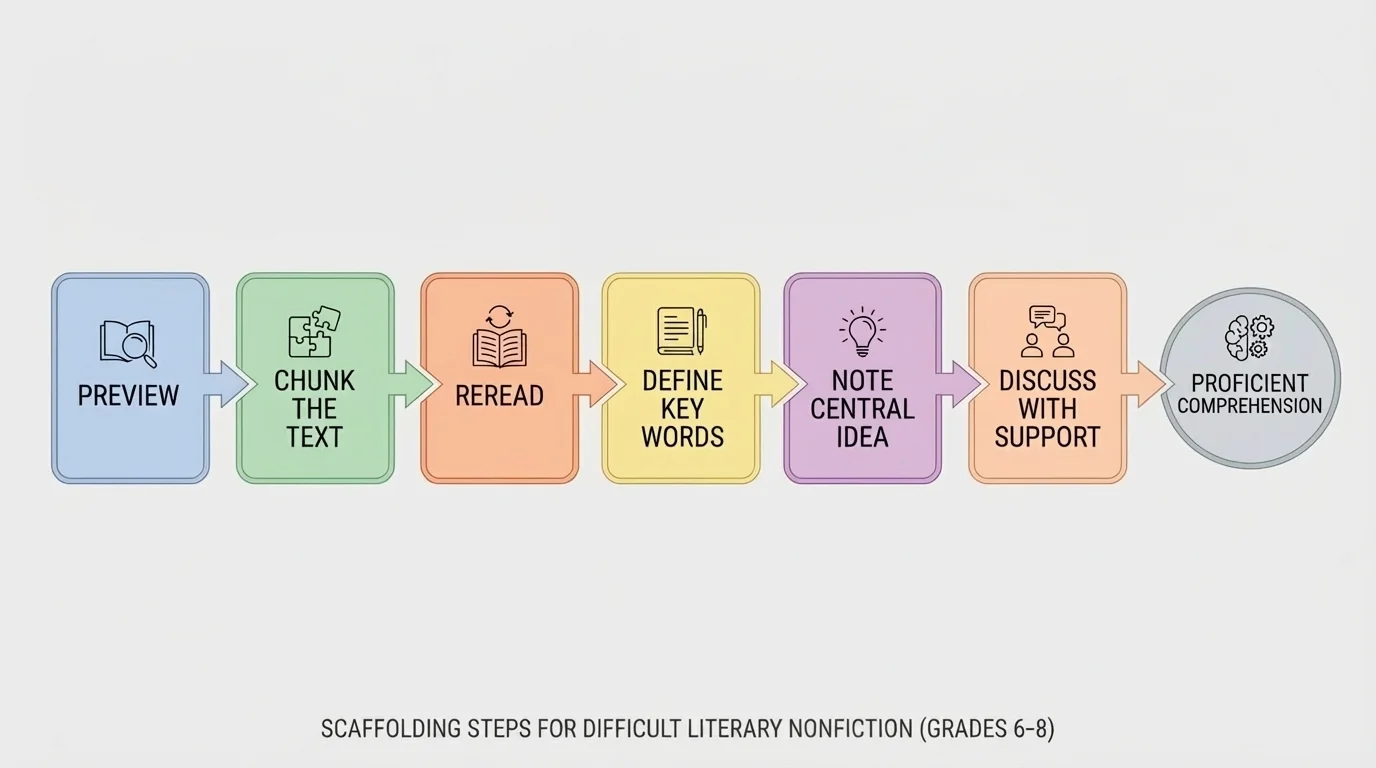
Complex texts often reward rereading. On the first read, you may understand the basic situation. On the second read, you might notice tone, symbolism, or a pattern in the details. On the third read, you may be ready to explain the author's larger message.
Remember that struggling at first does not mean you are failing. Strong readers often pause, reread, look back, and revise their understanding. Challenge is a normal part of growth.
If a sentence is dense, break it into smaller parts. If a word is unknown, use context clues from nearby words and examples. If a passage feels abstract, look for concrete moments where the author gives an image, memory, or event. These techniques build comprehension in texts at the high end of the range.
Literary nonfiction uses many of the same elements found in stories, but it uses them to tell the truth. Tone is the author's attitude toward the subject. The tone might be hopeful, serious, admiring, urgent, or reflective. Mood is the feeling the text creates in the reader. A stormy setting and tense word choice can create an anxious mood.
Imagery uses language that helps readers see, hear, smell, taste, or feel what is being described. In literary nonfiction, imagery can make a real event feel immediate. A line such as "The cold air bit my face as the boat slammed against the gray water" helps a reader experience the moment.
Authors may also use symbolism, repetition, contrast, and pacing. A repeated image of doors opening might symbolize opportunity. A speech might repeat a phrase to strengthen its message. A writer may slow down an important moment with extra detail and then speed up less important events.
As readers, you should ask not only what happened but also how the author tells it. This is where literary analysis begins. Earlier, [Figure 2] showed how elements such as voice, detail, and central idea work together on the page. In a stronger analysis, you explain how those choices shape the reader's understanding of the real event or person.
"The difference between the almost right word and the right word is really a large matter."
— Mark Twain
That idea matters in literary nonfiction because word choice affects truth and feeling at the same time. If a writer calls a crowd "restless," "excited," or "angry," each word changes the reader's picture of the event.
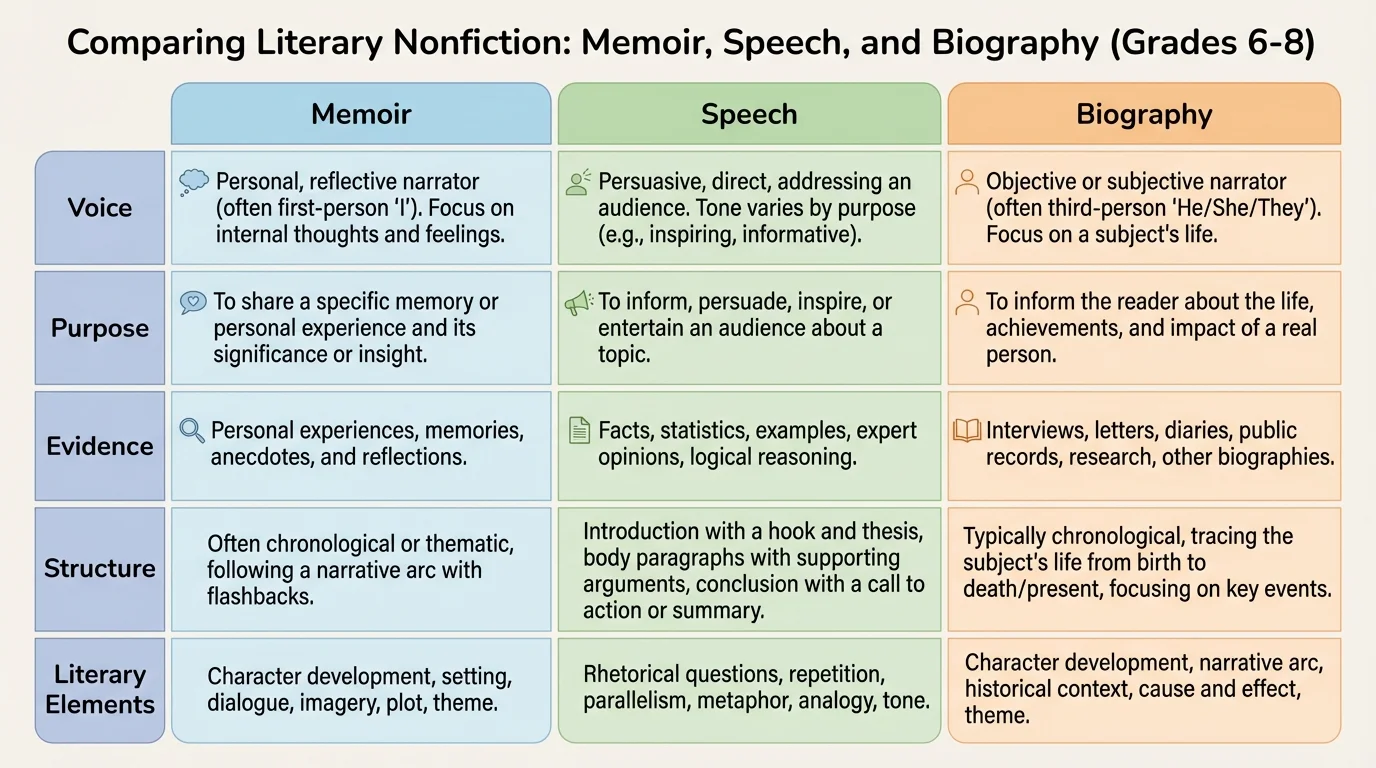
Different forms of literary nonfiction ask readers to focus on different things. As [Figure 4] illustrates, a memoir, a speech, and a biography may all be true, but they guide readers in different ways. A memoir often centers on personal experience and reflection. A speech often uses persuasive language and repetition. A biography often blends facts with interpretation of a person's life and importance.
When reading a memoir, pay attention to voice, memory, and reflection. Ask how the writer feels now about events from the past. Notice which moments are described in detail and which are skipped.
When reading a speech, pay attention to audience and purpose. Why is the speaker giving these words at this moment? Which phrases repeat? What emotions does the speaker try to awaken? A speech may have fewer story scenes than a memoir, but it can still contain strong literary language.
When reading a biography or narrative article, pay attention to how the author balances facts with storytelling. Which details reveal character? Which events seem most important? How does the structure guide your understanding of the subject's life or the event's meaning?
| Type of text | Main focus | What readers should notice |
|---|---|---|
| Memoir | Personal experience | Voice, reflection, important moments, feelings |
| Speech | Persuasion or inspiration | Audience, repeated phrases, tone, call to action |
| Biography | A person's life and importance | Key events, traits, evidence, author's interpretation |
| Narrative article | True event told as a story | Sequence, suspense, facts, scene details |
Table 1. Comparison of major literary nonfiction forms and the reading focus each one requires.
These differences do not mean the forms are completely separate. A biography may contain imagery. A speech may tell a short story. A memoir may include facts and explanation. Strong readers stay flexible.
Becoming proficient means you can read with understanding, think about what the author is doing, and explain your ideas using evidence from the text. Proficiency grows over time through practice with a range of texts, not by reading only one kind of piece again and again.
Read texts that are sometimes comfortable and sometimes challenging. When a text is difficult, use supports. Earlier, [Figure 3] presented a sequence of scaffolding moves that helps readers stay productive: preview, chunk the text, reread, define key words, and connect ideas. Those supports become habits you can begin to use on your own.
It also helps to build reading stamina. Longer and more complex texts require focus. If you lose concentration, pause and reset. Look back at the title, recent paragraph, or central idea. Then continue. Skilled readers do not always read fast; they read thoughtfully.
Example: Moving from support to independence
A student first reads a difficult biography excerpt with help from a teacher.
Step 1: Use support
The teacher explains the historical setting and highlights three important vocabulary words.
Step 2: Practice the strategy
The student rereads each paragraph, notes key details, and writes a short summary of the section.
Step 3: Try independently
On a new passage, the student previews the heading, identifies the speaker or subject, and tracks the central idea without as much help.
This is how scaffolding leads to stronger independent reading.
As you continue reading, keep asking yourself three powerful questions: What is true in this text? What is important in this text? How did the author help me understand and feel that importance? Those questions can guide you through almost any literary nonfiction text in the grades 6–8 band.
And remember the big goal: not just finishing the page, but truly understanding it. Literary nonfiction lets you learn from real lives, real struggles, and real achievements while also paying attention to language, structure, and meaning. That combination makes it one of the richest kinds of reading you can do.
