Have you ever listened to someone speak and thought, "I know the topic is interesting, but I can't follow what they mean"? A strong presentation is not just about having good ideas. It is also about putting those ideas in the right order, choosing the right details, and speaking in a way that helps people listen. Whether you are explaining why recess should be longer, sharing science results, or reporting on a book, your job is to help your audience understand your message clearly.
Speaking is a skill you use every day. You use it when you answer a question in class, explain a rule in a game, tell a story, or try to persuade someone. In school, oral presentations often ask you to share claims and findings. That means you are not only saying what you think. You are showing what you know and why it matters.
Oral presentations help people learn from one another. A student might present the findings from a plant experiment, explain why a character changed in a novel, or make a claim about the best way to reduce cafeteria waste. In each case, the speaker needs to be organized, accurate, and easy to understand.
A good presentation does three important things. First, it states a main idea clearly. Second, it supports that idea with facts, examples, and details. Third, it delivers the message in a confident and understandable way. If one of these parts is missing, the presentation becomes weaker. A speech with good facts but poor organization can feel confusing. A well-organized speech spoken too quietly can be hard to hear. A loud speech with no evidence may sound confident but still fail to convince.
Claim is a statement that says something is true or should happen.
Finding is a result discovered through reading, observing, investigating, or researching.
Evidence is the information that supports a claim or explains a finding. Evidence can include facts, examples, observations, quotations, and data.
When you present, you are building a bridge from your ideas to your audience's understanding. That bridge must be strong enough to hold your reasons and clear enough for listeners to cross easily.
A claim is more than just a personal preference. If a student says, "Blue is the best color," that is an opinion, but it is difficult to prove. If the student says, "Our class should have a recycling bin because it would reduce paper waste," that is a claim that can be supported with reasons and evidence.
A finding is something learned from investigation. For example, after measuring how much trash the class throws away in a week, a student might report the finding that most paper waste comes from unfinished worksheets. Findings often answer questions such as "What happened?" or "What did we discover?"
Evidence gives strength to your presentation. Suppose your claim is that students should have more time to read silently in class. You could support it with survey results, teacher observations, or information from an article about reading growth. The stronger your evidence is, the stronger your presentation becomes.
Example: claim, finding, and evidence working together
Topic: School garden
Step 1: State the claim.
"Our school should create a small vegetable garden."
Step 2: Share a finding.
"Students in a nearby school reported that garden projects helped them learn science concepts better."
Step 3: Add evidence.
"An article about school gardens explained that students can observe plant growth, soil conditions, and insect activity directly."
This presentation is stronger than simply saying, "I think gardens are nice."
Notice that a good speaker does not dump random facts into a speech. The facts must connect to the main message. If your claim is about school gardens, then a fact about basketball scores does not belong. Everything should support the central idea.
A clear presentation follows a sequence that makes sense to listeners, as [Figure 1] shows in a step-by-step structure. Most effective presentations begin with an opening that introduces the topic and states the main claim or key finding. Then they move through supporting points in order. Finally, they end with a conclusion that reminds the audience of the main idea.
This logical order matters because listeners cannot reread your words the way they can reread a page. They hear your presentation once, in real time. If your ideas jump around, they may lose the thread of your message. Good sequencing helps the audience know what comes first, what comes next, and why each part matters.
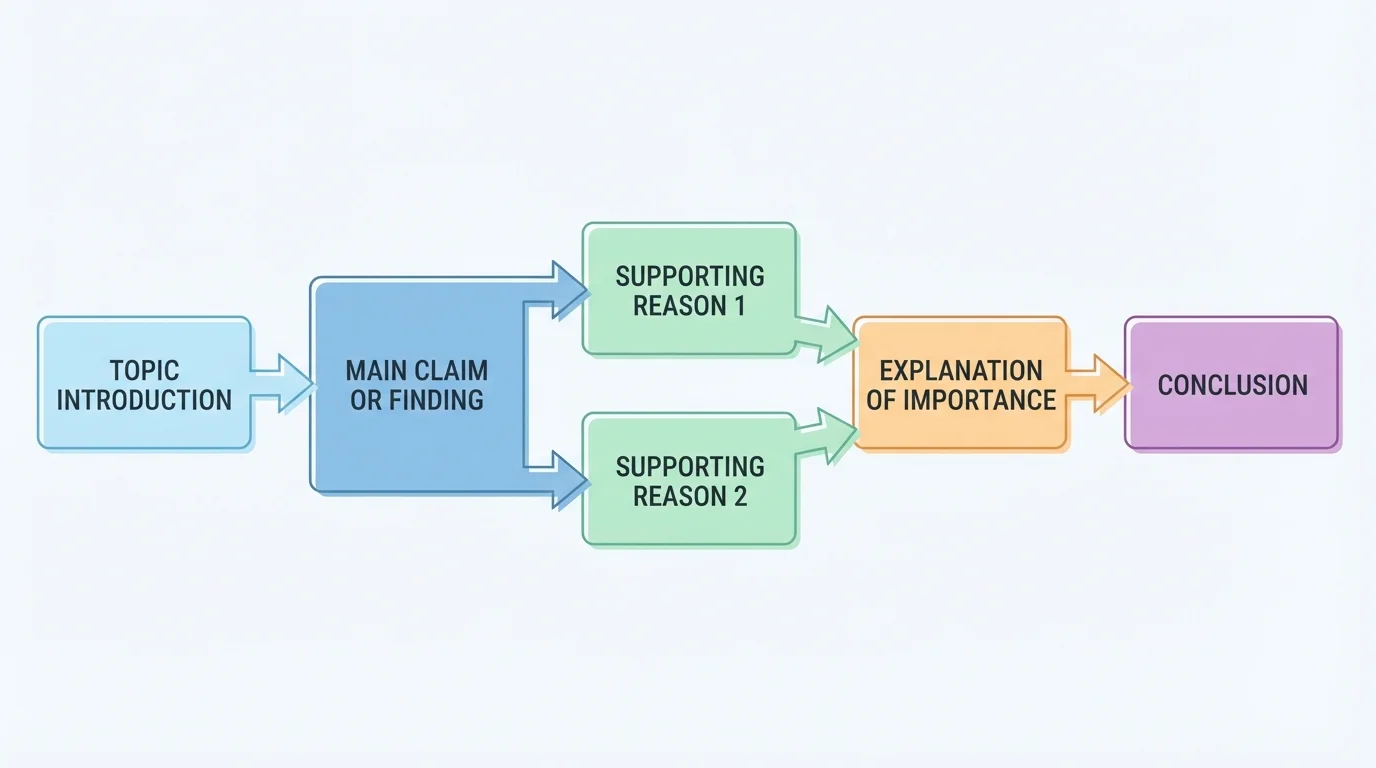
One helpful pattern is this: introduction, claim or finding, supporting details, explanation, and conclusion. Another pattern may be used if your topic fits it better, such as time order, cause and effect, or problem and solution. The key is that the order must help the audience understand.
Sequence means the arrangement of ideas in an order that makes sense. A speaker might sequence ideas by importance, by time, or by steps in a process. For example, if you are presenting findings from an experiment, you might explain the question, the method, the result, and the conclusion in that order.
Transitions are words and phrases that guide listeners from one idea to the next. They act like signposts on a road. Words such as first, next, for example, because of this, however, and finally help the audience follow your thinking.
| Purpose | Helpful transition words |
|---|---|
| Beginning an idea | first, to begin, one reason |
| Adding information | next, also, another, in addition |
| Giving an example | for example, for instance |
| Showing cause and effect | because, as a result, therefore |
| Ending | finally, in conclusion, overall |
Table 1. Transition words and phrases that help speakers connect ideas clearly.
Think of your presentation like building with blocks. If the blocks are stacked in the right order, the structure stands firm. If they are piled randomly, the structure wobbles. As seen earlier in [Figure 1], strong speaking moves listeners through ideas one step at a time.
A strong presentation does not stay vague. Instead of saying, "The experiment went well," a better speaker explains what happened. Specific details help listeners picture the situation and understand the importance of your point.
Descriptions help the audience imagine what you observed. If you are reporting on a science activity, you might say, "After three days, the plant near the window had a taller stem and brighter green leaves." This is much more useful than saying, "One plant looked better."
Facts are pieces of information that can be checked. If you say, "Our survey showed that 18 out of 24 students wanted more independent reading time," you are giving a fact. Facts make a presentation more trustworthy.
Details add precision. They can include names, numbers, examples, observations, or brief quotations. Good details support the main point. Too many unrelated details, however, can bury the main idea. A good speaker chooses the most relevant details, not every possible detail.
Choosing pertinent support
Pertinent means directly related and useful. In an oral presentation, pertinent descriptions, facts, and details are the ones that help prove your claim or explain your finding. If a detail is interesting but does not strengthen the message, it probably does not belong.
Suppose your theme is that teamwork improves learning. Pertinent details might include how group members shared jobs, solved a problem together, or learned from one another. A long story about what everyone ate for lunch would not support that theme.
Main ideas and themes become clearer when details are carefully chosen. The audience should be able to answer this question after each supporting point: "How does this help me understand the speaker's main message?"
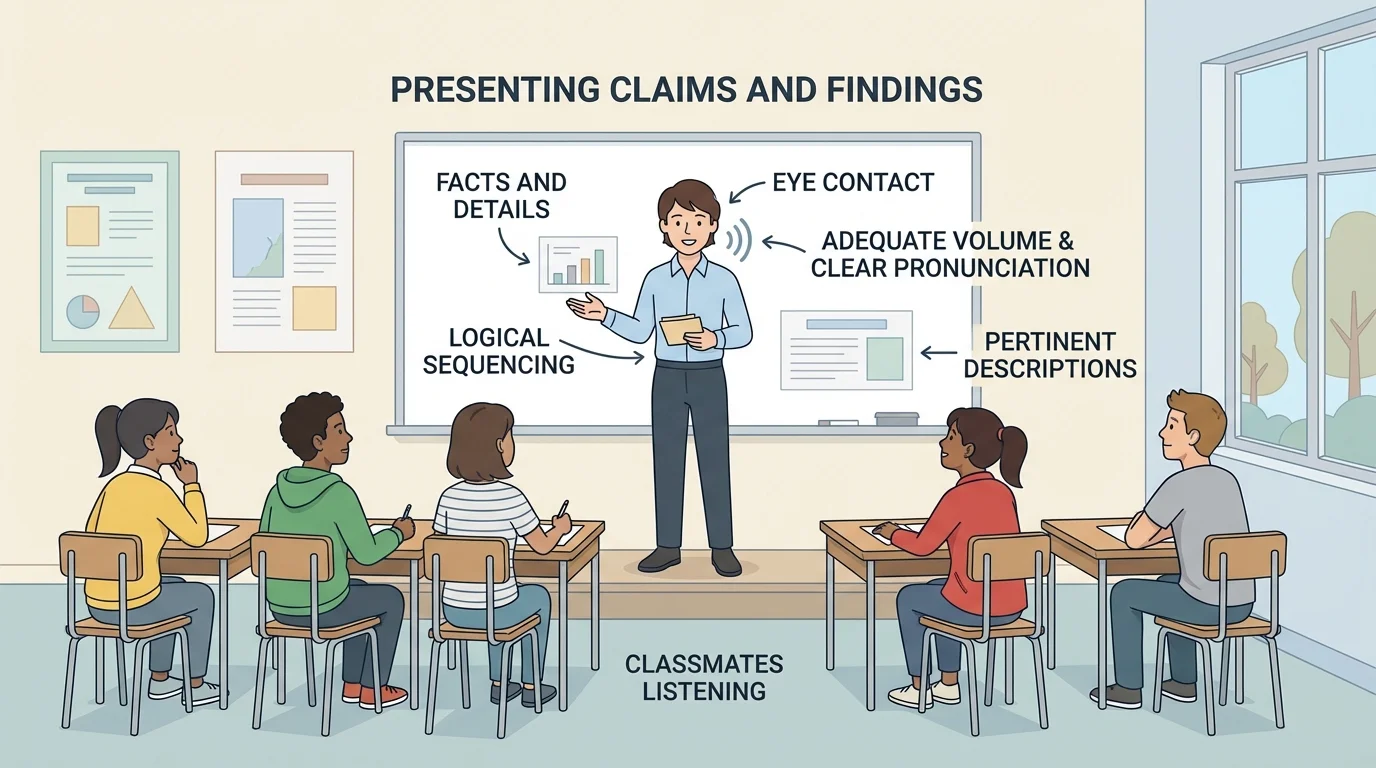
Delivery matters just as much as content. A speaker may have excellent ideas, but if the words are mumbled, rushed, or read with eyes fixed on the paper, the message becomes weaker. Strong delivery includes eye contact, adequate volume, and clear pronunciation, and these features work together as [Figure 2] illustrates in a classroom presentation.
Eye contact means looking at your audience as you speak. It shows confidence and helps you connect with listeners. You do not need to stare at one person. Instead, gently move your gaze around the room. Look at different people for a moment, then shift naturally. If you look down at your notes every second, the audience may feel as if you are reading rather than speaking to them.
Adequate volume means speaking loudly enough for everyone to hear without shouting. The students in the back of the room should be able to understand your words. Your volume may need to change depending on the size of the room and the amount of background noise.
Clear pronunciation means saying words correctly and distinctly so listeners can understand them. When speakers rush, endings of words may disappear. Speaking a little more slowly often improves pronunciation. It also gives your audience time to process important ideas.
Your pace also matters. If you speak too fast, ideas can blur together. If you speak too slowly, listeners may lose interest. Aim for a steady pace with pauses after important points. Pauses are useful. They give listeners time to think, and they make your words sound more confident.
Posture and expression support your voice. Standing upright helps you breathe and project your voice better. A calm face and natural gestures can make you seem more engaged. Wild movements, turning your back to the class, or slouching can distract from your message.
Professional speakers often practice where to pause, not just what to say. A short pause before an important fact can make the audience pay closer attention.
When delivery habits are strong, your audience focuses on your ideas instead of struggling to hear or understand you. Later, when you review your own speaking, you can think back to the habits shown in [Figure 2]: eyes up, voice clear, and posture ready.
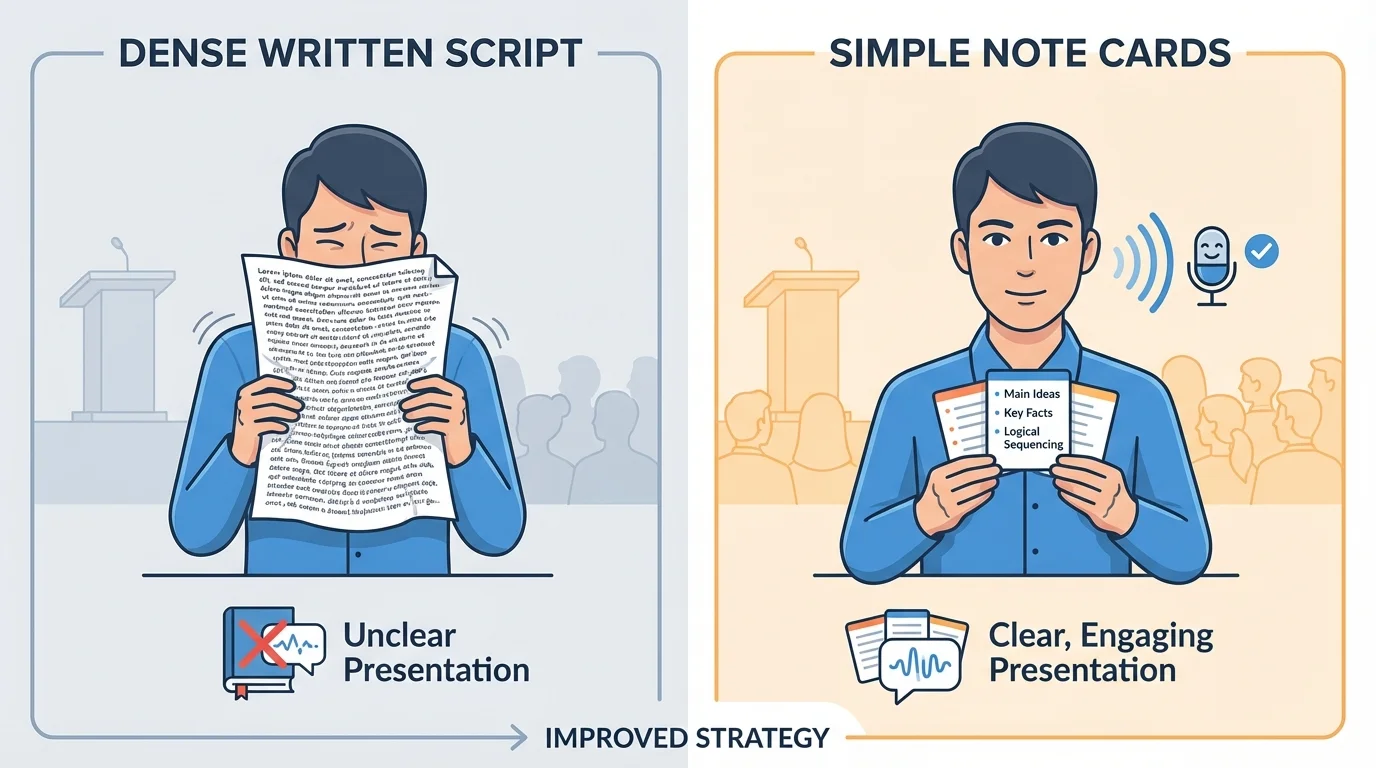
Strong speakers usually do not stand up and invent everything on the spot. They prepare. Good preparation helps you stay organized and speak naturally. Instead of memorizing every sentence, many speakers plan with key words and short notes, as [Figure 3] demonstrates through a comparison of full scripts and note cards.
Start by deciding your main message. Ask yourself: What do I want the audience to understand, believe, or remember? Then choose two or three supporting points. This keeps your presentation focused. If you try to include too many points, your talk may become crowded and confusing.
Next, gather evidence that fits each point. Use facts, observations, and examples that truly support your message. Write notes in short phrases rather than full paragraphs. Short notes encourage speaking, while full paragraphs tempt you to read every word.
A simple speaking plan might look like this:
| Part of presentation | What to include |
|---|---|
| Opening | Topic and main claim or finding |
| Point 1 | First reason or result with evidence |
| Point 2 | Second reason or result with evidence |
| Point 3 | Optional third support if needed |
| Closing | Restate main idea and explain why it matters |
Table 2. A simple outline for planning an oral presentation.
Practice is part of planning. Reading your notes silently is not enough. You need to hear how the words sound out loud. Practice helps you notice where you stumble, where you need a pause, and whether your transitions sound smooth. It also helps your ideas feel more natural.
Example: turning notes into a presentation
Topic: Why our class should reduce single-use plastic
Step 1: Identify the main claim.
"Our class should reduce single-use plastic because it creates unnecessary waste."
Step 2: Choose supporting points.
Point 1: Much classroom trash is plastic packaging.
Point 2: Reusable bottles and containers can lower waste.
Point 3: Small class changes can build better habits.
Step 3: Add evidence and a strong closing.
Use observations from the classroom trash can, an article about plastic waste, and a closing statement such as, "If we change a few habits now, we can make a real difference over time."
This plan gives the speaker a clear path without forcing them to memorize every sentence.
When you plan this way, your speech sounds more like real communication and less like reading from a page. That makes it easier for the audience to listen and respond.
Even prepared speakers make mistakes, but most common problems can be fixed. One problem is giving a claim without support. If you say, "School lunches should change," your audience needs to know why. Add evidence such as survey results, observations, or facts from reliable sources.
Another problem is weak organization. Some speakers mention point two, jump back to point one, then suddenly give the conclusion. A quick outline before speaking helps prevent this. The structure shown earlier in [Figure 1] remains useful because it keeps the message in a sensible order.
A third problem is speaking too quietly or too fast. Practice in the actual room if possible. Stand where you will present and test your voice. Ask yourself whether the farthest listener could hear you clearly.
Another common issue is reading directly from slides or paper. Listeners usually connect better when the speaker glances at notes and then speaks to the room. The note-card approach from [Figure 3] helps because key words are easier to talk from than long written sentences.
Finally, some speakers include too much information. More information does not always mean better speaking. Choose the most important and pertinent support. A clear, focused presentation is often more powerful than a crowded one.
Consider this short model opening: "Our school should add a refill station for water bottles near the gym. This change would reduce plastic waste, save money for families over time, and make it easier for students to stay hydrated during sports and recess." This opening works because it states a clear claim and hints at the supporting points.
A speaker could continue: "First, many students bring disposable plastic bottles. By the end of the day, the trash cans near the gym are often full of them. Second, reusable bottles can be filled again and again, which means families do not need to buy as many bottled drinks. Finally, students who play sports or run during recess need quick access to water. A refill station would make that easier."
Notice what makes this strong. The ideas are sequenced logically. The reasons are related to the claim. The details are specific enough to help listeners understand. The speaker can then end with a conclusion such as, "A refill station is a simple change that could reduce waste and support student health."
"Say what matters, support it well, and help your audience follow."
This sentence is not a formal rule from a textbook, but it captures an important truth about speaking. Presenting is not about sounding fancy. It is about being clear, organized, and convincing.
Not all presentations sound the same. A science report may focus on findings and observations. A persuasive speech may focus on claims and reasons. A book talk may emphasize theme, character, and evidence from the text. In each case, the structure changes slightly, but the same core skills matter: logical order, relevant details, and clear delivery.
Your audience also matters. If you are speaking to classmates, you may use school examples they already know. If you are speaking to teachers or family members, you may need more background information. Strong speakers think about what their audience knows already and what needs explanation.
Word choice matters too. Use language that is precise but understandable. If you use a difficult term, explain it. If a shorter, clearer word works better, choose it. The goal is not to impress listeners with complicated vocabulary. The goal is to communicate effectively.
Good speaking is really a combination of thinking and performing. You organize your ideas carefully, choose support wisely, and deliver your message so people can hear, understand, and remember it. That combination turns information into communication.
