Have you ever finished reading a page and thought, "Okay, but what was that mostly about?" Strong readers do more than notice separate facts, events, or descriptions. They pull those pieces together to understand the big message. That big message is the heart of reading closely. Whether you are reading a story about a kid training for a race or an article about sea turtles, finding the main point helps everything else make sense.
Authors do not usually write random sentences and hope they somehow fit together. They choose details carefully. A character's actions, a repeated image, an important fact, or a quoted statement can all point readers toward what the text is really saying. When you identify that larger meaning, you understand the text more deeply instead of just remembering scattered parts.
This skill matters in every subject. In language arts, it helps you understand stories, poems, and novels. In science and social studies, it helps you figure out what an article or chapter is teaching. It also helps in everyday life. When you read a news article, a website, or even directions for a game, you often need to decide what matters most and what is just extra information.
Central idea is the most important message, point, or understanding a text develops.
Supporting details are the facts, examples, descriptions, actions, or other pieces of information that help explain the central idea.
Summary is a short restatement of the most important parts of a text.
Objective means fair and neutral, without adding personal feelings, opinions, or judgments.
When readers work with central idea and summary, they are answering two different questions: What is the text mostly saying? and How can I explain that clearly and briefly? Those questions are connected, but they are not the same.
A topic is the general subject of a text, such as recycling, friendship, storms, or teamwork. But a central idea is more complete. It tells what the text says about that topic. One topic can lead to many different central ideas, as [Figure 1] makes clear when a broad subject is connected to one full statement and several supporting details.
For example, if the topic is "school gardens," the central idea might be: School gardens help students learn science in a hands-on way and encourage healthier eating. Notice that the topic is just a word group, but the central idea is a full idea. It tells something meaningful about the subject.
Another example: the topic might be "winter." But a central idea could be: Winter can be difficult for animals, so they survive by adapting in different ways. That statement gives you more than a subject. It gives you the main point the text develops.
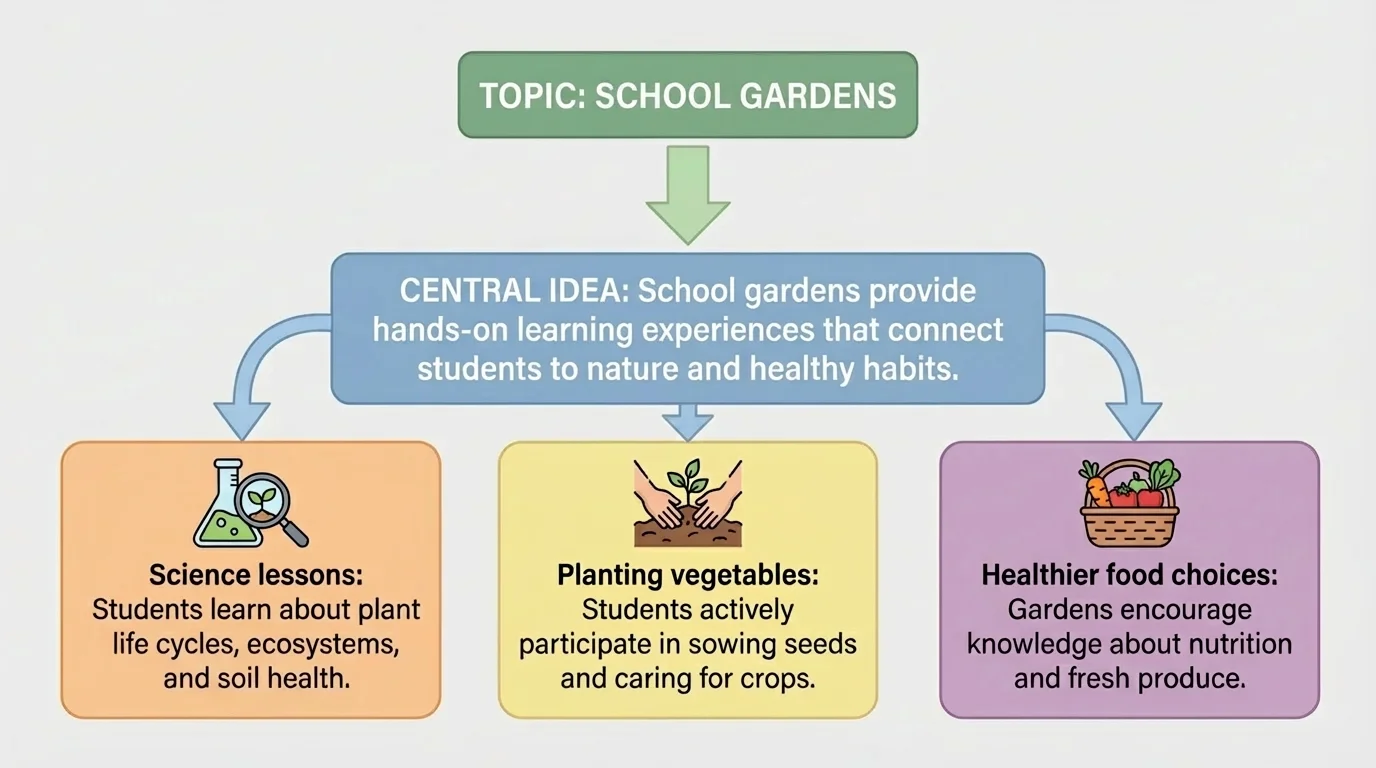
A good way to test whether you have found the central idea is to ask yourself, "Could most of the important details fit under this statement?" If the answer is yes, you probably have a strong central idea. If your statement is too broad or too narrow, it may need revision.
Sometimes the central idea is stated directly. An author may clearly say it in the introduction or conclusion. Other times, you must figure it out by putting clues together. That kind of smart reading is called making an inference. You infer the central idea when the author hints at it through details instead of writing it plainly.
Many strong nonfiction writers repeat a central idea in different ways instead of saying the exact same sentence over and over. Readers notice the pattern and build the big idea from those repeated clues.
That is why careful readers pay attention not only to what is said once, but also to what keeps showing up across the text.
Particular details are like clues in a mystery. A single clue may not tell you everything, but several clues together reveal the truth. In reading, those clues can include facts, examples, dialogue, descriptions, statistics, or events. They work together to show the text's meaning, as [Figure 2] illustrates through different kinds of details flowing toward one main idea.
Suppose you read a passage about a girl named Tasha who practices the violin every day, keeps going after making mistakes, and finally performs confidently at a concert. The central idea might be: Persistence helps people improve and succeed. The details that convey that idea are her daily practice, her mistakes, and her decision not to quit.
In an informational article about bees, you might read that bees pollinate crops, help flowers reproduce, and support food production. Those details together convey the central idea that bees are important to ecosystems and human agriculture.
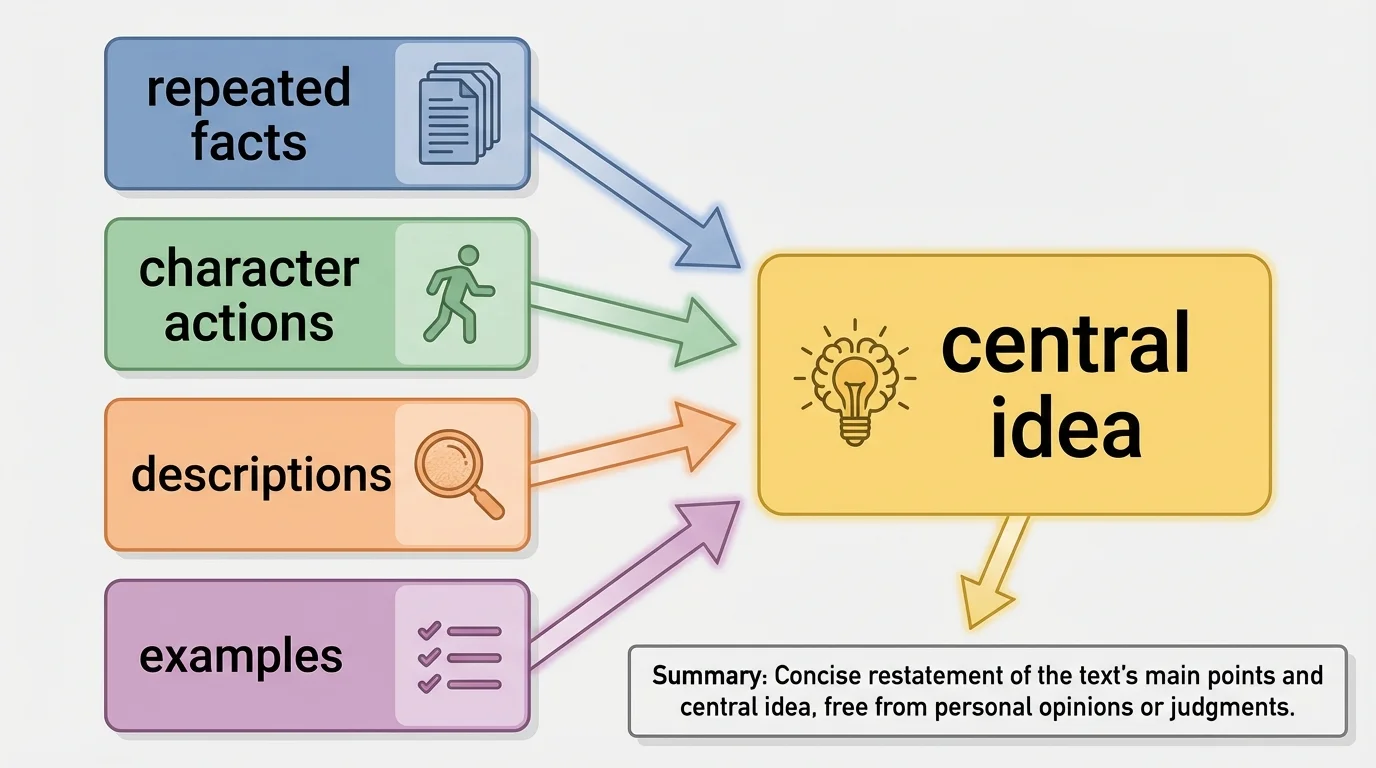
When several details connect, look for patterns. Ask questions such as: What keeps coming up? What do these details have in common? What lesson, message, or explanation are they building? Often, repeated ideas are a strong sign of the central idea.
Not every detail has equal importance. Some details are central, while others are minor. If a story mentions that a boy wears red shoes, that may not matter unless the shoes affect events or symbolize something important. If an article says a volcano erupted, caused ash clouds, and changed nearby communities, those details likely matter much more than the color of a scientist's jacket.
How readers connect details to meaning
Readers do not just collect details like objects in a box. They sort them. Important details connect to one another and point toward the same idea. Less important details may add flavor or description, but they do not carry the main message. The goal is to notice which details truly support what the text is saying overall.
This is also why a central idea should not be based on only one sentence from the text. A strong central idea grows from several parts working together. As you saw in [Figure 2], the most reliable answer comes from a pattern, not from one isolated clue.
In a story, play, or novel excerpt, the central idea often grows through plot, characters, setting, and conflict. Readers should pay attention to what characters want, what challenges they face, how they respond, and what changes by the end.
For example, imagine a short story about two friends who argue during a group project but later learn to listen to each other. The central idea might be: Cooperation becomes stronger when people respect one another's ideas. Details that convey this idea include the argument, the poor early results, the moment they begin listening, and the improved project.
Literary texts may also have more than one important idea. A story about moving to a new city could explore loneliness, courage, and belonging. When choosing a central idea, focus on the one most fully developed by the text. Ask yourself which idea is supported by the strongest and most repeated details.
Authors of literary texts also use symbolism, mood, and dialogue. If a character repeatedly watches birds flying free while feeling trapped by fear, those details may support a central idea about gaining courage. The meaning may not be announced directly, so readers need to think beneath the surface.
Informational texts usually develop the central idea through facts, explanations, examples, headings, diagrams, and quotations from experts. Here, the central idea often answers the question: What is the author teaching me?
Suppose you read an article about how extreme weather affects communities. The central idea might be: Communities can reduce damage from extreme weather by preparing ahead of time. Details that support this could include building stronger shelters, creating emergency plans, and practicing evacuation drills.
In a biography, the central idea may focus on a person's impact or achievements. A passage about Harriet Tubman might develop the central idea that she showed bravery and determination in helping others reach freedom. Specific details such as repeated rescue missions, dangerous travel, and leadership would convey that idea.
In a science text, the central idea may connect cause and effect. An article about plastic waste might explain that plastic pollution harms oceans because it injures animals and breaks down slowly. Details about sea life, floating trash, and long-lasting materials all build that idea.
Readers often already know how to identify a topic and key details. Finding the central idea builds on that skill. The next step is to explain what those details mean together, not just list them one by one.
This is the difference between simply noticing information and truly understanding it.
Once you know the central idea, you are ready to write a summary. A summary is shorter than the original text. It includes the most important points and leaves out minor details. Good summaries are based on the text, not on the reader's opinions. The process moves in clear stages, as [Figure 3] shows from first reading to final draft.
A strong summary usually does three things: it tells the central idea, includes a few key supporting details, and stays objective. It should be written mostly in your own words, though names and important terms from the text may stay the same.
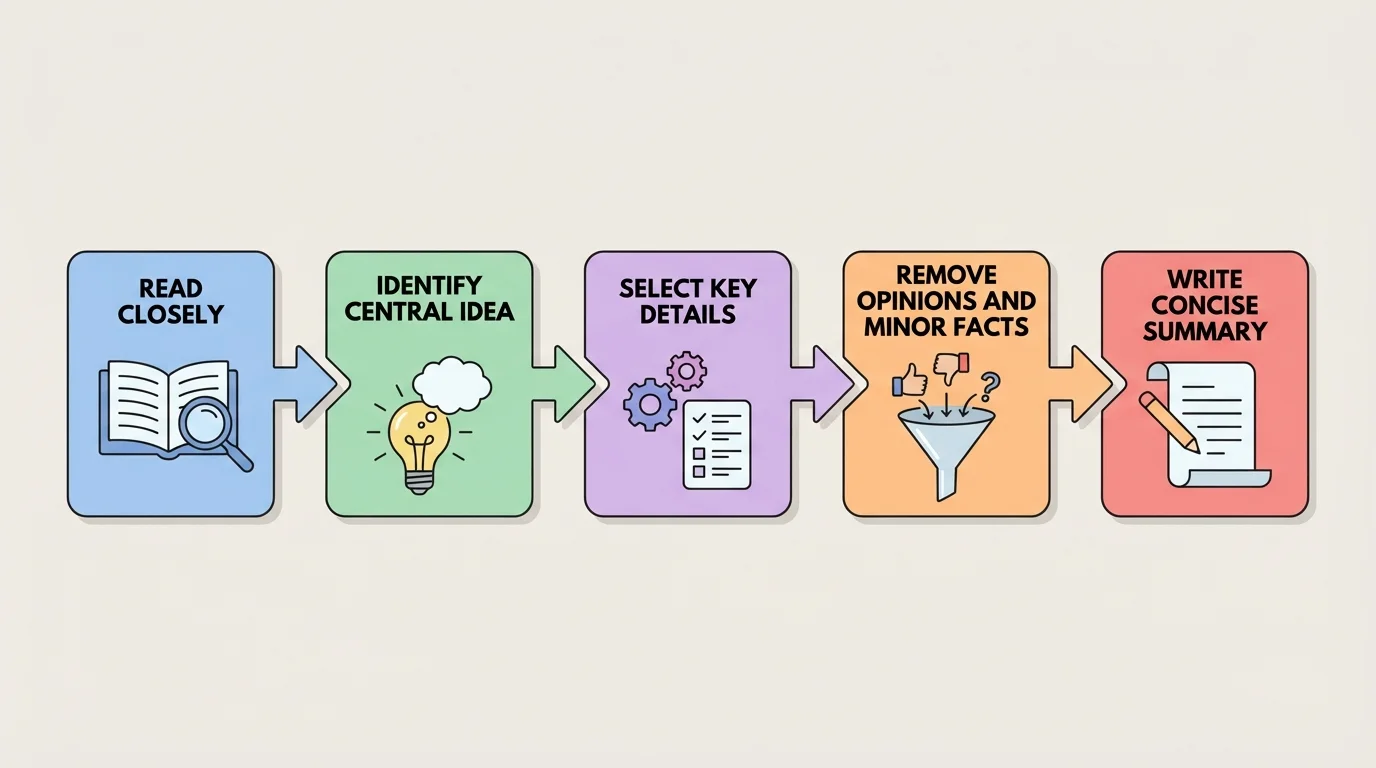
If the original text is long, your summary should not try to repeat every event or fact. Instead, choose the details that are most necessary for understanding the central idea. Think of a summary as a backpack: only the most useful items belong inside.
Example: From passage to summary
Suppose a text explains that a town created bike lanes, added safe crossings, and started a bike-share program. As a result, more people biked to school and work, traffic decreased, and pollution dropped.
Step 1: Identify the central idea.
The text is mostly saying that city planning can encourage biking and improve community life.
Step 2: Choose the most important details.
The important details are the new bike lanes, safer crossings, the bike-share program, and the results: more biking, less traffic, and less pollution.
Step 3: Write the summary in your own words.
A town encouraged more people to ride bikes by adding bike lanes, safe crossings, and a bike-share program. These changes reduced traffic and pollution while making biking a more common way to travel.
Notice what the summary does not include. It does not mention every street name, every person quoted, or every tiny statistic. It also does not say, "I think this is a brilliant plan," because that would be an opinion.
A helpful summary often begins with the subject of the text and then states the central idea. After that, it includes the most important supporting details. This makes the summary organized and easy to follow.
An objective summary must stay neutral. That means it should not include your personal feelings, likes, dislikes, or judgments about the text. Words such as "best," "boring," "awesome," "sadly," or "I believe" usually signal opinion instead of objective reporting.
Compare these two responses to a text about a young inventor.
| Response | Type | Why |
|---|---|---|
| The article explains how a student inventor designed a device to remind people to take medicine and tested it with feedback from users. | Objective summary | It states the main idea and key details without personal judgment. |
| I think the inventor is amazing, and her invention is much better than most adult ideas. | Opinion | It gives personal evaluation instead of summarizing the text. |
Table 1. Comparison of an objective summary and a personal opinion.
Even if you strongly agree or disagree with the text, save that reaction for a response or discussion, not for the summary itself. A summary should report the text faithfully.
"A summary tells what the text says, not what the reader thinks about it."
This rule matters because a summary should help someone understand the original text clearly, without mixing in extra judgment.
One common mistake is confusing the topic with the central idea. If you write only "dogs" or "space travel," you have named the subject, but you have not explained what the text says about it. Fix this by turning the subject into a full statement.
Another mistake is stuffing the summary with minor details. A list of every event in order can become a retelling instead of a summary. To fix this, ask which details are truly necessary to explain the central idea.
A third mistake is adding opinion. For example, "The character foolishly refuses help" may sound like summary, but the word "foolishly" is a judgment. A more objective version would be: "The character refuses help, which leads to more problems."
Readers also sometimes choose a central idea that is too narrow. If a story includes many scenes about teamwork, but you focus only on one argument, your answer may miss the bigger picture. Other times, readers choose an idea that is too broad, such as "life is hard." Better central ideas are specific enough to match the actual text.
Consider this short passage: A school noticed that many students threw away uneaten lunches. In response, students started a compost program, created a share table for unopened food, and taught younger classes about food waste. Within months, trash from the cafeteria dropped, and more students became interested in environmental action.
The central idea is not just "school lunch" or "trash." A stronger central idea is: Students can reduce waste and improve their community by taking organized action. Particular details convey that idea: the compost program, the share table, the lessons for younger students, and the decrease in cafeteria trash.
An objective summary could be: A school reduced cafeteria waste when students organized solutions such as composting, sharing unopened food, and teaching others about food waste. Their efforts lowered trash levels and encouraged broader environmental involvement.
Notice how this summary includes the big idea and the most important details while staying neutral. It follows the same process shown earlier in [Figure 3]: identify the central idea, choose the strongest details, and leave out personal reactions.
When you read closely, central idea and summary work together. First, you figure out what message the text builds. Then, you explain that message briefly and fairly. That is a powerful reading skill because it helps you understand not just what a text says, but what it means.
