Have you ever read an article that starts with one small fact and then suddenly grows into a much bigger story? A writer might begin with a young inventor fixing a broken toy, then add examples of other inventions, and finally explain how that person changed the world. Good readers notice that growth. They do not just ask, "What is this text about?" They also ask, "How does the author build my understanding?"
This skill matters in science articles, history writing, biographies, news stories, and essays. Informational texts are carefully built. Authors choose when to name a topic, when to show an example, and when to add more explanation. When you analyze how a key individual, event, or idea is introduced, illustrated, and elaborated, you are studying the author's design. You are figuring out how the text makes meaning.
Reading closely is a little like being a detective. A detective does not collect clues randomly. Instead, the detective asks how each clue fits the case. In the same way, a strong reader pays attention to how each detail fits the main subject of a text. This helps you understand not only what the author says, but also how the author helps the reader learn.
For example, suppose you read an article about sea turtles. The first paragraph may introduce the idea that sea turtles face danger from plastic waste. Later, the writer may illustrate that idea by describing a turtle trapped in a fishing net. After that, the writer may elaborate by explaining where ocean plastic comes from, how it harms animals, and what people are doing to help. If you notice this pattern, the article becomes clearer and easier to remember.
Introduce means to present a person, event, or idea for the first time. Illustrate means to make that subject clearer by using examples, anecdotes, facts, images in words, or comparisons. Elaborate means to expand the explanation by adding important details, causes, effects, evidence, or deeper discussion.
These three actions often work together. A text may introduce a subject quickly, illustrate it with one strong example, and then elaborate on it over several paragraphs. Sometimes writers repeat this pattern more than once, especially in longer articles.
Authors often build understanding in stages, as [Figure 1] shows. First they place the key subject in front of the reader. Then they make it more vivid and understandable. Finally, they deepen the reader's knowledge with explanation and evidence.
Think of building a treehouse. The introduction is like putting up the base. The illustration is like adding steps, rails, and windows so you can picture it clearly. The elaboration is like strengthening the structure and explaining how all the parts work together. Without the base, you do not know what is being built. Without the details, you cannot understand it fully.
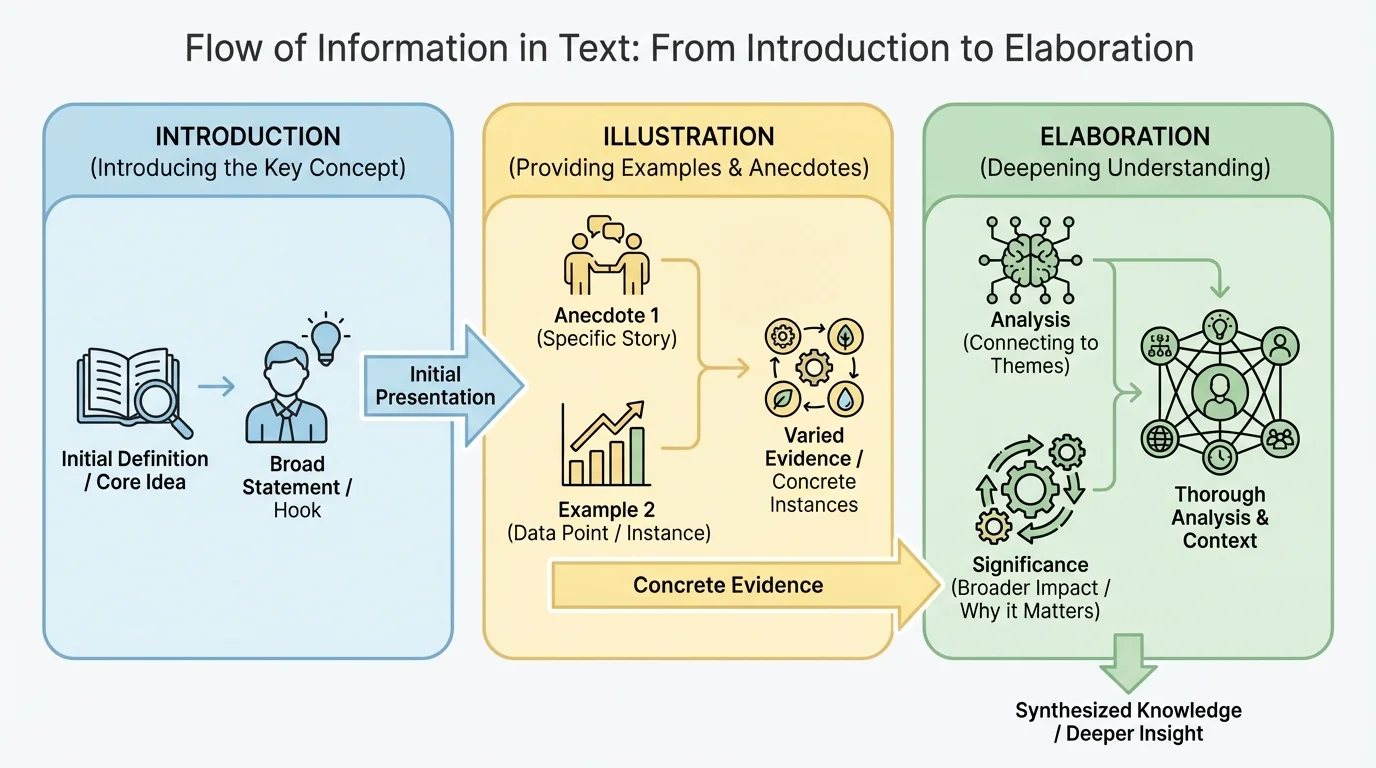
When you analyze a text, look for the moment a key subject first appears. Then ask what details make the subject clearer. After that, notice how later sentences or paragraphs add depth. This is more than retelling. It is analyzing development.
An author can introduce a person, event, or idea in several ways. Sometimes the author states the topic directly in the first sentence. Sometimes the author opens with a question. Sometimes the author begins with a surprising fact. In each case, the opening gives the reader a starting point.
For example, a biography might begin, "When Temple Grandin was a child, she saw the world differently from other people." Right away, the key individual is introduced. The reader knows who the text is about and is prepared to learn more. A science article might begin, "Bees help pollinate many of the foods people eat every day." That sentence introduces the main idea. A history text might begin, "The Great Fire of London changed the city forever." Now the key event is in focus.
Introductions often include one or more of these features:
The introduction does not usually explain everything. Its job is to begin the subject clearly enough that the reader can follow the rest of the text.
Some news articles introduce a topic in just one sentence and then spend the rest of the article unpacking that sentence. A short opening can lead to a very deep explanation.
That is why readers should not expect the first paragraph to do all the work. The opening points the way. The later details build understanding.
Once a topic is introduced, writers often make it clearer by adding examples. This is where the subject becomes more concrete. A reader stops seeing only a big idea and starts seeing how that idea works in real life.
An author may use an anecdote, which is a short story about a real person or moment. For instance, if a text is about the importance of clean water, the author may tell about one family who had to walk a long distance each day to get water. That small story illustrates the larger issue. It gives the reader a clear picture and often adds emotion.
Authors may also illustrate a point with:
Suppose a text says that volcanoes can reshape land. That statement introduces an idea. If the next paragraph describes lava hardening into new rock on an island, the author is illustrating the idea. The reader now has an example, not just a statement.
Illustration is important because many informational topics are large or abstract. A writer helps by zooming in. One anecdote, one example, or one case study can make a broad topic understandable.
After introducing and illustrating a topic, writers often go further. They add layers. They explain causes and effects. They describe why something happened, why it matters, and what resulted from it. This is elaboration.
Elaboration often answers questions such as: What led to this? What happened next? Why is this important? How does this connect to a bigger issue? These details deepen understanding.
Imagine a text about renewable energy. The author may introduce solar power, illustrate it by describing panels on a school roof, and elaborate by explaining how sunlight becomes electricity, how that reduces pollution, and how communities save money over time. The text is not just naming the topic anymore. It is developing it.
Analysis asks how the details work together. If you only list details, you are summarizing. If you explain how a detail helps introduce, illustrate, or elaborate the subject, you are analyzing. For example, saying "The article mentions one farmer" is summary. Saying "The farmer's story illustrates the larger problem of drought by showing its effects on one family" is analysis.
Elaboration often appears in later paragraphs, but not always. Skilled writers may elaborate early and then return to a new example later. That is why close readers keep asking how each detail connects to the key subject.
When the central subject is a person, readers should notice how the author presents that person at first and how the picture grows over time. A biography may begin with a single trait, such as bravery, curiosity, or determination. Later paragraphs may illustrate that trait with stories from the person's life and elaborate on it by explaining the person's impact.
For example, a text about Ruby Bridges might introduce her as the first Black child to attend an all-white elementary school in New Orleans. That introduction identifies the key individual and suggests why she is important. The text might then illustrate her courage by describing her walk into school while crowds shouted outside. Later, the author could elaborate by explaining how her actions became part of the larger civil rights movement.
Notice what happens here. The first detail tells who Ruby Bridges is. The anecdote shows what she experienced. The elaboration explains why her story matters beyond that one day. Strong reading connects all three parts.
When following a key individual, ask:
A key event usually unfolds over time, and readers can trace that development, as [Figure 2] illustrates, by noticing the setup, the event itself, and the results that follow. Events in informational texts are often explained through sequence, cause and effect, and impact.
Imagine an article about a town starting a recycling program. The author may first introduce the problem: too much trash was filling the local landfill. Then the writer may illustrate the event by describing the first community recycling day, including what people brought and how volunteers helped. Finally, the article may elaborate by explaining the results: less waste, cleaner parks, and new student projects at school.
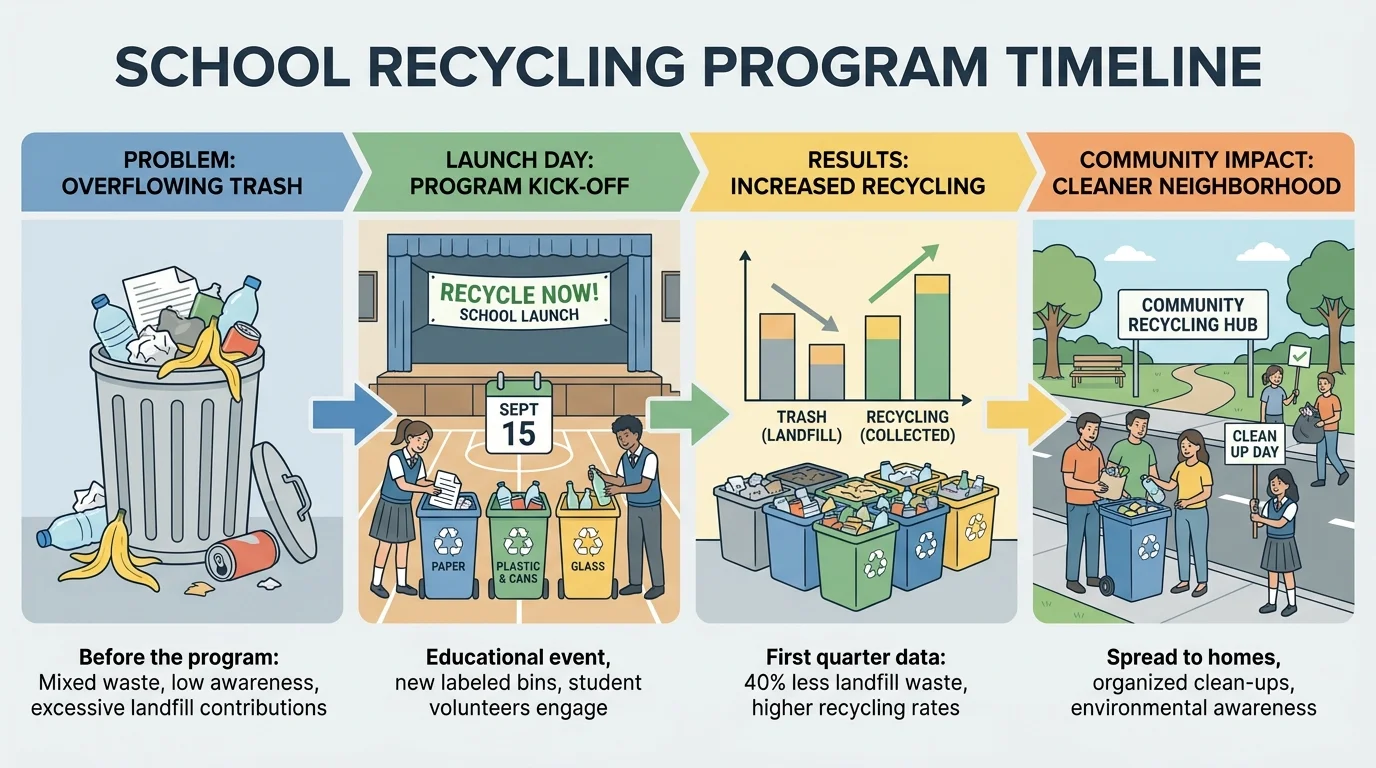
This pattern matters because events are not just isolated moments. They have causes and consequences. A reader who only notices the event itself misses the larger meaning.
History texts often develop events in exactly this way. A chapter on the Boston Tea Party, for example, may introduce rising tension over British taxes, illustrate the event through the action in the harbor, and elaborate by showing how the protest pushed the colonies closer to revolution.
When following a key event, ask:
Sometimes the most important subject in a text is not a person or an event, but a concept. A central idea may be something like teamwork, habitat loss, or the importance of sleep. Ideas are often harder to notice because they are not always named only once. They may appear in different forms across a text.
Suppose an article argues that sleep is essential for learning. The introduction may state that the brain needs rest to store memories. The illustration may come through an example of students who struggle after staying up too late. The elaboration may include an expert's explanation of how sleep helps focus, mood, and health. In this case, the key idea grows stronger as the text continues.
Readers should watch for repeated words, related details, and patterns in examples. These clues reveal the author's main message. Just as we saw earlier in [Figure 1], the text often moves from naming an idea to clarifying it and then expanding it.
The structure of a text gives powerful hints about how a subject is developed, and [Figure 3] shows several common patterns that authors use to organize key details. Structure is the way information is arranged. If you can identify the structure, you can better understand why details appear where they do.
Common structures in informational text include chronology, cause and effect, problem and solution, compare and contrast, and description. Each one helps introduce, illustrate, and elaborate in a slightly different way.
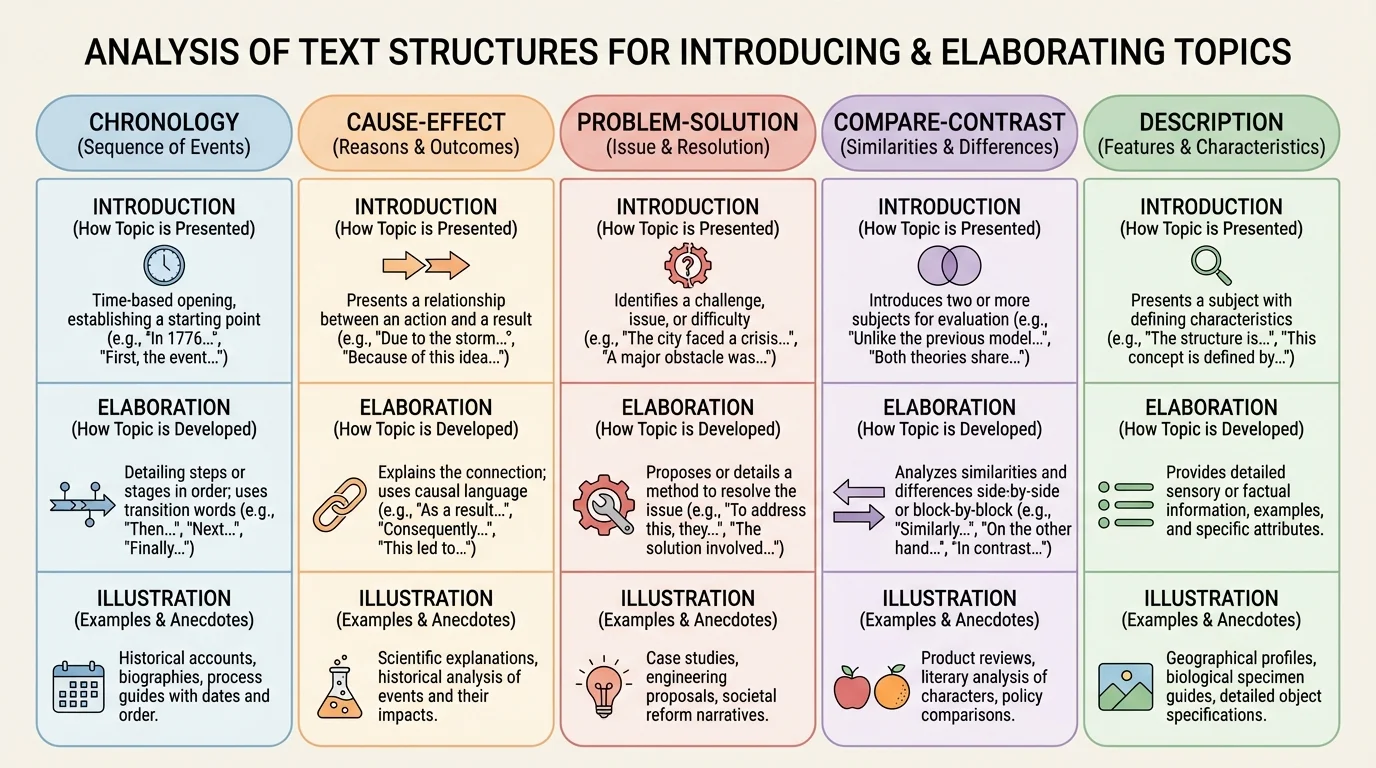
| Text Structure | How It Often Introduces | How It Often Illustrates | How It Often Elaborates |
|---|---|---|---|
| Chronology | Begins with an earlier moment | Shows events in order | Explains what happens over time |
| Cause and effect | Names a cause or problem | Gives examples of results | Explains deeper consequences |
| Problem and solution | Presents a challenge | Shows attempts to solve it | Evaluates results and limits |
| Compare and contrast | Names two subjects | Shows examples of similarities and differences | Explains why the comparison matters |
| Description | Identifies the topic | Provides key traits and examples | Adds precise details and supporting facts |
Table 1. Common informational text structures and how they help develop a key subject.
If a text uses chronology, the elaboration may come from what changes over time. If it uses cause and effect, the elaboration may come from showing how one action leads to many results. The structure helps the reader predict what kind of details to expect.
Close reading becomes easier when you ask strong questions while you read. These questions help you analyze development instead of just collecting facts.
Useful questions include:
These questions turn reading into active thinking. They also help when you need to discuss a text in class or write a response about it.
Remember that a main idea tells what a paragraph is mostly about, while a central idea often stretches across a whole text. The development of a key individual, event, or idea usually happens across several paragraphs, not just one sentence.
That is why analysis often sounds like this: "The author first introduces the topic by..., then illustrates it with..., and later elaborates by...." This kind of explanation shows that you understand how the text works.
One common mistake is confusing an interesting detail with the most important subject. A short story inside a text may be memorable, but it may only serve as an example. Ask yourself whether that detail is the focus of the text or whether it supports something bigger.
Another mistake is giving only summary. Summary tells what happened. Analysis explains how the author develops meaning. For example, "The article talks about a storm, damaged houses, and volunteers" is summary. "The article introduces the storm as a sudden disaster, illustrates its damage through descriptions of houses, and elaborates on recovery by showing how volunteers rebuilt the town" is analysis.
A third mistake is ignoring later paragraphs. Sometimes the deepest meaning of a text appears near the end, when the author explains why the topic matters. In the recycling example from [Figure 2], the launch day is important, but the long-term impact gives the event its full meaning.
Read this short model situation: An informational passage begins by stating that school gardens can improve learning. Next, it describes one class measuring plant growth and tasting vegetables they grew. Then it explains that school gardens can support science lessons, healthy eating, responsibility, and teamwork.
Here is how a reader can analyze it. The author introduces the key idea by stating that school gardens improve learning. The author illustrates the idea through a classroom example in which students measure plants and taste vegetables. The author elaborates on the idea by explaining several benefits, including science skills, health, and responsibility. The text moves from claim, to example, to deeper explanation.
Model analysis of an informational passage
Passage idea: "Community libraries are important."
Step 1: Identify the introduction.
The text introduces the idea by stating that libraries give communities access to books, technology, and learning spaces.
Step 2: Find the illustration.
The text illustrates the idea with an anecdote about a student who uses the library's computers to finish homework after school.
Step 3: Notice the elaboration.
The text elaborates by explaining that libraries also offer job help, language classes, and public events, which shows their wider value.
This analysis explains how the author builds understanding instead of only listing details.
You can use the same thinking with history, science, and current-events texts. In a history article, a small story may illustrate a much larger event. In a science article, a specific experiment may illustrate a broader idea. In a biography, one moment from childhood may help explain later achievements. Across all of these, the reader's job is to trace how the subject is introduced, illustrated, and elaborated.
When you read this way, texts become less like piles of facts and more like carefully built explanations. You begin to see the author's choices. You notice what comes first, what makes the topic vivid, and what deepens its meaning. That is the heart of strong informational reading.
