Have you ever heard two people tell the exact same story and noticed that it somehow sounded different both times? One person might focus on feelings, while the other focuses on facts. The same thing happens in books. When two authors write about the same person or the same event, readers often discover that the story is not just what happened. It is also how the author chooses to present what happened.
Strong readers do more than collect facts. They compare how texts work. They notice which events the author includes, which ones are left out, what order the events appear in, and what kind of language shapes the reader's understanding. This helps readers see not only the event itself, but also the author's choices.
Suppose one book is written by a famous athlete about her own childhood, and another comes from a historian writing about that same athlete's life. Both books may describe the same championship, the same injury, or the same hard decision. But the two books will not feel identical. One may sound personal and emotional. The other may sound more distant and explanatory.
That difference matters. Authors make decisions about what is important. They choose what to describe closely, what to mention briefly, and what to leave out. They also choose a tone, or attitude, toward the subject. As a result, two texts about the same events can lead readers to notice different meanings.
Memoir is a true account written by a person about part of his or her own life, usually focusing on important memories and experiences.
Biography is a true account of a person's life written by someone else.
Point of view is the position from which a story or text is told.
Tone is the feeling or attitude created by an author's word choices.
Emphasis is the special attention an author gives to certain details, ideas, or events.
When readers compare authors, they are not trying to decide that one text is automatically right and the other is wrong. Instead, they are asking thoughtful questions. Why did this author focus on these moments? Why does this text sound serious, proud, worried, or admiring? What does each version help us understand?
One major difference between authors is selection. Selection means choosing what to include. A memoir writer may spend three pages describing one small moment because it felt life-changing. A biographer may mention that same moment in only two sentences because the biographer is trying to cover many years of the person's life.
Another difference is emphasis. Even when both authors include the same event, they may stress different parts of it. A memoir might highlight fear, excitement, or confusion. A biography might highlight causes, effects, and historical background.
Authors also differ in tone. A memoir may sound intimate, proud, regretful, or reflective because the writer lived through the event. A biography may sound respectful, curious, or analytical because the writer is studying the subject from the outside.
Finally, authors often differ in the amount of detail they use. One author may describe the weather, the sounds in the room, and the subject's thoughts. Another may summarize the whole event quickly and move on to explain why it mattered. When readers compare texts, these differences reveal the author's purpose.
A memoir and a biography often present the same life through very different lenses, as [Figure 1] shows. In a memoir, the writer speaks from personal experience, often using first-person words such as I, me, and my. In a biography, the writer usually uses third-person words such as he, she, and the person's name.
This difference in point of view affects what readers learn. A memoir can reveal private thoughts, feelings, and memories. It can tell us what an event felt like from the inside. A biography can place the event into a broader picture. It may connect the event to history, family background, other people's opinions, or later achievements.
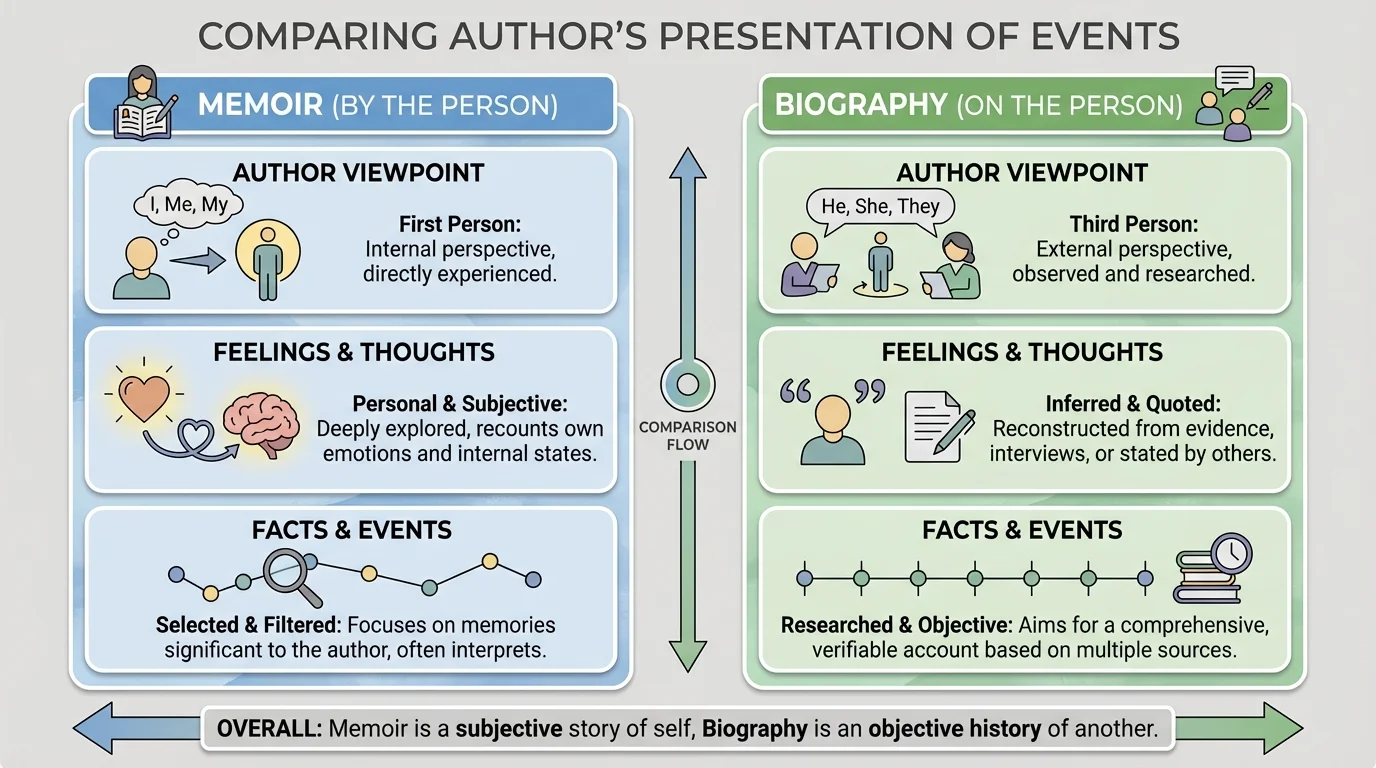
Neither type of text is automatically better. They simply offer different kinds of understanding. A memoir often gives readers emotional closeness. A biography often gives readers a wider view. When read together, they can help readers build a fuller picture of the same person and the same events.
| Feature | Memoir | Biography |
|---|---|---|
| Who writes it? | The person who lived the events | Another author |
| Usual point of view | First person | Third person |
| Main strength | Personal thoughts and feelings | Outside research and broader context |
| Possible focus | Important memories or selected experiences | A person's life story or major life periods |
| Common effect on reader | Feels immediate and personal | Feels informative and more distant |
Table 1. A comparison of common features of memoirs and biographies.
When readers return to a comparison later, [Figure 1] still helps them remember a key idea: one author may stand inside the event, while another stands outside it. That difference changes not just the words on the page, but the meaning readers build from those words.
Some people become famous enough that many different authors write about them. Reading several versions can show how one life story changes depending on who tells it and why.
That is why comparing texts is such a powerful reading skill. It teaches readers to look at writing as a set of choices, not just a list of facts.
One of the best ways to compare authors is to look closely at one shared event, as [Figure 2] illustrates. Consider a young scientist who failed an important school exam before later becoming successful. A memoir version and a biography version might both include that failure, but they may shape it differently.
In a memoir, the scientist might write something like this: I felt embarrassed when I saw the score. I thought I had disappointed everyone. That afternoon, I sat alone and decided I would not quit. This version centers on emotion, memory, and the moment of decision.
In a biography, the author might write something like this: At age twelve, she failed the regional exam. Family members later said this disappointment pushed her to study more seriously. By high school, her grades had improved greatly. This version gives outside information and shows consequences over time.
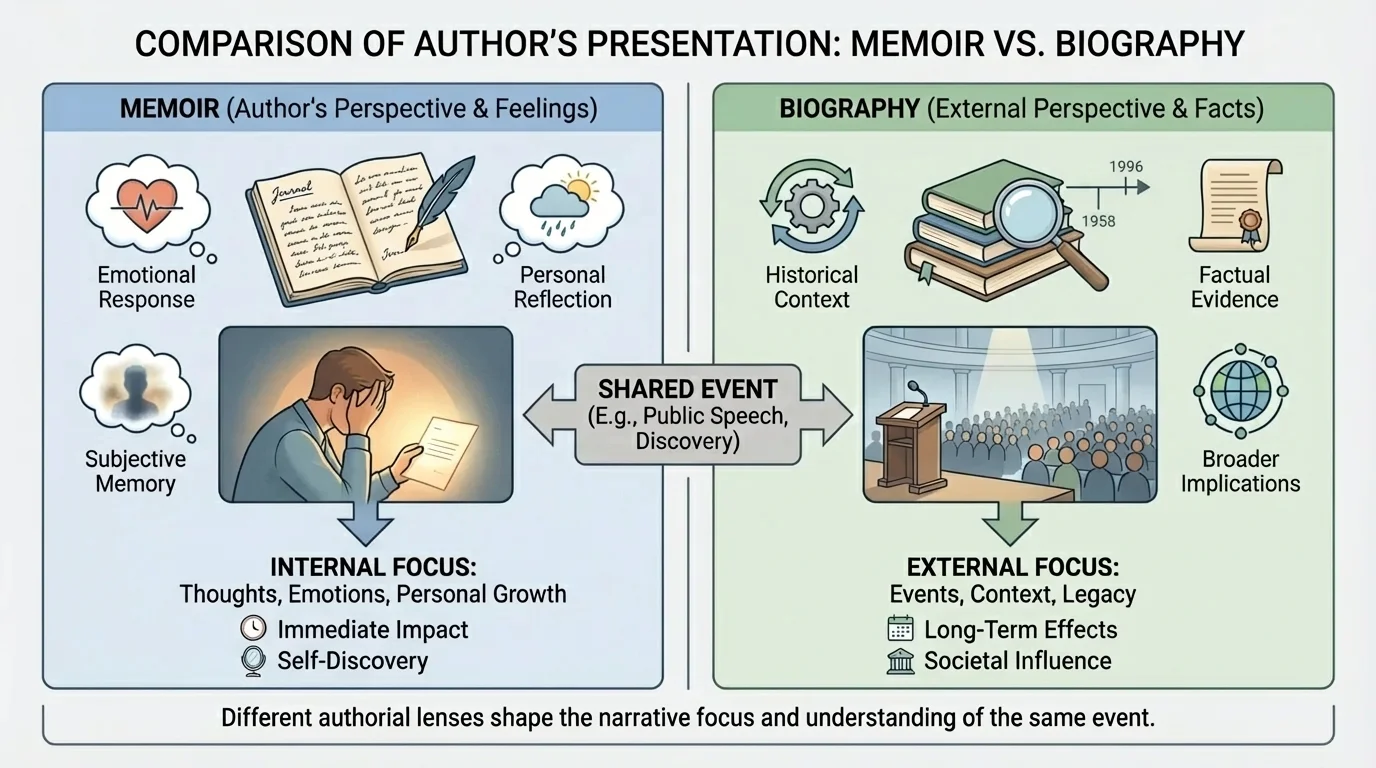
Notice that both versions may be true. Yet they do different work. The memoir helps readers feel the event from the inside. The biography helps readers understand the event in relation to the person's larger life story.
Case study: Comparing one event in two texts
Suppose both texts describe a civil rights leader riding a bus to school during a time of unfair laws.
Step 1: Notice the memoir-style focus.
The writer may describe the heat on the bus, the silence, the fear, and the exact thought running through the person's mind.
Step 2: Notice the biography-style focus.
The biographer may explain the laws of the time, quote newspaper records, and show how this daily experience influenced the leader's later actions.
Step 3: Compare the effect.
The memoir creates emotional closeness. The biography builds historical understanding. Together, they deepen the reader's understanding of the same event.
When readers compare these versions, they should pay attention to exact words. Is the event described as crushing, motivating, unfair, ordinary, shocking, or important? Word choice shapes the reader's response. The side-by-side view in [Figure 2] makes it easier to notice these differences in focus.
An author's interpretation is the understanding or explanation the author gives to events. Even when authors agree on the basic facts, they may interpret those facts differently. One author may present an event as a turning point. Another may present it as only one small step in a much larger journey.
Authors also write for different audiences. A memoir may be written for readers who want inspiration or personal truth. A biography may be written for readers who want a carefully researched account. Audience affects what the author explains, what background is included, and what style is used.
Another important idea is reliability. A memoir writer may remember feelings very clearly, but memory can sometimes be incomplete. A biographer may gather information from interviews, letters, photographs, and records, but the biographer still has to decide which sources matter most. Good readers understand that all nonfiction writing involves choices.
Different authors can be accurate and still be different. Accuracy means staying truthful to evidence and real events. Difference means choosing different details, tone, structure, and meaning. Comparing texts helps readers see both truth and perspective at the same time.
This does not mean readers should trust nothing. It means readers should read carefully. They should ask what kind of understanding each text offers and what each text may leave less fully explained.
When readers compare two authors' presentations of events, they often ask a set of useful questions. These questions help them move beyond "They are different" to a much stronger analysis.
They may ask: Who is telling this account? What is the author's relationship to the events? Which details appear in both texts? Which details appear in only one text? What feelings does each text create? What seems most important in each version? How does each author want readers to understand the event?
Readers should also look for evidence. A strong comparison uses details from the texts, not just opinions. For example, instead of saying, "The memoir is better," a stronger idea would be, "The memoir presents the event as more emotional by including the writer's private thoughts, while the biography presents it as more historical by connecting it to other events."
When you compare texts, you are looking for both similarities and differences. Similarities help you see the shared event clearly. Differences help you understand each author's choices.
Careful comparison is a thinking skill used far beyond language arts. Historians compare sources. Journalists compare accounts. Scientists compare reports from different observers. Learning this skill now helps build strong reading habits for every subject.
Not all differences come from word choice. Authors also shape meaning through structure, or the way a text is organized. As [Figure 3] shows, one author may tell events in strict time order, while another may begin with an exciting later moment and then jump back to explain earlier events.
A memoir often uses structure to reflect memory. The writer may begin with a powerful scene and then move backward to show how it happened. A biography often follows a clearer chronological path, especially when the goal is to explain a person's life over many years.
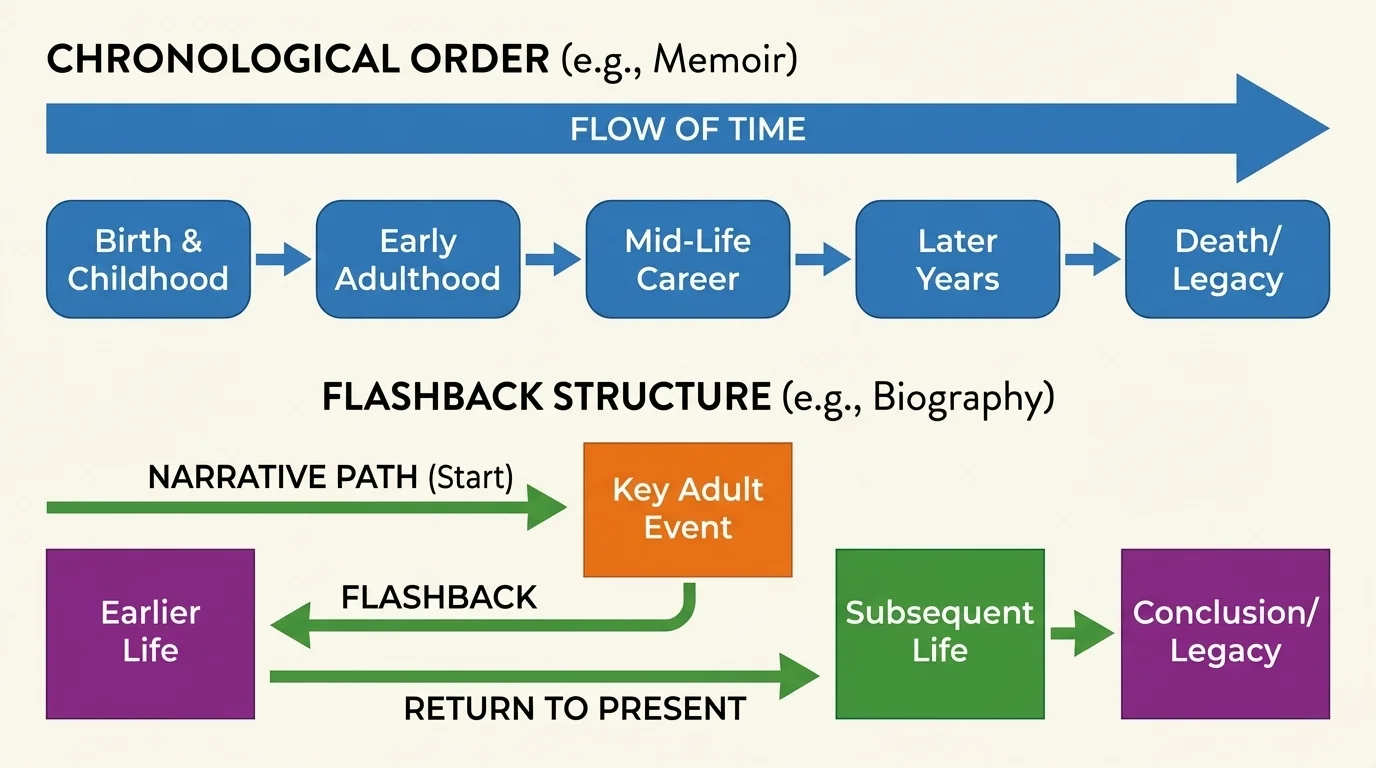
These structural choices affect reading. A chronological structure can help readers follow the sequence of events easily. A flashback structure can create suspense or highlight the importance of one key memory. The order changes how readers experience the same information.
Organization within chapters matters too. One author may group events by theme, such as family, school, and work. Another may group them by time period. One may include many quotations from people who knew the subject. Another may focus more on narration. Structure is not just a container. It helps create meaning.
Later, when readers compare how events unfold, [Figure 3] remains useful because it shows that order itself sends a message. Beginning with a dramatic moment tells readers, "This event is especially important." Beginning at the start of childhood tells readers, "To understand the person, we need to build the story step by step."
After examining details, tone, point of view, and structure, readers should be able to express a clear comparison. A strong comparison statement names both texts, identifies a shared event or topic, and explains an important difference in presentation.
For example, a clear statement might say: Both authors describe the singer's first public performance, but the memoir presents it as a frightening personal memory, while the biography presents it as the beginning of a public career. This works because it compares the same event and explains how the presentation differs.
Another strong statement might say: Although both texts include the injury, the memoir emphasizes pain and doubt through first-person reflection, while the biography emphasizes recovery and long-term impact through outside facts and dates. This kind of statement helps readers communicate their thinking clearly and precisely.
"The same event can tell more than one truth when different authors choose different angles."
Good comparison writing often uses words and phrases such as both, however, in contrast, similarly, while, and on the other hand. These signal words guide the reader through the relationship between the two texts.
The most important goal is not just to spot differences. It is to explain why those differences matter. When one author makes an event feel personal and another makes it feel historical, readers gain a deeper understanding than either text could provide alone.
