Have you ever watched a movie and thought, "Everything changed because of that one moment"? Great stories work that way. A character might lose something important, discover a secret, make a mistake, or face a fear. Each event pushes the next one forward. At the same time, the character reacts, and those reactions help us understand who that person is becoming.
When readers describe how a plot unfolds, they explain what happens and in what order. When readers explain how characters respond or change, they focus on how the people in the story think, feel, speak, and act as those events happen. These two ideas belong together. Plot is not just a list of events, and character is not just a list of traits. In strong reading, we connect the two.
A story is more than action. If a hero climbs a mountain, that event matters. But it matters even more if the climb shows courage, fear, stubbornness, or growth. In a drama, a scene may seem simple, like two people talking at a table. Yet that conversation might reveal a secret, change a friendship, or lead to the final conflict.
Readers make meaning by noticing patterns. What problem sets the plot in motion? What events come next? Why does one episode lead to another? How does the main character respond each time? By asking these questions, we understand not only what happened, but why it matters.
Plot is the sequence of events in a story or drama. A character is a person, animal, or other figure in the story or drama. A resolution is the part where the conflict is settled or the story reaches its ending. An episode is one connected part or section of the larger story.
Sometimes a character changes a lot. Sometimes the character stays mostly the same, but our understanding of that character becomes deeper. Both are important. A reader should be able to explain the events of the plot and how those events reveal or affect the characters.
[Figure 1] Many stories follow a shape that readers can trace. The plot usually begins by introducing the setting, the characters, and the situation. Then a problem appears. That problem starts the movement of the story.
The first part is often called the exposition. This is where readers learn important background information. After that comes the rising action, where the conflict grows through a series of events. The most intense turning point is the climax. After that, the story moves into the falling action, and then reaches the resolution.
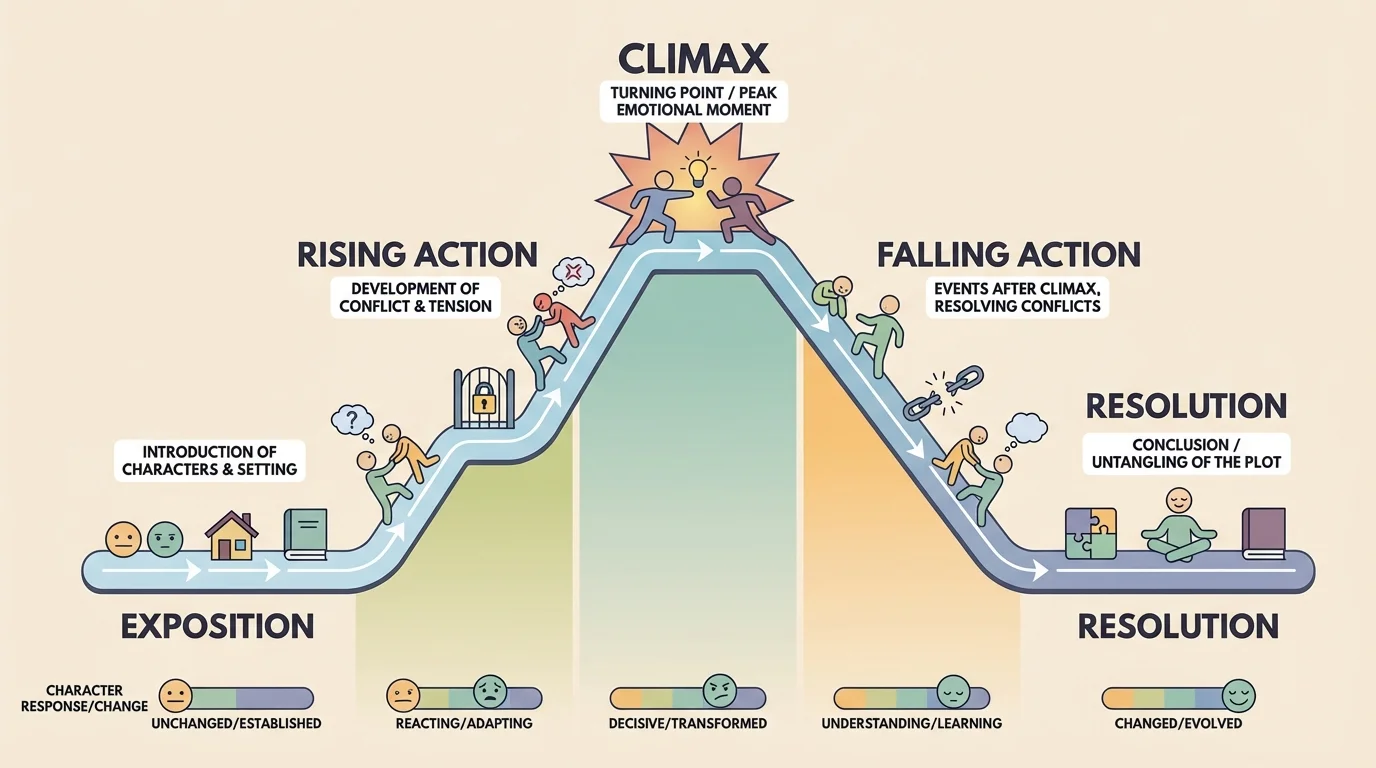
These parts are not just labels to memorize. They help readers explain how the story unfolds. For example, in the exposition, readers ask, "Who is involved? Where is this taking place? What is normal at first?" In the rising action, they ask, "What events build the problem?" At the climax, they ask, "What moment changes everything?" At the resolution, they ask, "How is the conflict resolved, or what final result do we see?"
Not every text follows exactly the same pattern, but many stories do. In longer stories, there may be several smaller problems inside the larger plot. In drama, the climax might come during a major argument, a confession, or a bold choice on stage. Even if the structure looks a little different, readers can still trace how the action develops toward an ending.
Plot is a chain of cause and effect. In a strong story, one event leads to another. A lost key leads to a search. The search leads to a discovery. The discovery leads to a decision. This cause-and-effect pattern helps readers explain why the plot unfolds the way it does instead of feeling random.
When you describe plot well, you do not simply retell everything. You choose the key episodes that push the story from beginning to middle to end. That is what makes a description clear and meaningful.
[Figure 2] Some plots are easiest to understand when we break them into a series of episodes. An episode is one part of the action that has its own focus, but also connects to the whole story. In a novel, an episode might be a chapter or a group of scenes. In a drama, it might be a scene or set of scenes centered on one event.
Think of episodes like stepping-stones across a river. Each stone is separate, but you need all of them to get across. In the same way, each episode moves the story closer to its ending.
For example, a story about a student entering a robotics contest might unfold like this: first, the student hears about the contest; next, the student builds a machine that fails; then, a friend offers help but an argument happens; after that, the student repairs the robot and competes; finally, the student learns something important whether or not the team wins. Each episode has its own event, but together they create one full plot.
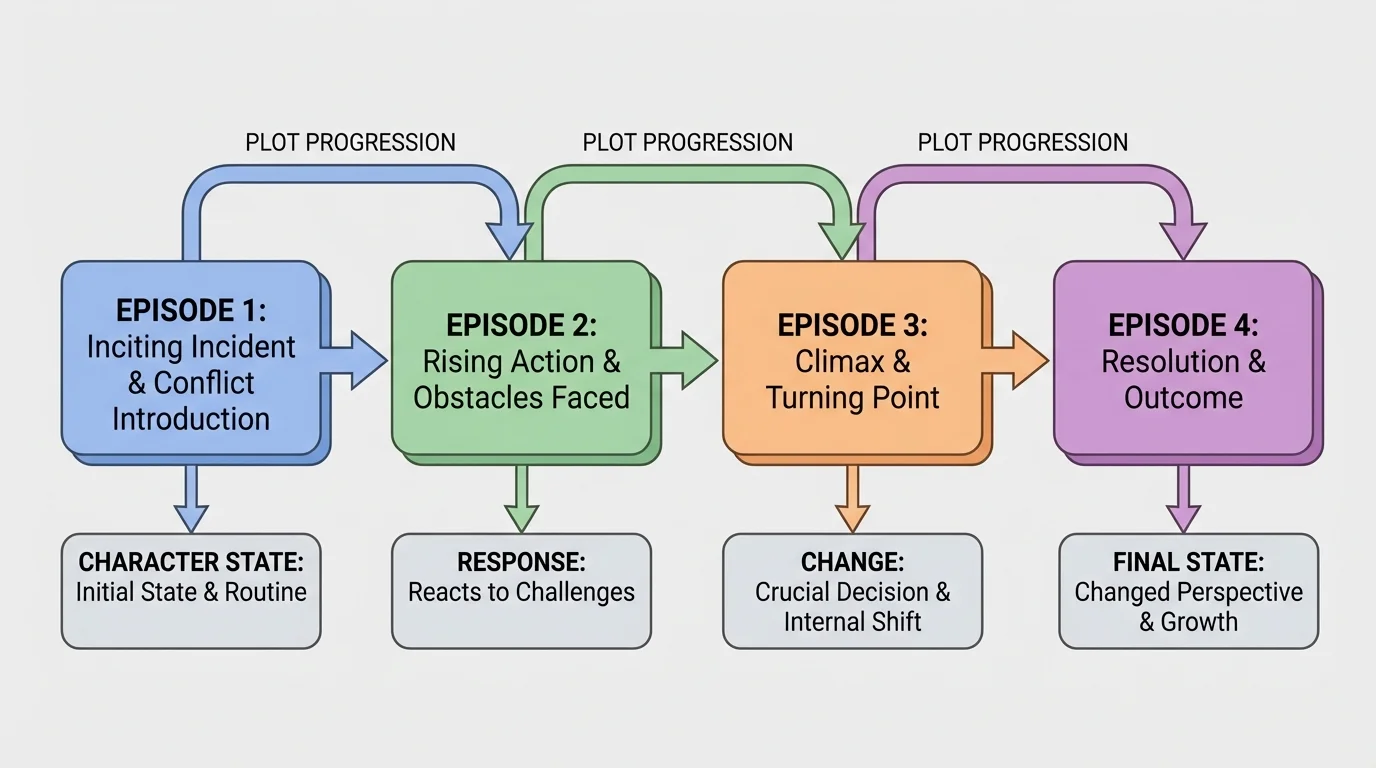
Episodes help readers stay organized. Instead of saying, "A lot of things happen," a strong reader can explain, "First this event introduces the problem. Next this episode makes the conflict worse. Then this scene creates the turning point. Finally, the last episode shows the resolution."
This matters in dramas too. A play often unfolds scene by scene. One conversation may plant an idea. The next scene tests it. Another scene creates conflict. By the end, the audience sees how those episodes build toward the final outcome.
A character response is how a character reacts to what happens. Readers pay attention to actions, words, thoughts, and feelings. If a storm destroys a family's home, one character may panic, another may stay calm, and another may try to help neighbors. The same event can reveal very different personalities.
Responses show motivation. Motivation is the reason behind what a character does. A character who lies may be trying to protect someone, avoid punishment, or gain power. A character who refuses help may feel proud, afraid, or ashamed. Readers look beyond the action itself and ask what the response tells us.
Authors reveal responses in many ways: dialogue, facial expressions, decisions, inner thoughts, and interactions with other characters. In a drama, readers and viewers often learn through spoken lines, stage directions, and the way characters behave during a scene. If a character says, "I'm fine," but the stage direction shows trembling hands, the response is more complicated than the words alone suggest.
Some of the most memorable characters are not the strongest or smartest. They stand out because their responses feel believable. A frightened character who chooses to act anyway often feels more real than a character who never struggles at all.
As the plot moves forward, responses often change. At first, a character may avoid a problem. Later, the same character may face it directly. That shift helps readers see growth.
[Figure 3] Readers compare a character at the beginning, middle, and end of a text. A character may change in feelings, beliefs, relationships, confidence, or goals. This is called character development.
Change can be external or internal. External change means something on the outside changes, such as a new home, a lost job, or a broken friendship. Internal change happens inside the character, such as learning patience, becoming braver, or understanding another person better.
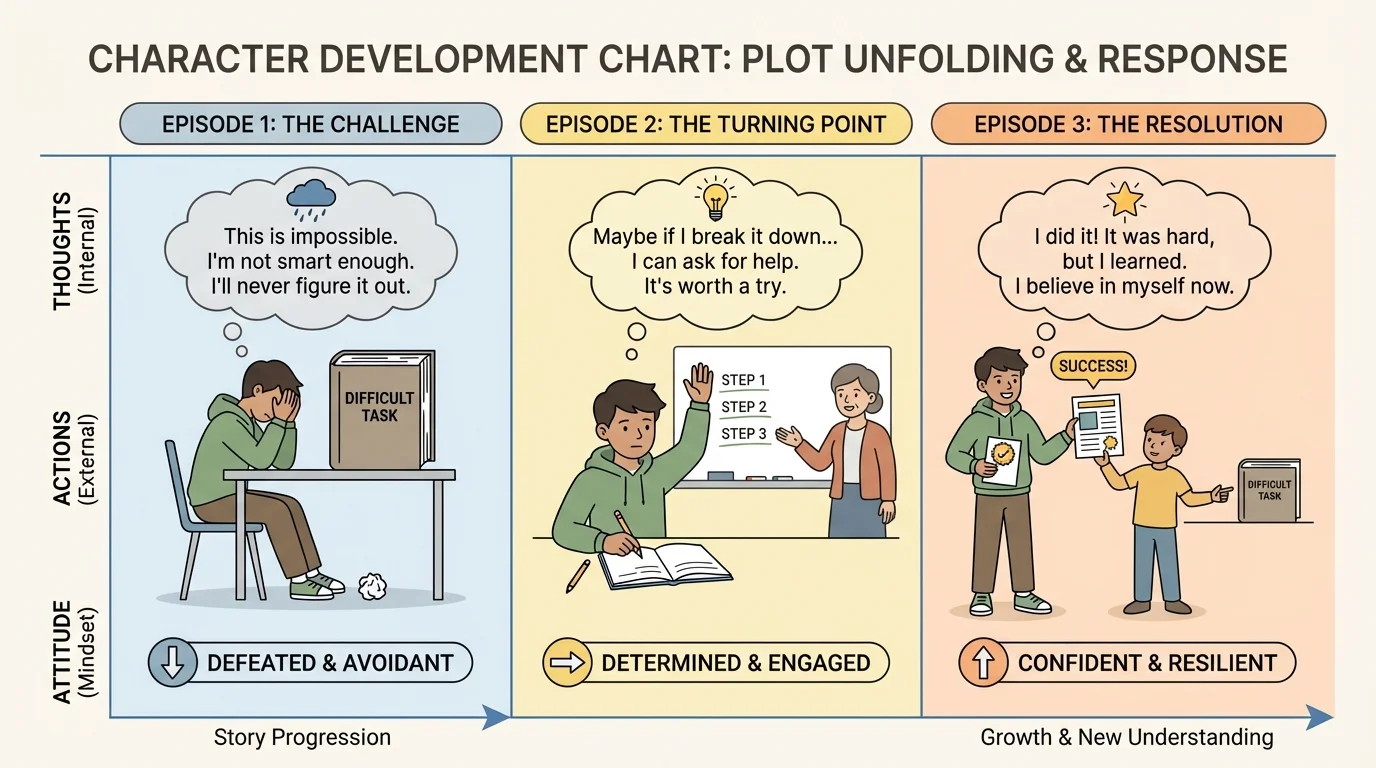
Not every character improves. Sometimes a character becomes more selfish, more fearful, or more dishonest. Sometimes a character refuses to learn and ends up alone or defeated. Readers should avoid assuming that all change is positive. The important question is whether the text shows a clear shift.
Sometimes the most important point is that a character does not change. A steady, loyal character may remain kind and brave even when everything becomes difficult. In that case, the events of the plot test that character's values instead of changing them.
Tracking character change in a simple story
A girl named Talia is afraid to speak in front of groups, but she must present her team's science project.
Step 1: Beginning of the plot
Talia avoids attention and hopes someone else will present. This response shows fear and low confidence.
Step 2: Middle episodes
Her teammates depend on her because she understands the project best. She practices, makes mistakes, and gets encouragement.
Step 3: Turning point
When another teammate gets sick, Talia chooses to present. Her response changes from avoidance to responsibility.
Step 4: Resolution
Even if she still feels nervous, she speaks clearly and completes the presentation. She has not become a completely different person, but she has grown more confident and brave.
This example shows that character change is often gradual, not sudden.
When you describe character change, it helps to use words like at first, later, as a result, and by the end. These words connect the development of character to the movement of the plot.
A drama tells its plot through action and dialogue that are meant to be performed. Instead of long descriptions from a narrator, readers often learn from scenes, stage directions, and what characters say to each other. That means readers must pay close attention to what happens in each scene and how each scene affects the next.
In a play, one episode may end with a question, a conflict, or a decision. The next episode shows the result. For example, if one scene ends with a promise, the next scene may reveal whether the promise is kept or broken. This is another way the plot unfolds in a series of episodes.
Character change in drama can be powerful because the audience sees it happen through performance. A character's voice, posture, and silence can reveal change just as much as spoken words. The structure may be divided into acts and scenes, but the same reading skill applies: identify key episodes, then explain how those episodes affect the characters.
Conflict is the struggle or problem in a story. It may be between two characters, between a character and nature, between a character and society, or even inside the character's own mind. Conflict drives the plot forward and often causes character change.
As we saw earlier in [Figure 2], scenes and episodes connect like links in a chain. In drama especially, one choice in one scene can shape everything that follows.
Consider Cinderella. The plot unfolds in clear episodes: Cinderella is mistreated at home, she is helped by magic, she attends the ball, she leaves behind the glass slipper, and the prince searches for the person who fits it. These episodes move step by step toward the resolution. Cinderella's responses also matter. She remains patient and hopeful even when treated unfairly. Her kindness does not disappear during the conflict. By the end, her situation changes, and her steady character is rewarded.
Now think about A Christmas Carol. Scrooge begins as cold, selfish, and uncaring. The story unfolds through episodes involving the visits of the spirits. Each visit reveals something different: his past, his present behavior, and his possible future. These episodes build toward a climax in which Scrooge faces the results of his choices. By the resolution, he changes greatly. He becomes generous and compassionate. Here, the plot episodes directly cause character change.
A drama example might involve a student in a school play who lies about breaking a prop. In the first scene, the lie protects the student from punishment. In the next episode, a friend is blamed. Then the guilt grows, and the student must decide whether to confess. The climax happens when the truth is revealed or admitted. The resolution shows whether trust is repaired. The important reading work is to explain both the order of events and the student's changing responses: fear, guilt, honesty, and responsibility.
Model literary analysis
Here is a strong way to describe plot and character together:
In A Christmas Carol, the plot unfolds through a series of ghostly visits that force Scrooge to examine his life. Each episode reveals a new truth about his past actions and future consequences. At first, Scrooge responds with anger and resistance, but as the plot moves toward the resolution, he becomes frightened, reflective, and finally generous. His change is important because it shows that the events of the story do not just happen around him; they transform him.
Notice that this kind of explanation does more than retell. It names the episodes, connects them, and explains how the main character changes because of them.
Strong readers look for patterns. They notice when a small event early in a story becomes important later. They watch how a conflict grows across episodes. They compare the plot mountain from [Figure 1] to the actual events in the text and ask where the turning point happens. They also compare the character at different points, much like the progression shown in [Figure 3], to decide whether the character has changed, stayed steady, or become more fully understood.
They also use evidence. If you say a character becomes brave, you should be able to point to the events and responses that prove it. If you say the plot unfolds through three major episodes, you should be able to name them and explain how each leads to the next.
One helpful way to think is this: event, response, result. An event happens. A character responds. That response creates a result, which leads to the next event. This pattern repeats until the resolution. When readers notice this chain, stories become clearer and more meaningful.
Describing plot and character this way helps you understand any kind of literature, from folktales and novels to scripts and plays. It turns reading into something more than following action. It becomes a way of seeing how people, choices, and consequences fit together inside a text.
