Two people can watch the same soccer game, school assembly, or thunderstorm and tell completely different stories about it. One person might say it was exciting. Another might say it was scary. A third might focus only on one important moment. Writers use that same idea in literature. The way a story or poem is told depends on who is telling it and how that voice sees the world. Learning to notice that voice helps you understand a text more deeply.
When you read, you are not just collecting facts about what happens. You are also noticing how those events are presented. If a character narrates a story, that character may sound proud, nervous, angry, or confused. If a poem has a speaker, that speaker may sound hopeful, lonely, or amazed. Those feelings and opinions shape the text. They help readers decide what is important, what is believable, and what the larger message may be.
An author does not choose a point of view by accident. Point of view is a craft choice. It helps create suspense, humor, mystery, sympathy, and even surprise. For example, if a story is told by a child, readers may notice details an adult narrator would ignore. If a poem is spoken by someone remembering the past, the speaker may focus on memory and emotion instead of exact facts.
Point of view is the position or perspective from which a story or poem is told. A narrator is the voice that tells a story, and a speaker is the voice that speaks in a poem. The author is the real person who wrote the text, but the narrator or speaker is the voice created inside the text.
This difference matters. The author creates the text, but the narrator or speaker may have opinions and feelings that are not the same as the author's own. Good readers keep those roles separate.
Point of view is more than whether a story uses words like "I" or "he." It includes the narrator's or speaker's thoughts, attitudes, and way of seeing events. A narrator may be brave, jealous, cheerful, or sarcastic. A speaker in a poem may sound quiet and reflective or excited and energetic. These qualities affect every line.
When you explain point of view, you should think about questions like these: What does the narrator or speaker notice? What feelings come through? What opinions are clear? What is left out? How does the voice guide the reader?
Remember that theme is the message or idea a text explores, while point of view is the position from which the text is told. Point of view often helps reveal theme, but the two are not the same.
A useful way to think about point of view is this: it is the lens through which the reader experiences the text. Just as a camera angle can make a scene feel close-up or far away, point of view changes what readers can see and feel.
Stories can use different narrator types, and each one changes the reading experience, as [Figure 1] illustrates. The narrator type affects what readers know, how close they feel to characters, and how much information the author can reveal at one time.
First-person point of view uses words like "I," "me," and "my." The narrator is inside the story and tells events from a personal perspective. Readers learn that narrator's thoughts directly, but they do not automatically know what other characters are thinking.
Third-person limited point of view uses words like "he," "she," or "they," but it stays close to one character's thoughts and feelings. Readers often know what that one character knows and may be surprised by information outside that character's understanding.
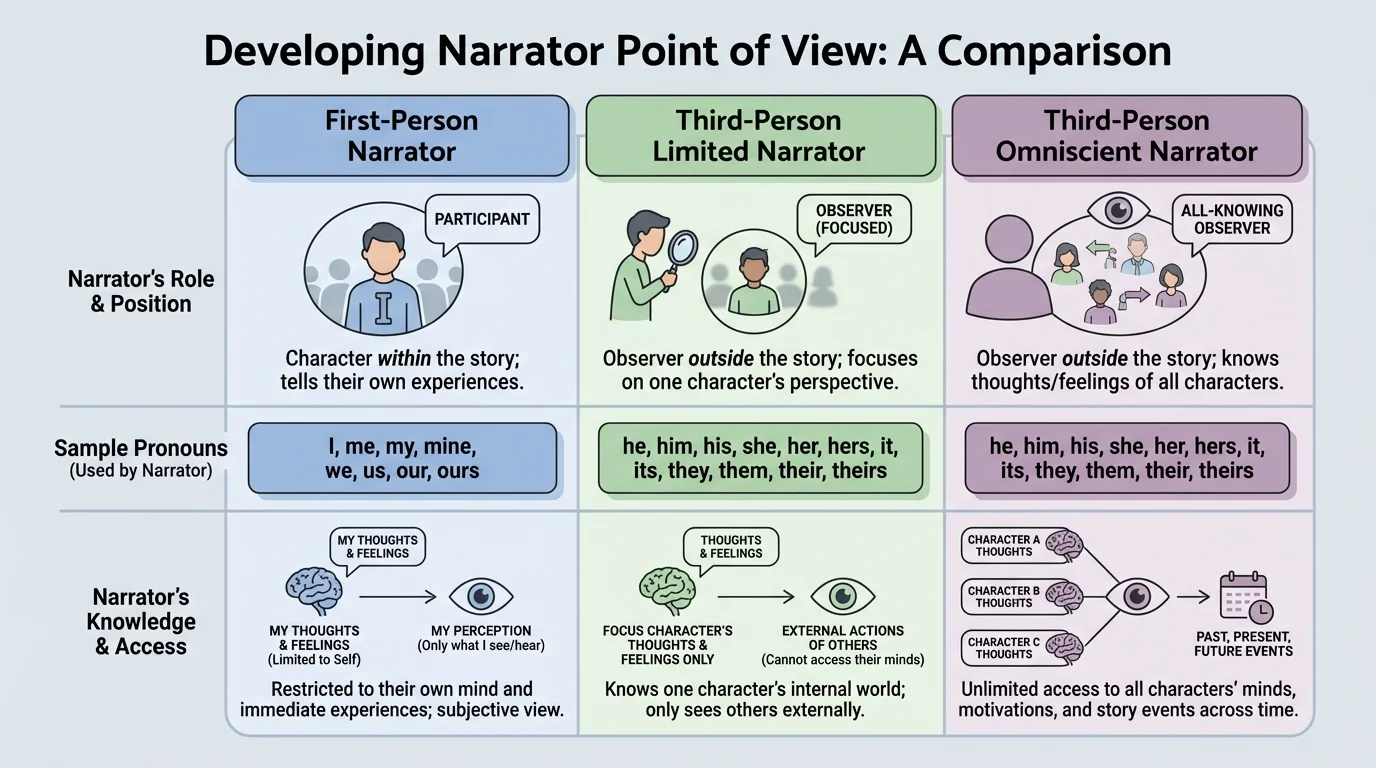
Third-person omniscient point of view also uses "he," "she," or "they," but the narrator can reveal the thoughts and feelings of multiple characters. This allows a wider view of events.
Poems usually do not have narrators in the same way stories do. Instead, they have a speaker. The speaker may be a child, an adult, a traveler, a friend, or even something unexpected, like an animal or the wind. Readers ask: Who is speaking? What does this voice feel? How does the poem reveal that perspective?
As you compare these narrator types, notice that point of view is not just a label. Saying "first person" is only the beginning. Strong analysis explains how that choice shapes the reader's understanding, as shown in [Figure 1].
Authors build point of view through several craft choices working together, and [Figure 2] shows how a single event can be shaped by thoughts, word choice, and selected details. A narrator's or speaker's perspective develops over the course of a text; it is not usually stated in one simple sentence.
One major tool is word choice. The exact words used by the narrator or speaker can reveal attitude. Compare these two lines: "The old house stood at the end of the road" and "The crooked, shadowy house crouched at the end of the road." The second version sounds more fearful because of the words "crooked," "shadowy," and "crouched."
Another tool is access to internal thoughts. If readers hear a narrator's worries, hopes, or doubts, they understand the world through that mind. In first-person and third-person limited narration, this can make the point of view feel close and personal.
Authors also develop point of view through selected details. A narrator who focuses on broken windows, strange noises, and flickering lights creates a different impression from one who notices warm bread, family pictures, and a soft chair. Both may describe the same place, but the chosen details reveal different perspectives.
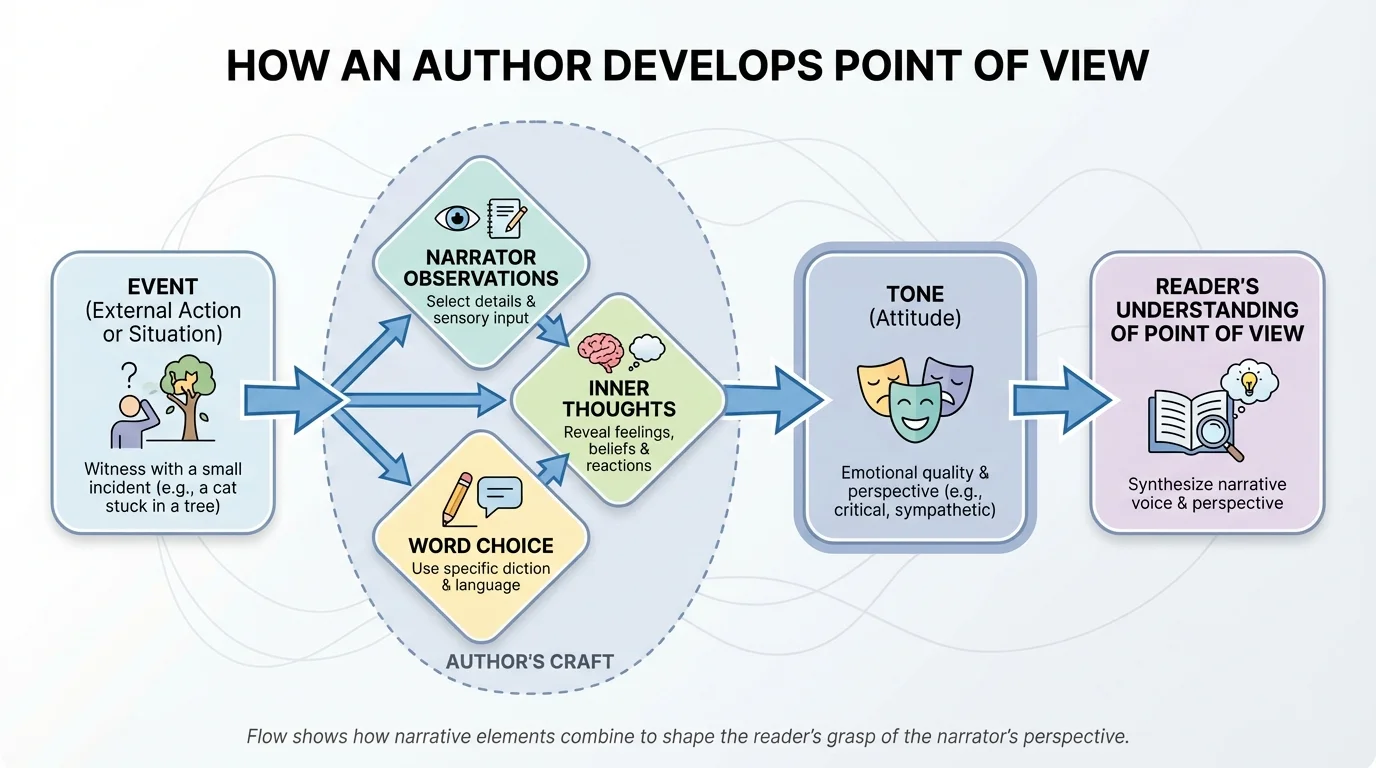
Tone matters too. Tone is the feeling or attitude the language creates. A narrator may sound respectful, bitter, amused, or frightened. A speaker in a poem may sound amazed by nature or disappointed by change. Tone helps readers infer point of view even when the text does not directly explain it.
Authors also show point of view through reactions. What makes the narrator laugh, panic, admire, or complain? Those reactions tell readers how the voice interprets events. In many texts, a narrator's reactions are more revealing than the events themselves.
Point of view develops through patterns
Readers should look for repeated clues, not just one line. If a narrator repeatedly notices unfair treatment, sounds angry when rules are mentioned, and describes adults as controlling, the point of view is developing through a pattern. The same is true in poetry: repeated images, emotions, and comparisons can build the speaker's perspective.
Sometimes authors develop point of view by limiting information. If readers know only what one character knows, they may share that character's confusion or suspense. This is especially powerful in mysteries and adventure stories.
To explain point of view well, readers need evidence. Start with pronouns. Words like "I" and "my" suggest first person. Words like "he," "she," and "they" may suggest third person. But do not stop there.
Next, notice opinions and judgments. Does the narrator call something "unfair," "beautiful," "ridiculous," or "boring"? Those judgments reveal perspective. Also ask what the narrator knows. Can the narrator tell what only one character thinks, or many characters? That clue helps identify the type of point of view.
Another clue is what the voice pays attention to. A narrator who keeps noticing scoreboards, speed, and competition may care strongly about winning. A speaker who notices clouds, silence, and fading light may be thoughtful or reflective. Attention reveals values.
Some stories become more powerful when readers realize the narrator does not understand everything. Readers may notice clues the narrator misses, which creates irony and adds depth to the text.
Readers should also ask whether the narrator seems fully trustworthy. A reliable narrator gives an account readers can generally trust. An unreliable narrator may exaggerate, misunderstand events, or leave out important facts. Even when a narrator is unreliable, the author is making a purposeful choice to shape meaning.
Stories and poems both present a voice, but readers name and analyze that voice a little differently, as [Figure 3] shows. In fiction, readers usually discuss the narrator. In poetry, readers usually discuss the speaker.
In a story, the narrator often guides plot, character understanding, and suspense. In a poem, the speaker often reveals emotion, attitude, and reflection in a concentrated way. Poems may be short, but the speaker's point of view can still be very rich, as shown in [Figure 3].
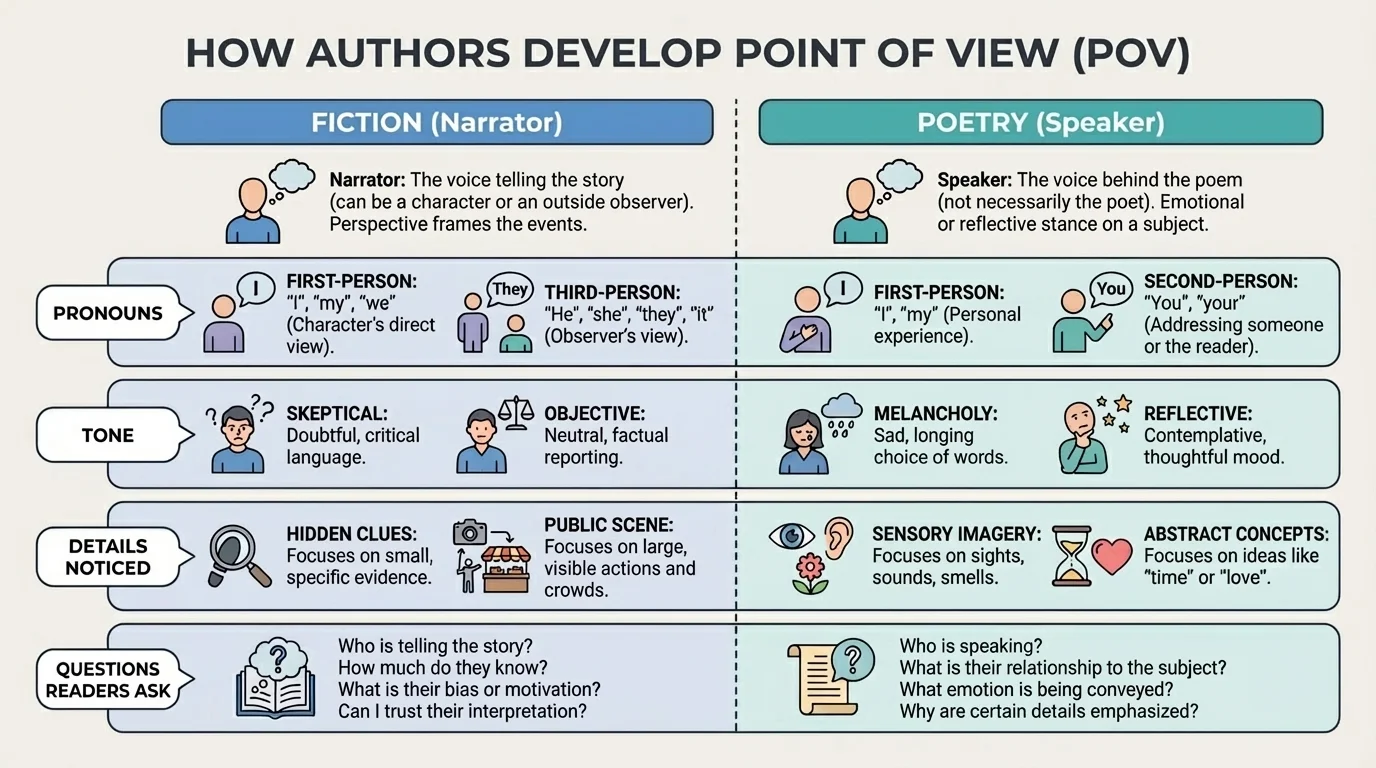
For example, a poem about winter could have one speaker who loves the quiet snow and another who dislikes the cold and darkness. The subject is the same, but the point of view changes the whole feeling of the poem.
Readers can use the comparison when moving between genres. The questions stay similar: Who is the voice? How does that voice feel? What language reveals that perspective? The main difference is whether the text presents a narrative voice or a poetic voice.
Point of view strongly affects meaning because it shapes how readers feel about characters and events. If a story is told by someone who feels left out, ordinary events may seem painful or unfair. If the same events are told by someone proud and confident, the meaning may shift completely.
Point of view can create sympathy. When readers hear a character's fears and hopes, they often feel closer to that character. This is one reason first-person and third-person limited points of view can be so effective.
It can also shape theme. Suppose a poem's speaker describes a city as noisy, crowded, and exhausting. The poem may explore themes of isolation or change. If another speaker describes the same city as lively, colorful, and full of possibility, the theme may lean toward hope or opportunity.
"The same world can feel different depending on whose eyes you borrow."
Point of view also affects suspense. If readers know only what one character knows, surprises feel immediate. If readers know more than the character, tension builds as they wait for the character to discover the truth.
Strong analysis uses exact evidence from a text and explains how that evidence shows the narrator's or speaker's point of view. Notice how each example moves from clue to interpretation.
Example 1: Story narrator
Text: "I pressed the science fair project against my chest as I walked into the gym. The volcano suddenly looked tiny. Everyone else's tables seemed taller, brighter, better."
Step 1: Identify the point of view type.
The pronouns "I" and "my" show that the story is in first-person point of view.
Step 2: Look for feelings and judgments.
The narrator says the volcano "looked tiny" and the other tables seemed "better." Those are judgments, not neutral facts.
Step 3: Explain how the author develops the point of view.
The author reveals the narrator's nervous and insecure point of view through inner reaction and comparison. The narrator focuses on feeling smaller than everyone else.
This perspective helps readers feel the pressure of the moment.
The explanation is stronger because it names the craft choices: first-person narration, judgments, and comparisons. It does more than just say "the narrator is nervous." It shows how the author creates that feeling.
Example 2: Third-person limited narrator
Text: "Marta lifted the note from her desk and read it again. Her stomach tightened. Maybe the principal knew. Maybe everyone knew."
Step 1: Identify the point of view type.
The story uses "Marta," not "I," so it is third person. Because readers know Marta's feelings and worries, it is third-person limited.
Step 2: Find the clues that build perspective.
The details "stomach tightened" and "Maybe the principal knew" reveal Marta's fear and anxiety.
Step 3: Explain the effect.
The author develops Marta's point of view by letting readers experience the scene through her worried thoughts. This creates suspense because readers know only what Marta knows.
The limited point of view keeps the reader close to one character's uncertainty.
This example also shows why point of view matters for mood. Because readers are inside Marta's fear, the scene feels tense.
Example 3: Speaker in a poem
Text: "The morning bus sighs at the curb, and I climb aboard with the moon still following me. My street sleeps behind me like a forgotten song."
Step 1: Identify the voice.
This is a speaker in a poem, not a narrator in a story.
Step 2: Notice imagery and tone.
The images of the moon "following" and the street "sleeping" create a quiet, thoughtful tone.
Step 3: Explain the point of view.
The author develops the speaker's reflective perspective through peaceful imagery and gentle personification. The speaker seems emotionally connected to the early morning world.
The language reveals a calm and observant perspective.
Notice that in poetry, even a few lines can reveal a rich perspective through imagery, sound, and tone. Readers should listen closely to the voice.
One common mistake is confusing the author with the narrator or speaker. The author created the voice, but the voice inside the text is not automatically the author's own opinion.
Another mistake is stopping too soon. If you say only "This is first person," you have identified the type of point of view, but you have not yet explained how the author develops it. To go deeper, discuss word choice, tone, thoughts, details, and reactions.
A third mistake is using evidence without explanation. Quoting a line is helpful, but your job is to connect that line to the narrator's or speaker's perspective. Explain what the clue means.
Perspective is not the same as plot
Plot tells what happens. Point of view helps explain how the voice experiences what happens. Two texts may have similar plots but very different meanings because the narrators or speakers see events differently.
Readers should also be careful not to assume that one detail explains everything. Good interpretations look for multiple clues working together across the text.
When writing or speaking about point of view, precise language helps. You can say that the author reveals, develops, shapes, emphasizes, or establishes the narrator's or speaker's point of view.
Here are useful sentence starters: "The author develops the narrator's point of view through..."; "The speaker's perspective is revealed by..."; "The word choice suggests that the narrator feels..."; "Because the text is told in first person, the reader..."; "The limited point of view creates..."
These sentence patterns can help you move from noticing a clue to making a clear explanation. The strongest answers combine the narrator type, evidence from the text, and the effect on meaning.
