Have you ever heard someone say, "School should start later," or "Kids should spend more time outdoors," and then try to convince others with examples and facts? Authors do the same thing in literary nonfiction. They do not just tell a story. They often share a message, idea, or opinion and try to support it. When you read carefully, you can tell whether their argument is strong or shaky.
Reading literary nonfiction is a little like being a detective and a judge at the same time. You search for clues in the text, and then you decide whether the author has really proved the point. This skill matters in school, but it also matters in life. News articles, speeches, essays, memoirs, and opinion pieces all ask readers to think critically.
Literary nonfiction is writing that tells about real people, real events, and real ideas, but uses some of the craft of literature. It may include strong description, a clear voice, dialogue, or scenes that feel vivid and memorable. Examples include memoirs, personal essays, biographies, and narrative articles.
Unlike fiction, literary nonfiction is based on truth. Unlike a simple textbook explanation, it often has style and personality. An author might describe a true event from childhood, explain a social issue through a personal story, or argue for a change while using storytelling to make the message powerful.
Claim, reason, and evidence are the three most important parts of an argument. A claim is what the author wants the reader to believe. A reason explains why the author thinks the claim is true. Evidence is the proof that supports the reasons, such as facts, examples, quotations, or details from real events.
Because literary nonfiction often mixes story and argument, readers need to notice both. A moving story may make you feel strongly, but feelings alone do not always prove a point. Good readers ask, "What is the author saying?" and also, "How does the author support it?"
An argument in writing is not a shouting match. It is a set of ideas meant to convince the reader. These ideas are built in layers, as [Figure 1] illustrates: the author makes a main point, explains it with reasons, and supports those reasons with proof.
The main claim is the central message. For example, an author might claim that school gardens help students learn better. That is the point the author wants readers to accept.
Next come the reasons. One reason might be that gardens make science lessons hands-on. Another reason might be that students feel more responsible when caring for living things. Reasons explain why the claim makes sense.
Then comes the evidence. Evidence might include an example from a real school, a quotation from a teacher, or details about what students learned while growing plants. Evidence is stronger than a simple opinion because it gives readers something concrete to examine.
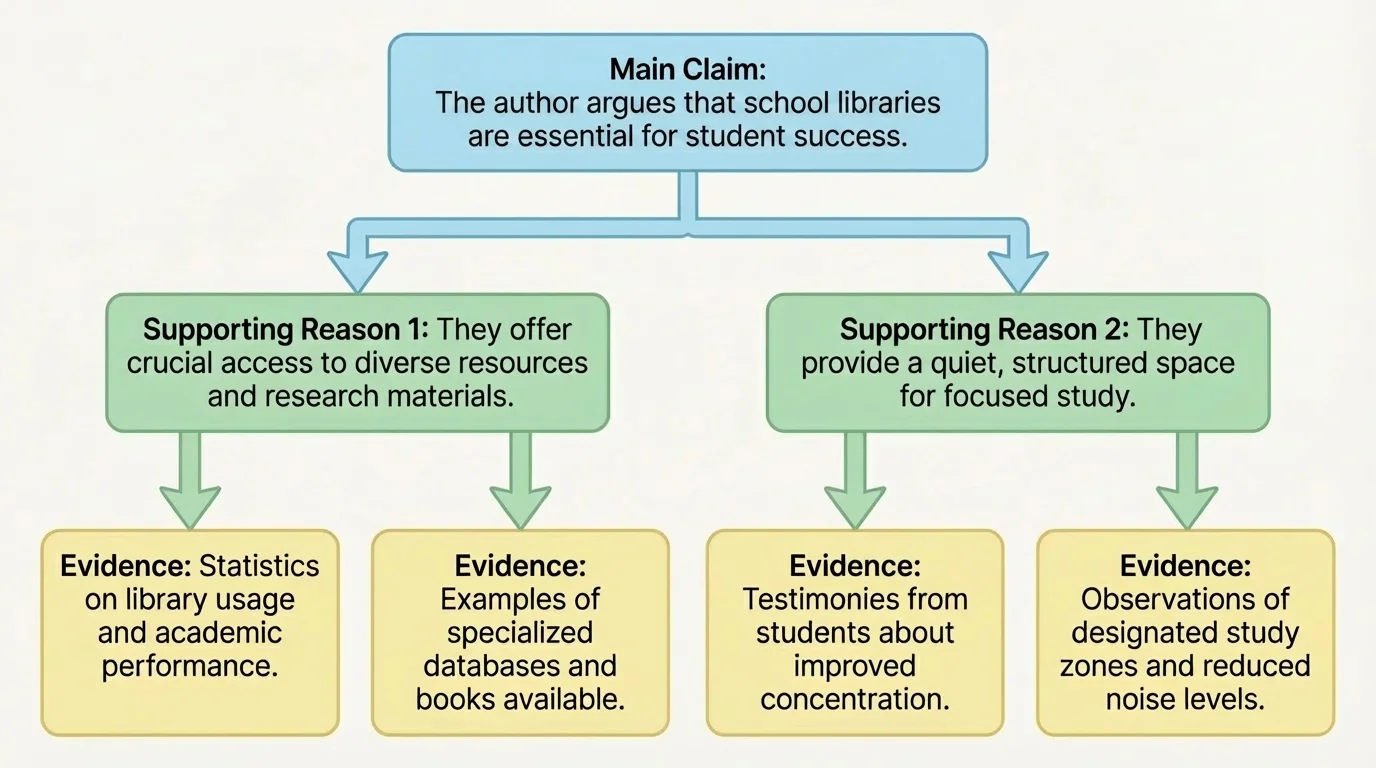
When these parts work together, an argument becomes clearer and stronger. If one part is missing, the writing may sound convincing at first, but it will not hold up under careful reading. A claim without reasons is incomplete. A reason without evidence is weak. Evidence that does not connect to the claim is not very useful.
Professional writers and speakers often spend more time finding strong evidence than writing their opinions. A bold opinion may catch attention, but reliable proof is what earns trust.
This is why readers should not be fooled by confidence alone. A sentence can sound powerful, but if the author does not back it up, the claim may still be unsupported.
To trace an argument means to follow the path of the author's thinking from beginning to end, as [Figure 2] shows with a marked-up page. You are looking for how one idea leads to the next.
Start by asking, "What is the author mostly trying to prove?" Sometimes the main claim appears near the beginning. Other times, it becomes clear after a story, example, or description. In literary nonfiction, the author may begin with a personal moment and then connect it to a bigger idea.
Next, look for the reasons. These may appear as separate points in different paragraphs. Signal words can help. Words like because, since, for example, as a result, and this shows often point to reasoning or evidence.
Then notice what proof the author gives. Does the text include facts, observations, quotations, or real experiences? Does each piece of proof support a specific reason? If so, the argument is easier to trace and understand.
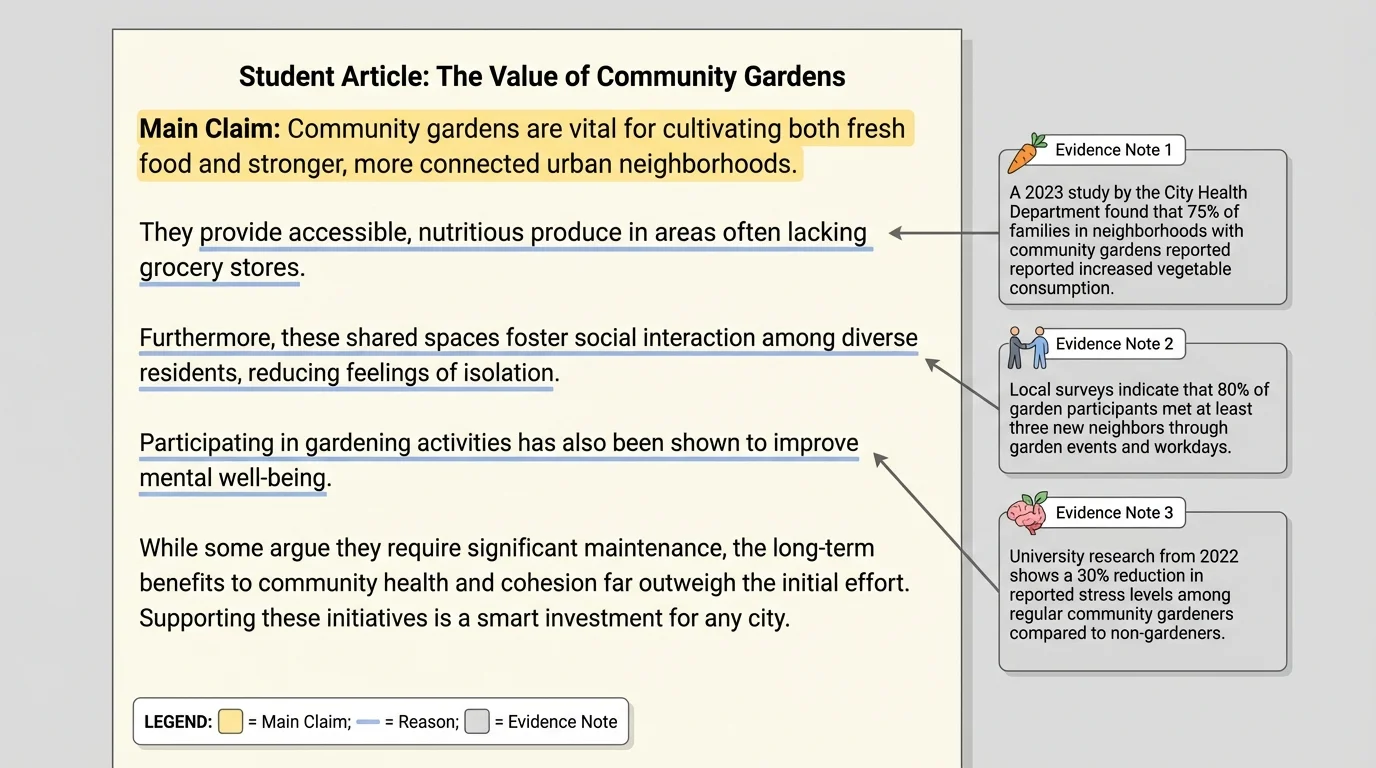
Tracing also means paying attention to order. An author may begin with a problem, present reasons why the problem matters, and then offer evidence. Another author may begin with a personal anecdote, then expand into a broader claim. The structure may change, but your job stays the same: follow the links between claim, reasons, and evidence.
For example, suppose a memoir-style article begins with a student describing the first day of volunteering at an animal shelter. Later, the author argues that volunteering helps young people become more responsible citizens. To trace the argument, a reader should connect the opening story to the larger point and notice the reasons and evidence that follow.
Tracing means mapping ideas, not just spotting sentences. A strong reader does more than underline one important line. The reader notices how details connect. A story detail may introduce a problem. A later paragraph may explain why it matters. A final paragraph may present evidence that supports the author's main claim. Tracing helps you see the whole design of the text.
As you keep reading, you may find that some evidence supports one reason better than another. That is an important discovery. Careful readers do not just collect details; they decide where each detail belongs in the author's argument.
To evaluate a claim means to judge how strong it is. You are not only asking what the author says. You are asking whether the author proves it well.
One important question is whether the evidence comes from a credible source. A credible source is one that is trustworthy and accurate. For example, a scientist, historian, teacher, or respected news organization may be more reliable than a random post online. In literary nonfiction, the author may include personal experience, but stronger arguments often also use outside sources.
Another question is whether the evidence is relevant. Relevant evidence connects clearly to the claim. If an author argues that recess improves focus in class, but only gives details about school lunch menus, the evidence does not match the claim very well.
You should also ask whether the evidence is enough. One example may be interesting, but it may not fully prove a broad claim. If an author says, "All students learn better outdoors," but only tells one story about one student, the support may be too limited.
Finally, consider whether the reasoning makes sense. Sometimes an author gives true details but jumps too quickly to a conclusion. Good reasoning shows how the evidence leads logically to the claim.
| Question to Ask | What to Look For | Why It Matters |
|---|---|---|
| Is the claim clear? | A central idea the author wants readers to believe | You cannot judge support if you do not know the point |
| Are the reasons strong? | Explanations that clearly connect to the claim | Reasons show why the claim might be true |
| Is the evidence relevant? | Facts, examples, and quotations that match the reason | Relevant proof supports the argument directly |
| Is the source credible? | Reliable people, publications, or first-hand experiences | Trustworthy evidence is more convincing |
| Is the evidence enough? | More than one detail or example when needed | A single detail may not fully prove a big claim |
Table 1. Questions readers can use to evaluate the strength of an argument in literary nonfiction.
When you judge support, remember that not all evidence is equal. A direct quotation from an expert may be stronger than a vague statement such as "everyone knows." Specific details are usually stronger than general claims.
[Figure 3] The difference between a strong argument and a weak one becomes easier to see when you compare them side by side. A supported claim has reasons and evidence that clearly fit together. An unsupported claim may sound interesting, but it lacks proof, uses weak proof, or includes details that do not actually connect.
Consider this claim: "Reading outside every day helps students enjoy books more." This could be a supported claim if the author gives examples from classrooms, student interviews, or observations from a reading program. The author might explain that outdoor reading feels relaxing and then support that reason with details from several students and a teacher.
Now consider a weaker version: "Reading outside is the best way for all students to learn because it feels nice." This statement gives almost no evidence. It also makes a very broad claim about all students without enough support, as [Figure 3] helps illustrate.
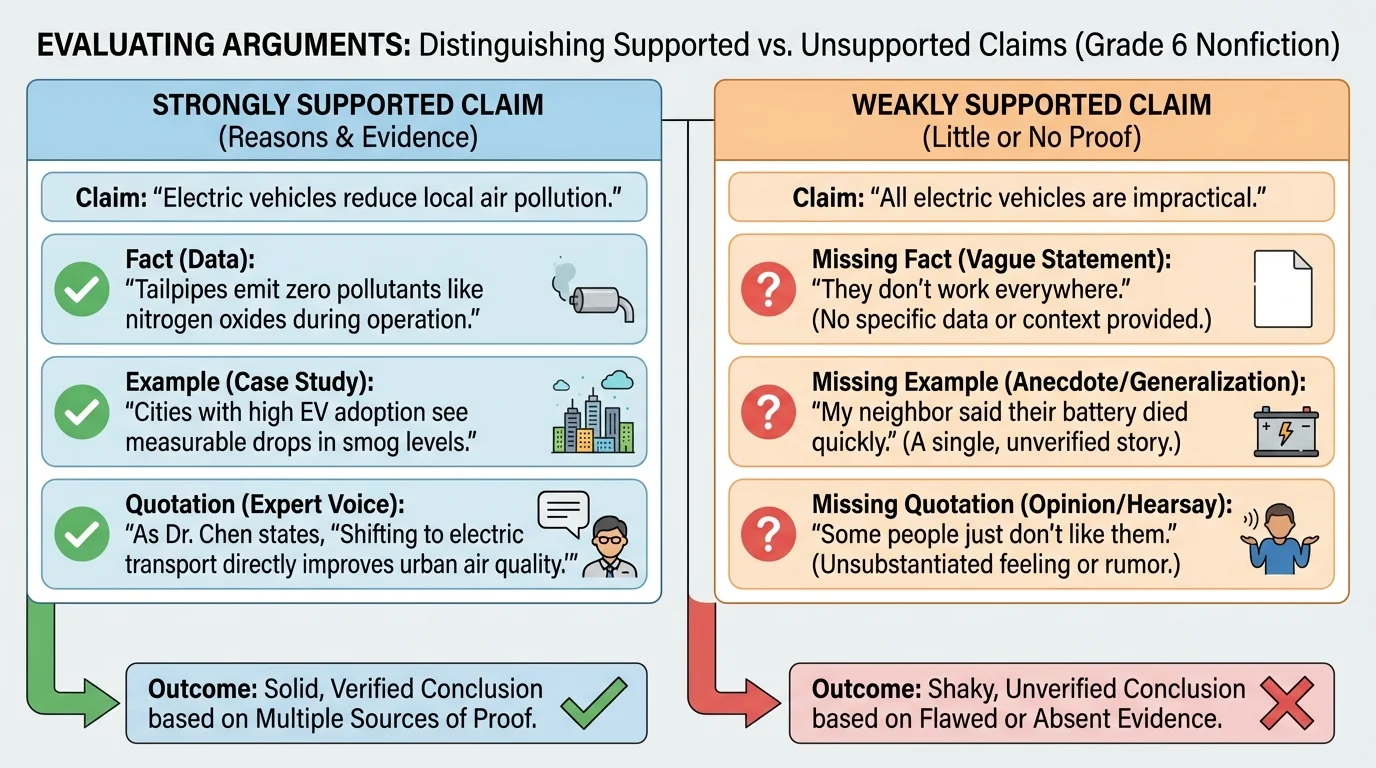
Unsupported claims often include words like always, never, everyone, or best without enough evidence. These words are not always wrong, but they require especially strong proof because they are so broad.
Sometimes a claim has some support but not enough. For instance, if an author says that music should be played during every class because one student said it helps concentration, the reader should notice that the evidence is too limited. One student's opinion may matter, but it does not prove what works for every class.
Case study: judging support
A personal essay argues that neighborhood libraries are more important than ever.
Step 1: Identify the claim.
The claim is that neighborhood libraries still matter greatly in modern communities.
Step 2: Find the reasons.
The author says libraries provide free access to books, safe study spaces, and community programs.
Step 3: Check the evidence.
The essay includes a librarian's quotation, a description of homework help sessions, and examples of families using computers there.
Step 4: Evaluate the strength.
The claim is fairly well supported because the reasons are clear and the evidence is specific and connected.
This kind of close reading helps you separate a thoughtful argument from one that depends mostly on emotion or opinion. The stronger the match between claim, reasons, and evidence, the stronger the argument.
Earlier, [Figure 1] showed the layers of an argument. That structure can help you test any literary nonfiction text you read: if you cannot find the proof under the reasons, the claim may not be well supported.
Reading literary nonfiction carefully also helps you become a better researcher. The process of moving from a question to a credited explanation follows a clear path, as [Figure 4] shows. When you study a topic, you need to gather information, decide which sources are trustworthy, and use evidence to support your own ideas.
Suppose your research question is, "How do community gardens affect neighborhoods?" You might read a narrative article about a family garden, a biography of a local activist, and an informational report about food access. Each source may offer different kinds of evidence. Your job is to gather useful details, compare them, and build your own understanding.
When using evidence, you may quote exactly, paraphrase in your own words, or summarize the main point. No matter which method you use, you must give credit to the source. This is called citation, or acknowledging where information came from.
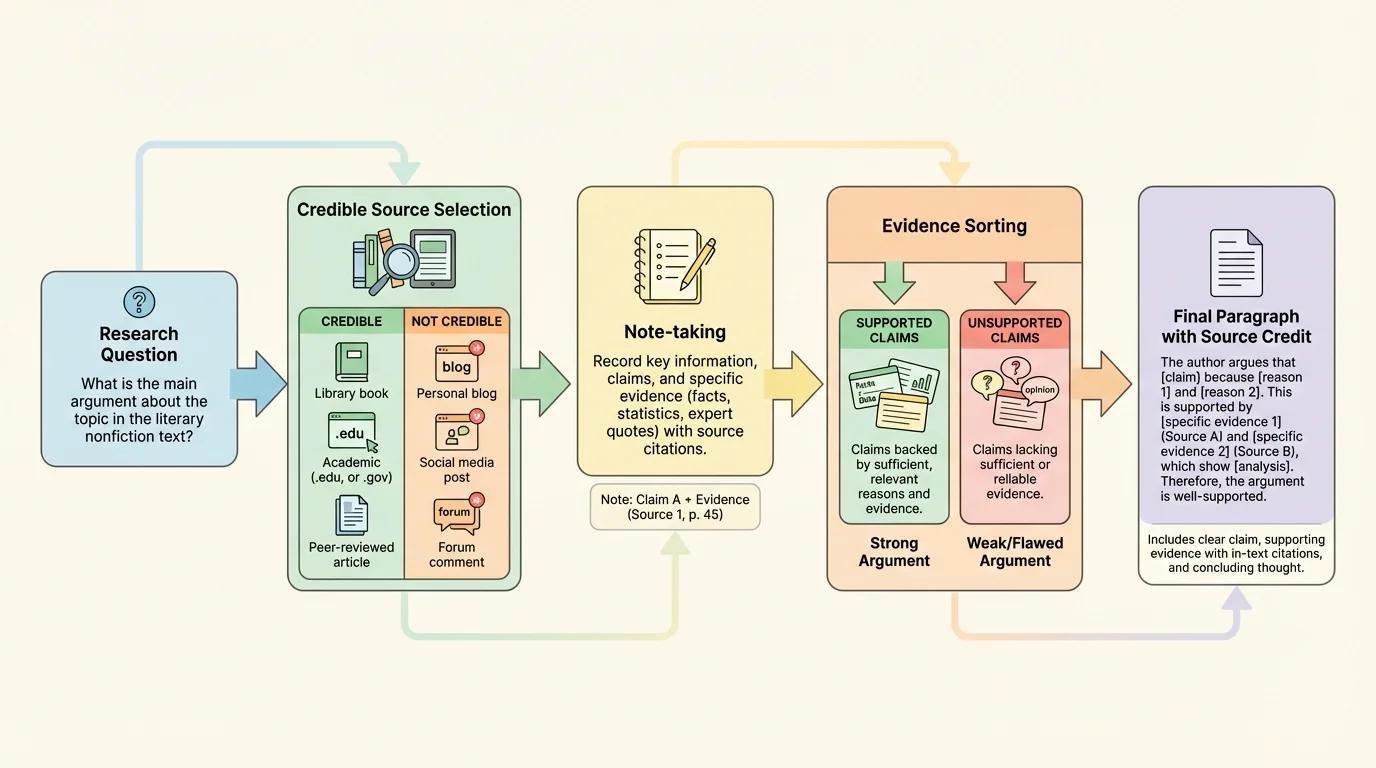
If you do not give credit, readers may think the idea is yours when it is not. Giving credit is part of honest research. It also helps others check the information for themselves.
When drawing evidence from texts, choose details that actually support your analysis. If you are writing about how an author builds an argument, include quotations or paraphrases that show the claim, reasons, and evidence. Do not choose random interesting details that do not connect to your point.
From earlier reading work, you already know how to find central ideas and supporting details. Evaluating an argument builds on those skills. Now you are asking an extra question: not just "What is important?" but also "Does this detail really prove the author's claim?"
In research, it also helps to compare sources. One source may give a personal story, while another provides broader facts. Together, they can create a fuller picture. But if two sources disagree, you need to evaluate which is more credible and which gives better evidence.
Consider a short literary nonfiction passage in which an author describes joining a city cleanup project. The writer begins by describing an empty lot filled with trash, then explains how volunteers turned it into a small park. After telling this story, the author argues that young people should have more chances to serve their communities.
The main claim is that community service opportunities are valuable for young people. One reason is that service teaches responsibility. Another reason is that service helps young people feel connected to their neighborhoods.
The evidence includes the author's own experience of working every Saturday, details about the park's improvement, and a quotation from a neighbor who says the space now feels safe and welcoming. These pieces of evidence support the reasons because they show both responsibility and community connection.
Now evaluate the argument. The personal story is strong because it is detailed and specific. The neighbor's quotation adds another voice. However, if the author wanted to prove a larger claim about many communities, the argument would become stronger with additional evidence, such as examples from other neighborhoods or facts from a community organization.
Text-based analysis response
A student wants to explain whether the author's claim is well supported.
Step 1: State the claim clearly.
The author claims that community service is important for young people.
Step 2: Name the reasons.
The author says service builds responsibility and strengthens neighborhood ties.
Step 3: Cite evidence from the text.
The student points to the weekly cleanup work, the changed condition of the lot, and the neighbor's quotation.
Step 4: Judge the support.
The student explains that the claim is supported by specific details, though broader evidence would make it even stronger.
This kind of response uses evidence from the text to support analysis. It does not simply say, "I agree" or "I disagree." Instead, it explains how the text works.
When you compare this example to the research process in [Figure 4], you can see that strong reading and strong research depend on the same habit: selecting meaningful evidence and connecting it clearly to a claim.
One common mistake is confusing a powerful story with strong proof. A moving anecdote can make a text memorable, but one story alone may not fully support a broad claim.
Another mistake is treating every fact as equally useful. A detail may be true, but if it does not connect to the claim, it does not strengthen the argument much.
Readers also sometimes accept weak sources too quickly. If a statement has no clear author, no date, or no trustworthy background, you should be careful about relying on it.
Finally, some readers miss how the text is organized. Looking back at the annotated page in [Figure 2] can help you remember to mark where the claim appears, where the reasons develop, and where the evidence is placed.
Strong readers stay curious. They ask questions while reading: What is the author trying to prove? What reasons are given? What evidence supports those reasons? Is the support strong, relevant, and credible?
They also stay fair. Evaluating an argument does not mean rejecting everything. It means looking closely and judging carefully. Some arguments are very well supported. Others are partly supported. Others are weak. Your job is to decide based on the text.
This skill gives you power. It helps you understand memoirs, essays, speeches, and articles more deeply. It helps you write stronger responses and stronger research. Most of all, it helps you become the kind of reader who is not easily misled.
"Good readers do not just ask what a text says. They ask how the text proves it."
When you read literary nonfiction with this mindset, you move beyond simply following a story. You learn to test ideas, examine proof, and support your own thinking with evidence.
