A story can turn an ordinary moment into something unforgettable. A missed bus can feel like a disaster. A creaking stair can sound like a warning. A single line of speech can reveal whether a character is brave, nervous, funny, or hiding something. Strong narratives do not simply tell readers what happened. They use craft to make readers feel as if they are right there in the scene.
When writers create a narrative, they build more than a list of events. They shape an experience. The tools they use to do this are called narrative techniques. These are choices a writer makes to develop events, experiences, and characters in ways that keep the reader interested and help the story make sense.
Three especially powerful techniques are dialogue, pacing, and description. Dialogue lets characters speak. Pacing controls how fast or slowly a story moves. Description helps readers imagine what people, places, and moments are like. Along with clear event order, these techniques help a story feel complete instead of flat.
Narrative techniques are writing methods that help authors tell a story effectively. They include dialogue, pacing, description, sequencing, sensory details, and other choices that develop characters and events.
Think about watching a movie. Some moments move quickly, like a training montage. Other moments slow down, like the second before a player takes the winning shot. Stories work the same way. Writers zoom in, zoom out, and choose what to highlight. That control helps readers understand what matters most.
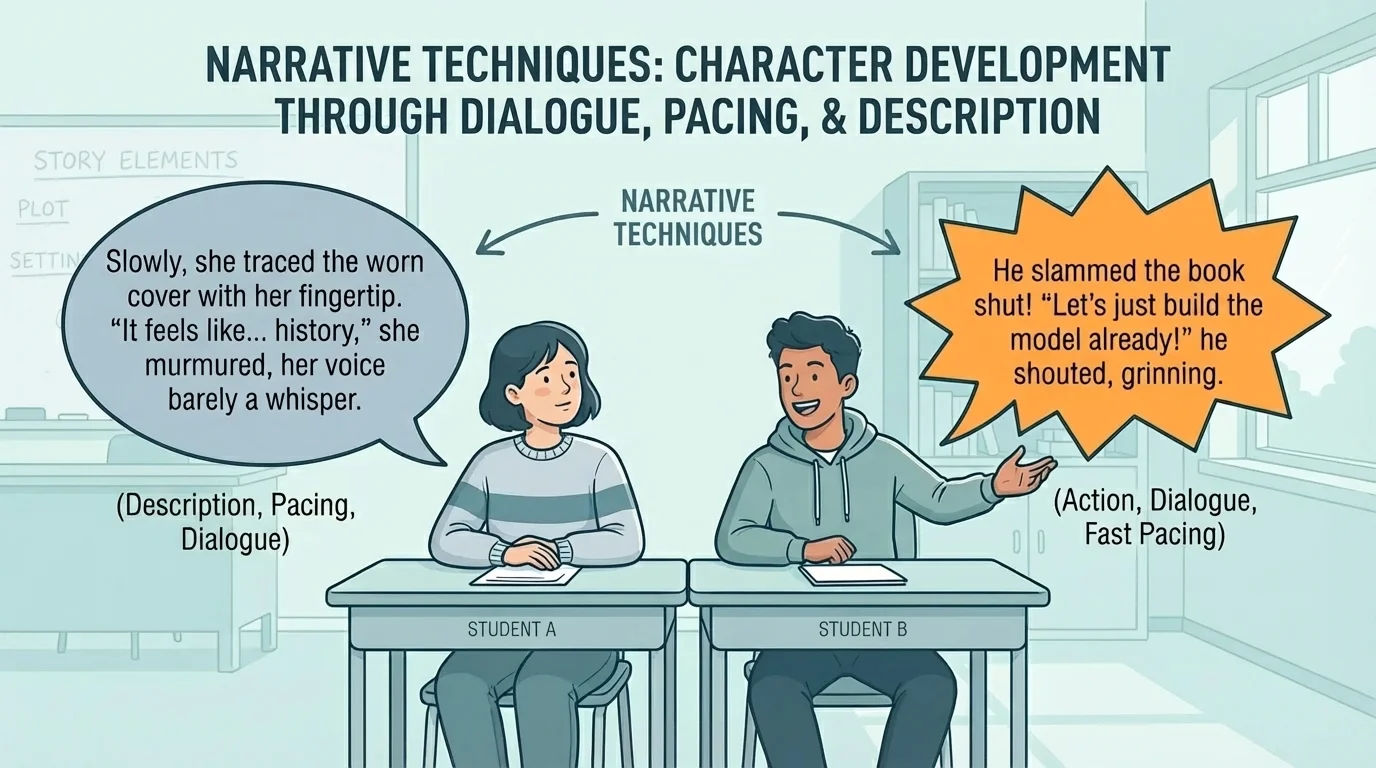
Characterization often begins with speech, and [Figure 1] shows how two characters can reveal different personalities just by the way they talk. Dialogue is the written conversation between characters. Good dialogue does more than fill space. It can reveal personality, show relationships, create conflict, and move the plot forward.
For example, compare these two lines: "I suppose we should leave now," Maya said. and "Come on, we have to go right now!" Maya shouted. Both lines communicate a similar idea, but they make Maya seem different. The first version sounds calm and thoughtful. The second sounds urgent and intense. Word choice matters.
Dialogue should sound natural, but it should not copy every part of real speech. In real life, people pause, repeat themselves, and wander off topic. In a story, dialogue needs to be clearer and more purposeful. Each line should help the reader learn something important.
Writers also use dialogue to show relationships. A character may speak one way to a best friend and another way to a principal. A short answer like "Fine." can suggest annoyance, sadness, or secrecy depending on the moment. Even silence after a question can be meaningful.
Correct punctuation helps readers follow dialogue easily. Writers place quotation marks around the spoken words. They also use dialogue tags such as said, asked, or whispered when needed. Here is an example: "I heard something outside," Lena whispered.
Notice how the punctuation works with the sentence. When the dialogue is followed by a tag, a comma usually appears before the closing quotation mark. If the spoken words form a question or exclamation, the punctuation changes: "Did you hear that?" Lena asked. Clear punctuation keeps the conversation readable.
Example: Weak dialogue and stronger dialogue
Weak version: "I am scared," Jamal said scaredly.
Step 1: Notice the problem
The word scared is repeated, and the sentence tells the feeling in a plain way.
Step 2: Revise the line
Stronger version: "Are you sure that noise came from the basement?" Jamal asked, taking a step back.
Step 3: Explain why it works
The revision shows fear through the question and the action instead of simply naming the emotion.
As seen earlier in [Figure 1], speech patterns can hint at personality. One character may use formal language, while another uses quick slang or jokes. Readers begin to recognize who a character is by how that character speaks.
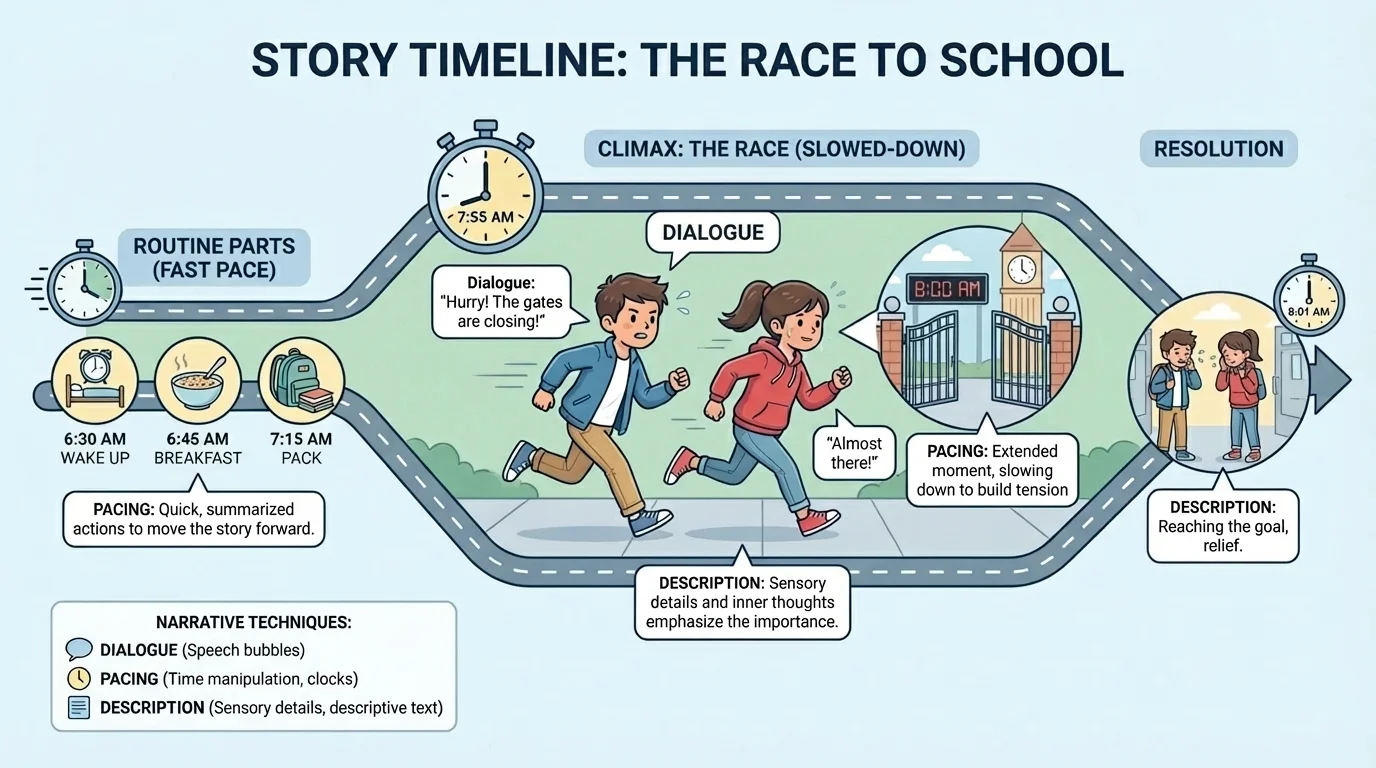
A writer controls story speed through pacing, and [Figure 2] illustrates how some moments are stretched out while others are summarized quickly. Pacing is the speed at which a narrative moves. It affects tension, emotion, and focus.
When a writer wants readers to feel suspense, the story often slows down. Small details become important. A character may notice a doorknob turning, a floorboard creaking, or a shadow moving across the wall. This slower pace makes readers pay attention.
When a writer wants to move through less important time, the story speeds up. Instead of describing every second of a long car ride, the writer may summarize: After three quiet hours on the highway, they finally reached the lake. Summary helps skip over parts that matter less.
A good narrative usually includes both. Important scenes are often written moment by moment. Less important parts are told more briefly. This balance keeps the reader from getting bored or confused.
Sentence length also affects pacing. Short sentences can create urgency. For example: The lights went out. Ben froze. Something moved. Longer sentences can slow the rhythm and allow a writer to add detail, reflection, or a calmer mood.
Paragraph breaks matter too. A new paragraph can signal a change in action, speaker, or focus. During a tense scene, short paragraphs can make the story feel faster and sharper. In a reflective moment, longer paragraphs may fit better.
How writers slow down or speed up a scene
Writers slow down a scene by adding actions, thoughts, sounds, and small details in order. They speed up a scene by summarizing time, combining actions, or skipping ahead to the next important event. Skilled pacing helps readers feel what the character feels.
Think of a basketball game. The score might stay close for most of the game, but everyone remembers the final seconds. A writer might summarize the first three quarters, then slow down the last play step by step. That choice tells readers where to focus.
Later in a narrative, readers can compare scene speed with the pattern shown in [Figure 2]. The story does not need every minute described equally. Strong pacing gives the most space to the moments with the most meaning.
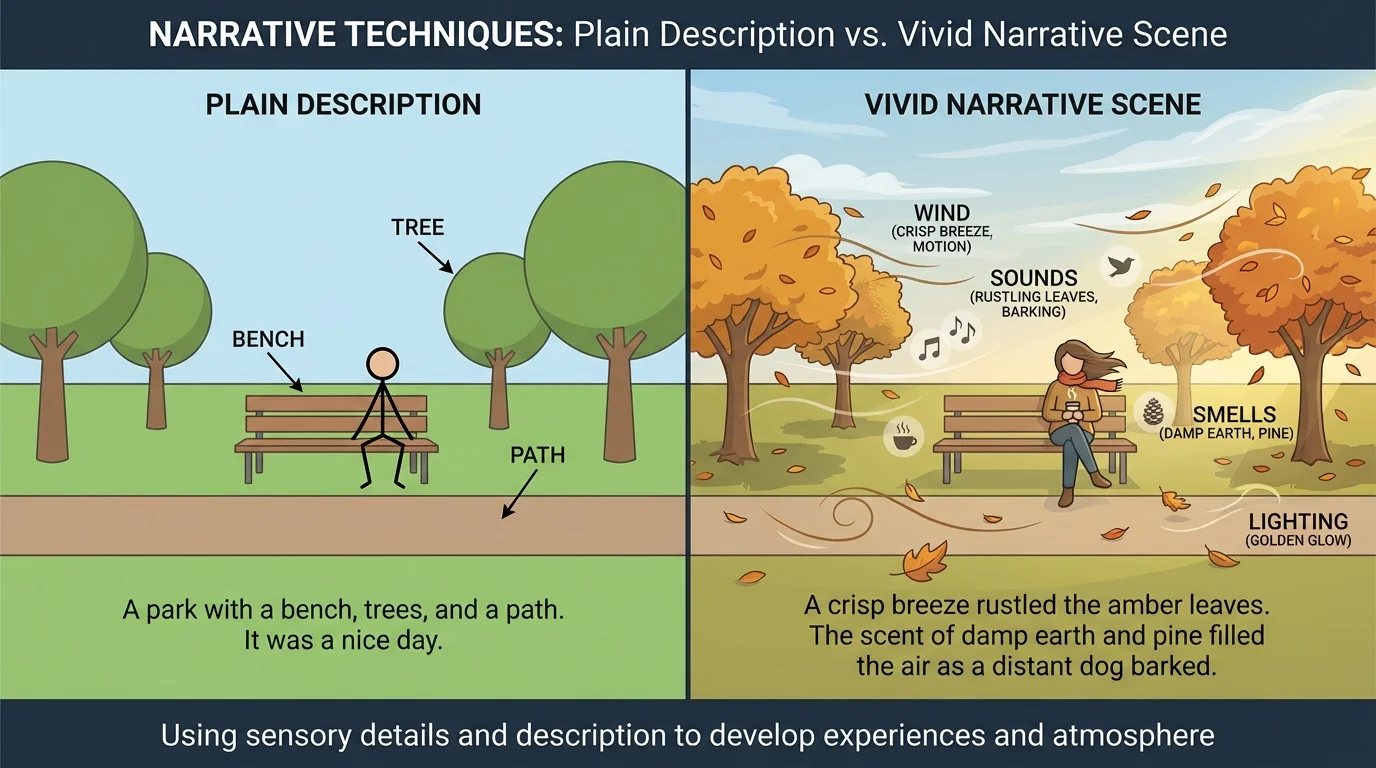
Description helps readers build a picture in their minds, and [Figure 3] shows how a setting becomes more vivid when sensory details are added. Description is the language a writer uses to show what something looks, sounds, smells, tastes, or feels like.
Without enough description, a story may seem empty. With too much, it may drag. Good description is specific and meaningful. Instead of writing the room was messy, a writer might say socks hung from the desk lamp, game controllers were buried under notebooks, and a half-finished sandwich sat on the windowsill. Those details create a clearer image.
Strong description often includes sensory details. These details appeal to the five senses. Readers do not just see the storm; they hear the thunder, smell the wet pavement, and feel the cold rain on skin. Sensory details make scenes more alive.
Description also helps create mood. Mood is the feeling a scene gives the reader. A dark hallway with flickering lights creates a very different mood from a sunny kitchen filled with the smell of cinnamon. The setting can influence how readers expect the story to unfold.
Writers use description to reveal characters too. Clothing, posture, gestures, and surroundings can suggest personality. A character who keeps every pencil lined up perfectly may seem organized or anxious. A character with grass-stained knees and a backpack full of random tools may seem curious and adventurous.
The same place can feel completely different depending on the details a writer chooses to include. A forest can seem peaceful if the writer focuses on birdsong and sunlight, or frightening if the writer focuses on snapping branches and deep shadows.
Precise word choice matters in description. Compare walked with stomped, drifted, or lurched. Each word gives a different picture and mood. Strong verbs often make description more powerful than adding many extra adjectives.
When readers picture the contrast in [Figure 3], they can see why specific details are better than vague ones. Description works best when it helps the reader understand the moment, not when it piles up random facts.
Even exciting details cannot save a story if the events are hard to follow. Writers need sequencing, which means putting events in an order that readers can understand. Most narratives follow a clear path: beginning, rising action, climax, falling action, and ending.
A clear beginning introduces the situation, setting, or problem. The middle develops the conflict through events and choices. The ending shows the result or change. This does not mean every story must be predictable, but readers should be able to trace what happens and why.
Transitions help connect events. Words and phrases such as first, later, meanwhile, suddenly, and by the time guide the reader through time. They act like signposts on a trail.
Writers can also use flashbacks or shifts in time, but these must be clear. If a narrative jumps from the present to a memory, readers need signals such as a phrase, a paragraph break, or a change in wording. Otherwise, the sequence can become confusing.
| Technique | What It Does | Example Effect |
|---|---|---|
| Chronological order | Presents events in the order they happen | Makes the story easy to follow |
| Transition words | Connects moments in time | Shows whether time is moving slowly, quickly, or suddenly |
| Flashback | Returns to an earlier event | Adds background or explains motivation |
| Scene and summary | Balances detailed moments with quick movement | Keeps the story focused |
Table 1. A comparison of common ways writers organize and connect events in narratives.
Good sequencing also involves cause and effect. One event should lead naturally to another. If a character suddenly runs away, readers should understand what happened to cause that decision. Stories feel stronger when events connect logically.
Characters become believable when readers learn about them from several angles. Dialogue is one part, but actions, thoughts, appearance, and reactions also matter. This process of revealing who a character is is called characterization.
There are two common ways to develop a character. Direct characterization happens when the writer directly tells what the character is like. For example: Tariq was patient and careful. Indirect characterization happens when the writer shows the character through behavior, words, and choices. For example: Tariq untangled the fishing line knot by knot while everyone else groaned and gave up.
Indirect characterization is often more powerful because readers get to infer meaning. They see the evidence and draw conclusions. That makes the character feel more real.
Example: Developing one character in different ways
Character idea: Elena is brave but worried.
Step 1: Show it through action
Elena pushed open the gate, even though her hands were shaking.
Step 2: Show it through thought
If I turn back now, she thought, no one will know what happened to the dog.
Step 3: Show it through dialogue
"Stay here if you want," Elena said. "I'm going in."
Step 4: Show it through description
She swallowed hard and tightened her flashlight grip until her knuckles turned pale.
Notice that the writer never has to say Elena was brave but worried. The details communicate that idea clearly. This is one reason narrative techniques matter so much: they allow readers to discover characters instead of being told everything directly.
Characters should also change or reveal deeper layers as the story moves forward. A nervous character may become confident. A selfish character may make a generous choice. Even a small change can make a story satisfying.
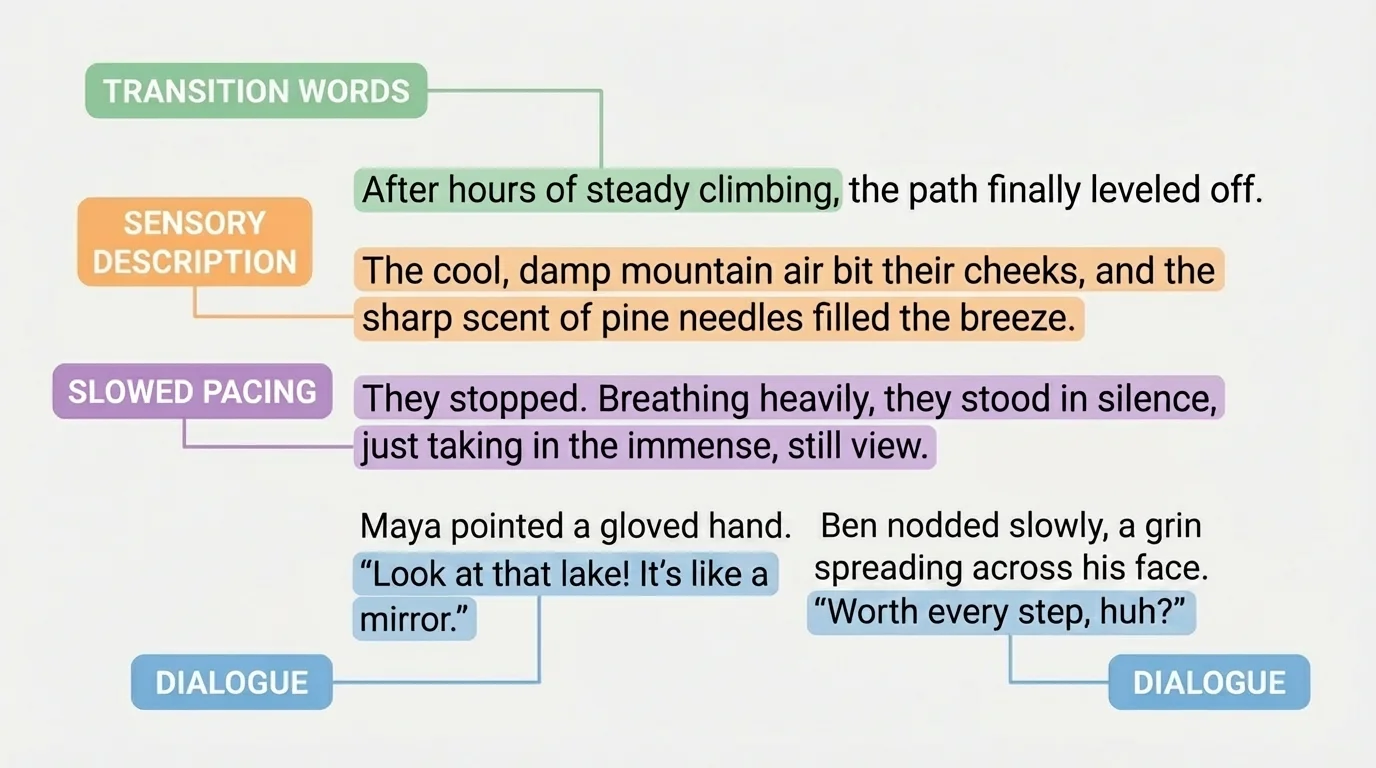
[Figure 4] Strong narratives do not use one technique at a time. They combine them. A writer may slow down an important scene, include sensory details, add dialogue, and show a character's thoughts all within a few paragraphs.
Read this short scene, which shows how dialogue, description, pacing, and sequencing can all work together in a single moment:
Marcus reached for the trophy case handle, but it was already warm from someone else's touch. The hallway was silent except for the hum of the old ceiling lights. "Who's there?" he called, trying to sound brave. No answer. Then, from the band room, a chair scraped the floor. Marcus took one careful step, then another. Suddenly, Priya burst through the doorway, clutching a violin case. "Why are you sneaking around in the dark?" she asked. Marcus let out a breath he had been holding for what felt like an hour.
This scene uses description through warm, silent, and hum. It uses dialogue to reveal both fear and surprise. It slows pacing by focusing on small actions such as reaching, listening, and stepping. It also keeps events in clear order, so the reader can follow exactly what happens.
When writers combine techniques well, the scene feels fuller. The reader does not just learn that Marcus was nervous. The reader experiences the nervousness. This is what effective narrative writing aims to do.
Later, a writer can study the annotated model in [Figure 4] to notice how one short passage can carry several jobs at once. A single sentence might describe the setting, slow the pace, and reveal character emotion all together.
One common mistake is writing dialogue that exists only to explain information the characters already know. For example, "As you know, my brother, today is our first day at Oak Street Middle School," sounds unnatural. Realistic dialogue fits the situation.
Another mistake is overloading description. If every object in a room gets equal attention, readers may not know what matters. Choose details that create mood, reveal character, or support the event.
Some narratives rush important moments. A writer might spend a paragraph on breakfast but only one sentence on the big argument or final decision. Revision often means adjusting pacing so the most important events get the most attention.
Stories can also become confusing if event order is unclear. To fix this, writers reread and ask: What happens first? What causes the next event? Are transitions helping readers move through time?
Readers need both interesting content and clear structure. A narrative should be exciting, but it should also be understandable. Strong writing usually comes from revising with both goals in mind.
Good narrative writing is not about adding as many details as possible. It is about choosing the right details, the right speed, and the right words at the right time. When a writer controls dialogue, pacing, description, and sequencing, the story becomes more vivid, clearer, and more powerful.
