One short question can change an entire discussion. If someone asks, "Was the story good?" the conversation may stop almost immediately. But if someone asks, "Which choice made by the main character changed the story most, and why?" people suddenly have something real to think about. Strong discussions do not happen by accident. They happen when people ask clear questions, listen closely, and respond with enough detail to help everyone understand the idea.
In grade 6, discussion is more than taking turns talking. It means working with others to explore a topic, understand a text, and think about an issue from more than one point of view. When you ask a careful question or give a detailed answer, you help the whole group. When you make a useful comment, you move the conversation forward instead of letting it stall.
A collaborative discussion is a conversation in which people work together to understand something better. This could happen with one partner, in a small group, or with the whole class. In a strong discussion, students do not just wait for their turns. They listen, think, and respond to what others actually say.
Good discussion matters because it helps people test ideas. You may start with one opinion and then hear a classmate explain something you had not noticed. For example, while discussing a novel, one student may focus on the action, while another notices how the setting affects the character's choices. When both ideas are shared, everyone understands the text more deeply.
Discussion builds understanding
Speaking and listening are connected. Asking a strong question shows that you are thinking carefully. Answering with detail shows that you understand the topic and can explain it. Making contributing comments shows that you can connect your own thinking to the ideas of others.
These skills also matter outside school. Athletes talk strategy during games. Scientists discuss evidence before reaching conclusions. Teams designing video games, apps, or community projects need people who can ask focused questions and explain ideas clearly. Being able to contribute thoughtfully is a real-world skill.
A specific question focuses attention on one clear idea, as [Figure 1] shows through different kinds of discussion prompts. Specific questions help a group think deeply because they give people a clear direction. Instead of asking about everything at once, they point to an important part of the topic, text, or issue.
A weak question is often too broad, too simple, or too unclear. Questions such as "Did you like it?" or "What happened?" may have a place at the very beginning of a conversation, but they usually do not lead to strong discussion. They invite short answers. A stronger question asks about reasons, effects, patterns, choices, or evidence.
Compare these examples:
| Weak Question | Why It Is Weak | Stronger Specific Question |
|---|---|---|
| "Was the article interesting?" | Too general | "Which fact in the article was most surprising, and why did it stand out?" |
| "Did the character make a good choice?" | Can be answered with yes or no | "What were the results of the character's decision, and do those results make the choice seem wise?" |
| "What is the problem?" | Too vague | "What is the main conflict, and which details in the text reveal it most clearly?" |
Table 1. Comparison of weak questions and stronger, more specific discussion questions.
Specific questions are often open-ended questions. That means they cannot be answered with only "yes," "no," or one short fact. They invite explanation. Open-ended questions often begin with words like how, why, which, or what evidence.
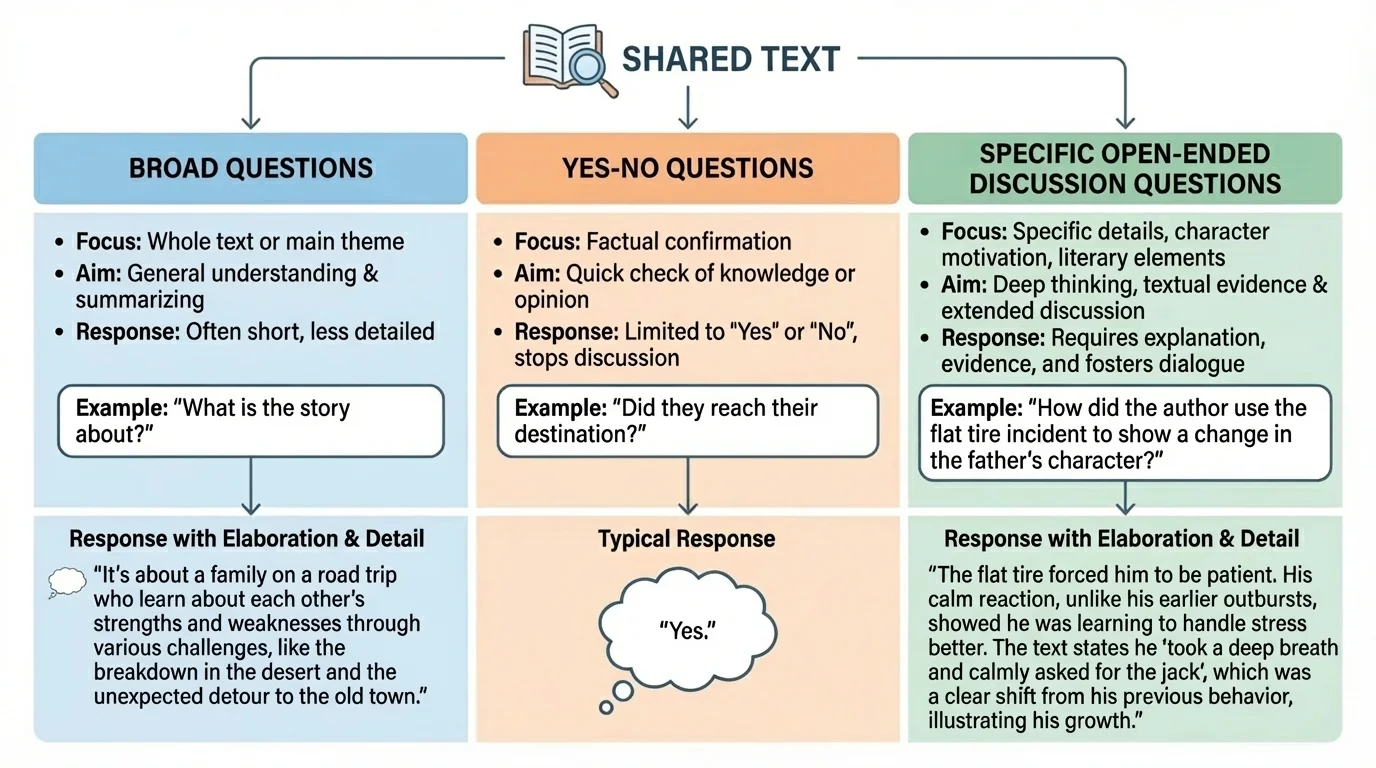
Here are useful question stems: "Why do you think...?" "What evidence shows...?" "How did ... affect ...?" "Which detail best supports...?" "What is another possible explanation?" These stems help you move from general talk to thoughtful talk.
Notice that being specific does not mean making a question complicated. A good question is still clear. It simply gives enough focus so that others know exactly what they are being asked to think about.
Professional interviewers, journalists, and scientists often prepare specific follow-up questions in advance because broad questions rarely lead to detailed answers.
Later in a discussion, the pattern in [Figure 1] still matters: the more focused the question, the more likely the answer will include real thinking instead of a quick opinion.
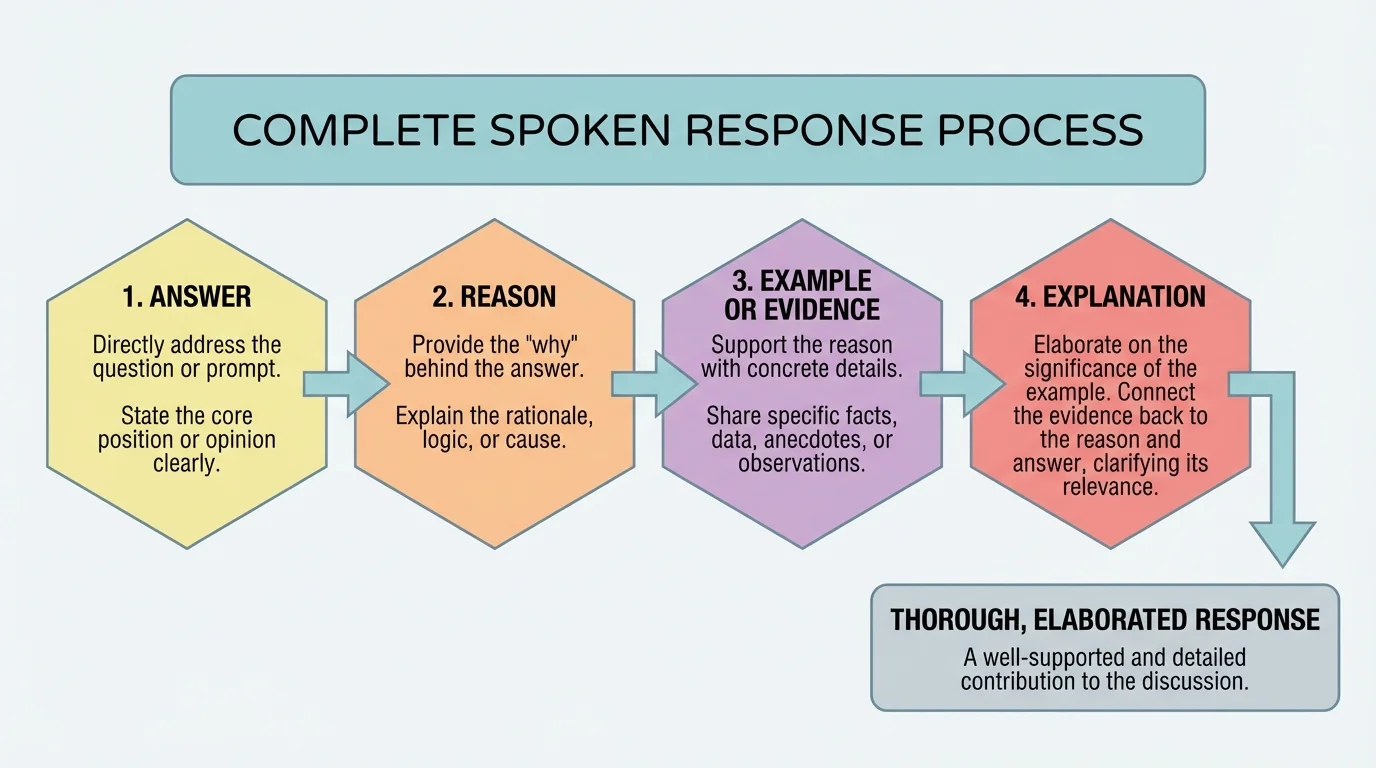
[Figure 2] A elaboration adds more information to make an idea clearer. If someone asks you a question in a discussion, a one-sentence answer may not be enough. You need to explain your thinking so others can follow it. A strong response often follows a simple structure: answer the question, give a reason, include evidence or an example, and explain how that evidence supports your point.
For example, suppose the class is discussing a story and someone asks, "Why did the main character leave home?" A weak answer is, "Because she was upset." A stronger answer is, "She left home because she felt ignored by her family. Early in the story, her parents interrupt her several times and pay more attention to her brother. That pattern makes her feel unimportant, so leaving seems like her way of taking control."
The stronger answer works because it does four things. It gives a clear answer. It explains the reason. It refers to details from the story. It connects those details back to the main point.
This four-part structure helps speakers give complete, thoughtful responses.
When you respond with detail, you do not need to make your answer overly long. The goal is not to talk the most. The goal is to say enough so that your thinking is understandable and useful. If your answer helps listeners know both what you think and why you think it, you are elaborating well.
Example: Turning a short answer into a detailed response
Question: "Which invention has changed daily life the most?"
Step 1: Start with a clear claim.
"I think the smartphone has changed daily life the most."
Step 2: Add a reason.
"It combines many tools people use every day."
Step 3: Give examples or evidence.
"People use it for communication, maps, schoolwork, photos, and news."
Step 4: Explain the importance.
"Because one device now does the job of many separate tools, it changes how people organize their time and get information."
The final response is much stronger because it includes elaboration and detail.
Another way to elaborate is to compare ideas. You might say, "At first I thought the character was selfish, but now I think she was frightened, because her actions changed after the storm." You can also explain cause and effect, describe a pattern, or mention an exception. These all add depth.
As the structure in [Figure 2] reminds us, details are strongest when they are connected to a claim, not dropped into the conversation without explanation.
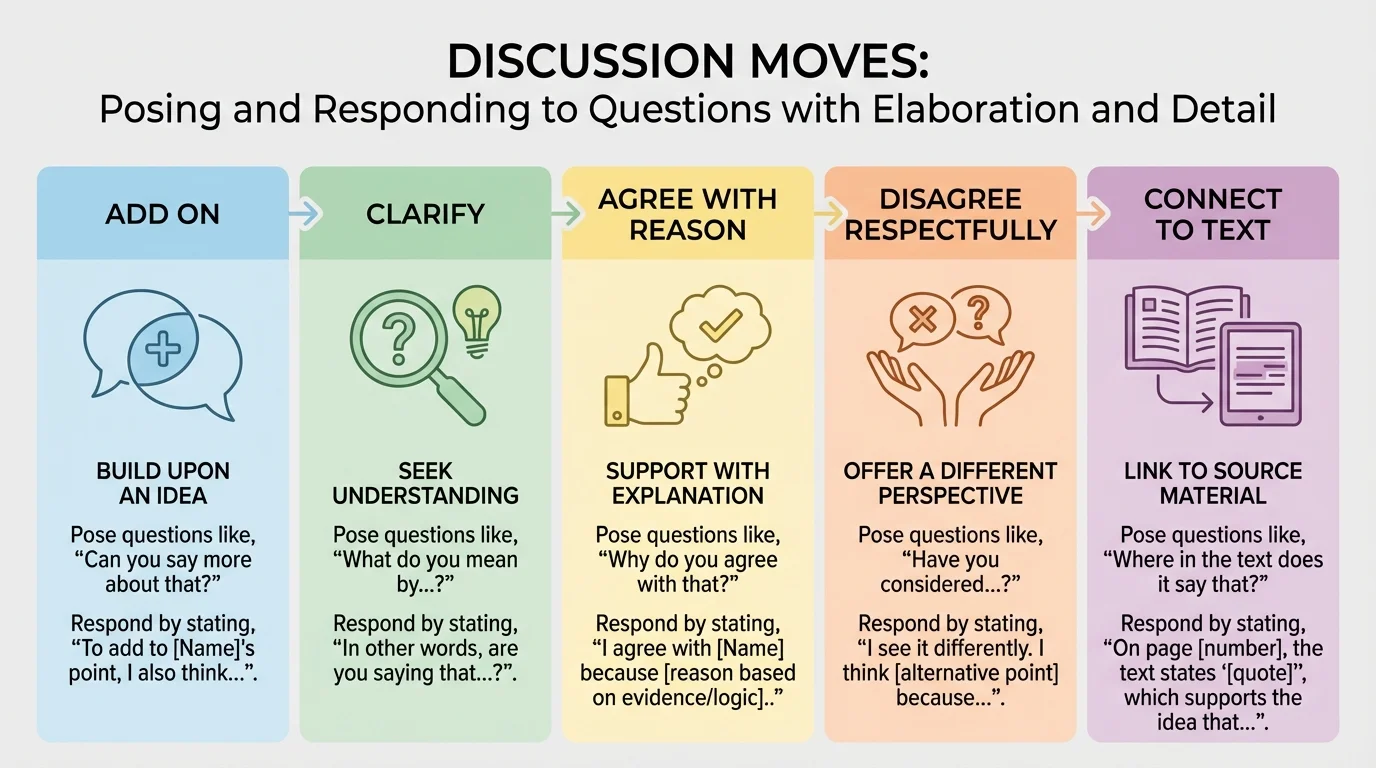
A contributing comment adds something useful to a discussion. [Figure 3] organizes several ways to do that. Not every comment is equally helpful. Saying "I agree" without more does not move the conversation very far. But saying "I agree because the author repeats that idea in the second and fourth paragraphs" gives the group something to consider.
Contributing means helping the discussion grow. You can add a new idea, connect two ideas, ask for clarification, provide evidence, respectfully challenge a point, or extend someone else's thinking. Good comments are connected to the topic and to what another person has said.
These discussion moves help speakers respond purposefully and keep the conversation moving forward.
Useful discussion moves include the following:
Respectful disagreement is especially important. Good discussions are not about everyone saying the same thing. They are about thinking carefully together. If you disagree, focus on the idea, not the person. Instead of saying, "You're wrong," say, "I interpret that part differently because the character's actions later in the story suggest another motive."
"Good discussion is not just speaking. It is building."
Building is the key word. The conversation should not stay flat. It should develop. The comment types in [Figure 3] help speakers move beyond short reactions toward real collaboration.
Discussion looks a little different depending on the setting. In a one-on-one conversation, you may ask more follow-up questions because there are only two speakers. In a small group, you need to balance speaking and listening so everyone has space. In a teacher-led discussion, you may respond to both the teacher's questions and your classmates' ideas.
In partner discussion, it is often easier to go deeper. You can say, "Can you give an example?" or "What makes you think that?" right away. This helps both partners elaborate. In small groups, however, speakers need to make sure the conversation does not get taken over by one or two voices. Helpful students invite others in by saying, "We have not heard from Jordan yet," or "Does anyone want to build on that idea?"
In a whole-class discussion, staying focused becomes even more important. Because many people are contributing, comments need to connect clearly to the topic. It helps to name the idea you are responding to: "I want to respond to the point about fairness," or "Going back to the article's second paragraph, I think..." These signals help everyone follow the conversation.
Listening is not passive. Good listeners track the speaker's main idea, notice evidence, and think about how their own response connects before they speak.
No matter the setting, the goal stays the same: ask clear questions, listen carefully, and speak in a way that helps the group understand more than it understood before.
Many school discussions are based on a reading, video, speech, article, or classroom issue. In those cases, your ideas become stronger when you refer to the source directly. That source may be a story, a nonfiction article, a poem, a historical speech, or even a chart the class has studied.
Evidence is information that supports an idea. In discussion, evidence might be a quotation, a detail from the text, a fact from an article, or a specific example from an event or issue. Saying "I just feel that way" may express an opinion, but it does not support it very strongly. Saying "The author states..." or "In the third paragraph, the article explains..." gives the group something solid to consider.
Suppose students are discussing whether schools should increase outdoor learning time. A strong contribution might be: "I support more outdoor learning because the article explains that students often focus better after physical movement. The writer also gives an example of a school where science lessons outside increased student engagement." That answer includes a claim, evidence, and explanation.
Text-based discussion also requires accuracy. If you refer to a source, make sure you represent it fairly. Do not twist a detail so it fits your opinion. Careful speakers return to what the text actually says.
Example: Using evidence in a discussion response
Question: "What is the author's main message?"
Step 1: State the message clearly.
"The author's main message is that teamwork is stronger than individual pride."
Step 2: Support it with evidence.
"One important detail is that the team starts winning only after the players begin sharing the ball instead of showing off."
Step 3: Explain how the evidence supports the idea.
"That detail matters because it shows success happens when people work together, not when one person tries to control everything."
This response contributes more than a simple opinion because it is tied to the text.
When discussing an issue instead of a text, evidence can also come from observations, shared class information, or reliable facts. The same rule still applies: support your point with clear details and explain how those details connect to your claim.
Students often know they should participate, but they are not always sure how to make their speaking stronger. One common mistake is being too vague. Another is repeating what someone else said without adding anything new. A third is changing the subject so suddenly that the discussion loses focus.
Here are some better choices. Instead of "That was cool," say, "That part stood out because it changed the mood from hopeful to tense." Instead of "I agree," say, "I agree that the character felt trapped, especially because the setting is described as closed and dark." Instead of "What about the end?" say, "How does the ending change the way we understand the character's earlier choices?"
| Common Mistake | Better Choice |
|---|---|
| Giving a very short answer | Answer, explain why, and add an example. |
| Asking a vague question | Focus on one idea, detail, or effect. |
| Repeating another speaker | Add a connection, example, or new angle. |
| Disagreeing rudely | Disagree with reasons and respectful language. |
| Going off topic | Link your comment directly to the discussion focus. |
Table 2. Common discussion problems and stronger alternatives.
Another mistake is speaking as if your first thought is automatically complete. Strong speakers are willing to revise their ideas. They may say, "At first I thought..., but now I think..." That kind of flexibility shows real thinking, not weakness.
Strong discussion depends not only on what you say, but also on how you say it. Speaking clearly means using a voice that can be heard, organizing your thoughts, and choosing words that fit the topic. You do not need to sound formal all the time, but you should sound focused and respectful.
Active listening means paying close attention to the speaker and showing that attention through your actions. You face the speaker, avoid interrupting, and think about the meaning of what was said. You may nod, take notes, or respond directly to an earlier point. Active listeners help a discussion stay connected because their comments come from real attention, not guesswork.
Good listeners also notice when a speaker needs clarification. If a classmate's idea is confusing, a respectful question can help: "Do you mean that the setting caused the conflict, or that it made the conflict worse?" That question supports the speaker and the group at the same time.
Elaboration means adding explanation so an idea becomes clearer and more complete. Evidence is a detail, fact, example, or quotation that supports a claim. Active listening means listening carefully in a way that helps you understand and respond thoughtfully.
Body language also matters. Looking at the speaker shows attention. Waiting for a pause before speaking shows respect. Keeping your tone calm, even during disagreement, helps the conversation stay productive. These small choices make a big difference.
When students ask specific questions, respond with detail, and make useful comments, discussion becomes more than classroom talk. It becomes a way to think together.
