A story can lose a reader in an instant. One moment a character is in a kitchen, and the next moment the character is on a soccer field two days later. If the writer does not guide the reader clearly, the story feels jumpy and confusing. Strong writers prevent that problem by using transitions. These small but powerful words and phrases act like bridges, carrying readers smoothly from one action to the next, from one time to another, and from one place to a different setting.
When you write a narrative, you are not only telling what happened. You are also guiding your reader through the experience. You help the reader know what happens first, what happens later, when the story moves into a memory, and when the action shifts from one location to another. A well-placed transition can make a story feel organized, vivid, and easy to follow.
Narratives often include action, dialogue, description, thoughts, and changes in scene. Without clear signals, these parts can feel disconnected. Transitions connect them. They create a path for the reader's mind to follow.
Think of a movie. The camera may move from a rainy street to a sunny classroom, or from the present day to a memory from years ago. In writing, you do not have music or camera effects to help. Instead, you use language. Transition words, phrases, and clauses tell readers, "We are moving ahead," "We are going back in time," or "We are now in a different place."
Transition words, phrases, and clauses are words or groups of words that connect ideas and show relationships between them. In narrative writing, they often show sequence, signal a change in time, or guide the reader to a new setting.
Sequence means the order in which events happen. In stories, sequence helps readers understand what happens first, next, and last.
Transitions also affect pacing. Short transitions can make action move quickly. Longer, more detailed transitions can slow the pace and prepare readers for an important change. Because of this, transitions do more than organize a story. They help shape the reader's experience.
A transition can be a single word, such as then. It can be a phrase, such as a few minutes later. It can even be a clause, such as when the final bell rang. All three forms can guide the reader clearly.
Here are three common forms:
| Type | Example | How it helps |
|---|---|---|
| Word | next | Moves the reader to the next event quickly |
| Phrase | later that afternoon | Shows a clearer time shift |
| Clause | after the storm had passed | Explains when or why the next event begins |
Table 1. Three forms of transitions and the role each one plays in narrative writing.
[Figure 1] Writers choose among these forms depending on what the reader needs to understand. A simple action may need only one word. A big jump in time or place may need a fuller phrase or clause.
When events happen in chronological order, chronological order helps the reader move step by step through the story. Sequence transitions are especially useful in action scenes, personal narratives, and any part of a story where one event leads directly to another.
Common sequence transitions include first, next, then, afterward, soon, meanwhile, and finally. Each one gives the reader a clue about where the story is moving.
Look at this example: "First, Maya heard the whistle. Next, she tightened her grip on the relay baton. Then, she sprinted across the track. Finally, she slapped the baton into Tori's hand." The transitions make the action easy to follow.
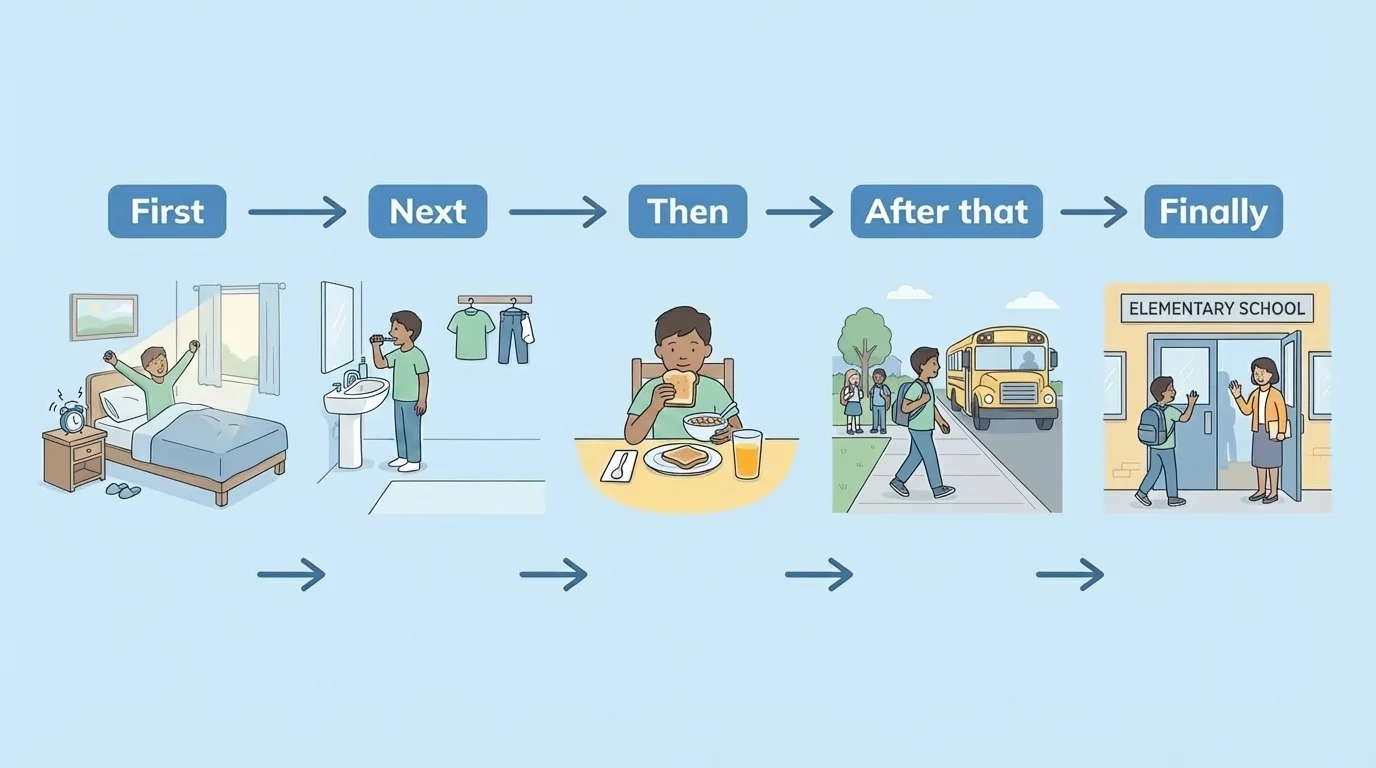
Sequence transitions do not always have to appear at the beginning of a sentence. You can place them in different spots to create smoother writing. For example: "Jordan packed his sketchbook and, a moment later, ran for the bus." This sounds more natural than beginning every sentence the same way.
Writers also use sequence transitions to show simultaneous actions. Words like meanwhile and at the same time let readers know that two things are happening together. That can add suspense. For example: "Lena searched the basement with a flashlight. Meanwhile, footsteps creaked across the kitchen floor above her."
Example of sequence in a narrative scene
Here is a short passage with clear event order:
Step 1: Opening action
"At sunrise, Eli unzipped the tent and stepped into the cold mountain air."
Step 2: Next event
"A few minutes later, he heard water rushing nearby and followed the sound to a stream."
Step 3: Final event
"By noon, he had filled his bottle, climbed the ridge, and spotted the lake below."
Each transition tells the reader how much time has passed and where the action stands in the sequence.
[Figure 2] As the flow of events becomes more complex, the kind of sequence shown in [Figure 1] remains important. Even exciting scenes feel clear when the reader can track the order of actions.
Stories do not always move in a straight line. A writer may jump ahead, slow down, or move into a memory. These time shifts help create mystery, reveal background information, or show how a character has changed.
To signal a change in time, writers use transitions such as earlier that day, the night before, years ago, by the time, later, the following morning, and in that moment. These clues prepare readers for a move in the timeline.
A writer may also use a flashback, which is a scene that returns to an earlier event. For example: "The smell of smoke filled the air. Suddenly, she remembered the campfire from last summer." The phrase signals that the story is leaving the present moment and entering a memory.
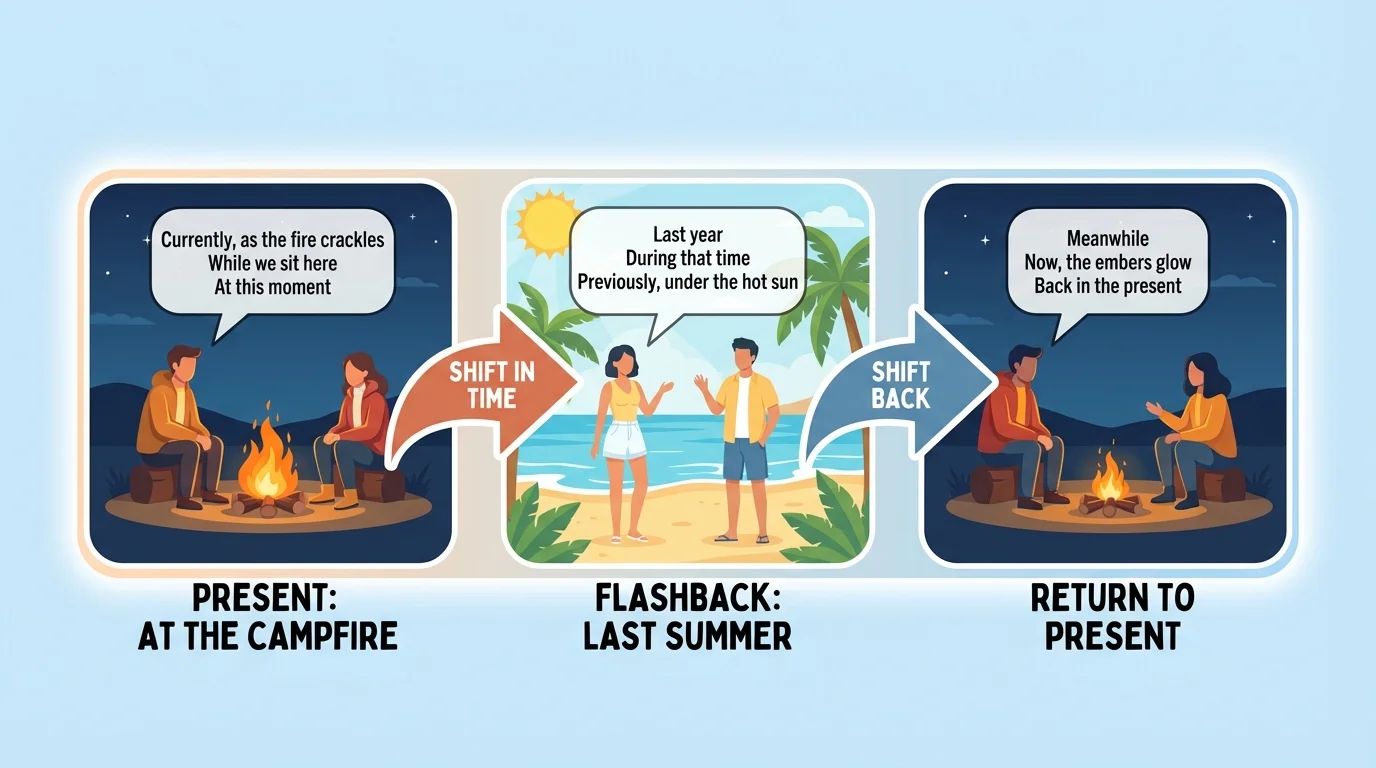
After a flashback, the reader must be guided back to the present. Transitions such as now, back in the classroom, when he returned to the present, or the memory faded make that return clear.
Here is an example: "Rosa gripped the edge of the canoe. For a second, she was eight years old again, wobbling on the town pool's diving board. A shout from the shore snapped her back. Now, the lake stretched dark and wide in front of her." The words signal both the move into the memory and the return to the current scene.
Clear time movement keeps readers grounded. If a narrative moves from present action to a memory and then back again, the writer must signal each move. Readers should never have to guess whether an event is happening now, happened before, or will happen later.
[Figure 3] Time shifts can be small or large. A small shift might be minutes later. A large shift might be three years later. The bigger the jump, the more clearly the transition should explain it.
A story may also move from one place to another. These setting shifts need clear signals so the reader can travel smoothly from one location to the next. Without that guidance, the reader may not know where the characters are.
Transitions for setting include phrases such as across the street, inside the cabin, back at the stadium, on the other side of town, outside, and by the riverbank. These phrases do more than mark a new place. They can also create mood.
Compare these two sentences: "They left." and "Outside, beneath the flickering streetlight, they left in silence." The second version uses a setting transition to guide the reader and add atmosphere at the same time.
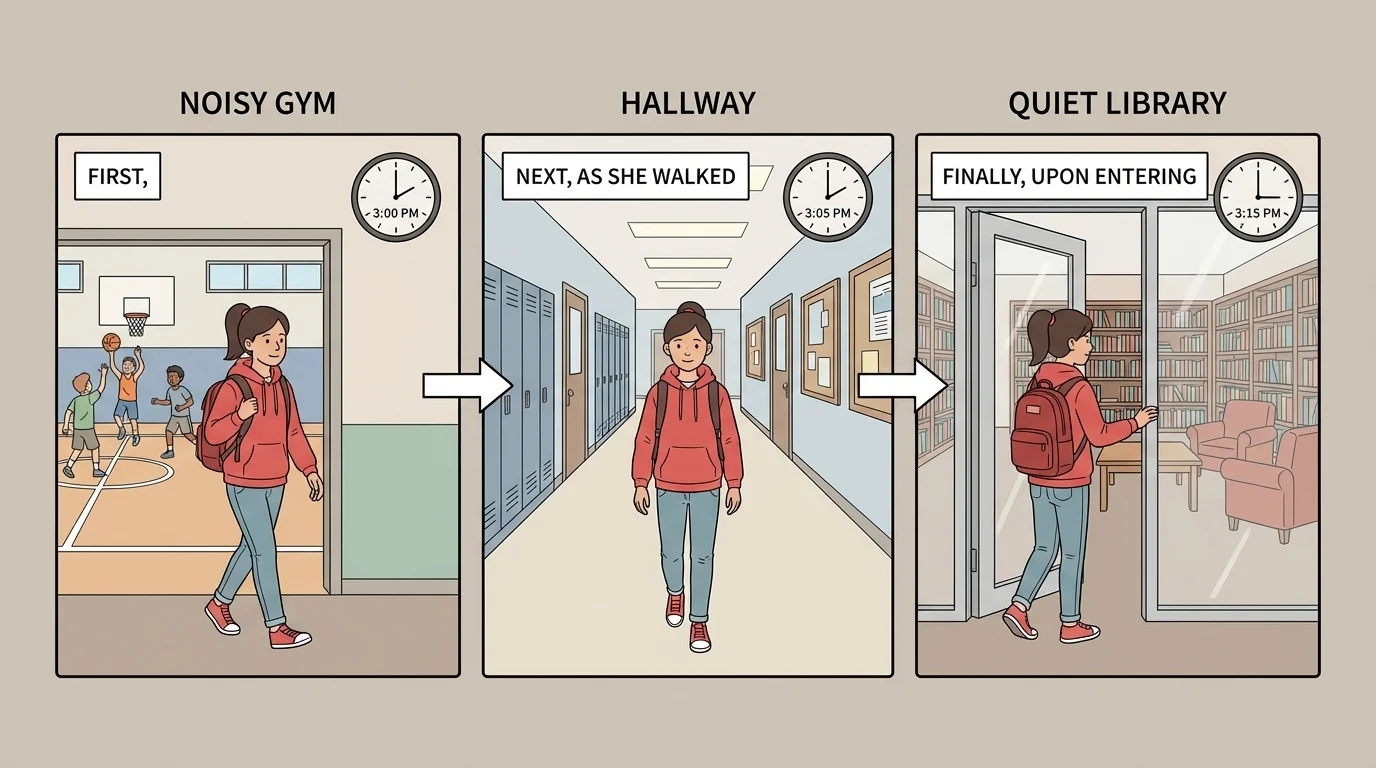
Writers often combine time and setting transitions in one sentence. For example: "After lunch, back on the playground, Amir finally found the missing notebook." This tells the reader both when and where the next event happens.
The movement between places shown in [Figure 3] also reminds us that setting changes can affect tone. A bright cafeteria, a silent hallway, and a stormy bus stop each create a different feeling, so transitions can quietly prepare readers for an emotional shift too.
Not all transitions do the same job. A quick action scene may need short words like then or next. A reflective memory may need a fuller phrase like years earlier, before everything changed. The choice depends on how much information the reader needs.
Single words are useful when the order is simple and easy to follow. Phrases work well when you need to show more detail about time or place. Clauses are especially effective when the transition connects the next event to a condition or action, such as "When the rain finally stopped, the team ran back onto the field."
A good transition matches the style of the sentence. If every sentence begins with then, the writing will sound repetitive. Strong writers vary their transitions: "Afterward, they laughed." "The laughter faded as the lights went out." "Minutes later, a knock sounded at the door."
Professional authors often revise transitions many times. A scene may have strong characters and vivid details, but if the movement between moments feels confusing, the writer adjusts the transitions until the reader can follow the story easily.
Transitions should also match the tone. In a tense moment, a simple and sharp transition may work best: "Suddenly, the window slammed." In a calm scene, a gentler phrase may fit better: "Later that evening, the lake turned silver under the moon."
Good transitions do not call too much attention to themselves. They help the story flow without sounding forced. If every sentence starts with a transition, the writing can feel mechanical, as if the author is checking boxes instead of telling a story.
One way to sound natural is to blend transitions with description and action. Instead of writing, "Then she went to the porch," you might write, "A moment later, she stepped onto the porch, where rain tapped softly against the railing." The transition is there, but it is part of a fuller sentence.
Another way is to let dialogue work with transitions. For example: "'Wait here,' Dad said. A minute later, the garage door groaned open." The transition connects the spoken moment to the next action.
Comparing weak and strong transitions
Weak: "Then we got on the bus. Then we sat down. Then the driver started talking."
Stronger: "After we climbed onto the bus, we squeezed into the last open seat. A few seconds later, the driver stood up and began speaking."
The stronger version sounds smoother because it varies the transitions and connects them to the action.
Natural transitions often disappear into the rhythm of the writing. The reader notices the story, not the bridge words, yet the guidance is still working.
Transitions are especially useful when a narrative paragraph includes several kinds of details. A writer may move from action to description, from dialogue to reflection, or from one scene to another. Clear signals keep these changes from feeling abrupt.
For example, consider this scene: "Noah shoved open the gate and ran into the yard. The grass was slick with rain, and the smell of wet soil rose around him. 'Milo!' he called. Across the fence line, a collar tag jingled." The setting transition guides the reader's attention across the scene.
Now add a time shift: "Noah knelt beside the dog, laughing with relief. Only an hour earlier, he had imagined the worst." The phrase tells the reader that the story is briefly reaching back to a previous moment.
Transitions are one reason some stories feel smooth and cinematic. They move the reader through action, memory, place, and emotion without confusion.
Read this short narrative passage: "The hallway buzzed with voices after the final bell. At first, Nia could not hear anything except the pounding in her chest. Then, through the crowd, she spotted her brother waving from the exit. Moments later, they were outside, breathing the cold autumn air. As they crossed the parking lot, Nia finally smiled."
This passage uses several kinds of transitions. At first and then show sequence. Moments later signals a small time jump. As they crossed the parking lot works as a clause that moves the action into a new setting while the characters continue moving.
Here is another example with a stronger time shift: "Leo stared at the cracked trophy on his shelf. Ten years earlier, it had gleamed under the gym lights while the crowd cheered. He blinked and touched the broken handle. Now, dust coated its base." The reader clearly understands when the story moves into the past and when it returns to the present.
Readers need orientation. In earlier writing lessons, you may have learned to include who, where, and when. Transitions support all three by helping readers know who is acting now, where the scene is happening, and when each event takes place.
Notice how the second example feels richer because the transitions do more than mark order. They reveal contrast between past success and present disappointment.
One common mistake is using no transition at all when a story shifts in time or place. Example: "Ava closed her locker. She was at the beach last summer." The reader may stop and wonder why the beach suddenly appeared. A clearer version is: "Ava closed her locker. For a moment, she remembered the beach from last summer."
Another mistake is repeating the same transition too often. Writing then again and again makes the style dull. Fix this by varying your choices: next, soon, afterward, later that day, when the crowd finally settled.
A third mistake is using a transition that does not match the event. For example, suddenly should be saved for something quick or surprising. It would sound strange in a sentence like "Suddenly, three months passed." For a long jump in time, use something clearer such as by winter or three months later.
A fourth mistake is making transitions too vague. Words like later may be fine sometimes, but in a complex story, the reader may need more detail. Compare "Later, she returned" with "Late that evening, after the storm ended, she returned." The second version gives the reader a much clearer picture.
"A reader should never feel lost between one moment and the next."
— Guiding principle for narrative writing
Strong transitions are not fancy decorations. They are tools that help a story make sense. They show order, connect scenes, signal memories, and guide readers through changes in time and place.
When writers choose transitions carefully, they create narratives that feel controlled and vivid. The reader can follow the events, picture the setting, and understand the movement of time. That clarity makes the story more powerful.
