Some stories disappear from your mind as soon as you finish reading them. Others stay with you because you can almost hear the hallway slam, smell the smoke from the campfire, or feel the icy water splashing over your shoes. The difference is often not the event itself, but the writer's language. A simple moment, like missing a bus or opening a door, can become powerful when a writer chooses exact words and meaningful details.
When you write a narrative, you are not just listing what happened. You are helping readers experience it. Strong narrative writing uses precise language, carefully chosen description, and details that fit the moment. It also arranges events clearly so readers can follow what happens, why it matters, and how it feels.
This kind of writing is important whether the narrative is real or imagined. You might write about a soccer game, a thunderstorm, a family trip, a mystery in a school hallway, or an invented adventure. In every case, your goal is the same: make the experience come alive.
Precise words are exact words that name an action, object, feeling, or image clearly. Descriptive details are specific pieces of information that help readers understand a scene, person, or event. Sensory language describes what can be seen, heard, smelled, tasted, or felt.
A writer's first tool is word choice. Broad, general words tell the basic idea, but exact words paint a sharper picture. Compare these sentences:
"I went into the room" gives information, but it is plain. "I tiptoed into the dark storage room" tells much more. The second sentence gives a clearer action, a mood, and a setting. The verb tiptoed is more exact than went, and the phrase dark storage room is more specific than room.
Precise words matter because they help readers form mental images. They also create tone. If a character strolled, that feels different from marched, dragged, or rushed. Each verb suggests a different attitude, speed, or emotion.
Writers often improve a sentence by replacing weak words with stronger ones. Instead of writing "nice," you might choose gentle, cheerful, kind, or welcoming. Instead of "bad," you might choose dangerous, disappointing, harsh, or awful. The more exact the word, the easier it is for the reader to understand your meaning.
The first step toward stronger narratives is noticing vague language. Words like thing, stuff, went, got, and nice are not always wrong, but they often hide important meaning. Replacing them with more specific language gives your writing strength.
One moment can be described through many senses, as [Figure 1] shows. Sensory language helps readers step into the scene instead of standing outside it. When readers can picture, hear, smell, taste, or feel what is happening, the narrative becomes more memorable.
Sensory language includes details from the five senses. A writer does not need all five in every paragraph, but using several can make a scene vivid and believable. Sensory details are especially useful during important moments, such as the start of a problem, a surprising discovery, or the climax of the story.
Here is how the senses can work in narrative writing:
| Sense | Question It Answers | Example Detail |
|---|---|---|
| Sight | What is visible? | The flashlight beam shook across the peeling yellow wall. |
| Sound | What can be heard? | Rain drummed on the metal roof. |
| Smell | What scent is in the air? | The air smelled like wet leaves and mud. |
| Taste | What flavor is noticed? | Salt from the ocean spray clung to my lips. |
| Touch | What texture or physical feeling is present? | The railing felt slick and icy under my hands. |
Table 1. Examples of how each sense can add vivid detail to a narrative scene.
Notice that these details are not random. Each one helps build the scene and mood. A writer chooses details that support the event. If the scene takes place at a carnival, bright lights, popping balloons, greasy food smells, and the rattle of rides may fit. If the scene is a quiet library, those details would not belong.
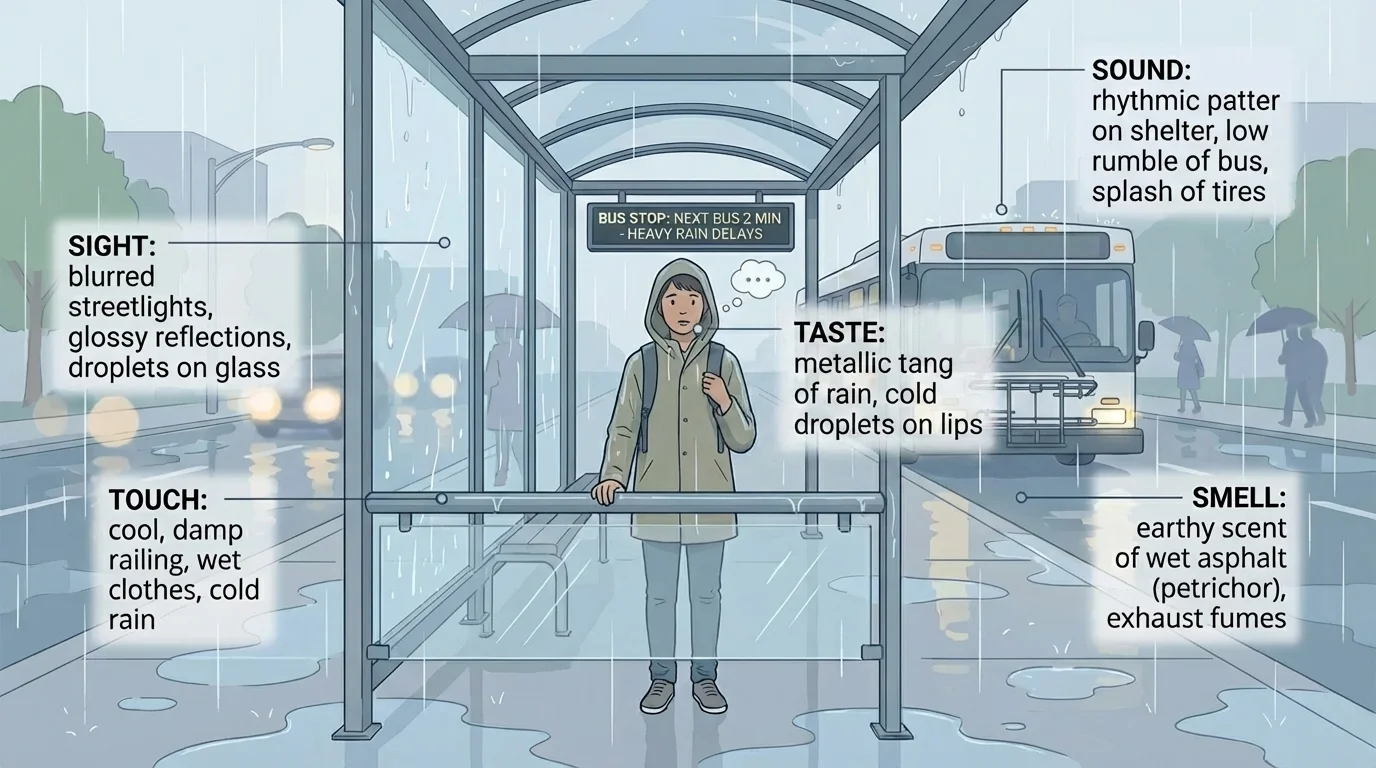
Sensory language also helps reveal emotion. If a character is nervous, the writer might describe sweaty palms, a dry mouth, or the buzz of every tiny sound in the room. If a character feels safe, the writer might focus on soft blankets, warm soup, and the low hum of a heater. The details readers notice often match the feelings of the character.
Professional authors often revise scenes by asking themselves what a character notices first. A frightened character may hear every creak and whisper, while an excited character may notice flashes of color and fast movement.
A good writer does not pile on details just to sound fancy. Too many details can slow the story or confuse the reader. Sensory language works best when it is purposeful.
Relevant details are details that matter. They help the reader understand the setting, mood, character, or action. They do not distract from the event.
Suppose a character is running late for an important audition. The details should support the urgency of that moment: the flashing clock, the twisted backpack strap, the squeak of sneakers on the floor, the character's quick breathing. A long description of every poster on the wall would probably weaken the scene because it pulls attention away from what matters most.
Writers choose relevant details by asking questions such as: What does the reader need to picture? What should the reader feel here? Which details reveal the character's problem or reaction? Which details help move the story forward?
Relevant description can also reveal personality. If two characters enter the same room, they may notice different things. A basketball player might notice the height of the ceiling and the bounce of the floor. A musician might notice the echo. A younger sibling might notice the bowl of candy by the door. These choices make characters feel real.
Choosing details with purpose means matching the description to the moment. In a tense scene, short, sharp details can increase suspense. In a peaceful scene, slower and softer details can help the reader settle into the setting. Description is not extra decoration; it is part of storytelling.
Writers often hear the advice "show, don't tell." This does not mean telling is always wrong. Sometimes a writer should tell information quickly. But important moments usually become stronger when the writer shows them through action, dialogue, thoughts, and sensory clues.
A telling sentence might say, "I was scared." A showing version might say, "My hands tightened around the flashlight, and I stopped breathing when the floorboard cracked behind me." The second version does not directly name the feeling, but the reader understands it.
Showing often uses a mix of techniques. Action reveals what the character does. Dialogue reveals what people say and how they speak. Thoughts reveal what the character notices or worries about. Description reveals what the world around the character feels like.
Here is a comparison:
Telling: "The cafeteria was noisy."
Showing: "Chairs scraped the floor, trays clattered, and a hundred voices bounced off the walls at once."
Both sentences communicate an idea, but the second one gives the reader an experience. The goal is not to make every sentence long. The goal is to make key moments clear and vivid.
Example: Turning a flat sentence into a vivid one
Flat sentence: "We walked home during the storm."
Step 1: Make the action more precise.
Replace walked with a stronger verb such as splashed, trudged, or stumbled.
Step 2: Add relevant sensory details.
Think about what the characters feel and hear: cold rain, thunder, soggy shoes, wind.
Step 3: Put the details into a smooth sentence.
Revised sentence: "We trudged home through the storm while rain needled our faces and thunder rolled above us."
The revised version is stronger because it uses a precise verb and sensory language that fits the event.
[Figure 2] A narrative needs more than vivid details. It also needs a clear order of events. Readers should understand what happens first, what changes next, and how the experience ends.
A sequence is the order in which events happen. In a strong narrative, events connect logically. One action leads to another. The beginning introduces the situation, the middle develops the problem or experience, and the ending shows the result, decision, or change.
Description should support the sequence, not stop it. If the writer pauses too long for extra detail in the middle of an important action scene, the pace may slow down too much. If the writer gives almost no detail at a major moment, the scene may feel rushed. Good pacing means expanding the important moments and moving more quickly through less important ones.
Transitions help readers follow the sequence. Words and phrases like first, meanwhile, a moment later, after that, suddenly, and by the time can show how events connect. Writers do not need a transition in every sentence, but they should guide readers clearly through time and action.
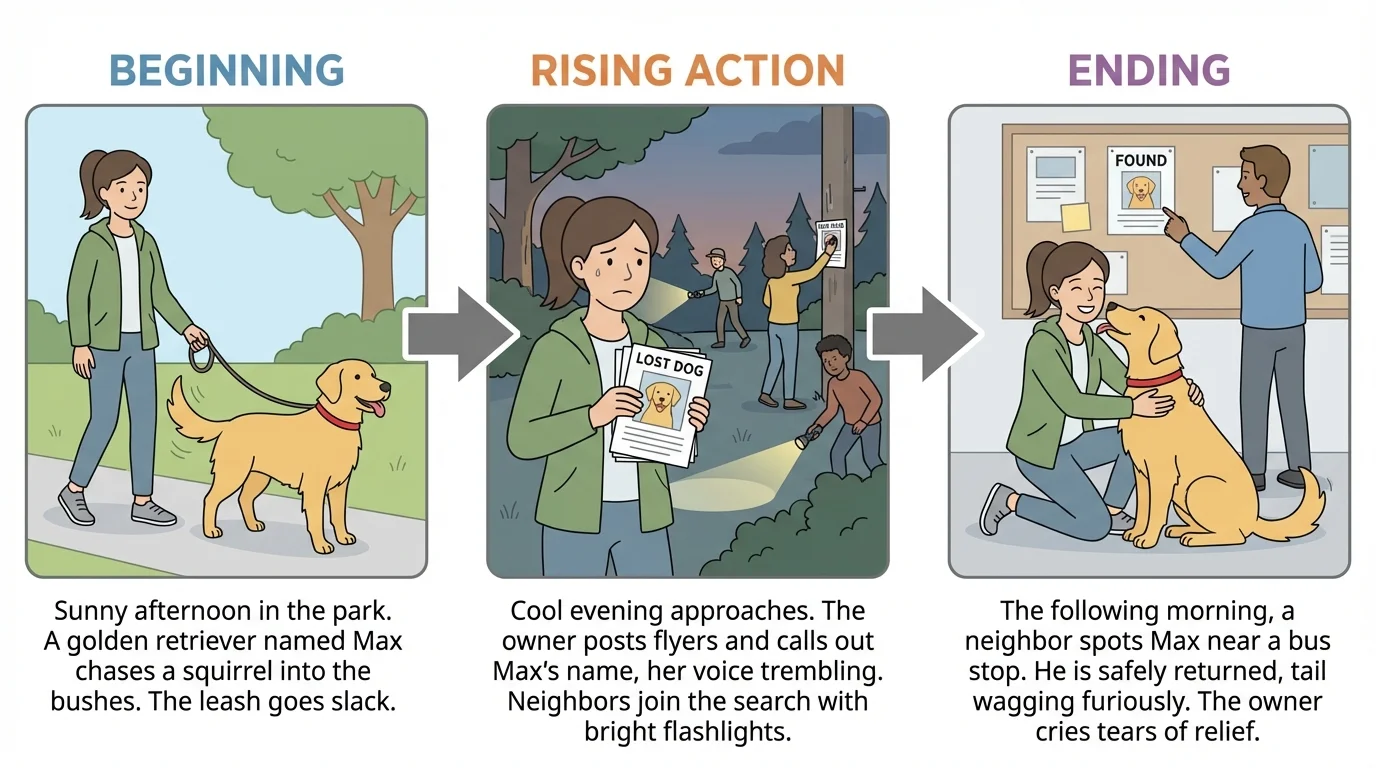
Writers also zoom in and zoom out. They zoom in on important scenes with sensory details, dialogue, and close description. They zoom out to move across less important time. For example, a writer may spend several sentences on the moment a character opens a mysterious envelope, but only one sentence on the bus ride before it.
As readers saw earlier in [Figure 1], sensory details work best when attached to meaningful moments. Event sequence helps a writer decide where those moments are. The strongest description usually appears where the story changes.
Dialogue is the exact words characters say. In narratives, dialogue can make a scene feel immediate and real. It can also reveal personality, relationships, and emotion.
Compare these two lines:
"My brother told me to hurry."
"'Move it,' my brother snapped. 'If we miss the train, I'm blaming you.'"
The second version reveals much more. The dialogue shows tone and relationship. The verb snapped adds emotional meaning. Readers learn not just what was said, but how it was said.
Dialogue works best when it sounds natural and has a purpose. It should reveal character, move the event forward, or increase tension. Long stretches of unimportant conversation can slow the narrative.
The writer's voice also matters. Voice is the style and personality that come through in the writing. A nervous narrator may describe things differently from a confident one. A funny narrator may notice strange details. A thoughtful narrator may reflect deeply on a small event. Word choice, sentence length, and detail selection all contribute to voice.
"The right word may be effective, but no word was ever as effective as a rightly timed pause."
— Mark Twain
Even though this idea is about timing, it also connects to narrative description. Good writers choose not only the right words, but the right moment for those words.
The same event can feel completely different depending on the language used. If you are writing a suspenseful scene, you might choose sharp verbs, dark images, and short sentences. If you are writing a peaceful memory, you might choose softer words and calmer details.
For example, suppose a character enters a forest.
Suspenseful version: "Branches clawed at my jacket as I pushed into the shadows. Somewhere ahead, something snapped."
Peaceful version: "Sunlight filtered through the leaves, and the path smelled fresh and green after the rain."
Both describe a forest, but the details and word choices create different moods. This is why precise language matters so much. It does not only identify objects and actions. It shapes feeling.
Writers should think about mood at every stage of a narrative. What should the reader feel here: excitement, worry, joy, surprise, relief, curiosity? Then the writer chooses details that support that feeling.
You already know that a narrative tells about events in order. This lesson builds on that idea by making each event clearer and more vivid through stronger language and better detail choices.
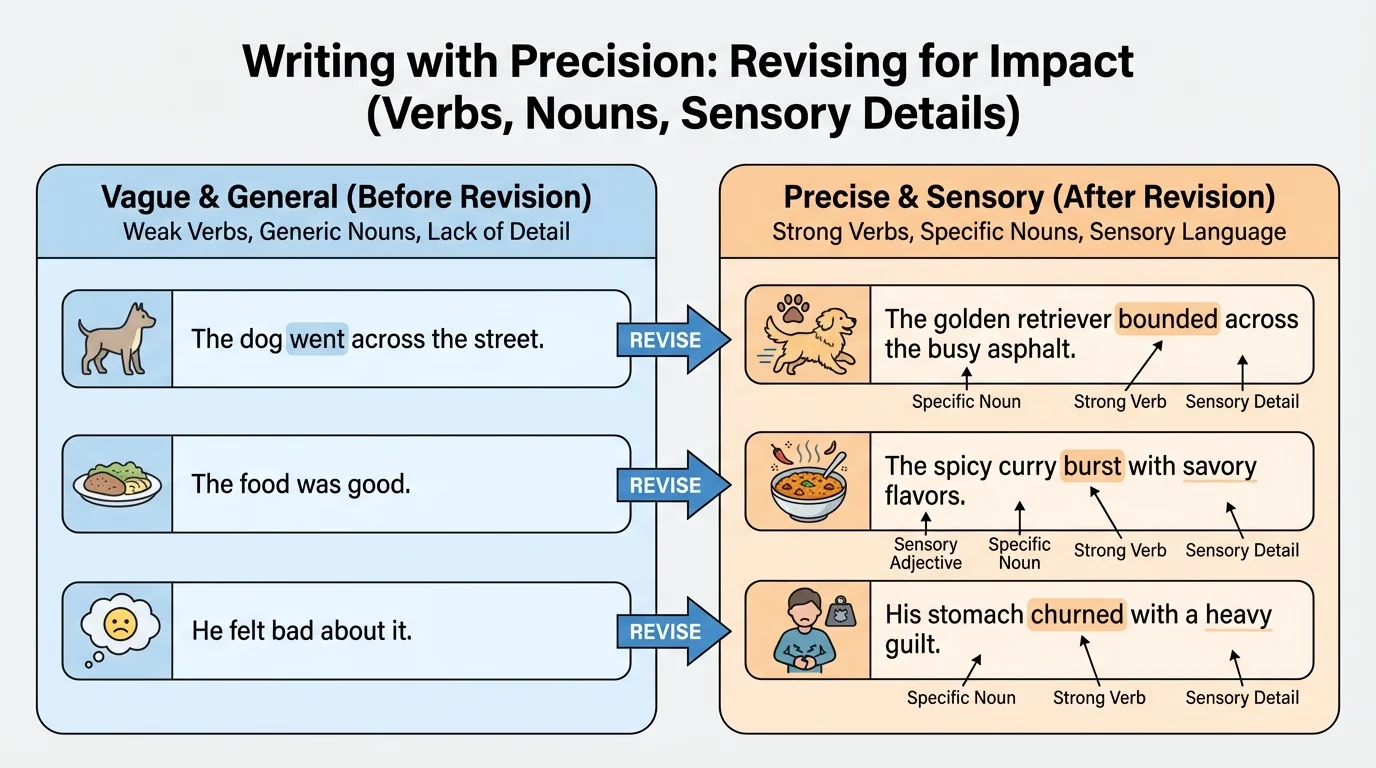
[Figure 3] Strong narratives are rarely perfect in the first draft. Revision is where writers sharpen language, and replacing general words with specific ones can transform a sentence. During revision, writers ask whether each word is doing useful work.
One revision strategy is to underline weak verbs and replace them. If a sentence says a character went, looked, or got, think about a more exact choice. Did the character dart, peer, snatch, drag, or collapse?
Another strategy is to check nouns. A bird might become a sparrow. A vehicle might become a pickup truck. A food smell might become the smell of garlic bread. Exact nouns often improve writing immediately.
Writers should also cut details that do not matter. If a description is interesting but does not support the character, mood, or event, it may need to be shortened or removed. Good writing is not just about adding more. It is also about choosing better.
A useful revision checklist includes these questions:
Later, when you reread an important scene, think back to [Figure 2]. Sequence and detail work together. A vivid line is strongest when it appears at the right point in the event, not when it interrupts the flow.
Read this short narrative passage:
"The gym was almost empty when Lena stepped onto the court. Her sneakers squeaked against the polished floor, loud in the silence. At the far end, the scoreboard glowed red, and the basket cast a thin shadow across the wood. She bounced the ball once. Twice. The sound echoed through the room like a challenge. 'One shot,' she whispered, wiping her damp hands on her shorts. The ball left her fingers in a smooth arc, and for a second everything held still."
This passage works because the writer uses precise words like squeaked, glowed, and echoed. The details are relevant: the empty gym, the scoreboard, the sound of the ball, the damp hands. These details support the tension of the moment. The short sentence "One shot" adds pressure. The event sequence is clear, moving from entry to preparation to action.
Why the model passage is effective
Step 1: It uses precise verbs.
Words such as stepped, squeaked, glowed, and whispered create clear images.
Step 2: It includes sensory details.
The reader can hear the sneakers and ball, see the red scoreboard, and notice Lena's damp hands.
Step 3: It keeps the details relevant.
Every detail supports the suspense of taking an important shot.
Step 4: It follows a strong sequence.
The action moves naturally from entering the gym to releasing the ball.
When writers combine all of these techniques, narratives become stronger. The event does not need to be huge or dramatic. A well-written small moment can feel important because the language makes readers care.
Whether you are writing about a real memory or an invented adventure, choose words that do more than fill space. Choose words that let the reader see, hear, and feel the experience. That is what turns a basic account into an engaging narrative.
