Have you ever read a story that was exciting all the way through, but the ending felt rushed, confusing, or just plain wrong? A weak ending can make a strong story feel unfinished. A strong ending does something different: it makes the reader feel that the events mattered. In narrative writing, a conclusion should not appear out of nowhere. It should grow out of the experiences, choices, and events that came before it.
A conclusion is the part of a narrative that brings the story to a close. But "close" does not simply mean "stop writing." A conclusion gives the reader a sense that the journey is complete. It answers the question What now? after the main action is over.
Think of a story like a path through the woods. The beginning opens the trail, the middle leads through challenges and discoveries, and the ending brings the traveler somewhere meaningful. If the traveler suddenly disappears, the reader feels lost. If the traveler reaches a place that does not connect to the path, the reader feels tricked. A good conclusion feels earned.
For sixth-grade writers, this means your ending should match the events you narrated. If your character learned to be brave, the ending might show that new bravery. If your story was about a misunderstanding between friends, the ending might show forgiveness, honesty, or the result of not fixing the problem. The conclusion follows from what happened; it does not ignore it.
Narrative conclusion is the ending of a story that grows naturally from the experiences, events, and choices in the narrative. It gives closure, shows a result, reveals a change, or leaves the reader with a clear final idea.
Readers remember endings. Sometimes they remember the very last sentence most of all. That sentence can leave them with relief, surprise, pride, sadness, hope, or thoughtfulness. The key is that the feeling should fit the story you told.
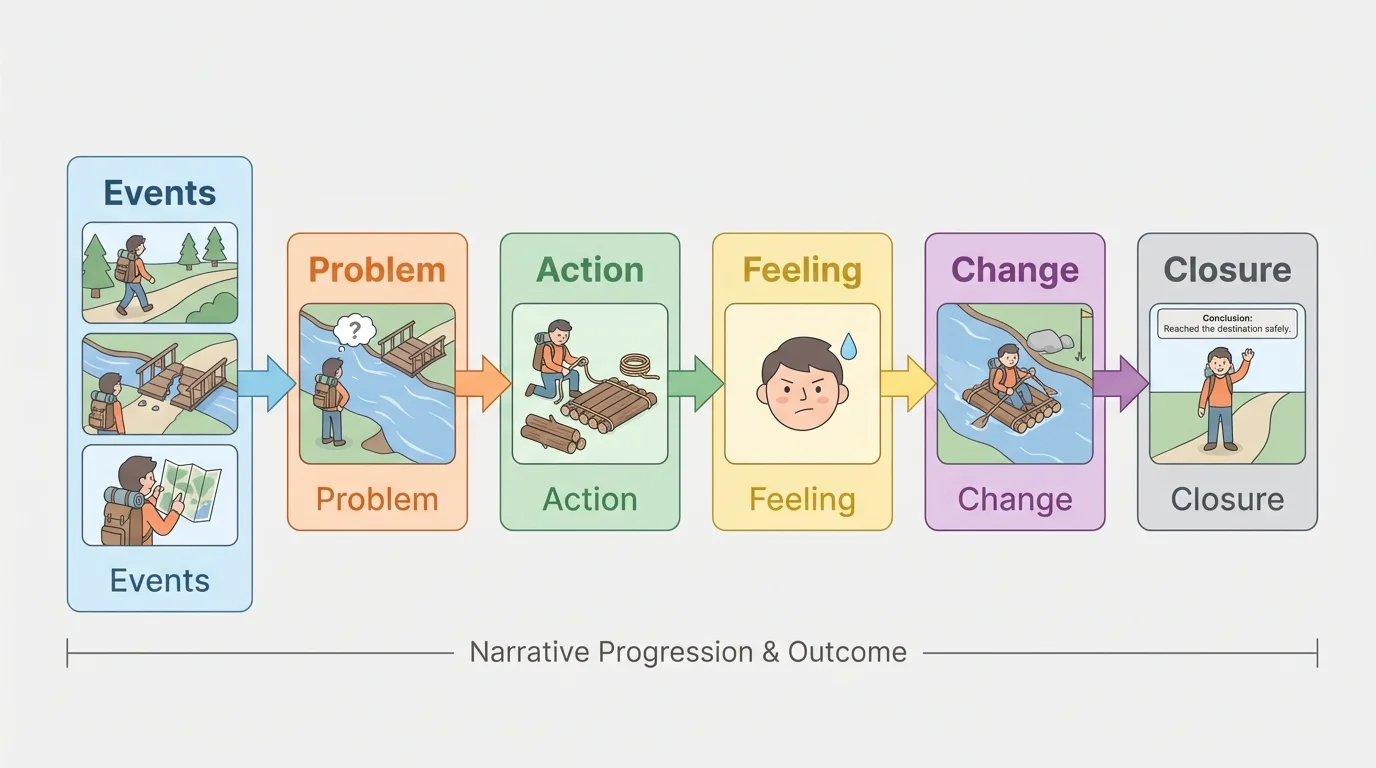
A strong ending is not random. It comes from the story's event sequence, as [Figure 1] shows, where each event leads toward a final result. The conclusion grows from the problem, the character's response, and what changes because of the experience.
One job of a conclusion is to provide closure. Closure means the reader feels the main moment has been completed. This does not mean every tiny question must be answered, but the main action should feel settled. If a story is about finding a lost dog, the ending should show what happened with the dog and why that moment matters.
Another job of a conclusion is to show reflection. Reflection is when the narrator or character thinks about what happened and what it meant. Reflection helps the reader understand why the event mattered. Even in a fast-moving story, a brief reflective line can make the ending deeper and stronger.
A conclusion can also reveal change. Maybe the character feels different, understands something new, or decides what to do next. The story's final lines often answer a silent question: How did this experience affect the character?
Notice that a conclusion does not need to be long. Sometimes only a few sentences are enough. What matters is not length but connection. An ending that connects clearly to earlier events is stronger than a long ending that wanders into unrelated ideas.
Professional authors often rewrite the last paragraph many times. They know that a satisfying ending can change how the whole story feels in the reader's mind.
If a narrative includes a challenge, the ending should show the result of that challenge. If it includes an important relationship, the ending should show where that relationship stands. If it includes a strong emotion, the ending should help the reader understand how that emotion has changed, as we can still trace in [Figure 1] from event to response to conclusion.
[Figure 2] Writers do not all end stories the same way. There are several useful conclusion patterns, and different stories need different endings.
One common type is an action ending. In this kind of conclusion, the final event itself closes the story. For example, if the story is about a runner trying to finish a race, the ending may show the runner crossing the finish line and collapsing with relief.
This comparison illustrates how each type can fit a different kind of experience.
Another type is a reflection ending. Here the final lines explain what the experience meant. After the race, the runner might think, "I had not won, but for the first time I knew I could finish something that scared me."
A third type is a lesson-learned ending. This works when the events naturally teach the character something. The lesson should come from the story itself, not from a random moral added at the end.
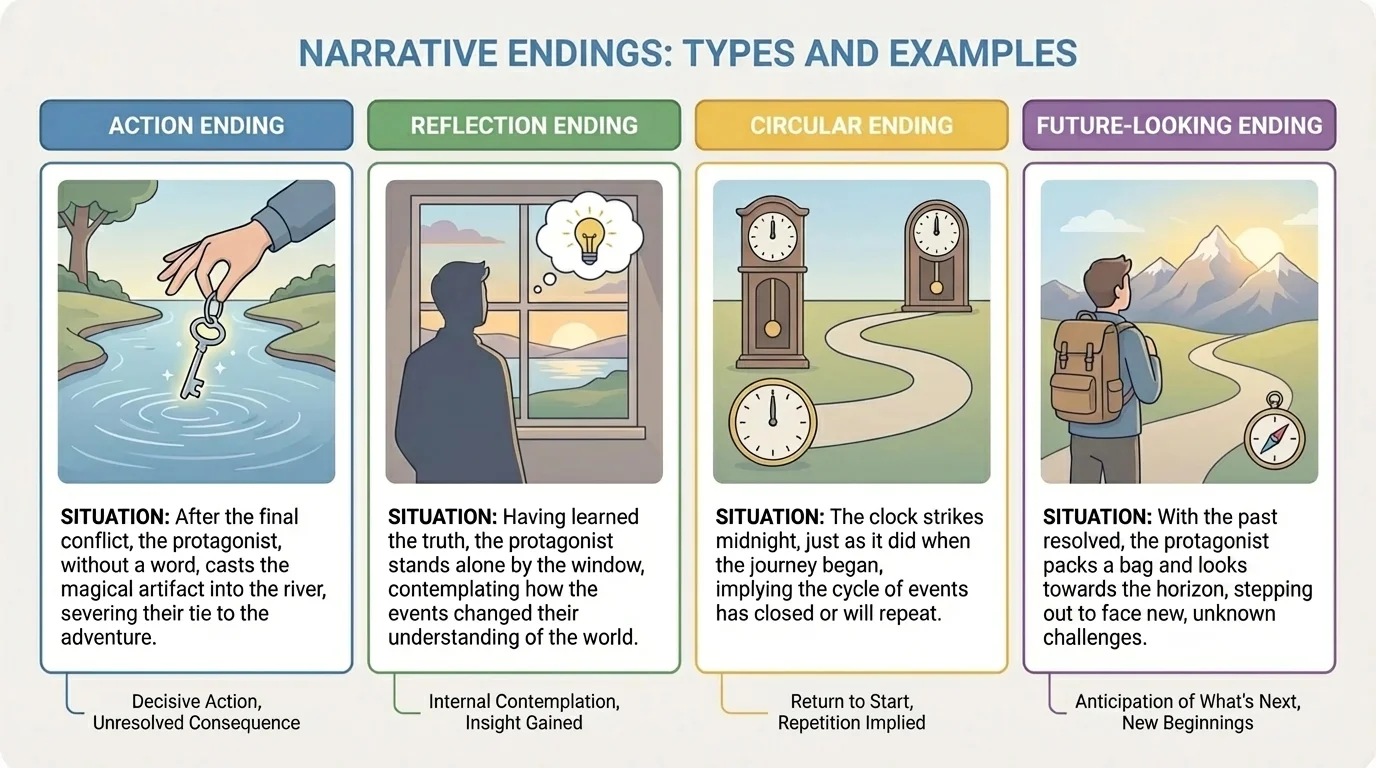
A circular ending returns to an image, object, place, or idea from the beginning. This makes the story feel complete. For example, if a story begins with a girl staring nervously at a diving board, it might end with her touching that same board after finally jumping, now feeling proud instead of afraid.
A future-looking ending hints at what comes next. It still closes the current story, but it lets the reader feel that life will continue. For example, after moving to a new town and making one friend, the narrator might conclude, "On Monday, I still didn't know everyone's name, but I no longer felt like I was arriving alone."
Dialogue can also help. A single line of speech at the end can feel powerful if it matches the experience. For instance, after siblings work together during a storm, one might whisper, "Next time, we bring the chairs in before the thunder starts." That line can show humor, relief, and growth all at once.
A conclusion should fit the story's tone. If the narrative is thoughtful and quiet, a wild dramatic ending may feel false. If the narrative is tense and action-filled, a very slow ending with too much explanation may weaken the energy.
This is why writers pay attention to tone, or the feeling carried by the words. A story about embarrassment at a school talent show might end with gentle humor. A story about helping during a family emergency might end with gratitude or relief. The tone of the ending should match the emotional path of the narrative.
The conclusion should also match the size of the problem. A small everyday event does not need an extreme ending. If your story is about forgetting your lines in a class play, the ending should not suddenly claim that your whole life changed forever. It is enough to show what you realized, how you recovered, or what happened afterward.
Earned endings come from cause and effect. The character experiences something, responds to it, and is changed by it in some way. Because of that chain, the ending feels believable. When an ending adds a big idea that the earlier events never supported, it feels unearned.
One useful question to ask is: If a reader looked back at the earlier events, would this ending make sense? If the answer is yes, the conclusion probably follows from the narrated experiences. If the answer is no, the writer may need to revise.
Writers often use sensory details in their final lines. A smell, sound, or image can make the ending vivid. Instead of saying, "I was happy," a writer might say, "The cold lemonade tasted sweeter than anything I had ever had." That detail helps the reader feel the moment.
Dialogue is another strong tool. One short line can reveal a relationship, a mood, or a new understanding. The best final dialogue usually sounds natural and meaningful, not overly dramatic.
Description matters too. If a storm has filled the whole story, ending with calm sunlight on wet pavement can create a strong contrast. If a crowded gym has made the character nervous, ending with the sound of applause fading as the character smiles can show that the conflict has passed.
Writers also repeat a key image or phrase from earlier in the story. This repetition creates unity. The reader notices that the ending connects to the beginning, and the narrative feels complete.
Good narratives already include a clear beginning, middle, and end. The conclusion works best when the middle has shown a sequence of events, not a random list of moments. Strong sequencing makes the final outcome easier for the reader to understand.
Inner thinking can be especially useful in first-person narratives. A simple thought such as, "This time I didn't look away," can show growth more effectively than a long explanation. The best reflective lines are specific and connected to the experience, not general statements that could fit any story.
Some endings are weak because they simply stop. For example: "Then I went home. The end." This tells the reader that time passed, but it does not explain why the experience mattered.
Other endings are weak because they add a lesson that does not match the story. If the narrative is about losing a soccer game and learning teamwork, an ending like "That day I learned to always protect nature" makes no sense. The lesson is unrelated to the events.
Another weak choice is the sudden surprise ending that has no support. If a story about a science fair suddenly ends with "Then I found out I was actually a secret spy," the reader feels confused because the story never prepared for that twist.
Fixing weak endings
Weak ending: "Then it was over, and I went to bed."
Step 1: Ask what the main event changed.
If the story was about speaking in front of the class, the character may feel less afraid, more confident, or still nervous but proud for trying.
Step 2: Add a detail connected to the event.
The writer might remember the sound of clapping, the shaking hands, or the teacher's smile.
Step 3: Write a final sentence that shows meaning.
Revised ending: "When I sat down, my hands were still shaking, but this time I was smiling too."
The revised ending follows from the event and shows change.
A conclusion can also become weak if it explains too much. Young writers sometimes add several sentences that repeat the entire story. Instead, choose the most important result, feeling, or realization and focus on that.
If your ending feels flat, return to the main event and ask: What is the natural result? What emotion remains? What changed? The answers will help you write a conclusion that belongs to your story.
One reliable method is to build the ending step by step from what already happened. The process in [Figure 3] begins with key events, then moves to feelings, changes, and final lines that connect back to the story.
Start by identifying the most important event near the end of the story. This is often the moment when the problem is solved, faced, or understood. Next, think about how the character feels because of that event. Then ask whether the character has changed, learned something, or made a decision.
After that, look back at the beginning. Is there an object, image, fear, hope, or question from the start that can return in the ending? Bringing back an earlier detail is one of the easiest ways to create a satisfying conclusion.
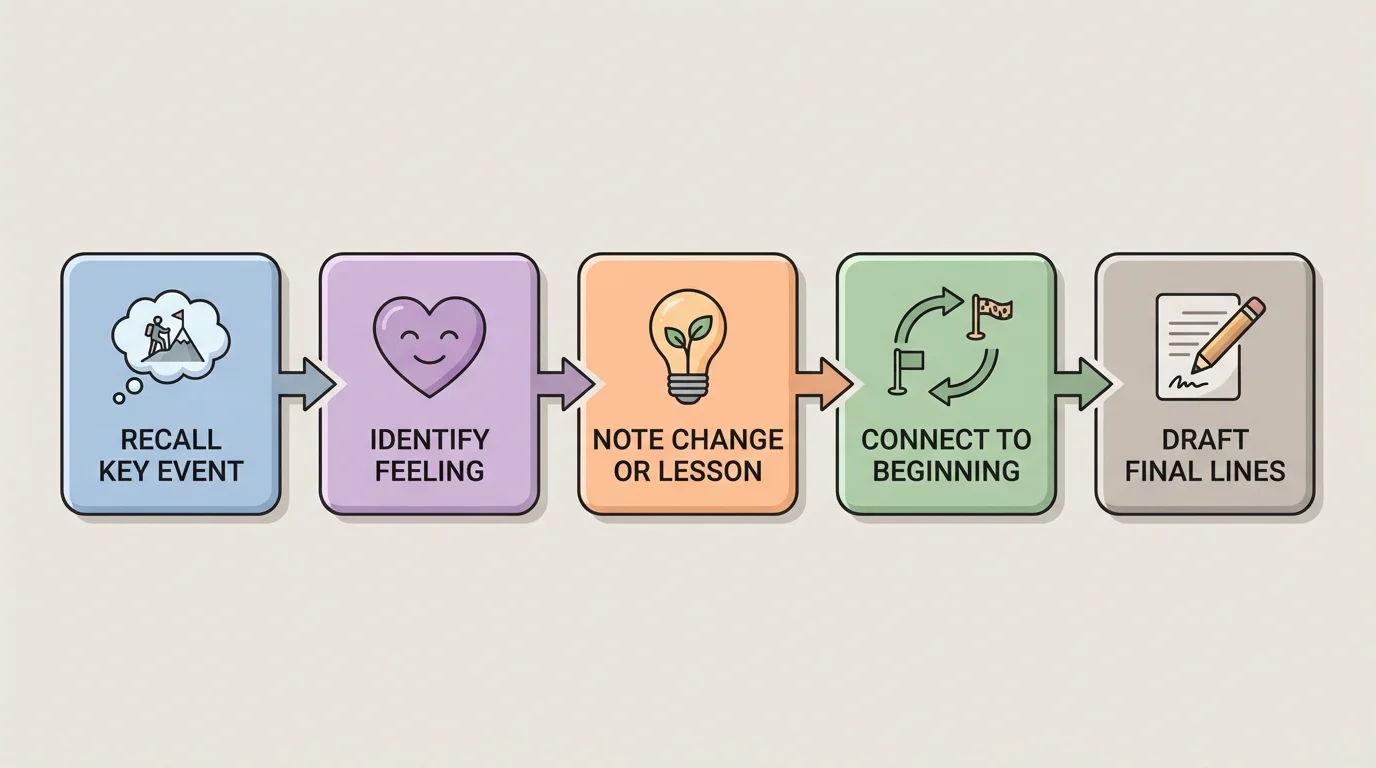
Finally, draft one or two strong last lines. Keep them clear. Keep them connected. Make sure they sound like your narrator or character.
You can think of the process in four simple moves:
First, remember what happened. Second, decide why it mattered. Third, show what changed. Fourth, choose a final detail or sentence that leaves the reader with the right feeling.
When writers skip one of these moves, the ending often feels weak. For example, if they show what happened but never show why it mattered, the story may feel empty. If they add a feeling but forget the actual event, the ending may feel disconnected. As [Figure 3] makes clear, a strong conclusion grows through connected steps, not random additions.
Look at how different conclusions can follow naturally from different narrated experiences.
Example 1: Swim meet
Beginning and middle: A student is terrified before a swim race. She remembers freezing during a race the year before. This time, she hears her coach, steps onto the block, and finishes the race even though she does not win.
Possible conclusion: "I wrapped my towel around my shoulders and looked back at the pool. The water was still choppy from the race, but the fear that had followed me all year was finally quiet."
This ending works because it does not suddenly claim victory or perfection. It follows from the event: the student faced her fear and changed emotionally.
[Figure 4] This example also uses a circular feeling. The towel and the pool connect to the race experience, and the final image of the quieted fear gives emotional closure.
The repeated pattern of returning to the same objects and setting shows how a story can return to an earlier detail while revealing change.
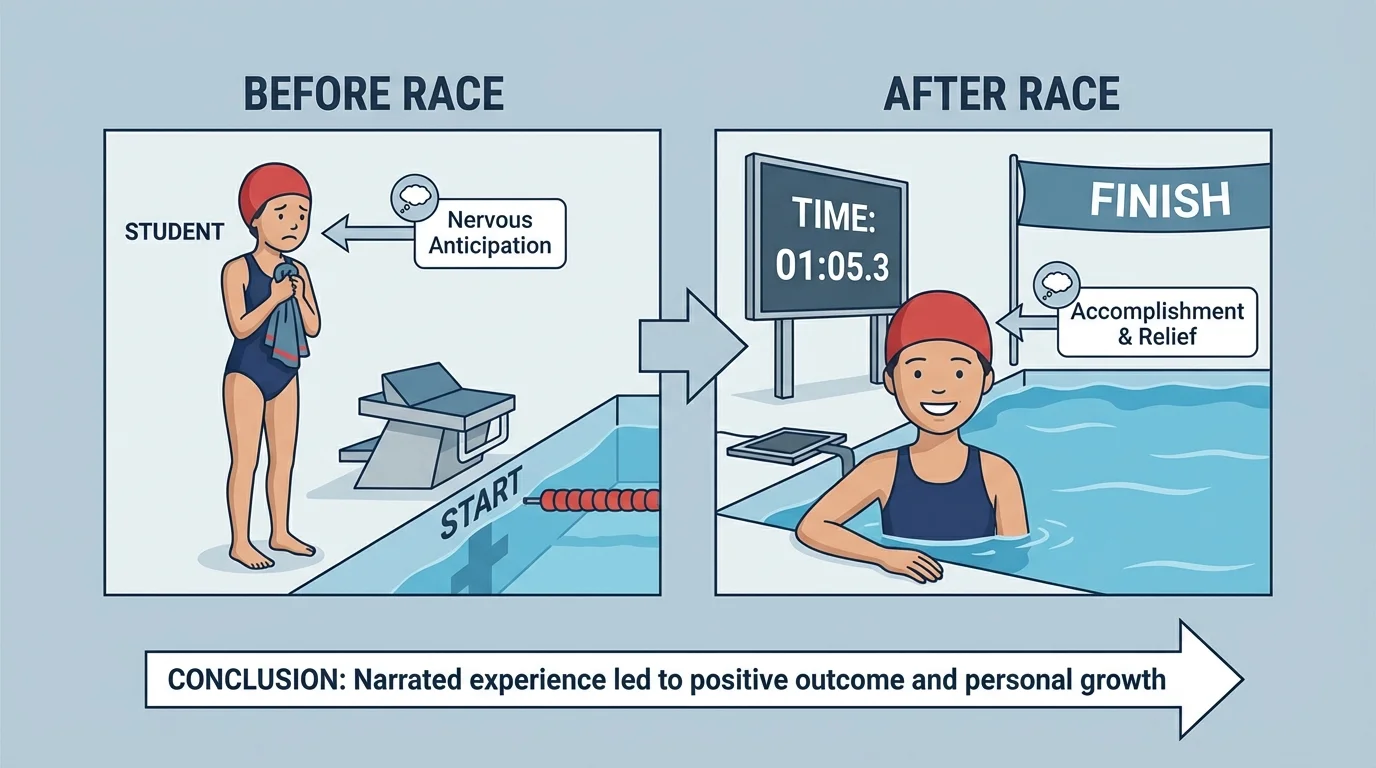
Notice that the conclusion focuses on the most important result: not winning the race, but overcoming fear. That is why the ending feels true to the narrated events.
Example 2: Lost wallet at the store
Beginning and middle: A boy notices that his grandmother has lost her wallet in a crowded grocery store. He retraces their steps, asks a cashier for help, and finally finds it near the fruit section.
Possible conclusion: "Grandma squeezed my hand as we walked to the car. 'Good eyes,' she said, laughing a little now. I laughed too, but secretly I stood a little taller all the way home."
This ending follows from the events by showing the emotional result of helping someone important. The grandmother's dialogue gives warmth, and the final image of standing taller shows pride without directly announcing it.
Here the experience leads to confidence and connection. The ending does not need a giant lesson. A small, believable change is enough.
Example 3: New student at lunch
Beginning and middle: A student moves to a new school and spends several lonely days eating lunch in silence. On Friday, another student invites her to sit at a table and asks about her old town.
Possible conclusion: "The cafeteria was still loud, and I still missed home. But when I carried my tray to that table on Monday, I wasn't searching for a place anymore. I already knew where to sit."
This ending works because it is realistic. The character is not suddenly completely changed. She still misses home, but something important has improved.
That realistic balance is important. Strong conclusions often show progress, not perfection. They stay believable because they match the scale of the story's experiences.
When you write a narrative conclusion, trust the events of your story. You do not need to force a huge message into every ending. Instead, pay attention to what the character experienced, what changed, and what final image or thought best expresses that change.
Read your ending and your beginning side by side. Do they belong to the same story? Do the final lines sound like the natural result of the earlier events? If so, the conclusion is probably doing its job.
A reader should finish your story feeling that the ending was the right one for this character, this conflict, and this sequence of events. That is what it means to provide a conclusion that follows from narrated experiences or events.
