One short word can cause a big reading problem. Think about the word bat. Is it an animal flying at night, or is it the tool used in baseball? Strong readers do not just guess when a word has more than one meaning. They use reference materials to investigate the word and choose the meaning that fits. That skill matters in every subject, from novels and poems to science articles and social studies textbooks.
Reference materials are tools that help readers figure out words more precisely. When you consult a dictionary, glossary, or thesaurus, you are not just "looking up a word." You are gathering evidence. You may learn how the word is pronounced, what it means in different situations, what part of speech it is, and which meaning matches the sentence you are reading.
Sometimes context clues in a sentence are enough to help you understand a word. But sometimes the context is not clear enough, or the word has several possible meanings. In those moments, reference materials make your understanding more accurate. They help you avoid misunderstanding a character in a story, a direction in a science lab, or an important term in history.
Reference materials as reading tools
Good readers switch strategies when needed. They may first use context clues, word parts, or prior knowledge. If the word still seems unclear, they consult a reference source. This flexible approach is important because not every unknown word can be solved in the same way.
These tools also help with speaking and writing. If you know the pronunciation of a word, you can say it confidently in class. If you know its precise meaning, you can write with accuracy. If you know its part of speech, you can use it correctly in a sentence.
A dictionary is a reference source that gives information about words. It usually includes pronunciation, meanings, part of speech, and sometimes example sentences or word history. Dictionaries can be printed in books or found online.
A glossary is a list of important words and definitions, usually found at the back of a textbook or article collection. Glossaries are especially helpful in school subjects because they focus on the special vocabulary of that topic. A science textbook glossary, for example, may explain words such as habitat, erosion, or molecule.
A thesaurus lists synonyms and sometimes antonyms. It helps a writer find words with similar meanings, but it does not always explain the exact differences between them. That is why a thesaurus is most useful when paired with a dictionary.
Digital reference tools include online dictionaries, apps, and school-approved websites. These often include audio buttons for pronunciation, quick search bars, and links to related words. Digital tools are fast, but readers still need to think carefully about which meaning fits the context.
Dictionary gives word meanings and other details such as pronunciation and part of speech. Glossary explains important topic-specific words, often in a textbook. Thesaurus provides similar and opposite words. Digital reference tool is an electronic source, such as a website or app, used to look up word information.
Each source has a different job. A glossary is often best for subject-specific terms. A dictionary is best for full word information. A thesaurus helps when you want to compare words with related meanings. Skilled readers choose the tool that matches their purpose.
[Figure 1] A dictionary entry contains more information than many students notice at first. One entry may include the word itself, a pronunciation guide, syllable breaks, the part of speech, several numbered definitions, and an example sentence. Learning to read all of those parts helps you find the precise meaning you need.
In a print dictionary, guide words appear at the top of a page. These words tell you the first and last entry on that page, helping you know whether the word you want is there. In a digital dictionary, a search bar replaces guide words, but you still need to read the full entry carefully instead of stopping at the first line.
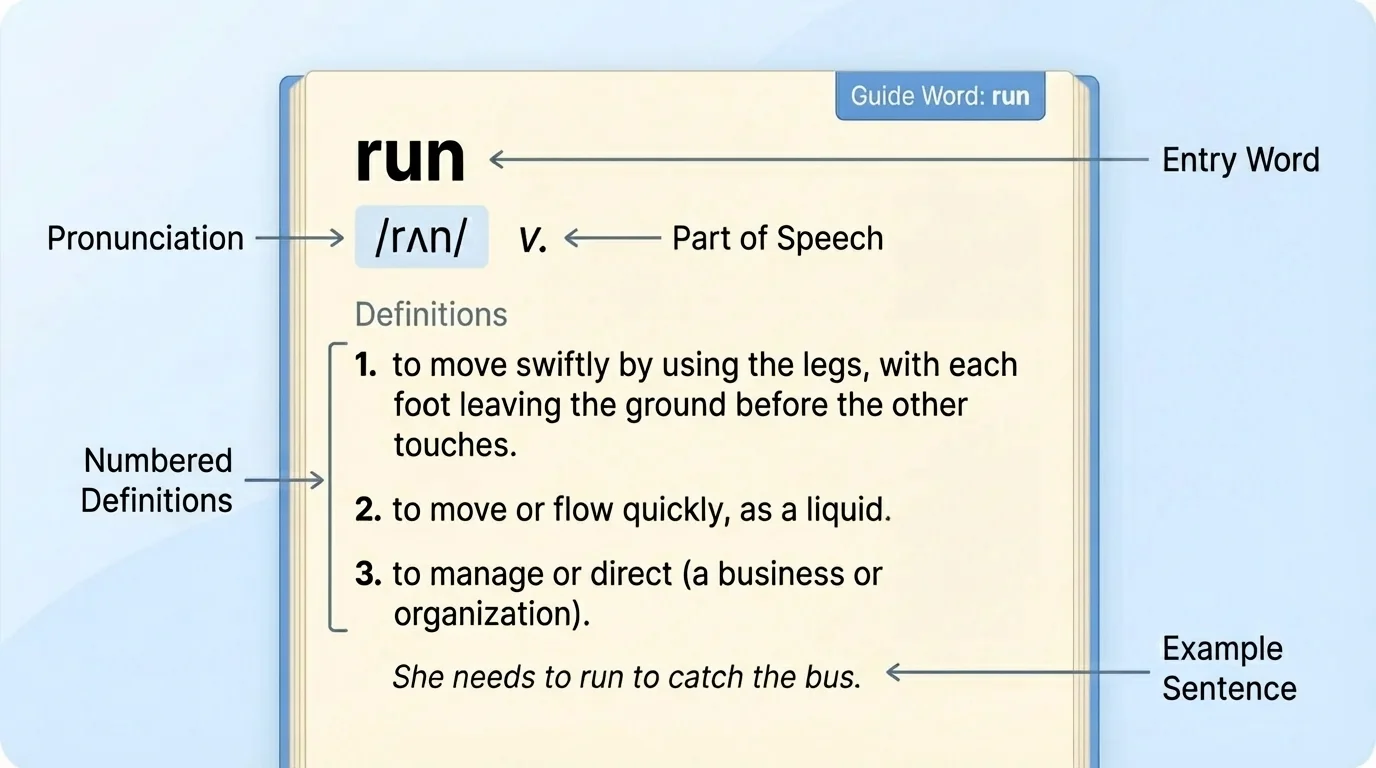
The pronunciation guide tells how a word sounds when spoken. Some dictionaries use special symbols, while others provide a simpler sound-spelling system or an audio button. If you see a word such as resourceful, the pronunciation guide helps you hear where the syllables and stresses belong.
The entry also shows the word's meaning or meanings. Numbered definitions matter because many words have more than one meaning. The word current can refer to the flow of water, electricity, or something happening now. A reader must choose the definition that matches the sentence.
The part of speech tells how the word functions in a sentence. A word may be labeled as a noun, verb, adjective, or adverb. This matters because the same spelling can sometimes belong to more than one part of speech. Later, when you compare meanings in context, the information in the dictionary entry remains useful because the correct definition often depends on how the word is being used.
[Figure 2] Looking up a word is only the beginning. The real goal is to choose the meaning that fits the sentence you are reading. Context clues help readers do that with one word used in two different ways. This is especially important for multiple-meaning words.
Consider the word context in these examples: "The dog's bark woke the baby," and "The bark of the tree was rough." A dictionary may list both meanings, but the sentence tells which one fits. Words like dog and woke point to the sound an animal makes. Words like tree and rough point to the outer covering of a tree.
The same thing happens with the word light. In "Please turn on the light," the word means illumination. In "This backpack feels light," it means not heavy. If a student chooses the first definition every time, the sentence may stop making sense.
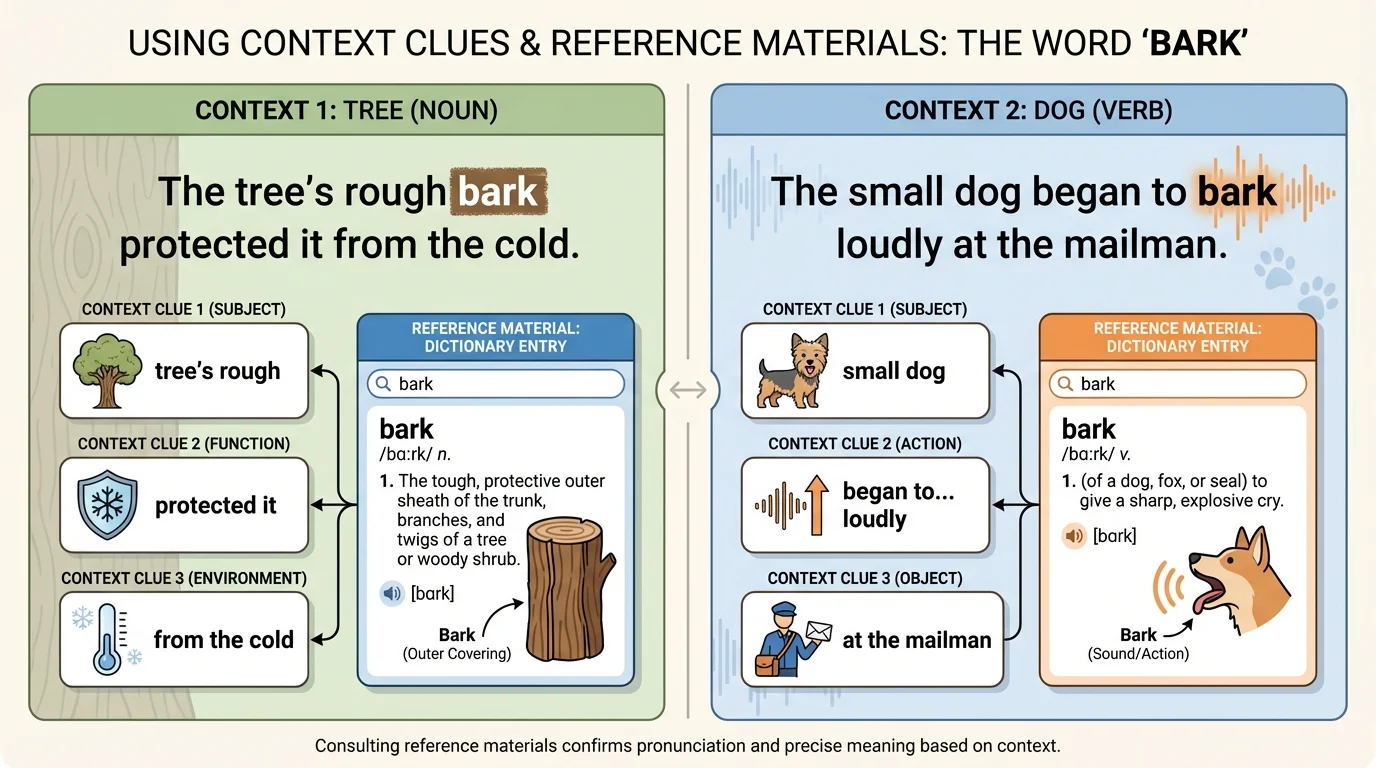
To find the right meaning, ask yourself three questions: What is happening in the sentence? What words around the unknown word give clues? Which dictionary definition matches both the sentence and the paragraph? Reading only the word itself is not enough; you must connect the reference source to the text you are reading.
Example: choosing the correct meaning
Read this sentence: "After the race, Maya collapsed on the bank of the river."
Step 1: Identify the multiple-meaning word.
The word is bank.
Step 2: Check the possible meanings in a dictionary.
Bank might mean a place where money is kept, or it might mean the land beside a river.
Step 3: Use context clues.
The phrase of the river tells you which meaning fits.
The correct meaning is the land beside a river.
Writers count on readers to notice these details. In literature, choosing the wrong meaning can change the mood or action of a scene. In science, choosing the wrong meaning can change your understanding of a process or instruction.
The part of speech gives important information about how a word works in a sentence. A noun names a person, place, thing, or idea. A verb shows action or a state of being. An adjective describes a noun, and an adverb usually describes a verb, adjective, or another adverb.
Sometimes the same word can shift from one part of speech to another. For example, in "We watch the play," play is a noun because it names a performance. In "We play soccer after school," play is a verb because it shows action. A dictionary entry usually separates those uses clearly.
This is why part of speech and meaning belong together. If you are reading "The team will record the experiment," the word is a verb. If you are reading "The scientist kept a record of the results," the word is a noun. The spelling is the same, but the job of the word changes.
| Word | Sentence | Part of speech | Meaning |
|---|---|---|---|
| play | We watched the play. | Noun | a performance |
| play | We play after lunch. | Verb | take part in a game or activity |
| record | Please record the data. | Verb | write down or capture information |
| record | She kept a record. | Noun | a stored account of information |
Table 1. Examples showing how the same spelling can have different parts of speech and meanings.
When you consult a reference source, check the part of speech before choosing a definition. That one small habit can prevent many mistakes.
[Figure 3] Print and digital references often give similar information in different formats. A print dictionary depends on alphabetical order and guide words, while a digital dictionary uses a search bar, clickable entries, and often audio pronunciation. Neither one is automatically better in every situation.
Print tools build strong alphabetical search skills and can help readers slow down and scan nearby words. Digital tools are faster and may include helpful extras such as spoken pronunciation, translations, or word history. Both types can be valuable when used thoughtfully.
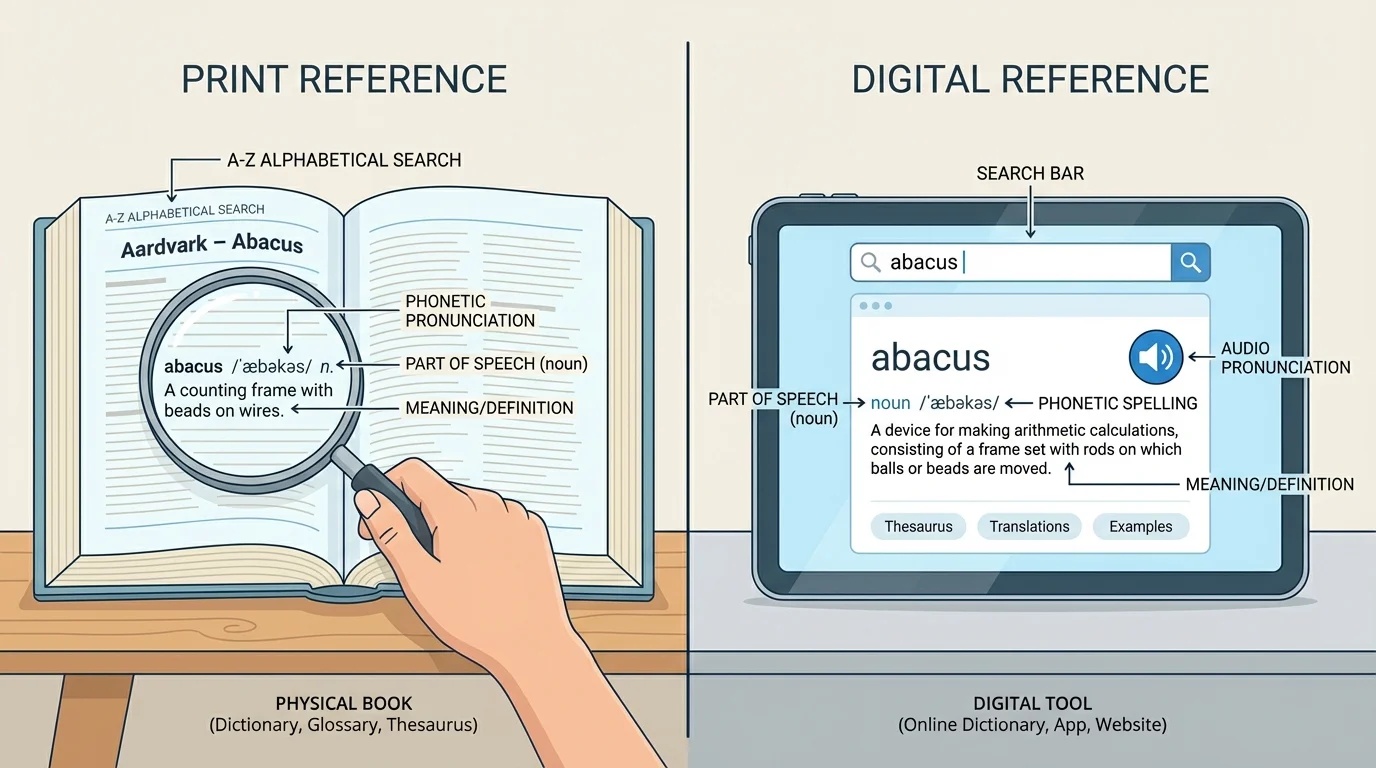
In a classroom, a glossary in a textbook may be the quickest tool for a special term from that unit. During independent reading, an online dictionary may be faster for checking pronunciation. During writing, a thesaurus app may help you compare possible word choices. The best tool depends on the task.
Many digital dictionaries let you hear different accepted pronunciations of the same word. That matters because English sometimes allows more than one correct pronunciation depending on region or speaking style.
Even with digital tools, you still need strong reading habits. Search results may list many definitions, and some websites are more reliable than others. School-approved dictionaries and trusted publisher sites are usually the safest choices.
A thesaurus can be exciting because it offers many choices. If you write that a character was happy, a thesaurus may suggest glad, cheerful, delighted, or content. But these words are not perfectly identical. They are synonyms, which means they have similar meanings, not always exact matches.
For example, slim and skinny both relate to being thin, but they can create different feelings. Slim is often positive, while skinny can sound negative. If a student chooses a synonym without checking the dictionary, the sentence may become awkward or inaccurate.
A smart writer uses the thesaurus to generate options, then checks the dictionary to compare meanings and tone. That way, the new word fits the sentence, the audience, and the purpose.
Example: using a thesaurus wisely
Suppose you wrote, "The movie was good," and you want a stronger word.
Step 1: Check a thesaurus for related words.
You might find enjoyable, exciting, funny, and powerful.
Step 2: Think about the exact meaning you want.
If the movie made people laugh, funny fits better than powerful.
Step 3: Confirm with a dictionary.
Check that the chosen word means what you intend.
The strongest replacement depends on the exact effect of the movie, not just on finding a fancier word.
This careful use of synonyms improves writing because it adds precision instead of confusion.
When readers consult reference materials, it helps to follow a process. First, read the whole sentence and, if needed, the sentences around it. Second, decide what kind of information you need: pronunciation, definition, part of speech, or a synonym. Third, choose the right tool. Fourth, read more than one line of the entry. Fifth, return to the sentence and test whether the meaning makes sense.
This process works in almost any subject. In a science chapter, you may need a glossary first because the term is topic-specific. In a novel, you may need a dictionary because the word has several possible meanings. In a writing assignment, you may use both a thesaurus and a dictionary together.
Earlier reading strategies still matter. Use context clues, prefixes, suffixes, roots, and sentence structure first when they help. Reference materials are part of a flexible toolkit, not a replacement for thinking.
As you become more skilled, this process becomes faster. Expert readers do not stop for every unfamiliar word, but they know when a word is important enough to check carefully.
One common mistake is choosing the first dictionary definition automatically. Dictionaries usually list several meanings, and the first one may not fit your passage. Another mistake is ignoring the part of speech. If the sentence needs a verb and you choose a noun definition, the meaning will likely be wrong.
A third mistake is trusting a thesaurus too quickly. A synonym may be close in meaning but different in tone, level of formality, or strength. Finally, some students focus only on pronunciation and skip meaning, or focus only on meaning and skip pronunciation. Strong word study pays attention to both.
Notice how the visual comparison reminds us that a single spelling can point to different meanings depending on nearby clues. That same careful thinking should guide every lookup.
In language arts, reference tools help readers understand stories, poems, and informational texts. In science, they clarify specialized words such as organism, condensation, or density. In social studies, they help with terms such as democracy, migration, or economy. In every case, precise word knowledge supports stronger learning.
When speaking in class, pronunciation tools can help you say a new word correctly. When writing, checking part of speech can help you build grammatical sentences. When revising, a thesaurus and dictionary together can help you replace vague words with clearer ones. The comparison of print and digital tools matters here, because different subjects and tasks may call for different kinds of reference tools.
"The difference between the almost right word and the right word is really a large matter."
— Mark Twain
Choosing the right word is not just a reading skill. It is a thinking skill. The better you understand words, the more accurately you can understand ideas, explain your own thinking, and communicate with others.
