One missing letter can change a whole message. If a student writes defiantly when they mean definitely, the sentence can suddenly sound funny, confusing, or even completely wrong. Good spelling is not about showing off. It is about making sure your reader understands exactly what you mean the first time.
Spelling is the correct arrangement of letters in a word. When words are spelled correctly, writing is easier to read, ideas are clearer, and the writer appears careful and trustworthy. In school, correct spelling helps teachers focus on your ideas instead of getting distracted by errors. Outside school, spelling matters in texts, emails, directions, forms, and online posts.
Spelling is also part of the larger set of rules called standard English. Standard English includes accepted rules for capitalization, punctuation, grammar, and spelling. These rules help people communicate in a consistent way. A story written for a friend may sound casual, but it still needs accurate spelling so the reader can understand it. A report for class needs even more attention because the audience expects polished writing.
Frequently used words are words writers see and use often, such as because, friend, their, and different. Less frequent vocabulary includes words that appear less often, especially specialized or challenging words such as architecture, environmental, or responsibility.
Strong writers usually know the spelling of common words right away. For harder or less common words, strong writers do not guess carelessly. Instead, they check a source and correct the word. That habit is a sign of maturity in writing.
Some words appear so often that you should aim to spell them without stopping. These include words used in everyday sentences, school assignments, and conversations. Examples include because, people, could, would, should, enough, different, answer, thought, really, favorite, through, beautiful, and important.
Automatic spelling matters because writing flows better when you do not pause for every common word. If you know how to spell high-frequency words, your brain can spend more energy on ideas, organization, and style. That is one reason frequent reading helps spelling. The more often you see words correctly written, the more familiar they become.
Many commonly used words are tricky because they do not sound exactly the way they are spelled. Consider these examples:
When you learn these words well, you build a foundation. Then you can handle more challenging vocabulary with more confidence.
English spelling comes from many languages, including Old English, French, Latin, and Greek. That is one reason some words follow patterns while others seem surprising at first.
It helps to notice which words give you trouble again and again. Maybe you often mix up there and their, or maybe you leave out a letter in separate. Once you know your patterns, you can watch for them while editing.
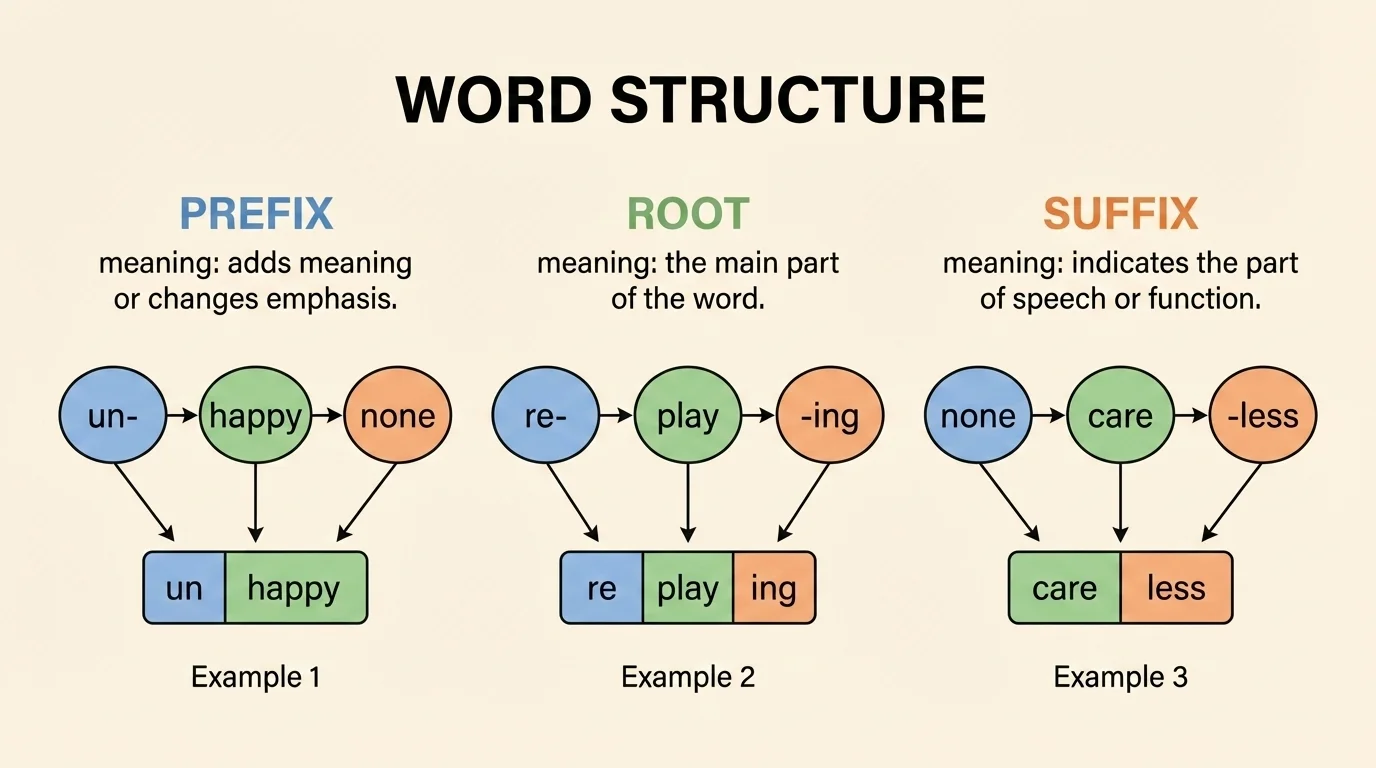
[Figure 1] Good spellers do not rely on memory alone. They also look for patterns in words. One useful strategy is to break a word into parts. A prefix comes at the beginning of a word, a root word carries the main meaning, and a suffix comes at the end. Knowing these parts can help you spell long words more accurately because you are not trying to memorize one giant letter string all at once.
For example, the word careless can be thought of as care + less. The word replaying can be thought of as re + play + ing. The word unhappily can be broken into un + happy + ly. When you see words this way, spelling becomes more logical.
Another helpful strategy is to notice word families. If you know how to spell magic, that can help you with magical. If you know music, that can help with musician. If you know sign, it may help you remember signal and signature.
You can also listen for syllables. A long word may feel hard until you divide it into spoken parts, such as im-por-tant or re-spon-si-ble. This does not solve every spelling challenge, but it gives you a structure to work with.
Writers also use visual memory. Sometimes a word "looks right" because you have read it many times. That skill grows when you read often and pay attention to print. Seeing correct spelling repeatedly trains your brain. This is why readers often become stronger spellers over time.
Another pattern involves adding endings. Sometimes adding a suffix changes the spelling of the base word. For example:
Later, when you are editing a longer piece, the word-part pattern in [Figure 1] still helps. It reminds you that many "hard" words are really made from smaller, familiar parts.
Spelling is both memory and pattern recognition. Strong spelling grows when you combine repeated exposure to words with careful noticing of sounds, letter groups, and word parts. Instead of guessing, you learn to ask, "What pattern does this word follow?"
A useful habit is to say the word slowly to yourself, then picture it, then write it, then reread it in context. Context matters. A word may be spelled correctly but still be the wrong word for the sentence.
Some spelling mistakes happen because English has many words that sound alike but are spelled differently. These are called homophones. Examples include their, there, and they're. All three are real words, but each has a different meaning. Spell check might not catch the mistake if you choose the wrong one, because the word is still spelled correctly.
Here are the differences:
Other errors happen because of silent letters. In knock, the k is silent. In answer, the w is silent. In listen, the t is silent. If a writer spells only what they hear, the word may be wrong.
Vowel combinations can also be confusing. Words like piece, receive, through, and beauty do not always sound the way a beginner expects. Some common sayings about spelling patterns can help, but they are not perfect rules. That is why checking a trusted source matters.
Writers may also make mistakes when writing quickly. They may skip letters, repeat letters, or switch letter order. For example, environment might become enviroment, or finally might become finaly. These errors often happen during drafting, which is normal. The key is to catch them during editing.
Spotting why a spelling is wrong
A student writes: I definately want to go because its going to be great over their.
Step 1: Look for words that seem uncertain.
definately, its, and their may need checking.
Step 2: Fix the spelling or word choice.
definately becomes definitely. its may need to become it's if the sentence means it is. their becomes there if it names a place.
Step 3: Read the whole sentence again.
The corrected sentence is: I definitely want to go because it's going to be great over there.
This example shows an important truth: spelling is connected to grammar and meaning. You cannot always fix spelling by sound alone. You must also understand what the sentence is trying to say.
[Figure 2] Even excellent writers meet words they are not sure how to spell. The smart move is to consult a reference. Different tools help in different ways. A careful writer chooses the tool that best fits the situation instead of relying on only one method.
A dictionary is one of the most useful spelling resources. A print dictionary helps you find a word by alphabetical order. A digital dictionary lets you search quickly, and sometimes it can even suggest the word if your first spelling attempt is close. Dictionaries do more than give spelling. They also give pronunciation, meanings, word forms, and sometimes examples of how the word is used.
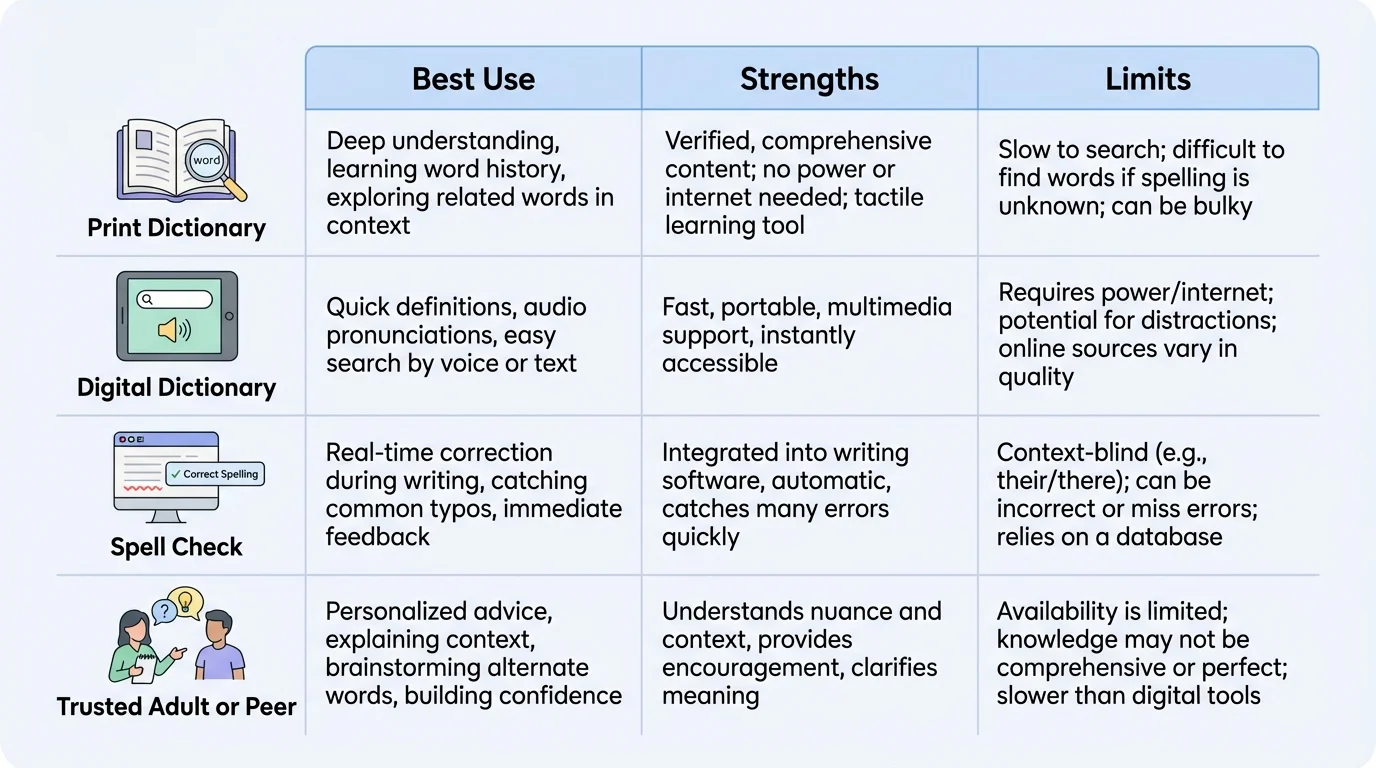
To use a print dictionary, you need to know the beginning letters of the word and understand guide words at the top of pages. That takes patience, but it is a strong skill because it builds independence. Digital dictionaries are faster, which is helpful during drafting and revising.
Spell check is another powerful tool. It can underline words that may be misspelled and offer suggestions. This is useful, but it has limits. Spell check may miss homophones, such as there and their, because both are real words. It may also suggest the wrong choice if the writer clicks too quickly without rereading the sentence.
You can also ask a trusted peer, teacher, parent, or other adult. Sometimes another person notices a misspelled word right away, especially if you have looked at your own writing for a long time. Fresh eyes are valuable. Still, the best habit is not to depend completely on someone else. Try first, check a reference, and then ask for help if needed.
When using a resource, do more than copy the corrected word once. Study it. Notice which letters surprised you. Say it aloud. Think about whether it has a prefix, root, or suffix. That deeper attention makes it more likely you will remember the word next time, just as the word-part strategy in [Figure 1] supports long-term learning.
| Reference tool | Best use | Strength | Limitation |
|---|---|---|---|
| Print dictionary | Careful checking | Builds alphabetical search skills | Slower to use |
| Digital dictionary | Quick lookup | Fast and convenient | Requires device access |
| Spell check | Drafting and editing | Catches many misspelled words | May miss wrong-word errors |
| Trusted peer or adult | Final review | Provides another perspective | Not always available |
Table 1. Common spelling reference tools, including when each tool is most useful.
A strong writer often uses more than one tool. For example, a student might notice a red underline from spell check, check the suggested spelling in a digital dictionary, and then reread the sentence to make sure the correct word fits the meaning.
[Figure 3] Editing is the stage of writing when you improve correctness and clarity. It is not the same as drafting. During drafting, your main job is to get ideas down. During editing, your job is to slow down and fix mistakes. A good routine makes this much easier, and checking spelling works best as a series of steps rather than one quick glance at the end.
First, finish your draft. Then reread it slowly, one line at a time. Circle or highlight words that look uncertain. Next, check those words using a dictionary, spell check, or another trusted source. After correcting them, read the sentence again to confirm that the word fits the meaning. Finally, read the whole piece one more time, preferably aloud, because your ears can help you catch problems your eyes missed.
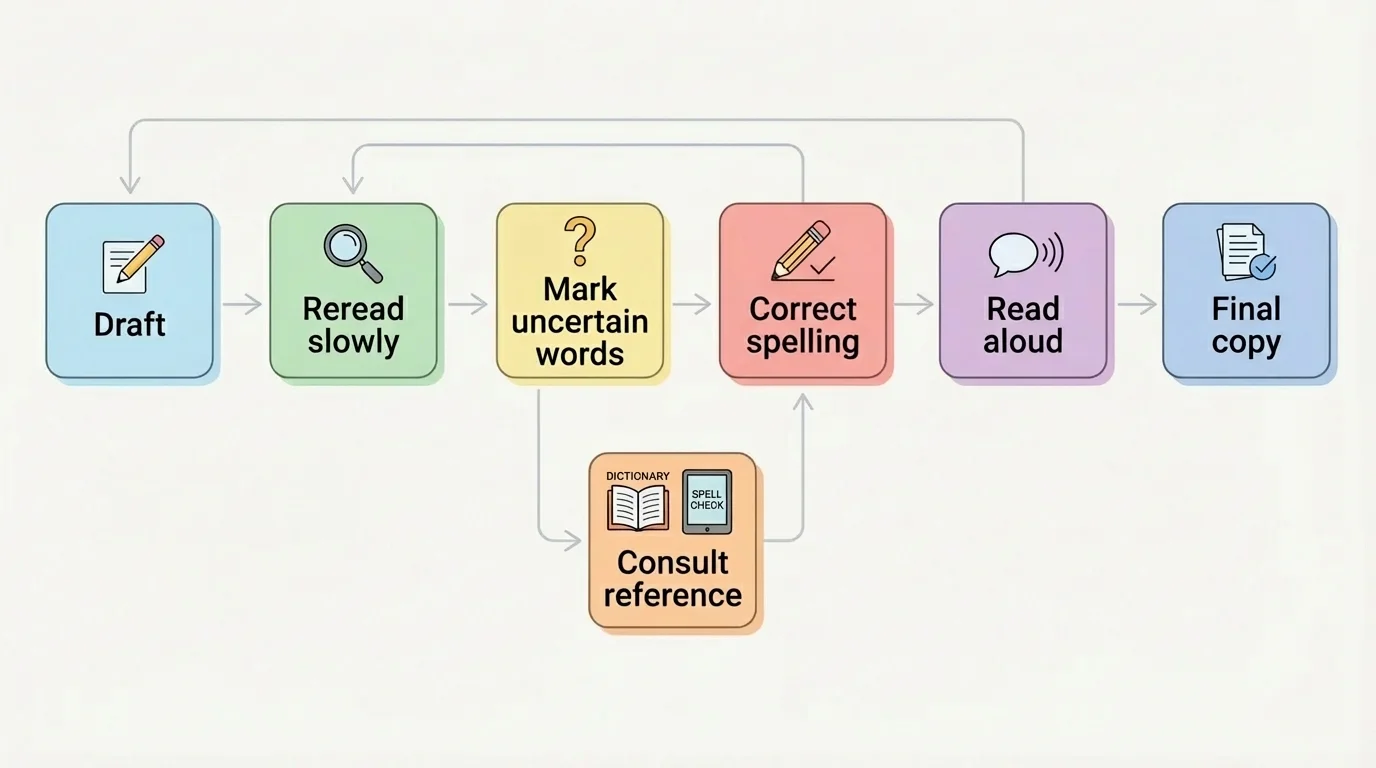
Reading aloud is especially helpful because it forces you to go more slowly. When students silently skim, their brains often "autocorrect" errors without noticing them. Reading aloud makes each word more visible in your mind.
Another smart trick is to check one kind of error at a time. On one pass, look mainly for capital letters. On another pass, look for punctuation. On a third pass, focus on spelling, especially words you often misspell. This keeps the job manageable.
You already know that writing has stages: planning, drafting, revising, and editing. Spelling belongs mostly to editing, but paying attention to correct words during drafting can make editing easier later.
You should also think about your audience. A quick note to yourself may not need perfect polish, but school writing for a teacher or classmates should show care. Formal writing usually needs more complete spelling accuracy because the purpose is to communicate clearly and responsibly.
Later, when you build your own proofreading habits, the sequence in [Figure 3] still applies: draft first, then check carefully, then confirm that each correction makes sense in context.
Different writing situations call for the same basic spelling skill, but they may require different levels of attention. In a personal journal, a few mistakes may not cause major confusion. In a science response, a misspelled academic word can make an answer seem less accurate. In an email to a teacher, correct spelling shows respect and seriousness.
Think about these examples:
Suppose you are writing about weather and are unsure whether the word is humidity or something close to it. That is less frequent vocabulary than a word like rain. A careful writer checks. If you are writing about ancient civilizations and are unsure how to spell Mesopotamia, you definitely use a reference. The more specialized the word, the more important checking becomes.
Using a reference during real writing
A student is writing a report and types: The archtecture of the city showed great creativity.
Step 1: Notice the uncertain word.
archtecture does not look quite right.
Step 2: Use a reference source.
The student searches a digital dictionary and finds architecture.
Step 3: Confirm meaning and spelling.
The dictionary shows that architecture refers to the design and style of buildings, which matches the sentence.
Step 4: Reread the corrected sentence.
The architecture of the city showed great creativity.
This process is faster and more accurate than guessing. It also helps the student learn the word for future writing.
Over time, good spelling becomes a combination of habits: read often, notice patterns, learn frequently used words well, and check less frequent words with reliable tools. Writers do not need to know every word instantly. They do need to know how to find the correct spelling when it matters.
"Careful writing shows careful thinking."
That idea is especially true with spelling. Accurate spelling supports your ideas, protects your meaning, and helps your audience focus on what you want to say.
